수리논술, 이게 다다.

자연계열 I 1번

오류 제보

문제

[1] 다음 글을 읽고 물음에 답하시오.

(가) 좌표평면 위의 두 점 A(x1,y1)\displaystyle \mathrm A(x_1,y_1), B(x2,y2)\displaystyle \mathrm B(x_2,y_2)를 이은 선분 AB\displaystyle \mathrm{AB}를 m:n\displaystyle m:n (m>0,n>0\displaystyle m>0,n>0)으로 내분하는 점 P\displaystyle \mathrm P의 좌표는P(mx2+nx1m+n,my2+ny1m+n)\displaystyle \mathrm P\left(\dfrac{mx_2+nx_1}{m+n},\dfrac{my_2+ny_1}{m+n}\right)

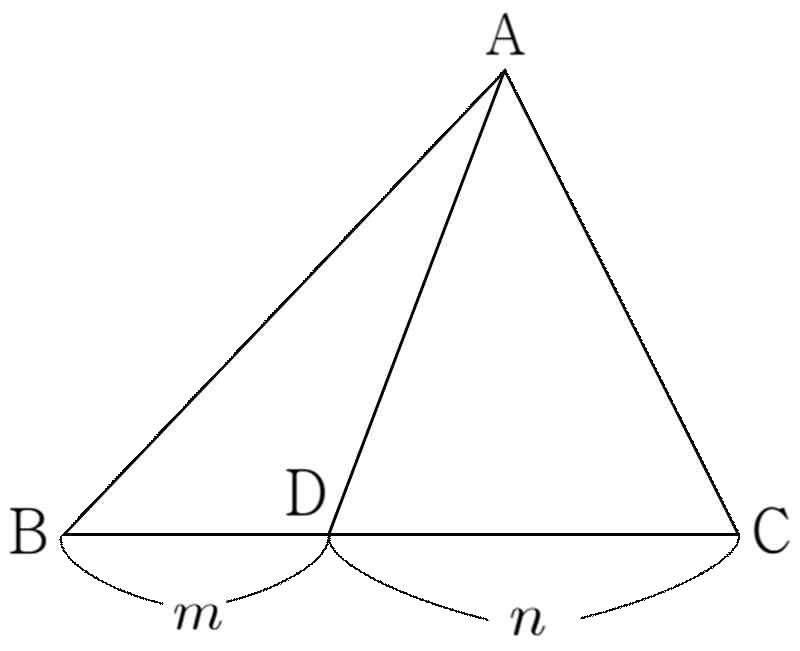
(나) 삼각형 ABC\displaystyle \mathrm{ABC}와 변 BC\displaystyle \mathrm{BC}위의 점 D\displaystyle \mathrm D에 대하여BD‾CD‾=mn\displaystyle \dfrac{\overline{\mathrm{BD}}}{\overline{\mathrm{CD}}}=\dfrac mn (m>0,n>0\displaystyle m>0,n>0)이면 삼각형 ABD의 넓이삼각형 ACD의 넓이=mn\displaystyle \dfrac{\text{삼각형 }\mathrm{ABD}\text{의 넓이}}{\text{삼각형 }\mathrm{ACD}\text{의 넓이}}=\dfrac mn이다.

삼각형 ABC의 변 BC를 m:n으로 나누는 점 D와 선분 AD의 원본 그림

※ 모든 문항에서 풀이 과정을 반드시 기술하시오.

좌표평면 위의 세 점 P\displaystyle \mathrm P, Q\displaystyle \mathrm Q, R\displaystyle \mathrm R에 대하여 세 점 P\displaystyle \mathrm P, Q\displaystyle \mathrm Q, R\displaystyle \mathrm R을 꼭짓점으로 하는 삼각형의 넓이를 SPQR\displaystyle S_{\mathrm{PQR}}이라고 하자. (단, 세 점이 한 직선 위에 있는 경우 SPQR=0\displaystyle S_{\mathrm{PQR}}=0으로 정의한다.)

세 점 A(1,4)\displaystyle \mathrm A(1,4), B(−2,−3)\displaystyle \mathrm B(-2,-3), C(7,2)\displaystyle \mathrm C(7,2)를 꼭짓점으로 하는 삼각형 ABC\displaystyle \mathrm{ABC}에 대하여, 점 F\displaystyle \mathrm F가 삼각형 ABC\displaystyle \mathrm{ABC}의 내부 또는 세 변 위에 있을 때,SBCFSABC=a\displaystyle \dfrac{S_{\mathrm{BCF}}}{S_{\mathrm{ABC}}}=a, SCAFSABC=b\displaystyle \dfrac{S_{\mathrm{CAF}}}{S_{\mathrm{ABC}}}=b, SABFSABC=c\displaystyle \dfrac{S_{\mathrm{ABF}}}{S_{\mathrm{ABC}}}=c라고 하자.

점 F\displaystyle \mathrm F를 지나고 변 BC\displaystyle \mathrm{BC}에 평행한 직선이 변 AB\displaystyle \mathrm{AB}, 변 AC\displaystyle \mathrm{AC}와 만나는 점을 각각 점 D\displaystyle \mathrm D, 점 E\displaystyle \mathrm E라 하자.

다음 물음에 답하시오.

【1-1】 a=13\displaystyle a=\dfrac13, b=12\displaystyle b=\dfrac12, c=16\displaystyle c=\dfrac16일 때, DF‾EF‾\displaystyle \dfrac{\overline{\mathrm{DF}}}{\overline{\mathrm{EF}}}의 값을 구하시오. (30점)

【1-2】 점 F(x,y)\displaystyle \mathrm F(x,y)가 삼각형 ABC\displaystyle \mathrm{ABC}의 내부를 움직일 때,x=(ㄱ)×a+(ㄴ)×b+(ㄷ)×c\displaystyle x=\boxed{\text{(ㄱ)}}\times a+\boxed{\text{(ㄴ)}}\times b+\boxed{\text{(ㄷ)}}\times c,y=(ㄹ)×a+(ㅁ)×b+(ㅂ)×c\displaystyle y=\boxed{\text{(ㄹ)}}\times a+\boxed{\text{(ㅁ)}}\times b+\boxed{\text{(ㅂ)}}\times c,가 성립한다. 실수 (ㄱ), (ㄴ), (ㄷ), (ㄹ), (ㅁ), (ㅂ)의 값을 구하시오. (40점)

【1-3】 삼각형 ABC\displaystyle \mathrm{ABC}의 내부 또는 그 세 변 위의 점 J,K,L\displaystyle \mathrm J,K,L에 대하여 점 A,J,K,L\displaystyle \mathrm A,J,K,L이 사각형 AJKL\displaystyle \mathrm{AJKL}을 이룬다. 점 F\displaystyle \mathrm F가 사각형 AJKL\displaystyle \mathrm{AJKL}의 내부에 있을 때, 항상 2a≥b\displaystyle 2a\ge b, 2a≥c\displaystyle 2a\ge c를 만족시킨다. 가능한 사각형 AJKL\displaystyle \mathrm{AJKL}의 넓이의 최댓값이 rSABC\displaystyle rS_{\mathrm{ABC}}일 때, 실수 r\displaystyle r의 값을 구하시오. (50점)

해설강의 준비중
+30점 · 답 13\displaystyle \dfrac13이 맞으면 (DE‾:EF‾=1:3\displaystyle \overline{\mathrm{DE}}:\overline{\mathrm{EF}}=1:3까지만 구한 경우 10점)

Correction. 1-1 부분점수 기준의 DE‾:EF‾=1:3\displaystyle \overline{DE}:\overline{EF}=1:3에서 DE‾\displaystyle \overline{DE}는 DF‾\displaystyle \overline{DF}의 오기이다. 예시답안에서 구한 비는 DF‾:EF‾=1:3\displaystyle \overline{DF}:\overline{EF}=1:3 이며, DE‾=DF‾+FE‾\displaystyle \overline{DE}=\overline{DF}+\overline{FE}이므로 DE‾:EF‾=4:3\displaystyle \overline{DE}:\overline{EF}=4:3이다. 그러나 원칙에 따라 원문 표기를 그대로 실었다.

【1-1】 문제로부터 a≠0\displaystyle a\ne0, b≠0\displaystyle b\ne0, c≠0\displaystyle c\ne0이므로 점 F\displaystyle \mathrm F가 삼각형 ABC\displaystyle \mathrm{ABC}의 세 변 위에 있지 않다. 따라서 점 F\displaystyle \mathrm F가 삼각형 ABC\displaystyle \mathrm{ABC}의 내부에 있다고 하자. AF\displaystyle \mathrm{AF}가 변 BC\displaystyle \mathrm{BC}와 만나는 점을 P\displaystyle \mathrm P이라 하자. 직선 DE\displaystyle \mathrm{DE}는 선분 BC\displaystyle \mathrm{BC}에 평행하므로, △ADF\displaystyle \triangle\mathrm{ADF}와 △ABP\displaystyle \triangle\mathrm{ABP}는 닮음이고, △AEF\displaystyle \triangle\mathrm{AEF}와 △ACP\displaystyle \triangle\mathrm{ACP} 역시 닮음이며, 두 경우 모두 닮음비는 AF‾:AP‾\displaystyle \overline{\mathrm{AF}}:\overline{\mathrm{AP}}이다. 따라서 DF‾:EF‾=BP‾:CP‾\displaystyle \overline{\mathrm{DF}}:\overline{\mathrm{EF}}=\overline{\mathrm{BP}}:\overline{\mathrm{CP}}이다. △ABF\displaystyle \triangle\mathrm{ABF}와 △CAF\displaystyle \triangle\mathrm{CAF}의 넓이비는 c:b\displaystyle c:b인데, 두 삼각형이 변 AF\displaystyle \mathrm{AF}를 공통변으로 가지므로, 넓이비 c:b\displaystyle c:b는 공통변에서 각 꼭짓점 B\displaystyle \mathrm B와 꼭짓점 C\displaystyle \mathrm C까지의 높이비와 같다. 이 높이비는 △ABP\displaystyle \triangle\mathrm{ABP}과 △ACP\displaystyle \triangle\mathrm{ACP}에서 변 AP\displaystyle \mathrm{AP}을 밑변으로 한 높이비와 같다. 따라서 △ABP\displaystyle \triangle\mathrm{ABP}과 △ACP\displaystyle \triangle\mathrm{ACP}의 넓이의 비는 c:b\displaystyle c:b이다. 제시문 (나)에 의하여 BP‾:CP‾=DF‾:EF‾=c:b\displaystyle \overline{\mathrm{BP}}:\overline{\mathrm{CP}}=\overline{\mathrm{DF}}:\overline{\mathrm{EF}}=c:b이고, 문제로부터 b=12\displaystyle b=\dfrac12이고 c=16\displaystyle c=\dfrac16이므로 DF‾EF‾=13\displaystyle \dfrac{\overline{\mathrm{DF}}}{\overline{\mathrm{EF}}}=\dfrac13이다.

+10점 · 답을 구하기 위한 과정 설명이 있고 타당한 경우: 경우 1: 직선의 방정식 이용 경우 2: 점 D\displaystyle \mathrm D는 선분 AB\displaystyle \mathrm{AB}를 b+c:a\displaystyle b+c:a로 내분하는 점, 점 E\displaystyle \mathrm E는 선분 AC\displaystyle \mathrm{AC}를 b+c:a\displaystyle b+c:a로 내분하는 점, 점 F\displaystyle \mathrm F는 선분 DE\displaystyle \mathrm{DE}를 c:b\displaystyle c:b로 내분하는 점

【1-2】 점 A(x1,y1)\displaystyle \mathrm A(x_1,y_1), B(x2,y2)\displaystyle \mathrm B(x_2,y_2), C(x3,y3)\displaystyle \mathrm C(x_3,y_3), D(x4,y4)\displaystyle \mathrm D(x_4,y_4), E(x5,y5)\displaystyle \mathrm E(x_5,y_5), F(x,y)\displaystyle \mathrm F(x,y)에 대하여 다음을 계산한다. 점 P\displaystyle \mathrm P은 【1-1】의 풀이에서의 점과 같이 정의한다. △ABC\displaystyle \triangle\mathrm{ABC}와 △FBC\displaystyle \triangle\mathrm{FBC}의 넓이의 비 1:a\displaystyle 1:a는 변 BC\displaystyle \mathrm{BC}에서 점 A\displaystyle \mathrm A와 점 F\displaystyle \mathrm F까지의 높이비이다. 이 높이비는 △ABP\displaystyle \triangle\mathrm{ABP}와 △ADF\displaystyle \triangle\mathrm{ADF}의 닮음비이고, 따라서 AF‾:FP‾=b+c:a\displaystyle \overline{\mathrm{AF}}:\overline{\mathrm{FP}}=b+c:a이다. 삼각형의 닮음을 이용하면, 점 D\displaystyle \mathrm D는 선분 AB\displaystyle \mathrm{AB}를 b+c:a\displaystyle b+c:a로 내분하는 점, 점 E\displaystyle \mathrm E는 선분 AC\displaystyle \mathrm{AC}를 b+c:a\displaystyle b+c:a로 내분하는 점, 점 F\displaystyle \mathrm F는 선분 DE\displaystyle \mathrm{DE}를 c:b\displaystyle c:b로 내분하는 점임을 알 수 있다. 따라서,D(x4,y4)=(ax1+(b+c)x2,ay1+(b+c)y2)\displaystyle \mathrm D(x_4,y_4)=(ax_1+(b+c)x_2,ay_1+(b+c)y_2),E(x5,y5)=(ax1+(b+c)x3,ay1+(b+c)y3)\displaystyle \mathrm E(x_5,y_5)=(ax_1+(b+c)x_3,ay_1+(b+c)y_3),F(x,y)=(ax1+bx2+cx3,ay1+by2+cy3)\displaystyle \mathrm F(x,y)=(ax_1+bx_2+cx_3,ay_1+by_2+cy_3)이다.

+30점 · 답 (ㄱ)=1\displaystyle =1,(ㄴ)=−2\displaystyle =-2,(ㄷ)=7\displaystyle =7,(ㄹ)=4\displaystyle =4,(ㅁ)=−3\displaystyle =-3,(ㅂ)=2\displaystyle =2이 맞으면 각 5점

문제로부터 (ㄱ)=1\displaystyle =1,(ㄴ)=−2\displaystyle =-2,(ㄷ)=7\displaystyle =7,(ㄹ)=4\displaystyle =4,(ㅁ)=−3\displaystyle =-3,(ㅂ)=2\displaystyle =2이다.

+30점 · 넓이가 최대인 경우의 사각형을 구했으면, 또는 D가

Comment. 대학 공개 자료의 【1-3】 채점기준은 ‘넓이가 최대인 경우의 사각형을 구했으면, 또는 D가’에서 문장이 끊겨 있다. 뒤에 이어지는 내용은 이 자료에서 확인할 수 없다. 원칙에 따라 원문 표기를 그대로 실었다.

【1-3】 실수 m,n,k,ℓ\displaystyle m,n,k,\ell가 m>0\displaystyle m>0, n>0\displaystyle n>0, k>0\displaystyle k>0, ℓ>0\displaystyle \ell>0를 만족한다. 선분 AB\displaystyle \mathrm{AB}를 m:n\displaystyle m:n으로 내분하는 점을 Q\displaystyle \mathrm Q라 하자. 제시문 (나)에 의하여 △CAQ\displaystyle \triangle\mathrm{CAQ}과 △BCQ\displaystyle \triangle\mathrm{BCQ}의 넓이의 비는 m:n\displaystyle m:n이고, 【1-1】의 풀이와 같이 선분 CQ\displaystyle \mathrm{CQ}위의 임의의 점 X\displaystyle \mathrm X에 대하여 (단, X≠C\displaystyle \mathrm X\ne\mathrm C)△CAX\displaystyle \triangle\mathrm{CAX}와 △BCX\displaystyle \triangle\mathrm{BCX}의 넓이의 비도 m:n\displaystyle m:n이다. 따라서 점 F\displaystyle \mathrm F가 선분 CQ\displaystyle \mathrm{CQ}위에 있으면 (단, F≠C\displaystyle \mathrm F\ne\mathrm C), b:a=m:n\displaystyle b:a=m:n임을 알 수 있다. 마찬가지로, 선분 AC\displaystyle \mathrm{AC}를 k:ℓ\displaystyle k:\ell로 내분하는 점을 R\displaystyle \mathrm R이라 할 때, 점 F\displaystyle \mathrm F가 선분 BR\displaystyle \mathrm{BR}위에 있으면 (단, F≠B\displaystyle \mathrm F\ne\mathrm B), c:a=k:ℓ\displaystyle c:a=k:\ell임을 알 수 있다.따라서 mn≤2\displaystyle \dfrac mn\le2일 때 점 F\displaystyle \mathrm F가 선분 CQ\displaystyle \mathrm{CQ}위에 있으면 (단, F≠C\displaystyle \mathrm F\ne\mathrm C) b≤2a\displaystyle b\le2a이고, 반대로 mn>2\displaystyle \dfrac mn>2일 때 점 F\displaystyle \mathrm F가 선분 CQ\displaystyle \mathrm{CQ}위에 있으면 (단, F≠C\displaystyle \mathrm F\ne\mathrm C) b>2a\displaystyle b>2a이다. 마찬가지로, kℓ≤2\displaystyle \dfrac k\ell\le2일 때 점 F\displaystyle \mathrm F가 선분 BR\displaystyle \mathrm{BR}위에 있으면 (단, F≠B\displaystyle \mathrm F\ne\mathrm B) c≤2a\displaystyle c\le2a이고, 반대로 kℓ>2\displaystyle \dfrac k\ell>2일 때 점 F\displaystyle \mathrm F가 선분 BR\displaystyle \mathrm{BR}위에 있으면 (단, F≠B\displaystyle \mathrm F\ne\mathrm B) c>2a\displaystyle c>2a이다.m:n=2:1\displaystyle m:n=2:1일 때의 점 Q\displaystyle \mathrm Q와 k:ℓ=2:1\displaystyle k:\ell=2:1일 때의 점 R\displaystyle \mathrm R에 대하여, 선분 CQ\displaystyle \mathrm{CQ}와 선분 BR\displaystyle \mathrm{BR}의 교점을 V\displaystyle \mathrm V라 하자. 점 V\displaystyle \mathrm V는 두 선분 CQ\displaystyle \mathrm{CQ}와 BR\displaystyle \mathrm{BR}의 교점이므로, 점 F\displaystyle \mathrm F가 V\displaystyle \mathrm V일 때 2a=b=c\displaystyle 2a=b=c이고, a+b+c=1\displaystyle a+b+c=1이므로, 이 때 a=15\displaystyle a=\dfrac15이다.점 F\displaystyle \mathrm F가 사각형 AQVR\displaystyle \mathrm{AQVR} 내부에 있으면 b≤2a\displaystyle b\le2a이고, c≤2a\displaystyle c\le2a이다. 이제 점 F\displaystyle \mathrm F가 사각형 AQVR\displaystyle \mathrm{AQVR} 외부에 있다고 하자. a=0\displaystyle a=0이면 b>2a\displaystyle b>2a 또는 c>2a\displaystyle c>2a임이 자명하고, a>0\displaystyle a>0이면 b>2a\displaystyle b>2a 또는 c>2a\displaystyle c>2a이다. 따라서 AQVR\displaystyle \mathrm{AQVR}이 사각형 AJKL\displaystyle \mathrm{AJKL}일 때의 사각형 AJKL\displaystyle \mathrm{AJKL}의 넓이가 최대 넓이이다. 이때의 Q=J\displaystyle \mathrm Q=\mathrm J, R=L\displaystyle \mathrm R=\mathrm L, V=K\displaystyle \mathrm V=\mathrm K로 두자.

+20점 · 이 때 넓이가 삼각형 ABC\displaystyle \mathrm{ABC}의 넓이의 815\displaystyle \dfrac8{15}임을 맞게 구했으면

△BCK의 넓이△ABC의 넓이=15\displaystyle \dfrac{\triangle\mathrm{BCK}\text{의 넓이}}{\triangle\mathrm{ABC}\text{의 넓이}}=\dfrac15, △AJK의 넓이△ABK의 넓이=23\displaystyle \dfrac{\triangle\mathrm{AJK}\text{의 넓이}}{\triangle\mathrm{ABK}\text{의 넓이}}=\dfrac23, △ALK의 넓이△ACK의 넓이=23\displaystyle \dfrac{\triangle\mathrm{ALK}\text{의 넓이}}{\triangle\mathrm{ACK}\text{의 넓이}}=\dfrac23이므로사각형 AJKL의 넓이△ABC의 넓이=△AJK의 넓이+△ALK의 넓이△ABC의 넓이=(1−15)×23=815\displaystyle \dfrac{\text{사각형 }\mathrm{AJKL}\text{의 넓이}}{\triangle\mathrm{ABC}\text{의 넓이}}=\dfrac{\triangle\mathrm{AJK}\text{의 넓이}+\triangle\mathrm{ALK}\text{의 넓이}}{\triangle\mathrm{ABC}\text{의 넓이}}=\left(1-\dfrac15\right)\times\dfrac23=\dfrac8{15}이다.

첨삭 사례

아직 등록된 첨삭 사례가 없습니다.

질문과 답변 · 0개질문과 답변 · 고정 0개

아직 등록된 질문이 없습니다. 질문 작성은 멤버십 회원만 가능합니다.