수리논술, 이게 다다.

자연계열 1번

오류 제보

문제

[문제 1] 다음 제시문을 이용하여 문항별로 풀이와 함께 답하시오.(50점)

[타원의 정의와 방정식] 평면 위의 서로 다른 두 초점 F,F′\displaystyle \mathrm{F}, \mathrm{F}^{\prime}으로부터 거리의 합이 일정한 점들의 집합을 타원이라 한다. 두 초점이 F(c,0),F′(−c,0)\displaystyle \mathrm{F}(c,0), \mathrm{F}^{\prime}(-c,0)이고 거리의 합이 2a\displaystyle 2a인 타원의 방정식은 다음과 같다.

x2a2+y2b2=1\displaystyle \frac{x ^{2}}{a ^{2}} + \frac{y ^{2}}{b ^{2}} =1 (단, a>c>0\displaystyle a>c>0, b2=a2−c2\displaystyle b ^{2} =a ^{2} -c ^{2}) (1)

이 때 식 (1)의 타원으로 둘러싸인 도형의 내부 넓이 S\displaystyle S는 다음과 같다.

S=πab\displaystyle S=\pi ab (2)

[제이코사인법칙] △ABC\displaystyle \triangle \mathrm{ABC}에 대하여 다음이 성립한다.

cos⁡B=a2+c2−b22ac\displaystyle \cos \mathrm{B}= \frac{a ^{2} +c ^{2} -b ^{2}}{2ac} (3)

[산술평균, 기하평균] 양의 실수 a,b\displaystyle a, b에 대하여 다음과 같은 식이 항상 성립한다.

a+b2≥ab\displaystyle \frac{a+b}{2} \ge \sqrt {ab} (4)

[평면벡터의 내적] 두 벡터 a⃗=(a1,a2),b⃗=(b1,b2)\displaystyle \vec{a} =(a _{1} , a _{2} ), \vec{b} =(b _{1} ,b _{2} )가 이루는 각의 크기가 θ\displaystyle \theta일 때,

a⃗⋅b⃗=a1b1+a2b2=∣a⃗∣∣b⃗∣cos⁡θ\displaystyle \vec{a} \cdot \vec{b} =a _{1} b _{1} +a _{2} b _{2} =| \vec{a} || \vec{b} |\cos \theta (5)

[삼각함수의 덧셈정리]

tan⁡(α±β)=tan⁡α±tan⁡β1∓tan⁡αtan⁡β\displaystyle \tan(\alpha\pm\beta)=\frac{\tan\alpha\pm\tan\beta}{1\mp\tan\alpha\tan\beta} (복부호동순) (6)

※([1]~[5]) 점 (0,1)\displaystyle (0,1)을 지나고 두 초점이 F′(−1,0)\displaystyle \mathrm{F}^{\prime}(-1,0)과 F(1,0)\displaystyle \mathrm{F}(1,0)인 타원에 대한 다음 물음에 답하시오.

[1] 타원의 방정식을 구하시오. [5점]

[2] 타원의 두 초점에서 타원 위의 임의의 점 P\displaystyle \mathrm{P}를 이을 때 각 ∠F′PF\displaystyle \angle \mathrm{F}^{\prime}\mathrm{PF}의 최댓값을 구하시오. [10점]

[3] 타원의 두 초점에서 타원 위의 임의의 점 P\displaystyle \mathrm{P}까지 이르는 두 벡터 FP→\displaystyle \overrightarrow {\mathrm{FP}}와 F′P→\displaystyle \overrightarrow {\mathrm{F}^{\prime}\mathrm{P}}의 합으로 주어지는 벡터를 원점을 시점으로 그릴 때, 얻어지는 도형의 넓이를 구하시오. [10점]

[4] 주어진 타원을 일차변환 (x′y′)=(0110)(xy)\displaystyle {\begin{pmatrix}x^{\prime}\\ y^{\prime}\end{pmatrix}} = {\begin{pmatrix}0&1\\ 1&0\end{pmatrix}} {\begin{pmatrix}x\\ y\end{pmatrix}}를 통해 얻은 도형과 주어진 타원의 공통되지 않는 부분을 x\displaystyle x축 둘레로 회전시켰을 때 생기는 회전체의 부피를 구하시오. [15점]

[5] 주어진 타원과 [4]번에서 변환을 통해 얻은 도형과의 교점 중 제 1사분면의 점을 P1\displaystyle \mathrm{P} _{1}, 제 2사분면의 점을 P2\displaystyle \mathrm{P} _{2}라 하자. 초점 F′(−1,0)\displaystyle \mathrm{F}^{\prime}(-1,0)에서 두 점 P1,P2\displaystyle \mathrm{P} _{1} ,\mathrm{P} _{2}를 잇는 두 벡터 F′P1→\displaystyle \overrightarrow {\mathrm{F} ^{\prime} \mathrm{P} _{1}}과 F′P2→\displaystyle \overrightarrow {\mathrm{F}^{\prime}\mathrm{P} _{2}}가 이루는 각의 크기를 θ\displaystyle \theta라고 할 때 tan⁡θ\displaystyle \tan \theta를 구하시오. [10점]

해설강의 준비중
+5점

[1] 제시문의 식 (1)에서 b2=a2−c2\displaystyle b ^{2} =a ^{2} -c ^{2}에서 b=1,c=1\displaystyle b=1, c=1이므로 a=2\displaystyle a= \sqrt {2} (a>0\displaystyle a>0)이고, 만족하는 타원의 방정식은 다음과 같다.

x22+y2=1\displaystyle \frac{x ^{2}}{2} +y ^{2} =1

+3점

[2] ∠F′PF=θ\displaystyle \angle \mathrm{F}^{\prime}\mathrm{PF}=\theta라고 하자. 이 때 △F′PF\displaystyle \triangle \mathrm{F}^{\prime}\mathrm{PF}에 대해 제시문 (3)의 제이코사인법칙을 적용하면 다음과 같다.

cos⁡θ=(F′P‾)2+(FP‾)2−(F′F‾)22(F′P‾)(FP‾)\displaystyle \cos\theta=\frac{(\overline{\mathrm{F}^{\prime}\mathrm{P}})^2+(\overline{\mathrm{FP}})^2-(\overline{\mathrm{F}^{\prime}\mathrm{F}})^2}{2(\overline{\mathrm{F}^{\prime}\mathrm{P}})(\overline{\mathrm{FP}})}

+3점

이 때 F′P‾+FP‾=22\displaystyle \overline {\mathrm{F}^{\prime}\mathrm{P}} + \overline {\mathrm{FP}} =2 \sqrt {2}, F′F‾=2\displaystyle \overline {\mathrm{F}^{\prime}\mathrm{F}}=2 이므로

cos⁡θ=(22)2−2(F′P‾)(FP‾)−(2)22(F′P‾)(FP‾)=4−2(F′P‾)(FP‾)2(F′P‾)(FP‾)=2(F′P‾)(FP‾)−1\displaystyle \cos \theta = \frac{(2 \sqrt {2} ) ^{2} -2( \overline {\mathrm{F} ^{\prime} \mathrm{P}} )( \overline {\mathrm{FP}} )-(2) ^{2}}{2( \overline {\mathrm{F} ^{\prime} \mathrm{P}} )( \overline {\mathrm{FP}} )} = \frac{4-2( \overline {\mathrm{F} ^{\prime} \mathrm{P}} )( \overline {\mathrm{FP}} ) ^{}}{2( \overline {\mathrm{F} ^{\prime} \mathrm{P}} )( \overline {\mathrm{FP}} )} = \frac{2}{( \overline {\mathrm{F} ^{\prime} \mathrm{P}} )( \overline {\mathrm{FP}} )} -1

+2점

제시문의 식 (4)에 의해 F′P‾+FP‾2=2≥(F′P‾)(FP‾)\displaystyle \frac{\overline {\mathrm{F} ^{\prime} \mathrm{P}} + \overline {\mathrm{FP}}}{2} = \sqrt {2} \ge \sqrt {(\overline {\mathrm{F} ^{\prime} \mathrm{P}})(\overline {\mathrm{FP}})}이므로 2≥(F′P‾)(FP‾)>0\displaystyle 2 \ge (\overline {\mathrm{F}^{\prime}\mathrm{P}})(\overline {\mathrm{FP}})>0이다. 따라서 cos⁡θ≥0\displaystyle \cos \theta \ge 0이므로 ∠F′PF≤π2\displaystyle \angle \mathrm{F}^{\prime}\mathrm{PF} \le \frac{\pi }{2}이다.

+2점

실제로 P(x,y)=(0,±1)\displaystyle \mathrm{P}(x,y)=(0,±1)일 때 F′P‾=FP‾=2\displaystyle \overline {\mathrm{F} ^{\prime} \mathrm{P}} = \overline {\mathrm{FP}} = \sqrt {2}이므로 cos⁡θ=0\displaystyle \cos \theta =0이다.

∠F′PF\displaystyle \angle \mathrm{F}^{\prime}\mathrm{PF}는 P(0,±1)\displaystyle \mathrm{P}(0,±1)일 때 가장 큰 각인 π2\displaystyle \frac{\pi }{2}를 갖는다.

+3점

[3] 궤도 위의 임의의 점 P=(x1,y1)\displaystyle \mathrm{P}=(x _{1} ,y _{1} )에 대해 두 벡터를 좌표로 표시하면,

F′P→=(x1+1,y1),FP→=(x1−1,y1)\displaystyle \overrightarrow {\mathrm{F}^{\prime}\mathrm{P}}=(x _{1} +1, y _{1} ), \overrightarrow {\mathrm{FP}}=(x _{1} -1, y _{1} )이고,

+2점

두 벡터의 합벡터를 좌표로 표시하면,

F′P→+FP→=(2x1,2y1)\displaystyle \overrightarrow {\mathrm{F} ^{\prime} \mathrm{P}} + \overrightarrow { \mathrm{FP}} =(2x _{1} ,2 y _{1} )이다.

+1점

따라서 본래 타원보다 두 배 궤도 반경이 큰 타원궤도가 된다.

+2점

면적이 본래 타원궤도의 네 배가 된다.제시문의 식 (2)에서 주어진 타원의 넓이식을 이용하면, 본래 타원궤도의 넓이는

+1점

S=πab=π2\displaystyle S=\pi ab=\pi\sqrt2따라서 벡터가 그리는 도형의 넓이는 다음과 같다.

+1점

S=4×π2=4π2\displaystyle S=4\times\pi\sqrt2=4\pi\sqrt2

+1점

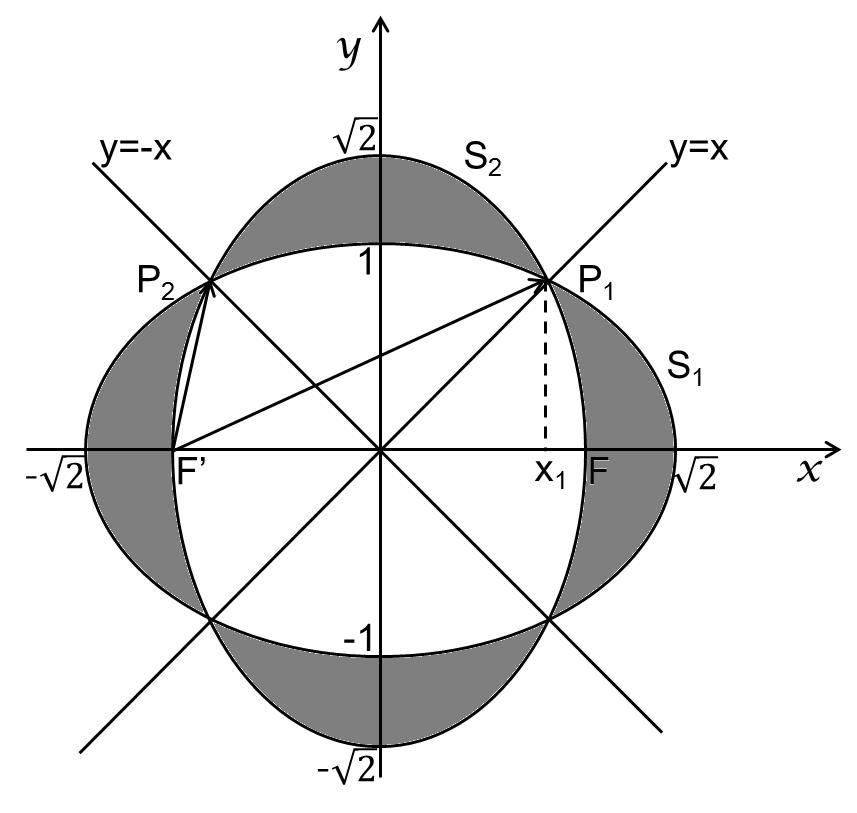
[4] 변환 (x′y′)=(0110)(xy)\displaystyle {\begin{pmatrix}x ^{\prime} \\ y ^{\prime} \end{pmatrix}} = {\begin{pmatrix}0&1\\ 1&0\end{pmatrix}} {\begin{pmatrix}x\\ y\end{pmatrix}}에 의해 x′=y,y′=x\displaystyle x^{\prime}=y, y^{\prime}=x인 관계식이 성립하여 공간적으로 y=x\displaystyle y=x대칭이 된다. 따라서 옮겨진 도형의 방정식은 다음과 같다.

두 타원 S1과 S2, 초점 F와 F prime, 제1·2사분면 교점 P1과 P2
[그림 1]

주어진 타원 S1:x22+y2=1\displaystyle S _{1 } : \frac{x ^{2}}{2} +y ^{2} =1

변환된 타원 S2:x2+y22=1\displaystyle S _{2} : x ^{2} + \frac{y ^{2}}{2} =1

+2점

y=x\displaystyle y=x와 타원식의 교점을 구하면 x122+x121=1\displaystyle \frac{x _{1} ^{2}}{2} + \frac{x _{1} ^{2}}{1} =1이므로 3x122=1\displaystyle \frac{3x _{1} ^{2}}{2} =1이고, x1=23\displaystyle x _{1} = \sqrt {\frac{2}{3}}이다. 따라서 두 타원의 교점은

(23,23),(−23,23)\displaystyle \left ( \sqrt {\frac{2}{3}} , \sqrt {\frac{2}{3}} \right ) , \left ( - \sqrt {\frac{2}{3}} , \sqrt {\frac{2}{3}} \right )이다.

+2점 · π∫02/3{2(1−x2)−(1−x2/2)}dx\displaystyle \pi\int_0^{\sqrt{2/3}}\{2(1-x^2)-(1-x^2/2)\}dx
+2점 · π∫2/31{(1−x2/2)−2(1−x2)}dx\displaystyle \pi\int_{\sqrt{2/3}}^1\{(1-x^2/2)-2(1-x^2)\}dx
+1점 · π∫12(1−x2/2)dx\displaystyle \pi\int_1^{\sqrt2}(1-x^2/2)dx

회전체의 부피는 πy2\displaystyle \pi y ^{2}을 구하면 되므로 타원식을 y2\displaystyle y ^{2}으로 정리하면 다음과 같다.

주어진 타원 S1:y2=1−x22\displaystyle S _{1 } : y ^{2} =1- \frac{x ^{2}}{2}

변환된 타원 S2:y2=2(1−x2)\displaystyle S _{2} : y ^{2} =2(1-x ^{2} )

좌우대칭이므로 x>0\displaystyle x>0인 영역의 부피를 구해서 두 배 하는 경우를 생각해보면 [0,x1]\displaystyle [0,x _{1} ] 영역에서는 S2\displaystyle S _{2}회전체에서 S1\displaystyle S _{1} 회전체의 부피를 빼주고, [x1,1]\displaystyle [x _{1} ,1]까지는 반대로 S1\displaystyle S _{1}회전체에서 S2\displaystyle S _{2}회전체의 부피를 빼주고, [1,2]\displaystyle [1, \sqrt {2} ]에서는 S1\displaystyle S _{1}회전체만 계산해주면 된다. 따라서 회전체의 부피는 다음 식으로 구해진다.

회전체 부피의 식을 세우면

V2=π∫023{2(1−x2)−(1−x22)}dx+π∫231{(1−x22)−2(1−x2)}dx+π∫12(1−x22)dx\displaystyle \frac{V}{2} =\pi \int _{0} ^{\sqrt {\frac{2}{3}}} {\left\{ 2(1-x ^{2} )- \left ( 1- \frac{x ^{2}}{2} \right ) \right\} dx} +\pi \int _{\sqrt {\frac{2}{3}}} ^{1} {\left\{ \left ( 1- \frac{x ^{2}}{2} \right ) -2(1-x ^{2} ) \right\} dx+\pi \int _{1} ^{\sqrt {2}} {\left ( 1- \frac{x ^{2}}{2} \right )} dx}

※ 혹은, 회전체 부피의 식을 다음과 같이 표현할 수도 있다.

V2=π∫023{2(1−x2)−(1−x22)}dx+π∫232(1−x22)dx−π∫2312(1−x2)dx\displaystyle \frac{V}{2} = \pi \int _{0} ^{\sqrt {\frac{2}{3}}} {\left\{ 2(1-x ^{2} )- \left ( 1- \frac{x ^{2}}{2} \right ) \right\} dx} + \pi \int _{\sqrt {\frac{2}{3}}} ^{\sqrt {2}} {\left ( 1- \frac{x ^{2}}{2} \right ) dx- \pi \int _{\sqrt {\frac{2}{3}}} ^{1} {2 \left ( 1-x ^{2} \right )} dx}

+2점 · π[6/3−6/9]\displaystyle \pi[\sqrt6/3-\sqrt6/9]
+2점 · π[6/3−1−6/9+1/2]\displaystyle \pi[\sqrt6/3-1-\sqrt6/9+1/2]
+1점 · π[2−1−2/3+1/6]\displaystyle \pi[\sqrt2-1-\sqrt2/3+1/6]

정적분을 계산해 부피를 계산하면,

V2=π∫023{1−32x2}dx+π∫231(−1+32x2)dx+π∫12(1−12x2)dx\displaystyle \frac{V}{2} = \pi \int _{0} ^{\sqrt {\frac{2}{3}}} {\left\{ 1- \frac{3}{2} x ^{2} \right\} dx} + \pi \int _{\sqrt {\frac{2}{3}}} ^{1} {\left ( -1+ \frac{3}{2} x ^{2} \right )} dx+\pi \int _{1} ^{\sqrt {2}} {\left ( 1- \frac{1}{2} x ^{2} \right ) dx}

=π[x−12x3]023+π[x−12x3]123+π[x−16x3]12\displaystyle =\pi \Biggl[ x- \frac{1}{2} x ^{3} \Biggr] _{0} ^{\sqrt {\frac{2}{3}}} + \pi \Biggl[ x- \frac{1}{2} x ^{3} \Biggr] _{1} ^{\sqrt {\frac{2}{3}}} + \pi \Biggl[ x- \frac{1}{6} x ^{3} \Biggr] _{1} ^{\sqrt {2}}

=π[23−122323]+π[(23−1)−12(2323−1)]+π[(2−1)−16(22−1)]\displaystyle =\pi \left [ \sqrt {\frac{2}{3}} - \frac{1}{2} \frac{2}{3} \sqrt {\frac{2}{3}} \right ] + \pi \left [ ( \sqrt {\frac{2}{3}} -1)- \frac{1}{2} ( \frac{2}{3} \sqrt {\frac{2}{3}} -1) \right ] + \pi \left [ ( \sqrt {2} -1)- \frac{1}{6} (2 \sqrt {2} -1) \right ]

=π[63−69+63−1−69+12+2−1−23+16]=π[469+223−43]\displaystyle =\pi \left [ \frac{\sqrt {6}}{3} - \frac{\sqrt {6}}{9} + \frac{\sqrt {6}}{3} -1- \frac{\sqrt {6}}{9} + \frac{1}{2} + \sqrt {2} -1- \frac{\sqrt {2}}{3} + \frac{1}{6} \right ] =\pi \left [ \frac{4 \sqrt {6}}{9} + \frac{2 \sqrt {2}}{3} - \frac{4}{3} \right ]

+2점

따라서 구하는 부피는 V=π[869+423−83]\displaystyle V=\pi \left [ \frac{8 \sqrt {6}}{9} + \frac{4 \sqrt {2}}{3} - \frac{8}{3} \right ]이다.

+3점

[5]두 점을 잇는 벡터를 구하면,

F′P1→=(23+1,23),F′P2→=(−23+1,23)\displaystyle \overrightarrow {\mathrm{F} ^{\prime} \mathrm{P} _{1}} =( \sqrt {\frac{2}{3}} +1, \sqrt {\frac{2}{3}} ), \overrightarrow {\mathrm{F}^{\prime}\mathrm{P} _{2} }=(- \sqrt {\frac{2}{3}} +1, \sqrt {\frac{2}{3}} )

+5점

제시문의 식 (5)에 두 벡터를 대입하면 두 벡터가 이루는 각에 대한 코사인 값을 구할 수 있다.

cos⁡θ=F′P1→⋅F′P2→∣F′P1→∣∣F′P2→∣=(23+1,23)⋅(−23+1,23)73+22373−223\displaystyle \cos \theta = \frac{\overrightarrow {\mathrm{F} ^{\prime} \mathrm{P} _{1}} \cdot \overrightarrow {\mathrm{F} ^{\prime} \mathrm{P} _{2}}}{| \overrightarrow {\mathrm{F} ^{\prime} \mathrm{P} _{1}} ||\overrightarrow {\mathrm{F}^{\prime}\mathrm{P} _{2} }|} = \frac{( \sqrt {\frac{2}{3}} +1, \sqrt {\frac{2}{3}} ) _{} \cdot (- \sqrt {\frac{2}{3}} +1, \sqrt {\frac{2}{3}} )}{\sqrt {\frac{7}{3} +2 \sqrt {\frac{2}{3}}} \sqrt {\frac{7}{3} -2 \sqrt {\frac{2}{3}}}}

=(−23+1+23)499−423=149−243=35\displaystyle = \frac{(- \frac{2}{3} +1+ \frac{2}{3} )}{\sqrt {\frac{49}{9} -4 \frac{2}{3}}} = \frac{1}{\frac{\sqrt {49-24}}{3}} = \frac35

+2점

이는 빗변의 길이가 5, 밑변의 길이가 3인 직각삼각형으로부터 얻는 값과 같으므로 tan⁡θ=43\displaystyle \tan \theta = \frac{4}{3} 이다.

첨삭 사례

아직 등록된 첨삭 사례가 없습니다.

질문과 답변 · 0개질문과 답변 · 고정 0개

아직 등록된 질문이 없습니다. 질문 작성은 멤버십 회원만 가능합니다.