+2점 · 식 ①에서 주어진 함수 F(x)는 닫힌구간 [a,b]에서 연속이고 열린구간 (a,b)에서 미분가능하다. +2점 · F ( a ) = F ( b ) = f ( b ) − f ( a ) \displaystyle F(a)=F(b)=f(b)-f(a) F ( a ) = F ( b ) = f ( b ) − f ( a ) [1]
두 함수 f ( x ) , g ( x ) \displaystyle f(x),g(x) f ( x ) , g ( x ) [ a , b ] \displaystyle [a,b] [ a , b ] ( a , b ) \displaystyle (a,b) ( a , b ) g ( a ) ≠ g ( b ) \displaystyle g(a)\ne g(b) g ( a ) = g ( b ) F ( x ) \displaystyle F(x) F ( x ) [ a , b ] \displaystyle [a,b] [ a , b ] ( a , b ) \displaystyle (a,b) ( a , b ) 또한 분명히 F ( a ) = F ( b ) = f ( b ) − f ( a ) \displaystyle F(a)=F(b)=f(b)-f(a) F ( a ) = F ( b ) = f ( b ) − f ( a ) 제시문의 [롤의 정리]에 의하면 다음을 만족시키는 실수 c \displaystyle c c a \displaystyle a a b \displaystyle b b
+2점 · F ′ ( c ) = 0 \displaystyle F^{\prime} \left ( c \right ) = 0 F ′ ( c ) = 0 F ′ ( c ) = 0 \displaystyle F^{\prime} \left ( c \right ) = 0 F ′ ( c ) = 0
+2점 · 여기서 F ′ ( x ) = f ′ ( x ) − f ( b ) − f ( a ) g ( b ) − g ( a ) g ′ ( x ) \displaystyle F^{\prime} \left ( x \right ) = f^{\prime} \left ( x \right ) - \frac{f \left ( b \right ) - f \left ( a \right )}{g \left ( b \right ) - g \left ( a \right )} g^{\prime} \left ( x \right ) F ′ ( x ) = f ′ ( x ) − g ( b ) − g ( a ) f ( b ) − f ( a ) g ′ ( x ) F ′ ( c ) = f ′ ( c ) − f ( b ) − f ( a ) g ( b ) − g ( a ) g ′ ( c ) = 0 \displaystyle F ^{\prime} \left ( c \right ) = f ^{\prime} \left ( c \right ) - \frac{f \left ( b \right ) - f \left ( a \right )}{g \left ( b \right ) - g \left ( a \right )} g ^{\prime} \left ( c \right ) = 0 F ′ ( c ) = f ′ ( c ) − g ( b ) − g ( a ) f ( b ) − f ( a ) g ′ ( c ) = 0 여기서 F ′ ( x ) = f ′ ( x ) − f ( b ) − f ( a ) g ( b ) − g ( a ) g ′ ( x ) \displaystyle F^{\prime} \left ( x \right ) = f^{\prime} \left ( x \right ) - \frac{f \left ( b \right ) - f \left ( a \right )}{g \left ( b \right ) - g \left ( a \right )} g^{\prime} \left ( x \right ) F ′ ( x ) = f ′ ( x ) − g ( b ) − g ( a ) f ( b ) − f ( a ) g ′ ( x )
F ′ ( c ) = f ′ ( c ) − f ( b ) − f ( a ) g ( b ) − g ( a ) g ′ ( c ) = 0 \displaystyle F ^{\prime} \left ( c \right ) = f ^{\prime} \left ( c \right ) - \frac{f \left ( b \right ) - f \left ( a \right )}{g \left ( b \right ) - g \left ( a \right )} g ^{\prime} \left ( c \right ) = 0 F ′ ( c ) = f ′ ( c ) − g ( b ) − g ( a ) f ( b ) − f ( a ) g ′ ( c ) = 0
+2점 · 구간 ( a , b ) \displaystyle \left ( a, b \right ) ( a , b ) g ′ ( x ) ≠ 0 \displaystyle g^{\prime} \left ( x \right ) \ne 0 g ′ ( x ) = 0 f ( b ) − f ( a ) g ( b ) − g ( a ) = f ′ ( c ) g ′ ( c ) \displaystyle \frac{f \left ( b \right ) - f \left ( a \right )}{g \left ( b \right ) - g \left ( a \right )} = \frac{f^{\prime} \left ( c \right )}{g^{\prime} \left ( c \right )} g ( b ) − g ( a ) f ( b ) − f ( a ) = g ′ ( c ) f ′ ( c ) 구간 ( a , b ) \displaystyle \left ( a, b \right ) ( a , b ) g ′ ( x ) ≠ 0 \displaystyle g^{\prime} \left ( x \right ) \ne 0 g ′ ( x ) = 0
f ( b ) − f ( a ) g ( b ) − g ( a ) = f ′ ( c ) g ′ ( c ) \displaystyle \frac{f \left ( b \right ) - f \left ( a \right )}{g \left ( b \right ) - g \left ( a \right )} = \frac{f^{\prime} \left ( c \right )}{g^{\prime} \left ( c \right )} g ( b ) − g ( a ) f ( b ) − f ( a ) = g ′ ( c ) f ′ ( c )
+2점 · [2] 점 s ∈ ( a , b ) \displaystyle s\in(a,b) s ∈ ( a , b ) f ( x ) \displaystyle f(x) f ( x ) g ( x ) \displaystyle g(x) g ( x ) f ( s ) = 0 , g ( s ) = 0 \displaystyle f(s)=0,g(s)=0 f ( s ) = 0 , g ( s ) = 0 f ( x ) g ( x ) = f ( x ) − f ( s ) g ( x ) − g ( s ) \displaystyle \frac{f \left ( x \right )}{g \left ( x \right )} = \frac{f \left ( x \right ) -f \left ( s \right )}{g \left ( x \right ) -g \left ( s \right )} g ( x ) f ( x ) = g ( x ) − g ( s ) f ( x ) − f ( s ) [2]
점 s ∈ ( a , b ) \displaystyle s\in(a,b) s ∈ ( a , b ) f ( x ) \displaystyle f(x) f ( x ) g ( x ) \displaystyle g(x) g ( x ) f ( s ) = 0 , g ( s ) = 0 \displaystyle f(s)=0,g(s)=0 f ( s ) = 0 , g ( s ) = 0
f ( x ) g ( x ) = f ( x ) − f ( s ) g ( x ) − g ( s ) \displaystyle \frac{f \left ( x \right )}{g \left ( x \right )} = \frac{f \left ( x \right ) -f \left ( s \right )}{g \left ( x \right ) -g \left ( s \right )} g ( x ) f ( x ) = g ( x ) − g ( s ) f ( x ) − f ( s )
+2점 · 여기서 x ≠ s \displaystyle x \ne s x = s f ( x ) g ( x ) = f ( x ) − f ( s ) g ( x ) − g ( s ) = f ( x ) − f ( s ) x − s g ( x ) − g ( s ) x − s \displaystyle \frac{f \left ( x \right )}{g \left ( x \right )} = \frac{f \left ( x \right ) -f \left ( s \right )}{g \left ( x \right ) -g \left ( s \right )} = \frac{\frac{f \left ( x \right ) -f \left ( s \right )}{x-s}}{\frac{g \left ( x \right ) -g \left ( s \right )}{x-s}} g ( x ) f ( x ) = g ( x ) − g ( s ) f ( x ) − f ( s ) = x − s g ( x ) − g ( s ) x − s f ( x ) − f ( s ) 여기서 x ≠ s \displaystyle x \ne s x = s
f ( x ) g ( x ) = f ( x ) − f ( s ) g ( x ) − g ( s ) = f ( x ) − f ( s ) x − s g ( x ) − g ( s ) x − s \displaystyle \frac{f \left ( x \right )}{g \left ( x \right )} = \frac{f \left ( x \right ) -f \left ( s \right )}{g \left ( x \right ) -g \left ( s \right )} = \frac{\frac{f \left ( x \right ) -f \left ( s \right )}{x-s}}{\frac{g \left ( x \right ) -g \left ( s \right )}{x-s}} g ( x ) f ( x ) = g ( x ) − g ( s ) f ( x ) − f ( s ) = x − s g ( x ) − g ( s ) x − s f ( x ) − f ( s )
+2점 · 조건에서 함수 f ( x ) \displaystyle f(x) f ( x ) g ( x ) \displaystyle g(x) g ( x ) x = s \displaystyle x=s x = s lim x → s f ( x ) − f ( s ) x − s = f ′ ( s ) , lim x → s g ( x ) − g ( s ) x − s = g ′ ( s ) \displaystyle \lim_{x\to s}\frac{f(x)-f(s)}{x-s}=f^{\prime}(s),~\lim_{x\to s}\frac{g(x)-g(s)}{x-s}=g^{\prime}(s) x → s lim x − s f ( x ) − f ( s ) = f ′ ( s ) , x → s lim x − s g ( x ) − g ( s ) = g ′ ( s ) 조건에서 함수 f ( x ) \displaystyle f(x) f ( x ) g ( x ) \displaystyle g(x) g ( x ) x = s \displaystyle x=s x = s
lim x → s f ( x ) − f ( s ) x − s = f ′ ( s ) , lim x → s g ( x ) − g ( s ) x − s = g ′ ( s ) \displaystyle \lim_{x\to s}\frac{f(x)-f(s)}{x-s}=f^{\prime}(s),~\lim_{x\to s}\frac{g(x)-g(s)}{x-s}=g^{\prime}(s) x → s lim x − s f ( x ) − f ( s ) = f ′ ( s ) , x → s lim x − s g ( x ) − g ( s ) = g ′ ( s )
+1점 · 또 조건에서 구간 ( a , b ) \displaystyle \left ( a, b \right ) ( a , b ) g ′ ( x ) ≠ 0 \displaystyle g^{\prime} \left ( x \right ) \ne 0 g ′ ( x ) = 0 g ′ ( s ) ≠ 0 \displaystyle g ^{\prime} \left ( s \right ) \ne 0 g ′ ( s ) = 0 또 조건에서 구간 ( a , b ) \displaystyle \left ( a, b \right ) ( a , b ) g ′ ( x ) ≠ 0 \displaystyle g^{\prime} \left ( x \right ) \ne 0 g ′ ( x ) = 0 g ′ ( s ) ≠ 0 \displaystyle g ^{\prime} \left ( s \right ) \ne 0 g ′ ( s ) = 0
+3점 · 이제 제시문의 [함수의 극한에 관한 성질]을 이용하여 다음을 얻는다. lim x → s f ( x ) g ( s ) = f ′ ( s ) g ′ ( s ) \displaystyle \lim _{x\to s} {\frac{f \left ( x \right )}{g \left ( s \right )} = \frac{f^{\prime} \left ( s \right )}{g^{\prime} \left ( s \right )}} x → s lim g ( s ) f ( x ) = g ′ ( s ) f ′ ( s ) 이제 제시문의 [함수의 극한에 관한 성질]을 이용하여 다음을 얻는다.
lim x → s f ( x ) g ( s ) = f ′ ( s ) g ′ ( s ) \displaystyle \lim _{x\to s} {\frac{f \left ( x \right )}{g \left ( s \right )} = \frac{f^{\prime} \left ( s \right )}{g^{\prime} \left ( s \right )}} x → s lim g ( s ) f ( x ) = g ′ ( s ) f ′ ( s )
+2점 · [3]
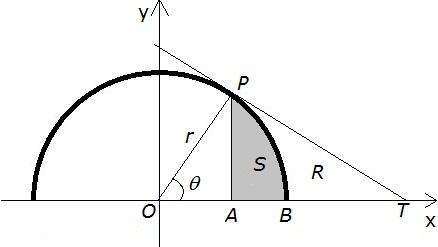
<그림 1>에서 직각삼각형 O P A \displaystyle \mathrm{OPA} OPA P \displaystyle \mathrm{P} P P ( r cos θ , r sin θ ) \displaystyle \mathrm{P} \left ( r\cos \theta , r \sin \theta \right ) P ( r cos θ , r sin θ ) [3]
<그림 1> <그림 1>에서 직각삼각형 O P A \displaystyle \mathrm{OPA} OPA P \displaystyle \mathrm{P} P P ( r cos θ , r sin θ ) \displaystyle \mathrm{P} \left ( r\cos \theta , r \sin \theta \right ) P ( r cos θ , r sin θ )
+2점 · 따라서 점 A의 좌표는 A ( r cos θ , 0 ) \displaystyle \mathrm{A}(r\cos\theta,0) A ( r cos θ , 0 ) +1점 · 점 B의 좌표는 분명히 B ( r , 0 ) \displaystyle \mathrm{B}(r,0) B ( r , 0 ) 따라서 점 A \displaystyle \mathrm{A} A A ( r cos θ , 0 ) \displaystyle \mathrm{A} \left ( r\cos \theta , 0 \right ) A ( r cos θ , 0 ) 점 B \displaystyle \mathrm{B} B B ( r , 0 ) \displaystyle \mathrm{B} \left ( r, 0 \right ) B ( r , 0 )
+3점 · 한편 점 P \displaystyle \mathrm{P} P y = r 2 − x 2 \displaystyle y= \sqrt {r ^{2} -x ^{2}} y = r 2 − x 2 y ′ = − x r 2 − x 2 \displaystyle y^{\prime} = - \frac{x}{\sqrt {r ^{2} -x ^{2}}} y ′ = − r 2 − x 2 x x = r cos θ \displaystyle x=r \cos \theta x = r cos θ − cos θ sin θ \displaystyle - \frac{\cos \theta }{\sin \theta } − sin θ cos θ P \displaystyle \mathrm{P} P y = r sin θ − cos θ sin θ ( x − r cos θ ) \displaystyle y=r \sin \theta - \frac{\cos \theta }{\sin \theta } \left ( x- r \cos \theta \right ) y = r sin θ − sin θ cos θ ( x − r cos θ ) 한편 점 P \displaystyle \mathrm{P} P y = r 2 − x 2 \displaystyle y= \sqrt {r ^{2} -x ^{2}} y = r 2 − x 2
y ′ = − x r 2 − x 2 \displaystyle y^{\prime} = - \frac{x}{\sqrt {r ^{2} -x ^{2}}} y ′ = − r 2 − x 2 x x = r cos θ \displaystyle x=r \cos \theta x = r cos θ − cos θ sin θ \displaystyle - \frac{\cos \theta }{\sin \theta } − sin θ cos θ P \displaystyle \mathrm{P} P
y = r sin θ − cos θ sin θ ( x − r cos θ ) \displaystyle y=r \sin \theta - \frac{\cos \theta }{\sin \theta } \left ( x- r \cos \theta \right ) y = r sin θ − sin θ cos θ ( x − r cos θ )
+2점 · 점 T \displaystyle \mathrm{T} T x \displaystyle x x T ( r cos θ , 0 ) \displaystyle \mathrm{T} \left ( \frac{r}{\cos \theta } ,0 \right ) T ( cos θ r , 0 ) 점 T \displaystyle \mathrm{T} T x \displaystyle x x T ( r cos θ , 0 ) \displaystyle \mathrm{T} \left ( \frac{r}{\cos \theta } ,0 \right ) T ( cos θ r , 0 )
+1점 · [4]
<그림1>에서 도형 P A B \displaystyle \mathrm{PAB} PAB S \displaystyle S S O P B \displaystyle \mathrm{OPB} OPB − \displaystyle - − O P A \displaystyle \mathrm{OPA} OPA O P B \displaystyle \mathrm{OPB} OPB = 1 2 r 2 θ \displaystyle = \frac{1}{2} r ^{2} \theta = 2 1 r 2 θ [4]
<그림1>에서 도형 P A B \displaystyle \mathrm{PAB} PAB S \displaystyle S S O P B \displaystyle \mathrm{OPB} OPB − \displaystyle - − O P A \displaystyle \mathrm{OPA} OPA
(부채꼴 O P B \displaystyle \mathrm{OPB} OPB = 1 2 r 2 θ \displaystyle = \frac{1}{2} r ^{2} \theta = 2 1 r 2 θ
+1점 · (직각삼각형 O P A \displaystyle \mathrm{OPA} OPA = 1 2 r 2 cos θ sin θ \displaystyle =\frac12r^2\cos\theta\sin\theta = 2 1 r 2 cos θ sin θ (직각삼각형 O P A \displaystyle \mathrm{OPA} OPA = 1 2 r 2 cos θ sin θ \displaystyle =\frac12r^2\cos\theta\sin\theta = 2 1 r 2 cos θ sin θ
+3점 · 따라서 S \displaystyle S S S = 1 2 r 2 ( θ − sin θ cos θ ) = 1 2 r 2 ( θ − 1 2 sin 2 θ ) \displaystyle S= \frac{1}{2} r ^{2} \left ( \theta - \sin \theta \cos \theta \right ) = \frac{1}{2} r ^{2} \left ( \theta - \frac{1}{2} \sin 2\theta \right ) S = 2 1 r 2 ( θ − sin θ cos θ ) = 2 1 r 2 ( θ − 2 1 sin 2 θ ) 따라서 S \displaystyle S S
S = 1 2 r 2 ( θ − sin θ cos θ ) = 1 2 r 2 ( θ − 1 2 sin 2 θ ) \displaystyle S= \frac{1}{2} r ^{2} \left ( \theta - \sin \theta \cos \theta \right ) = \frac{1}{2} r ^{2} \left ( \theta - \frac{1}{2} \sin 2\theta \right ) S = 2 1 r 2 ( θ − sin θ cos θ ) = 2 1 r 2 ( θ − 2 1 sin 2 θ )
+1점 · 한편 도형 P B T \displaystyle \mathrm{PBT} PBT R \displaystyle R R O P T \displaystyle \mathrm{OPT} OPT − \displaystyle - − O P B \displaystyle \mathrm{OPB} OPB O P T \displaystyle \mathrm{OPT} OPT 1 2 r sin θ r cos θ = 1 2 r 2 tan θ \displaystyle \frac{1}{2} r \sin \theta \frac{r}{\cos \theta } = \frac{1}{2} r ^{2} \tan \theta 2 1 r sin θ cos θ r = 2 1 r 2 tan θ 한편 도형 P B T \displaystyle \mathrm{PBT} PBT R \displaystyle R R O P T \displaystyle \mathrm{OPT} OPT − \displaystyle - − O P B \displaystyle \mathrm{OPB} OPB
(직각삼각형 O P T \displaystyle \mathrm{OPT} OPT 1 2 r sin θ r cos θ = 1 2 r 2 tan θ \displaystyle \frac{1}{2} r \sin \theta \frac{r}{\cos \theta } = \frac{1}{2} r ^{2} \tan \theta 2 1 r sin θ cos θ r = 2 1 r 2 tan θ
+3점 · R = 1 2 r 2 ( tan θ − θ ) \displaystyle R = \frac{1}{2} r ^{2} \left ( \tan \theta - \theta \right ) R = 2 1 r 2 ( tan θ − θ ) R = 1 2 r 2 ( tan θ − θ ) \displaystyle R = \frac{1}{2} r ^{2} \left ( \tan \theta - \theta \right ) R = 2 1 r 2 ( tan θ − θ )
+1점 · [5] 문항 [4]로부터 Q , R , S \displaystyle Q, R, S Q , R , S θ = 0 \displaystyle \theta = 0 θ = 0 Q = 1 4 r 2 sin 2 θ , S = 1 2 r 2 ( θ − 1 2 sin 2 θ ) , R = 1 2 r 2 ( tan θ − θ ) \displaystyle Q= \frac{1}{4} r ^{2} \sin 2 \theta , S= \frac{1}{2} r ^{2} \left ( \theta - \frac{1}{2} \sin 2 \theta \right ) , R= \frac{1}{2} r ^{2} \left ( \tan \theta -\theta \right ) Q = 4 1 r 2 sin 2 θ , S = 2 1 r 2 ( θ − 2 1 sin 2 θ ) , R = 2 1 r 2 ( tan θ − θ ) 따라서 다음을 얻는다. R Q = tan θ − θ 1 2 sin 2 θ = 2 tan θ − θ sin 2 θ \displaystyle \frac{R}{Q} = \frac{\tan\theta -\theta }{\frac{1}{2} \sin 2\theta } =2 \frac{\tan\theta-\theta }{\sin 2\theta } Q R = 2 1 sin 2 θ tan θ − θ = 2 sin 2 θ tan θ − θ [5]
문항 [4]로부터 Q , R , S \displaystyle Q, R, S Q , R , S θ = 0 \displaystyle \theta = 0 θ = 0
Q = 1 4 r 2 sin 2 θ , S = 1 2 r 2 ( θ − 1 2 sin 2 θ ) , R = 1 2 r 2 ( tan θ − θ ) \displaystyle Q= \frac{1}{4} r ^{2} \sin 2 \theta , S= \frac{1}{2} r ^{2} \left ( \theta - \frac{1}{2} \sin 2 \theta \right ) , R= \frac{1}{2} r ^{2} \left ( \tan \theta -\theta \right ) Q = 4 1 r 2 sin 2 θ , S = 2 1 r 2 ( θ − 2 1 sin 2 θ ) , R = 2 1 r 2 ( tan θ − θ )
따라서 다음을 얻는다.
R Q = tan θ − θ 1 2 sin 2 θ = 2 tan θ − θ sin 2 θ \displaystyle \frac{R}{Q} = \frac{\tan\theta -\theta }{\frac{1}{2} \sin 2\theta } =2 \frac{\tan\theta-\theta }{\sin 2\theta } Q R = 2 1 sin 2 θ tan θ − θ = 2 sin 2 θ tan θ − θ
+2점 · 여기서 R Q \displaystyle \frac{R}{Q} Q R θ → 0 \displaystyle \theta \to 0 θ → 0 0 \displaystyle 0 0 ( sin 2 θ ) ′ = 2 cos 2 θ \displaystyle \left ( \sin 2\theta \right ) ' = 2 \cos 2\theta ( sin 2 θ ) ′ = 2 cos 2 θ θ = 0 \displaystyle \theta = 0 θ = 0 ( sin 2 θ ) ′ = 2 ≠ 0 \displaystyle \left ( \sin 2\theta \right ) ' = 2 \ne 0 ( sin 2 θ ) ′ = 2 = 0 lim θ → 0 R Q = lim θ → 0 2 tan θ − θ sin 2 θ = 2 sec 2 0 − 1 2 cos 0 = 0 2 = 0 \displaystyle \lim _{\theta \to 0} {\frac{R}{Q} = \lim _{\theta \to 0} {2 \frac{\tan\theta - \theta }{\sin 2\theta } = 2 \frac{\sec ^{2} 0-1}{2 \cos 0} = \frac{0}{2} = 0}} θ → 0 lim Q R = θ → 0 lim 2 sin 2 θ tan θ − θ = 2 2 cos 0 sec 2 0 − 1 = 2 0 = 0 여기서 R Q \displaystyle \frac{R}{Q} Q R θ → 0 \displaystyle \theta \to 0 θ → 0 0 \displaystyle 0 0 ( sin 2 θ ) ′ = 2 cos 2 θ \displaystyle \left ( \sin 2\theta \right ) ' = 2 \cos 2\theta ( sin 2 θ ) ′ = 2 cos 2 θ θ = 0 \displaystyle \theta = 0 θ = 0 ( sin 2 θ ) ′ = 2 ≠ 0 \displaystyle \left ( \sin 2\theta \right ) ' = 2 \ne 0 ( sin 2 θ ) ′ = 2 = 0
lim θ → 0 R Q = lim θ → 0 2 tan θ − θ sin 2 θ = 2 sec 2 0 − 1 2 cos 0 = 0 2 = 0 \displaystyle \lim _{\theta \to 0} {\frac{R}{Q} = \lim _{\theta \to 0} {2 \frac{\tan\theta - \theta }{\sin 2\theta } = 2 \frac{\sec ^{2} 0-1}{2 \cos 0} = \frac{0}{2} = 0}} θ → 0 lim Q R = θ → 0 lim 2 sin 2 θ tan θ − θ = 2 2 cos 0 sec 2 0 − 1 = 2 0 = 0
+3점 · 한편 S ′ \displaystyle S^{\prime} S ′ R ′ \displaystyle R^{\prime} R ′ S ′ = d S d θ = 1 2 r 2 ( 1 − cos 2 θ ) , R ′ = d R d θ = 1 2 r 2 ( sec 2 θ − 1 ) \displaystyle S^{\prime}= \frac{dS}{d \theta } = \frac{1}{2} r ^{2} \left ( 1-\cos 2\theta \right ) , R^{\prime}= \frac{dR}{d \theta } = \frac{1}{2} r ^{2} \left ( \sec ^{2} \theta - 1 \right ) S ′ = d θ d S = 2 1 r 2 ( 1 − cos 2 θ ) , R ′ = d θ d R = 2 1 r 2 ( sec 2 θ − 1 ) 한편 S ′ \displaystyle S^{\prime} S ′ R ′ \displaystyle R^{\prime} R ′
S ′ = d S d θ = 1 2 r 2 ( 1 − cos 2 θ ) , R ′ = d R d θ = 1 2 r 2 ( sec 2 θ − 1 ) \displaystyle S^{\prime}= \frac{dS}{d \theta } = \frac{1}{2} r ^{2} \left ( 1-\cos 2\theta \right ) , R^{\prime}= \frac{dR}{d \theta } = \frac{1}{2} r ^{2} \left ( \sec ^{2} \theta - 1 \right ) S ′ = d θ d S = 2 1 r 2 ( 1 − cos 2 θ ) , R ′ = d θ d R = 2 1 r 2 ( sec 2 θ − 1 )
+3점 · 여기서 제시문의 [삼각함수의 항등식]과 삼각함수의 정의를 이용하면 다음을 얻는다. lim θ → 0 S ′ R ′ = lim θ → 0 1 − cos 2 θ sec 2 θ − 1 = lim θ → 0 2 sin 2 θ tan 2 θ = lim θ → 0 2 cos 2 θ = 2 \displaystyle \lim _{\theta \to 0} {\frac{S ^{\prime} }{R ^{\prime} } = \lim _{\theta \to 0} {\frac{1-\cos 2 \theta }{\sec ^{2} \theta -1} = \lim _{\theta \to 0} {\frac{2 \sin ^{2} \theta }{\tan ^{2} \theta } = \lim _{\theta \to 0} { 2 \cos ^{2} \theta = 2}}}} θ → 0 lim R ′ S ′ = θ → 0 lim sec 2 θ − 1 1 − cos 2 θ = θ → 0 lim tan 2 θ 2 sin 2 θ = θ → 0 lim 2 cos 2 θ = 2 여기서 제시문의 [삼각함수의 항등식]과 삼각함수의 정의를 이용하면 다음을 얻는다.
lim θ → 0 S ′ R ′ = lim θ → 0 1 − cos 2 θ sec 2 θ − 1 = lim θ → 0 2 sin 2 θ tan 2 θ = lim θ → 0 2 cos 2 θ = 2 \displaystyle \lim _{\theta \to 0} {\frac{S ^{\prime} }{R ^{\prime} } = \lim _{\theta \to 0} {\frac{1-\cos 2 \theta }{\sec ^{2} \theta -1} = \lim _{\theta \to 0} {\frac{2 \sin ^{2} \theta }{\tan ^{2} \theta } = \lim _{\theta \to 0} { 2 \cos ^{2} \theta = 2}}}} θ → 0 lim R ′ S ′ = θ → 0 lim sec 2 θ − 1 1 − cos 2 θ = θ → 0 lim tan 2 θ 2 sin 2 θ = θ → 0 lim 2 cos 2 θ = 2
+2점 · 따라서 제시문의 [우극한과 좌극한]에 의하면 구하는 극한값은 다음과 같다. lim θ → 0 + 0 R Q = 0 , lim θ → 0 + 0 S ′ R ′ = 2 \displaystyle \lim _{\theta \to 0+0} {\frac{R}{Q} = 0} , \lim _{\theta \to 0+0} {\frac{S^{\prime}}{R^{\prime}} = 2} θ → 0 + 0 lim Q R = 0 , θ → 0 + 0 lim R ′ S ′ = 2 따라서 제시문의 [우극한과 좌극한]에 의하면 구하는 극한값은 다음과 같다.
lim θ → 0 + 0 R Q = 0 , lim θ → 0 + 0 S ′ R ′ = 2 \displaystyle \lim _{\theta \to 0+0} {\frac{R}{Q} = 0} , \lim _{\theta \to 0+0} {\frac{S^{\prime}}{R^{\prime}} = 2} θ → 0 + 0 lim Q R = 0 , θ → 0 + 0 lim R ′ S ′ = 2
※ 문항 [1]을 이용하는 경우: f ′ ( x ) , g ′ ( x ) \displaystyle f^{\prime} \left ( x \right ) , g^{\prime} \left ( x \right ) f ′ ( x ) , g ′ ( x ) f ( x ) g ( x ) = f ( x ) − f ( s ) g ( x ) − g ( s ) = f ′ ( c ) g ′ ( c ) \displaystyle \frac{f \left ( x \right )}{g \left ( x \right )} = \frac{f \left ( x \right ) -f \left ( s \right )}{g \left ( x \right ) -g \left ( s \right )} = \frac{f^{\prime} \left ( c \right )}{g^{\prime} \left ( c \right )} g ( x ) f ( x ) = g ( x ) − g ( s ) f ( x ) − f ( s ) = g ′ ( c ) f ′ ( c ) 에서 x → s \displaystyle x\to s x → s c → s \displaystyle c\to s c → s f ′ ( s ) g ′ ( s ) \displaystyle \frac{f^{\prime}(s)}{g^{\prime}(s)} g ′ ( s ) f ′ ( s )
극한을 구할 때 (교육과정에는 없지만) 로피탈의 정리를 (언급이 없이) 사용하여 바르게 구할 경우도 제시된 점수 부여.
 수리논술, 배움에서 논증의 완성까지.