수리논술, 이게 다다.

자연계열 1번

오류 제보

배점 비율 1번: 35%

배점 비율 2번: 35%

배점 비율 3번 인문 문항: 30%

문제

<문제 1: 35%> 다음 글을 읽고, 물음 【1-1】, 【1-2】, 【1-3】, 【1-4】에 답하라.

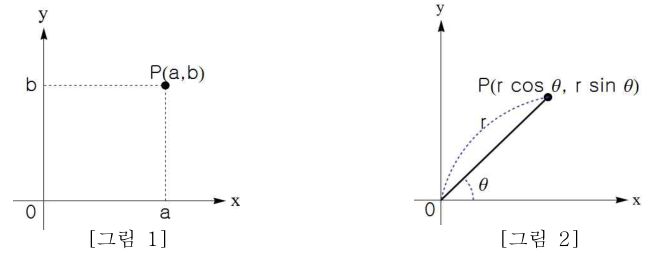
a,b\displaystyle a, b를 실수라 하고, i2=−1\displaystyle i^2=-1이라 하자. 좌표평면에서 복소수 a+bi\displaystyle a+bi를 [그림 1]과 같이 점 P(a,b)\displaystyle P(a,b)에 대응시키자. r=a2+b2\displaystyle r=\sqrt{a^2+b^2}이라 하고, 원점 O\displaystyle O와 점 P\displaystyle P를 지나는 동경 OP\displaystyle OP가 나타내는 각을 θ\displaystyle \theta라 하면 a=rcos⁡θ,b=rsin⁡θ\displaystyle a=r\cos\theta, b=r\sin\theta이다. 따라서 점 a+bi\displaystyle a+bi는 (rcos⁡θ,rsin⁡θ)\displaystyle (r\cos\theta,r\sin\theta)로 나타낼 수 있다([그림 2] 참조). 만일 r=1\displaystyle r=1이면 a+bi\displaystyle a+bi는 (cos⁡θ,sin⁡θ)\displaystyle (\cos\theta,\sin\theta)이다.

a,b,c,d\displaystyle a,b,c,d가 실수일 때, 복소수 a+bi\displaystyle a+bi와 c+di\displaystyle c+di의 곱셈은(a+bi)(c+di)=(ac−bd)+(ad+bc)i\displaystyle (a+bi)(c+di)=(ac-bd)+(ad+bc)i이고, 이것을 집합 {(a,b)∣a,b는 실수}\displaystyle \{(a,b)\mid a,b\text{는 실수}\}에서의 곱셈 연산(a,b)(c,d)=(ac−bd,ad+bc)\displaystyle (a,b)(c,d)=(ac-bd,ad+bc) ……①로 쓸 수 있다. 식 ①을 행렬로 나타내면(a,b)(c,d)=(a−bba)(cd)\displaystyle (a,b)(c,d)=\begin{pmatrix}a&-b\\b&a\end{pmatrix}\begin{pmatrix}c\\d\end{pmatrix} ……②이다. 또한 점 P(a,b)\displaystyle P(a,b)에 대하여 원점 O\displaystyle O를 시점으로 하는 위치벡터 OP→\displaystyle \overrightarrow{OP}는 (a,b)\displaystyle (a,b)이다. 따라서 (a,b)\displaystyle (a,b)는 복소수 a+bi\displaystyle a+bi로 볼 수도 있고, 벡터로 볼 수도 있다. 즉, (a,b)=a+bi\displaystyle (a,b)=a+bi이다.

[그림 1] 복소수의 좌표평면 표현과 [그림 2] 극형식 표현

【1-1】 회전변환을 이용하여 점 (2,1)\displaystyle (2,1)을 원점을 중심으로 45∘\displaystyle 45^\circ만큼 회전한 점을 구하라.

【1-2】 실수 α,β\displaystyle \alpha,\beta에 대하여, 식 ①, ②를 이용하여cos⁡(α+β)=cos⁡αcos⁡β−sin⁡αsin⁡β,sin⁡(α+β)=sin⁡αcos⁡β+cos⁡αsin⁡β\displaystyle \cos(\alpha+\beta)=\cos\alpha\cos\beta-\sin\alpha\sin\beta,\quad\sin(\alpha+\beta)=\sin\alpha\cos\beta+\cos\alpha\sin\beta임을 보여라.

【1-3】 (cos⁡θ,sin⁡θ)1=(cos⁡θ,sin⁡θ)\displaystyle (\cos\theta,\sin\theta)^1=(\cos\theta,\sin\theta)라 하고, 1\displaystyle 1보다 큰 자연수 n\displaystyle n에 대하여 (cos⁡θ,sin⁡θ)n=(cos⁡θ,sin⁡θ)(cos⁡θ,sin⁡θ)n−1\displaystyle (\cos\theta,\sin\theta)^n=(\cos\theta,\sin\theta)(\cos\theta,\sin\theta)^{n-1}이라 정의하자. 자연수 n\displaystyle n에 대하여 (cos⁡θ,sin⁡θ)n=(cos⁡nθ,sin⁡nθ)\displaystyle (\cos\theta,\sin\theta)^n=(\cos n\theta,\sin n\theta)임을 보여라.

【1-4】 점 A1,A2,⋯ ,Am\displaystyle A_1,A_2,\cdots,A_m은 중심이 원점이고 반지름이 1\displaystyle 1인 원 위의 서로 다른 점이며, 점 Am\displaystyle A_m의 좌표는 (1,0)\displaystyle (1,0)이다. 점 A1,A2,⋯ ,Am\displaystyle A_1,A_2,\cdots,A_m은 정 m\displaystyle m각형의 꼭지점이다. z=(cos⁡2πm,sin⁡2πm)=cos⁡2πm+sin⁡2πmi\displaystyle z=\left(\cos\frac{2\pi}{m},\sin\frac{2\pi}{m}\right)=\cos\frac{2\pi}{m}+\sin\frac{2\pi}{m}i라 할 때 OA1→+OA2→+⋯+OAm→\displaystyle \overrightarrow{OA_1}+\overrightarrow{OA_2}+\cdots+\overrightarrow{OA_m}을 z\displaystyle z를 이용하여 나타내고, 이 벡터의 합과1+cos⁡2πm+cos⁡4πm+⋯+cos⁡2(m−1)πm,sin⁡2πm+sin⁡4πm+⋯+sin⁡2(m−1)πm\displaystyle 1+\cos\frac{2\pi}{m}+\cos\frac{4\pi}{m}+\cdots+\cos\frac{2(m-1)\pi}{m},\quad\sin\frac{2\pi}{m}+\sin\frac{4\pi}{m}+\cdots+\sin\frac{2(m-1)\pi}{m}값을 구하라.

해설강의 준비중
이 예시답안은 준비중입니다.

첨삭 사례

아직 등록된 첨삭 사례가 없습니다.

질문과 답변 · 0개질문과 답변 · 고정 0개

아직 등록된 질문이 없습니다. 질문 작성은 멤버십 회원만 가능합니다.