수리논술, 이게 다다.

자연계열 2-2번

오류 제보

문제

<나>극장에서 스크린이 가장 크게 보이는 자리는 어디일까?

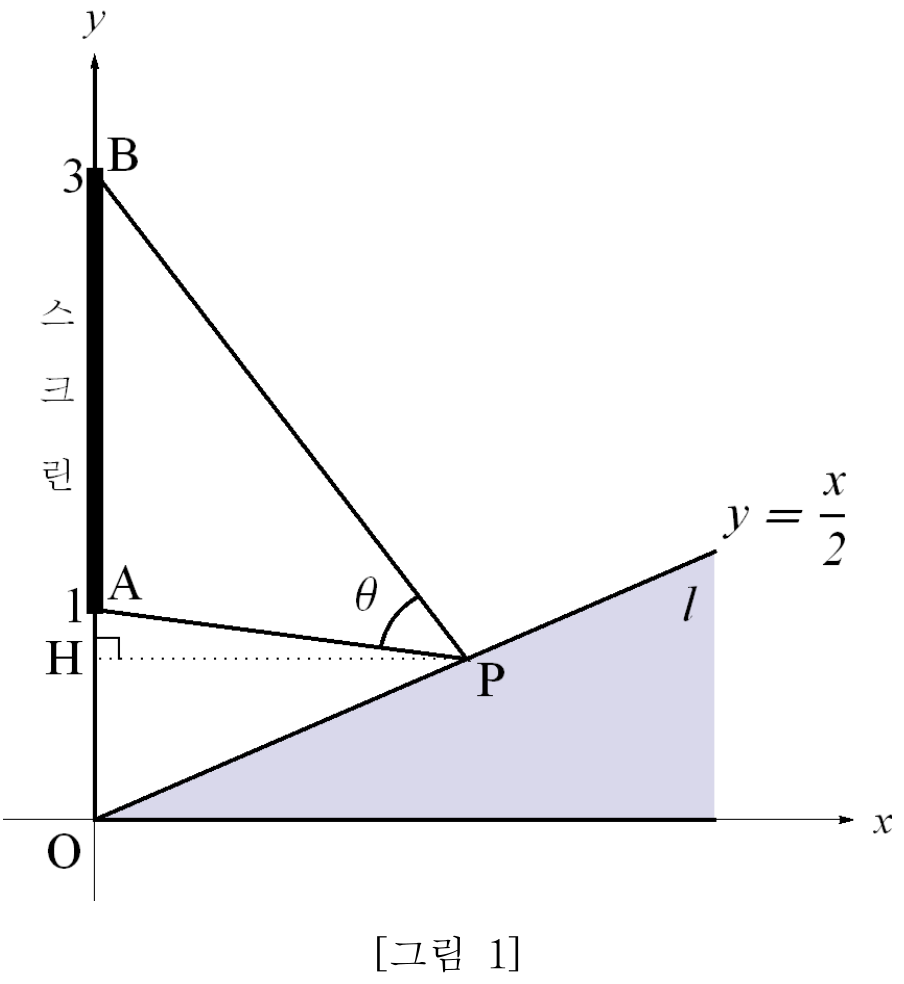
그림1: 극장의 스크린 AB와 직선 l 위의 관객 P

[그림1]은 극장을 옆에서 본 단면을 나타낸 것이다. [그림1]에서 스크린은 선분 AB\displaystyle \mathrm{AB}이고 관객의 눈의 위치는 직선 l\displaystyle l위에 있다. ∠APB\displaystyle \angle\mathrm{APB}가 클수록 직선 l\displaystyle l위의 점 P\displaystyle \mathrm P에서 스크린이 크게 보인다고 가정하자.이제 ∠APB=θ\displaystyle \angle\mathrm{APB}=\theta라 하고 직선 l\displaystyle l의 방정식이 y=x2 (x>0)\displaystyle y=\frac x2\ (x>0)일 때, 각 θ\displaystyle \theta가 최대가 되는 점 P\displaystyle \mathrm P를 구해보자. 여기서 부등식 0<θ<π2\displaystyle 0<\theta<\frac\pi2가 성립함을 증명할 수 있다.

각 θ\displaystyle \theta가 최대가 되는 점 P\displaystyle \mathrm P는 함수 y=cos⁡θ\displaystyle y=\cos\theta가 0<θ<π2\displaystyle 0<\theta<\frac\pi2에서 감소한다는 사실을 이용하거나, 함수 y=tan⁡θ\displaystyle y=\tan\theta가 0<θ<π2\displaystyle 0<\theta<\frac\pi2에서 증가한다는 사실을 이용하여 구할 수 있다. 예를 들어, y=tan⁡θ\displaystyle y=\tan\theta가 0<θ<π2\displaystyle 0<\theta<\frac\pi2에서 증가한다는 사실을 이용하면, 다음과 같이 구할 수 있다. 좌표평면 위의 네 점 O(0,0)\displaystyle \mathrm O(0,0), A(0,1)\displaystyle \mathrm A(0,1), B(0,3)\displaystyle \mathrm B(0,3), P(x,x2)\displaystyle \mathrm P\left(x,\frac x2\right)에 대하여 점 P\displaystyle \mathrm P에서 y\displaystyle y축에 내린 수선의 발을 H\displaystyle \mathrm H, ∠HPB=α\displaystyle \angle\mathrm{HPB}=\alpha, ∠HPA=β\displaystyle \angle\mathrm{HPA}=\beta라고 하자. 이때, θ\displaystyle \theta가 최대가 되는 점 P\displaystyle \mathrm P의 좌표는tan⁡θ=tan⁡(α−β)=tan⁡α−tan⁡β1+tan⁡αtan⁡β=8x5x2−8x+12\displaystyle \tan\theta=\tan(\alpha-\beta)=\frac{\tan\alpha-\tan\beta}{1+\tan\alpha\tan\beta}=\frac{8x}{5x^2-8x+12}임을 이용하여 구할 수 있다.

2-2(a). <나>에서 각 θ\displaystyle \theta가 최대가 되는 점 P\displaystyle \mathrm P를 구하고, 이 점 P\displaystyle \mathrm P와 두 점 A(0,1)\displaystyle \mathrm A(0,1), B(0,3)\displaystyle \mathrm B(0,3)을 지나는 원은 직선 y=x2\displaystyle y=\frac x2와 서로 접함을 증명하시오.

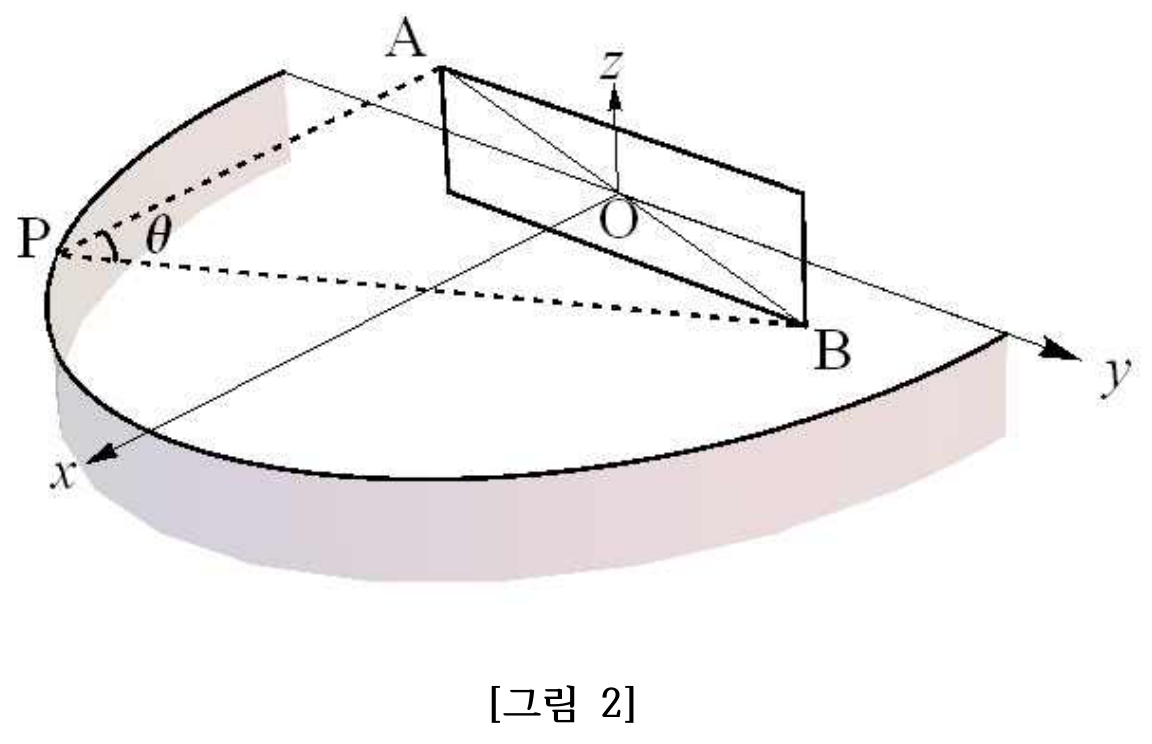
2-2(b). [그림2]는 극장을 좌표공간 위에 나타낸 것이다. 원형으로 배치된 좌석들 중에서 스크린의 대각선이 가장 크게 보이는 곳을 찾으려고 한다. [그림2]에서 두 점 A(0,−2,1)\displaystyle \mathrm A(0,-2,1), B(0,2,−1)\displaystyle \mathrm B(0,2,-1)을 잇는 선분을 스크린의 대각선이라 하고 원형의 좌석을 나타내는 xy\displaystyle xy평면에 놓인 원의 방정식을 x2+y2=16\displaystyle x^2+y^2=16이라 하자. 관객의 눈의 위치가 이 원 위의 점 P(x,y,0) (x>0)\displaystyle \mathrm P(x,y,0)\ (x>0)이고 ∠APB=θ\displaystyle \angle\mathrm{APB}=\theta일 때, θ\displaystyle \theta가 최대가 되는 점 P\displaystyle \mathrm P의 좌표를 구하시오.

그림2: 원형 좌석과 스크린 대각선 AB
해설강의 준비중

■ 2-2(a)제시문 <나>에서 tan⁡α=3−x2x\displaystyle \tan\alpha=\frac{3-\frac x2}x, tan⁡β=1−x2x\displaystyle \tan\beta=\frac{1-\frac x2}x이고, 따라서tan⁡θ=tan⁡(α−β)=tan⁡α−tan⁡β1+tan⁡αtan⁡β=3−x2x−1−x2x1+(3−x2)(1−x2)x2=8x5x2−8x+12\displaystyle \tan\theta=\tan(\alpha-\beta)=\frac{\tan\alpha-\tan\beta}{1+\tan\alpha\tan\beta}=\frac{\frac{3-\frac x2}x-\frac{1-\frac x2}x}{1+\frac{(3-\frac x2)(1-\frac x2)}{x^2}}=\frac{8x}{5x^2-8x+12}이다. 여기서 tan⁡θ\displaystyle \tan\theta는 θ∈[0,π/2)\displaystyle \theta\in[0,\pi/2)에서 증가하므로 함수 f(x)=8x5x2−8x+12\displaystyle f(x)=\frac{8x}{5x^2-8x+12}가 최댓값을 갖는 x\displaystyle x를 구하면 이 x\displaystyle x가 점 O\displaystyle \mathrm O에서 각 ∠APB\displaystyle \angle\mathrm{APB}가 최대가 되는 양의 x\displaystyle x축 위의 점 P\displaystyle \mathrm P의 x\displaystyle x좌표이다. 한편,f′(x)=−8(5x2−12)(5x2−8x+12)2=0\displaystyle f^{\prime}(x)=\frac{-8(5x^2-12)}{(5x^2-8x+12)^2}=0이면 x2=125\displaystyle x^2=\frac{12}5이므로 x\displaystyle x는 125\displaystyle \sqrt{\frac{12}5}이다. 즉, 점 P\displaystyle \mathrm P의 좌표는 (125,12125)\displaystyle \left(\sqrt{\frac{12}5},\frac12\sqrt{\frac{12}5}\right)이다.Correction. 기본 풀이의 “점 O\displaystyle \mathrm O에서”와 “양의 x\displaystyle x축 위”는 각각 “점 P\displaystyle \mathrm P에서”와 “직선 y=x2 (x>0)\displaystyle y=\frac{x}{2}~(x>0) 위”의 오기이다. 그러나 원칙에 따라 원문 표기를 그대로 실었다.

Caution. 길이나 각의 크기를 합과 차로 나타낼 때는 점들의 위치 관계를 확인해야 한다: 대학 예시답안은 θ=α−β\displaystyle \theta=\alpha-\beta로 놓았으나, 점 H\displaystyle H가 A\displaystyle A와 B\displaystyle B 사이에 있으면 θ=α+β\displaystyle \theta=\alpha+\beta이고, H\displaystyle H가 B\displaystyle B보다 위에 있으면 θ=β−α\displaystyle \theta=\beta-\alpha이다. 각 위치에서 AH\displaystyle AH와 BH\displaystyle BH를 올바른 길이로 나타내어 탄젠트의 합·차 공식을 적용하면 모두 tan⁡θ=8x5x2−8x+12\displaystyle \tan\theta=\frac{8x}{5x^2-8x+12}를 얻는다. 따라서 중간 설명은 보완해야 하지만 최종 식과 답은 맞다. 원칙에 따라 원문 표기를 그대로 실었다.

이제 A(0,1)\displaystyle \mathrm A(0,1), B(0,3)\displaystyle \mathrm B(0,3), P(125,12125)\displaystyle \mathrm P\left(\sqrt{\frac{12}5},\frac12\sqrt{\frac{12}5}\right)를 지나는 원의 방정식을x2+y2+ax+by+c=0\displaystyle x^2+y^2+ax+by+c=0이라 하자. 이 원은 A(0,1)\displaystyle \mathrm A(0,1), B(0,3)\displaystyle \mathrm B(0,3)을 지나므로1+b+c=0,9+3b+c=0 ⇒ b=−4,c=3\displaystyle 1+b+c=0,\quad9+3b+c=0\ \Rightarrow\ b=-4,c=3이고 원의 방정식은 x2+y2+ax−4y+3=0\displaystyle x^2+y^2+ax-4y+3=0이 된다. 또한 점 P(125,12125)\displaystyle \mathrm P\left(\sqrt{\frac{12}5},\frac12\sqrt{\frac{12}5}\right)를 지나므로125+1220+125a−2125+3=0 ⇒ 125a−2125+6=0 ⇒ a=2−15\displaystyle \begin{aligned}\frac{12}5+\frac{12}{20}+\sqrt{\frac{12}5}a-2\sqrt{\frac{12}5}+3=0&\ \Rightarrow\ \sqrt{\frac{12}5}a-2\sqrt{\frac{12}5}+6=0\\&\ \Rightarrow\ a=2-\sqrt{15}\end{aligned}이고, 구하는 원의 방정식은x2+y2+(2−15)x−4y+3=0\displaystyle x^2+y^2+(2-\sqrt{15})x-4y+3=0이다. 이제 y=x2\displaystyle y=\frac x2를 대입하면54x2−15x+3=0\displaystyle \frac54x^2-\sqrt{15}x+3=0이고 이 방정식의 판별식은 D=15−4⋅54⋅3=0\displaystyle D=15-4\cdot\frac54\cdot3=0이므로 세 점 A\displaystyle \mathrm A, B\displaystyle \mathrm B, P\displaystyle \mathrm P를 지나는 원은 직선 y=x2\displaystyle y=\frac x2에 접한다.

<다른 풀이>위의 풀이로부터 함수 f(x)=8x5x2−8x+12\displaystyle f(x)=\frac{8x}{5x^2-8x+12}가 최댓값을 갖는 x\displaystyle x를 구하면 이 x\displaystyle x가 점 O\displaystyle \mathrm O에서 각 ∠APB\displaystyle \angle\mathrm{APB}가 최대가 되는 양의 x\displaystyle x축 위의 점 P\displaystyle \mathrm P의 x\displaystyle x좌표임을 알 수 있다. 한편,f(x)=8x5x2−8x+12=85x−8+12x\displaystyle f(x)=\frac{8x}{5x^2-8x+12}=\frac8{5x-8+\frac{12}x}에서 x>0\displaystyle x>0임을 이용하여 산술평균과 기하평균의 관계를 이용하면 5x+12x≥415\displaystyle 5x+\frac{12}x\ge4\sqrt{15}이므로f(x)≤8415−8\displaystyle f(x)\le\frac8{4\sqrt{15}-8}임을 알 수 있다. 이 때, 등호는 5x=12x\displaystyle 5x=\frac{12}x, 즉 x=125\displaystyle x=\sqrt{\frac{12}5}일 때 성립한다. 따라서 점 P\displaystyle \mathrm P의 좌표는 (125,12125)\displaystyle \left(\sqrt{\frac{12}5},\frac12\sqrt{\frac{12}5}\right)이다.Correction. <다른 풀이>의 “점 O\displaystyle \mathrm O에서”와 “양의 x\displaystyle x축 위”는 각각 “점 P\displaystyle \mathrm P에서”와 “직선 y=x2 (x>0)\displaystyle y=\frac{x}{2}~(x>0) 위”의 오기이다. 그러나 원칙에 따라 원문 표기를 그대로 실었다.

세 점 A\displaystyle \mathrm A, B\displaystyle \mathrm B, P\displaystyle \mathrm P를 지나는 원 x2+y2+(2−15)x−4y+3=0\displaystyle x^2+y^2+(2-\sqrt{15})x-4y+3=0과 직선 y=x2\displaystyle y=\frac x2이 서로 접함도 다른 방법들을 이용하여 증명할 수 있다. 원의 방정식으로부터 원의 중심이 (−1+152,2)\displaystyle \left(-1+\frac{\sqrt{15}}2,2\right)이고 반지름이 234−15\displaystyle \sqrt{\frac{23}4-\sqrt{15}}임을 알 수 있다. 이제 다음 둘 중 하나를 보이면 증명이 끝난다.(1) 원의 중심 (−1+152,2)\displaystyle \left(-1+\frac{\sqrt{15}}2,2\right)에서 직선 y=x2\displaystyle y=\frac x2까지의 거리가 반지름 234−15\displaystyle \sqrt{\frac{23}4-\sqrt{15}}와 같다.(2) 원의 중심과 점 P\displaystyle \mathrm P를 잇는 직선의 기울기가 −2\displaystyle -2이므로 이 직선은 y=x2\displaystyle y=\frac x2와 점 P\displaystyle \mathrm P에서 서로 수직으로 만난다.

■ 2-2(b)두 벡터 PA→=(−x,−2−y,1)\displaystyle \overrightarrow{\mathrm{PA}}=(-x,-2-y,1), PB→=(−x,2−y,−1)\displaystyle \overrightarrow{\mathrm{PB}}=(-x,2-y,-1)이 이루는 각의 크기가 θ\displaystyle \theta이므로cos⁡θ=PA→⋅PB→∣PA→∣∣PB→∣=x2−(4−y2)−1x2+(2+y)2+1x2+(2−y)2+1\displaystyle \cos\theta=\frac{\overrightarrow{\mathrm{PA}}\cdot\overrightarrow{\mathrm{PB}}}{|\overrightarrow{\mathrm{PA}}||\overrightarrow{\mathrm{PB}}|}=\frac{x^2-(4-y^2)-1}{\sqrt{x^2+(2+y)^2+1}\sqrt{x^2+(2-y)^2+1}}이다. 이제 x2=16−y2\displaystyle x^2=16-y^2이므로cos⁡θ=1121+4y21−4y\displaystyle \cos\theta=\frac{11}{\sqrt{21+4y}\sqrt{21-4y}}이다. 함수 y=cos⁡θ\displaystyle y=\cos\theta는 구간 (0,π2)\displaystyle \left(0,\frac\pi2\right)에서 감소하므로 f(y)=−16y2+441\displaystyle f(y)=-16y^2+441이 최댓값을 갖는 y\displaystyle y에서 각 θ\displaystyle \theta가 최대가 된다. 따라서 y=0\displaystyle y=0일 때, 각 θ\displaystyle \theta가 최대가 되며 x2=16−y2\displaystyle x^2=16-y^2이고 x>0\displaystyle x>0이므로 x=4\displaystyle x=4이다. 즉 구하는 점 P\displaystyle \mathrm P의 좌표는 (4,0,0)\displaystyle (4,0,0)이다.

<참고>고등학교 교육과정을 벗어나지만 코사인 제2법칙을 이용하여 cos⁡θ\displaystyle \cos\theta를 구할 수도 있다.∣PA‾∣=x2+(2+y)2+1,∣PB‾∣=x2+(2−y)2+1,∣AB‾∣=20\displaystyle |\overline{\mathrm{PA}}|=\sqrt{x^2+(2+y)^2+1},\quad |\overline{\mathrm{PB}}|=\sqrt{x^2+(2-y)^2+1},\quad |\overline{\mathrm{AB}}|=\sqrt{20}이므로cos⁡θ=∣PA‾∣2+∣PB‾∣2−∣AB‾∣22∣PA‾∣∣PB‾∣=2x2+2y2−102(x2+y2+5)2−16y2\displaystyle \cos\theta=\frac{|\overline{\mathrm{PA}}|^2+|\overline{\mathrm{PB}}|^2-|\overline{\mathrm{AB}}|^2}{2|\overline{\mathrm{PA}}||\overline{\mathrm{PB}}|}=\frac{2x^2+2y^2-10}{2\sqrt{(x^2+y^2+5)^2-16y^2}}이다. 이제 x2+y2=16\displaystyle x^2+y^2=16임을 이용하면cos⁡θ=11212−16y2\displaystyle \cos\theta=\frac{11}{\sqrt{21^2-16y^2}}을 얻는다.

[계열문항] 채점기준 — 답안 구성요소

확률은 사건이 일어나는 정도에 대하여 공부하는 수학의 한 분야이다. 확률은 일기예보, 보험 등 광범위한 분야에서 널리 활용된다. 함수, 미분, 도형 등은 수학을 비롯한 자연과학, 사회과학 등 제반 학문에 기본으로 사용되는 필수 불가결한 도구이다. 본 문항들은 수학I, 수학II, 미적분I, 미적분II, 확률과 통계, 기하와 벡터 등 고등학교에서 배우는 대부분의 수학 교과들로부터의 이해를 바탕으로 한다. 따라서 본 문항들을 통해 학생들이 제시문들을 읽고 확률, 극대극소, 원과 직선과의 관계, 좌표공간에 대한 풀이과정을 논리적으로 전개할 수 있는지를 평가한다.

첨삭 사례

아직 등록된 첨삭 사례가 없습니다.

질문과 답변 · 0개질문과 답변 · 고정 0개

아직 등록된 질문이 없습니다. 질문 작성은 멤버십 회원만 가능합니다.