[문제 4-1]
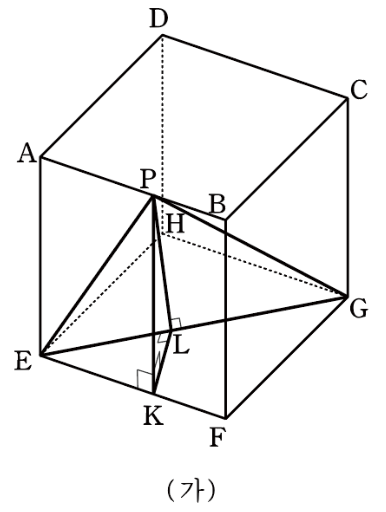
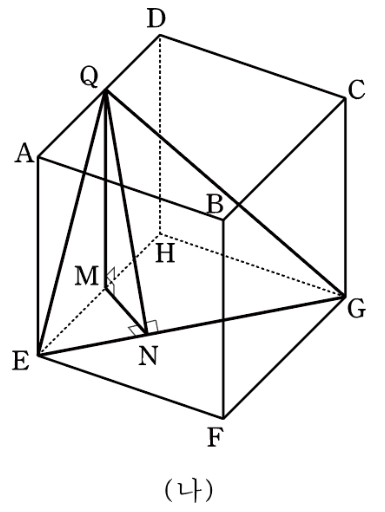
그림 (가), (나)와 같이 점 P, Q에서 선분 EF, EH에 내린 수선의 발을 각각 K, M이라고 하고 점 K, M에서 선분 EG에 내린 수선의 발을 각각 L, N이라고 하자. 삼수선의 정리에 의하여 P L ‾ ⊥ E G ‾ \displaystyle \overline{\mathrm{PL}}\perp\overline{\mathrm{EG}} PL ⊥ EG Q N ‾ ⊥ E G ‾ \displaystyle \overline{\mathrm{QN}}\perp\overline{\mathrm{EG}} QN ⊥ EG
직각이등변삼각형 EFG에서 E G ‾ = 2 2 \displaystyle \overline{\mathrm{EG}}=2\sqrt2 EG = 2 2 10 = △ P E G = E G ‾ × P L ‾ 2 \displaystyle \sqrt{10}=\triangle\mathrm{PEG}=\frac{\overline{\mathrm{EG}}\times\overline{\mathrm{PL}}}2 10 = △ PEG = 2 EG × PL P L ‾ = 5 \displaystyle \overline{\mathrm{PL}}=\sqrt5 PL = 5 3 = △ Q E G = E G ‾ × Q N ‾ 2 \displaystyle 3=\triangle\mathrm{QEG}=\frac{\overline{\mathrm{EG}}\times\overline{\mathrm{QN}}}2 3 = △ QEG = 2 EG × QN Q N ‾ = 3 2 \displaystyle \overline{\mathrm{QN}}=\frac3{\sqrt2} QN = 2 3
직각삼각형 PKL, QMN에서 K L ‾ = P L ‾ 2 − P K ‾ 2 = 1 \displaystyle \overline{\mathrm{KL}}=\sqrt{\overline{\mathrm{PL}}^2-\overline{\mathrm{PK}}^2}=1 KL = PL 2 − PK 2 = 1 M N ‾ = Q N ‾ 2 − Q M ‾ 2 = 1 2 \displaystyle \overline{\mathrm{MN}}=\sqrt{\overline{\mathrm{QN}}^2-\overline{\mathrm{QM}}^2}=\frac1{\sqrt2} MN = QN 2 − QM 2 = 2 1
+5점 · A P ‾ = 2 \displaystyle \overline{\mathrm{AP}}=\sqrt2 AP = 2 직각이등변삼각형 KLE, ENM에서 A P ‾ = E K ‾ = E L ‾ 2 + K L ‾ 2 = K L ‾ 2 + K L ‾ 2 = 2 \displaystyle \overline{\mathrm{AP}}=\overline{\mathrm{EK}}=\sqrt{\overline{\mathrm{EL}}^2+\overline{\mathrm{KL}}^2}=\sqrt{\overline{\mathrm{KL}}^2+\overline{\mathrm{KL}}^2}=\sqrt2 AP = EK = EL 2 + KL 2 = KL 2 + KL 2 = 2
+5점 · A Q ‾ = 1 \displaystyle \overline{\mathrm{AQ}}=1 AQ = 1 A Q ‾ = E M ‾ = E N ‾ 2 + M N ‾ 2 = M N ‾ 2 + M N ‾ 2 = 1 \displaystyle \overline{\mathrm{AQ}}=\overline{\mathrm{EM}}=\sqrt{\overline{\mathrm{EN}}^2+\overline{\mathrm{MN}}^2}=\sqrt{\overline{\mathrm{MN}}^2+\overline{\mathrm{MN}}^2}=1 AQ = EM = EN 2 + MN 2 = MN 2 + MN 2 = 1
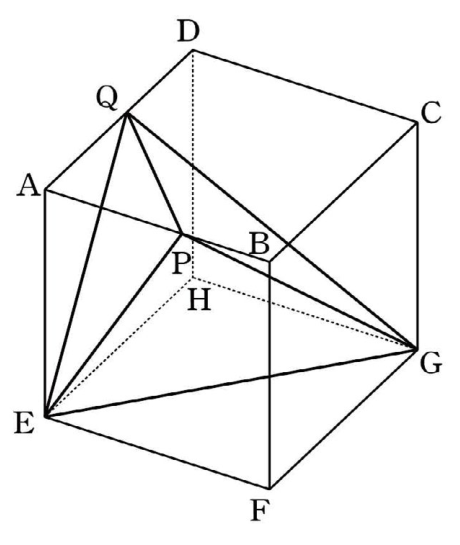
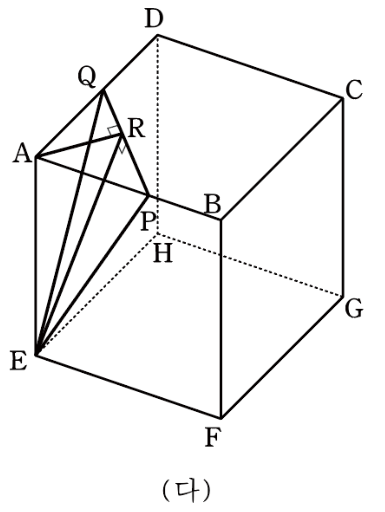
+5점 · △ E P Q = 14 2 \displaystyle \triangle\mathrm{EPQ}=\frac{\sqrt{14}}2 △ EPQ = 2 14 그림 (다)와 같이 점 A에서 선분 PQ에 내린 수선의 발을 R라 하면 P Q ‾ ⊥ E R ‾ \displaystyle \overline{\mathrm{PQ}}\perp\overline{\mathrm{ER}} PQ ⊥ ER P Q ‾ = A P ‾ 2 + A Q ‾ 2 = 3 \displaystyle \overline{\mathrm{PQ}}=\sqrt{\overline{\mathrm{AP}}^2+\overline{\mathrm{AQ}}^2}=\sqrt3 PQ = AP 2 + AQ 2 = 3 2 2 = A P ‾ × A Q ‾ 2 = △ A P Q = P Q ‾ × A R ‾ 2 \displaystyle \frac{\sqrt2}2=\frac{\overline{\mathrm{AP}}\times\overline{\mathrm{AQ}}}2=\triangle\mathrm{APQ}=\frac{\overline{\mathrm{PQ}}\times\overline{\mathrm{AR}}}2 2 2 = 2 AP × AQ = △ APQ = 2 PQ × AR A R ‾ = 2 3 \displaystyle \overline{\mathrm{AR}}=\frac{\sqrt2}{\sqrt3} AR = 3 2 E R ‾ = A R ‾ 2 + A E ‾ 2 = 14 3 \displaystyle \overline{\mathrm{ER}}=\sqrt{\overline{\mathrm{AR}}^2+\overline{\mathrm{AE}}^2}=\frac{\sqrt{14}}{\sqrt3} ER = AR 2 + AE 2 = 3 14 △ E P Q = 1 2 × P Q ‾ × E R ‾ = 14 2 \displaystyle \triangle\mathrm{EPQ}=\frac12\times\overline{\mathrm{PQ}}\times\overline{\mathrm{ER}}=\frac{\sqrt{14}}2 △ EPQ = 2 1 × PQ × ER = 2 14
※ 논리 전개 과정이 맞으면 답이 틀리더라도 부분 점수를 부여할 수 있습니다.
※ 채점자는 답안의 완성도에 따라 ±1점을 부여할 수 있습니다.
 수리논술, 배움에서 논증의 완성까지.