수리논술, 배움에서 논증의 완성까지.

자연계열 II 3-2번

문제

[문제 3] 다음을 읽고 문제에 답하시오.

● 좌표평면 위에서 한 곡선 위의 점 P의 좌표를 (x,y)\displaystyle (x,y)라고 할 때, x\displaystyle x와 y\displaystyle y를 각각 x=f(t)\displaystyle x=f(t), y=g(t)\displaystyle y=g(t)인 함수의 꼴로 나타낼 수 있다. 이때 t\displaystyle t를 x,y\displaystyle x,y의 매개변수라고 한다.

● 수직선 위를 움직이는 점 P의 시각 t\displaystyle t에서의 좌표를 x\displaystyle x라고 하면 x\displaystyle x는 시각 t\displaystyle t에 대한 함수이므로 x=f(t)\displaystyle x=f(t)로 놓을 수 있다. 함수 f(t)\displaystyle f(t)의 시각 t\displaystyle t에서의 순간 변화율

lim⁡Δt→0f(t+Δt)−f(t)Δt=lim⁡Δt→0ΔxΔt=dxdt\displaystyle \lim_{\Delta t\to0}\frac{f(t+\Delta t)-f(t)}{\Delta t}=\lim_{\Delta t\to0}\frac{\Delta x}{\Delta t}=\frac{dx}{dt}

를 점 P의 시각 t\displaystyle t에서의 순간 속도 또는 속도라고 한다.

● 삼각함수의 덧셈정리를 이용하여 asin⁡θ+bcos⁡θ  (a≠0,b≠0)\displaystyle a\sin\theta+b\cos\theta\;(a\ne0,b\ne0)를 rsin⁡(θ+α)\displaystyle r\sin(\theta+\alpha)의 꼴로 나타내는 것을 삼각함수의 합성이라고 한다. (단, r>0\displaystyle r>0, 0≤α<2π\displaystyle 0\le\alpha<2\pi)

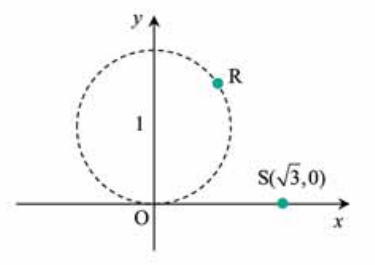
[문제 3-2] 다음 그림과 같이 점 R(x,y)\displaystyle (x,y)는 중심이 (0,1)\displaystyle (0,1)인 단위원 위에 있고, 점 S는 (3,0)\displaystyle (\sqrt3,0)에 있다. 원점을 O라 할 때 벡터 OR→+OS→\displaystyle \overrightarrow{\mathrm{OR}}+\overrightarrow{\mathrm{OS}}의 길이가 최대가 되는 R의 좌표를 구하시오. [15점]

중심 (0,1)인 단위원 위의 R과 x축 위 S(√3,0)
해설강의 준비중

문제 3-2

+3점 · [3-2] 점 R을 매개변수 θ\displaystyle \theta로 바르게 나타내면

● 매개변수 θ\displaystyle \theta를 이용하여 원 위의 점 R을 (cos⁡θ,sin⁡θ+1)\displaystyle (\cos\theta,\sin\theta+1)로 나타낼 수 있다. 원점 O에서 점 R로의 벡터는OR→=(cos⁡θ,sin⁡θ+1)\displaystyle \overrightarrow{\mathrm{OR}}=(\cos\theta,\sin\theta+1)이고, 원점 O에서 점 S(3,0)\displaystyle (\sqrt3,0)으로의 벡터는 OS→=(3,0)\displaystyle \overrightarrow{\mathrm{OS}}=(\sqrt3,0)이다.

+3점 · [3-2] 두 벡터의 합을 매개변수 θ\displaystyle \theta로 바르게 나타내면 +3점 · [3-2] 합벡터의 길이 또는 길이의 제곱을 θ\displaystyle \theta의 함수로 바르게 나타내면

● 두 벡터의 합이 OR→+OS→=(cos⁡θ+3,sin⁡θ+1)\displaystyle \overrightarrow{\mathrm{OR}}+\overrightarrow{\mathrm{OS}}=(\cos\theta+\sqrt3,\sin\theta+1)이라고 할 때, 이 벡터의 길이의 제곱은 다음과 같다.∣OR→+OS→∣2=(cos⁡θ+3)2+(sin⁡θ+1)2=23cos⁡θ+2sin⁡θ+5\displaystyle \begin{aligned}|\overrightarrow{\mathrm{OR}}+\overrightarrow{\mathrm{OS}}|^2&=(\cos\theta+\sqrt3)^2+(\sin\theta+1)^2\\&=2\sqrt3\cos\theta+2\sin\theta+5\end{aligned}

● 위 식을 삼각함수의 합성 방법을 이용하여 정리하면,∣OR→+OS→∣2=5+4(234cos⁡θ+24sin⁡θ)=5+4sin⁡(θ+π3)\displaystyle \begin{aligned}|\overrightarrow{\mathrm{OR}}+\overrightarrow{\mathrm{OS}}|^2&=5+4\left(\frac{2\sqrt3}4\cos\theta+\frac24\sin\theta\right)\\&=5+4\sin\left(\theta+\frac\pi3\right)\end{aligned}

+3점 · [3-2] 합벡터가 최대가 되는 θ\displaystyle \theta의 조건을 바르게 제시하면

● 이 벡터의 길이가 최대가 되려면,sin⁡(θ+π3)=1,즉 θ+π3=π2\displaystyle \sin\left(\theta+\frac\pi3\right)=1,\quad\text{즉 }\theta+\frac\pi3=\frac\pi2이다.

+3점 · [3-2] 합벡터가 최대가 되는 R의 값을 바르게 구하면

● 따라서 θ=π/6\displaystyle \theta=\pi/6이고, R은 (cos⁡π/6,1+sin⁡π/6)=(3/2,3/2)\displaystyle (\cos\pi/6,1+\sin\pi/6)=(\sqrt3/2,3/2)이다.

※ 계산 실수로 틀렸어도 논리 전개 과정이 맞으면 해당 부분에 1~2점의 부분 점수를 부여함

첨삭 사례

아직 등록된 첨삭 사례가 없습니다.

질문과 답변 · 0개질문과 답변 · 고정 0개

아직 등록된 질문이 없습니다. 질문 작성은 멤버십 회원만 가능합니다.