수리논술, 이게 다다.

의학계 1-(1)~(2)번

오류 제보

문제

[가] 좌표평면 위의 두 점 A(x1,y1)\displaystyle \mathrm{A} \left( x_{1} , y_{1} \right), B(x2,y2)\displaystyle \mathrm{B} \left( x_{2} , y_{2} \right)사이의 거리는 AB‾=(x2−x1)2+(y2−y1)2\displaystyle \overline{\mathrm{AB}} = \sqrt{( x_{2} - x_{1} )^{2} + ( y_{2} - y_{1} )^{2}}이다.

[나] 좌표평면 위의 점 P(x1,y1)\displaystyle \mathrm{P} \left( x_{1} , y_{1} \right)과 직선 ax+by+c=0\displaystyle a x + b y + c = 0 사이의 거리는 ∣ax1+by1+c∣a2+b2\displaystyle \frac{{| a x_{1} + b y_{1} + c |}}{\sqrt{a^{2} + b^{2}}}이다.

[다] 함수 y=f(x)\displaystyle y=f(x)에서 x\displaystyle x의 값이 a\displaystyle a에서 a+Δx\displaystyle a+\Delta x까지 변할 때의 평균변화율 ΔyΔx=f(a+Δx)−f(x)Δx\displaystyle \frac{\Delta y}{\Delta x}=\frac{f(a+\Delta x)-f(x)}{\Delta x}는 함수 y=f(x)\displaystyle y=f(x)의 그래프 위의 두 점 P(a,f(a)), Q(a+Δx,f(a+Δx))\displaystyle P(a,f(a)),\ Q(a+\Delta x,f(a+\Delta x))를 지나는 직선 PQ의 기울기와 같다.Correction. 평균변화율의 분자에서 f(x)\displaystyle f(x)는 f(a)\displaystyle f(a)이어야 한다. 그러나 원칙에 따라 원문 표기를 그대로 실었다.이때 Δx→0\displaystyle \Delta x\to0이면 점 Q는 곡선 y=f(x)\displaystyle y=f(x)를 따라 점 P에 한없이 가까워지고, 직선 PQ는 점 P를 지나는 일정한 직선에 한없이 가까워진다. 이 직선을 곡선 y=f(x)\displaystyle y=f(x)의 점 P에서의 접선이라고 하고, 점 P를 이 접선의 접점이라고 한다.

[라] 미분가능한 함수 y=f(x)\displaystyle y = f ( x )에서 f′(a)=0\displaystyle f^{\prime} ( a ) = 0이고, x=a\displaystyle x = a의 좌우에서 f′(x)\displaystyle f^{\prime} ( x )의 부호가 양에서 음으로 바뀌면 f(x)\displaystyle f ( x )는 x=a\displaystyle x = a에서 극대이고, 극댓값 f(a)\displaystyle f ( a )를 가진다. f′(x)\displaystyle f^{\prime} ( x )의 부호가 음에서 양으로 바뀌면 f(x)\displaystyle f ( x )는 x=a\displaystyle x = a에서 극소이고, 극솟값 f(a)\displaystyle f ( a )를 가진다.

[마] 함수 f(x)\displaystyle f ( x )가 구간 [a,b]\displaystyle [ a , b ]에서 연속일 때, 곡선 y=f(x)\displaystyle y = f ( x )와 x\displaystyle x축 및 두 직선 x=a\displaystyle x = a, x=b\displaystyle x = b로 둘러싸인 부분의 넓이 S\displaystyle S는 S=∫ab∣f(x)∣dx\displaystyle S = \int_{a}^{b} | f ( x ) | d x이다.

[바] 좌표평면 위에서 x\displaystyle x축의 양의 부분을 시초선으로 하고, 일반각의 크기 θ\displaystyle \theta가 나타내는 동경과 원점 O\displaystyle \mathrm{O}를 중심으로 하고 반지름이 r\displaystyle r인 원이 만나는 점 P\displaystyle \mathrm{P}의 좌표를 (x,y)\displaystyle \left( x , y \right)라고 하면 yr\displaystyle \frac{y}{r}, xr\displaystyle \frac{x}{r}, yx\displaystyle \frac{y}{x} (x≠0)\displaystyle \left( x \ne 0 \right)의 값은 반지름의 길이 r\displaystyle r에 관계없이 θ\displaystyle \theta에 따라 각각 하나씩 결정된다. 즉,

θ→yr\displaystyle \theta \to \frac{y}{r}, θ→xr\displaystyle \theta \to \frac{x}{r}, θ→yx\displaystyle \theta \to \frac{y}{x} (x≠0)\displaystyle \left( x \ne 0 \right)

의 대응 관계는 각각 θ\displaystyle \theta에 대한 함수이다. 이 함수를 각각 θ\displaystyle \theta에 대한 사인함수, 코사인함수, 탄젠트함수라고 하며, 다음과 같이 나타낸다.

sin⁡θ=yr\displaystyle \sin \theta = \frac{y}{r}, cos⁡θ=xr\displaystyle \cos \theta = \frac{x}{r}, tan⁡θ=yx\displaystyle \tan \theta = \frac{y}{x} (x≠0)\displaystyle \left( x \ne 0 \right)

한편 sin⁡θ\displaystyle \sin \theta, cos⁡θ\displaystyle \cos \theta, tan⁡θ\displaystyle \tan \theta의 역수로 정의한 함수를 차례로 코시컨트함수, 시컨트함수, 코탄젠트함수라고 하며, 다음과 같이 나타낸다.

csc⁡θ=ry\displaystyle \csc \theta = \frac{r}{y} (y≠0)\displaystyle \left( y \ne 0 \right), sec⁡θ=rx\displaystyle \sec \theta = \frac{r}{x} (x≠0)\displaystyle \left( x \ne 0 \right), cot⁡θ=xy\displaystyle \cot \theta = \frac{x}{y} (y≠0)\displaystyle \left( y \ne 0 \right)

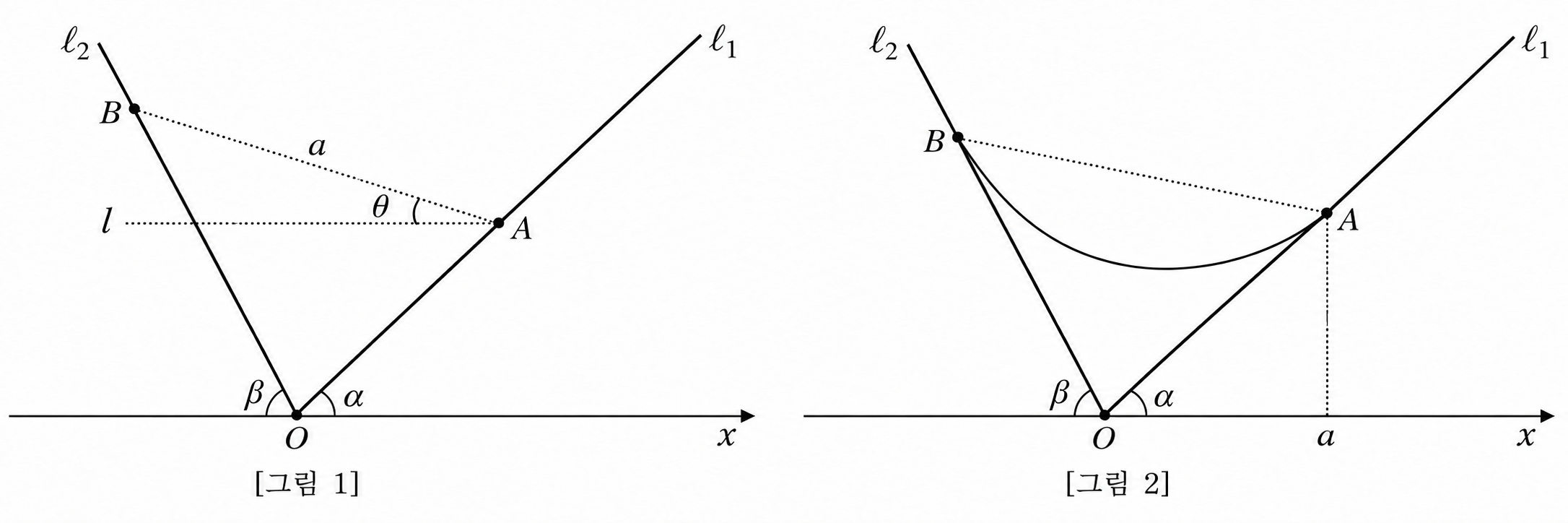
그림 1: 두 반직선 사이의 선분, 그림 2: 두 반직선에 접하는 포물선

[논제 Ⅰ-1][그림 1]에서 원점 O를 지나는 두 반직선 ℓ1\displaystyle \ell_1과 ℓ2\displaystyle \ell_2가 x\displaystyle x축과 이루는 각이 각각 α\displaystyle \alpha와 β\displaystyle \beta이다 (단, α\displaystyle \alpha는 양의 x\displaystyle x축으로 부터의 각이고, β\displaystyle \beta는 음의 x\displaystyle x축으로 부터의 각이다. 또한 0<α<π2, 0<β<π2\displaystyle 0<\alpha<\frac\pi2,\ 0<\beta<\frac\pi2인 상수이다). 점 A는 ℓ1\displaystyle \ell_1 위에, 점 B는 ℓ2\displaystyle \ell_2 위에 놓여 있고 선분 AB의 길이는 4이다. 점 A를 지나면서 x\displaystyle x축과 평행한 반직선 ℓ\displaystyle \ell과 선분 AB가 이루는 각을 θ\displaystyle \theta라 하자 (단, 선분 AB가 ℓ\displaystyle \ell의 위쪽에 있으면 양의 값을 아래쪽에 있으면 음의 값을 갖는다). 이때, θ\displaystyle \theta의 범위를 구하고, 선분 AB의 중점 H로부터 x\displaystyle x축까지의 거리 f(θ)\displaystyle f(\theta)를 θ\displaystyle \theta에 관한 함수로 나타내시오. 그리고 그 근거를 논술하시오. (15점)

[논제 Ⅰ-2][논제 Ⅰ-1]에서 α=π4, β=π3\displaystyle \alpha=\frac\pi4,\ \beta=\frac\pi3라 하자. f(θ)\displaystyle f(\theta)가 최대가 될 때의 두 점 A와 B를 지나는 직선의 기울기를 구하고, 그 근거를 논술하시오. (10점)

해설강의 준비중
+5점 · θ\displaystyle \theta의 범위 −α≤θ≤β\displaystyle -\alpha\le\theta\le\beta.

[논제 Ⅰ-1]θ\displaystyle \theta는 점 B가 점 O에 있을 때, θ=−α\displaystyle \theta=-\alpha로 가장 작으며, 점 A가 점 O에 있을 때, θ=β\displaystyle \theta=\beta로 가장 크다. 따라서 θ\displaystyle \theta의 범위는 −α≤θ≤β\displaystyle -\alpha\le\theta\le\beta이다.

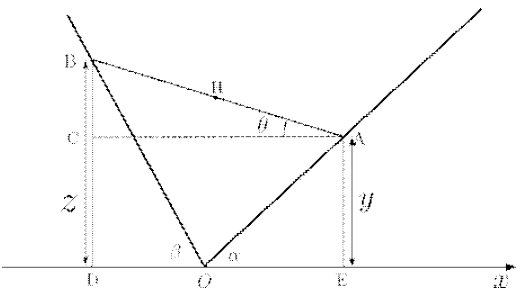
두 반직선 위의 점 A, B와 수선의 발 D, E
+5점 · y\displaystyle y와 z\displaystyle z를 θ\displaystyle \theta에 관한 함수 y=4cos⁡(θ)−4cot⁡(β)sin⁡(θ)cot⁡(α)+cot⁡(β)\displaystyle y=\frac{4\cos(\theta)-4\cot(\beta)\sin(\theta)}{\cot(\alpha)+\cot(\beta)}과 z=y+4sin⁡(θ)\displaystyle z=y+4\sin(\theta)으로 표현한다.

오른쪽 그림처럼 A와 B에서 x\displaystyle x축에 내린 수선의 발을 각각 E와 D라 하고, y=AE‾\displaystyle y=\overline{AE}와 z=BD‾\displaystyle z=\overline{BD}라 하자. 그러면 OE‾=ycot⁡(α)\displaystyle \overline{OE}=y\cot(\alpha)이고 OD‾=zcot⁡(β)\displaystyle \overline{OD}=z\cot(\beta)이기 때문에, AC‾=4cos⁡(θ)=OE‾+OD‾=ycot⁡(α)+zcot⁡(β)\displaystyle \overline{AC}=4\cos(\theta)=\overline{OE}+\overline{OD}=y\cot(\alpha)+z\cot(\beta)이 된다. 이 식과 z=y+4sin⁡(θ)\displaystyle z=y+4\sin(\theta)로부터 y=4cos⁡(θ)−4cot⁡(β)sin⁡(θ)cot⁡(α)+cot⁡(β)\displaystyle y=\frac{4\cos(\theta)-4\cot(\beta)\sin(\theta)}{\cot(\alpha)+\cot(\beta)}를 얻을 수 있다.

+5점 · f(θ)=4cos⁡(θ)+2cot⁡(α)−cot⁡(β)cot⁡(α)+cot⁡(β)sin⁡(θ)\displaystyle f(\theta)=4\cos(\theta)+2\frac{\cot(\alpha)-\cot(\beta)}{\cot(\alpha)+\cot(\beta)}\sin(\theta)

따라서 점 H로부터 x\displaystyle x축과의 최단거리는f(θ)=y+z2=4cos⁡(θ)+2cot⁡(α)−cot⁡(β)cot⁡(α)+cot⁡(β)sin⁡(θ)\displaystyle f(\theta)=\frac{y+z}2=4\cos(\theta)+2\frac{\cot(\alpha)-\cot(\beta)}{\cot(\alpha)+\cot(\beta)}\sin(\theta)Correction. f(θ)\displaystyle f(\theta)의 첫 항 4cos⁡θ\displaystyle 4\cos\theta에는 분모 cot⁡α+cot⁡β\displaystyle \cot\alpha+\cot\beta가 빠졌다. 채점기준에도 같은 오류가 있다. 그러나 원칙에 따라 원문 표기를 그대로 실었다.이 된다.

+2점 · f(θ)\displaystyle f(\theta)의 도함수 f′(θ)=−43sin⁡(θ)+2(3−1)cos⁡(θ)3+1\displaystyle f^{\prime}(\theta)=\frac{-4\sqrt3\sin(\theta)+2(\sqrt3-1)\cos(\theta)}{\sqrt3+1}를 구한다.

[논제 Ⅰ-2]α=π4\displaystyle \alpha=\frac\pi4이고 β=π3\displaystyle \beta=\frac\pi3이면, f(θ)=43cos⁡(θ)+2(3−1)sin⁡(θ)3+1\displaystyle f(\theta)=\frac{4\sqrt3\cos(\theta)+2(\sqrt3-1)\sin(\theta)}{\sqrt3+1}f(θ)\displaystyle f(\theta)가 최대가 되는 θ\displaystyle \theta를 찾기 위해 f′(θ)=0\displaystyle f^{\prime}(\theta)=0의 해를 찾아야 한다. 따라서, 방정식f′(θ)=−43sin⁡(θ)+2(3−1)cos⁡(θ)3+1=cos⁡(θ)3+1(−43tan⁡(θ)+2(3−1))=0\displaystyle f^{\prime}(\theta)=\frac{-4\sqrt3\sin(\theta)+2(\sqrt3-1)\cos(\theta)}{\sqrt3+1}=\frac{\cos(\theta)}{\sqrt3+1}(-4\sqrt3\tan(\theta)+2(\sqrt3-1))=0

+3점 · tan⁡(θ)\displaystyle \tan(\theta)가 증가함수임을 이용하여 함수 f(θ)\displaystyle f(\theta)가 극값을 갖는 θ0\displaystyle \theta_0가 θ\displaystyle \theta의 범위인 −π4≤θ≤π3\displaystyle -\frac\pi4\le\theta\le\frac\pi3에 있음을 보인다.

로부터 tan⁡(θ)=3−123\displaystyle \tan(\theta)=\frac{\sqrt3-1}{2\sqrt3}을 만족하는 θ\displaystyle \theta에서 극값을 갖는다는 것을 알 수 있다. tan⁡(θ)\displaystyle \tan(\theta)는 증가함수이고 −1=−tan⁡(α)<3−123<tan⁡(β)=3\displaystyle -1=-\tan(\alpha)<\frac{\sqrt3-1}{2\sqrt3}<\tan(\beta)=\sqrt3이어서 f′(θ)=0\displaystyle f^{\prime}(\theta)=0의 해 θ0\displaystyle \theta_0는 θ\displaystyle \theta의 범위인 −π4≤θ≤π3\displaystyle -\frac\pi4\le\theta\le\frac\pi3에 있게 된다.

+3점 · tan⁡(θ0)=3−123\displaystyle \tan(\theta_0)=\frac{\sqrt3-1}{2\sqrt3}임을 보인다.

또한 f′(θ)\displaystyle f^{\prime}(\theta)는 θ=θ0\displaystyle \theta=\theta_0의 좌우에서 부호가 양에서 음으로 바뀌게 되어 f(θ)\displaystyle f(\theta)는 θ=θ0\displaystyle \theta=\theta_0에서 최댓값을 갖는다는 것을 알 수 있다. 그러므로 f(θ)\displaystyle f(\theta)가 최대가 되는 θ=θ0\displaystyle \theta=\theta_0에서의 tan⁡(θ0)=3−123\displaystyle \tan(\theta_0)=\frac{\sqrt3-1}{2\sqrt3}이 된다.

+2점 · 기울기가 −tan⁡(θ0)=1−323\displaystyle -\tan(\theta_0)=\frac{1-\sqrt3}{2\sqrt3}임을 보인다.

따라서 선분 AB의 기울기는 tan⁡(π−θ0)=−tan⁡(θ0)=1−323\displaystyle \tan(\pi-\theta_0)=-\tan(\theta_0)=\frac{1-\sqrt3}{2\sqrt3}이다.

첨삭 사례

아직 등록된 첨삭 사례가 없습니다.

질문과 답변 · 0개질문과 답변 · 고정 0개

아직 등록된 질문이 없습니다. 질문 작성은 멤버십 회원만 가능합니다.