수리논술, 배움에서 논증의 완성까지.

의학계 1번

문제

🔒
짧은 시간에 너무 많은 문제를 여셔서 열람을 잠시 제한했습니다. 잠시 후 다시 시도하시거나 로그인해 주세요.
해설강의 준비중
+5점 · θ\displaystyle \theta의 범위 αθβ\displaystyle -\alpha\le\theta\le\beta.

[논제 Ⅰ-1]θ\displaystyle \theta는 점 B가 점 O에 있을 때, θ=α\displaystyle \theta=-\alpha로 가장 작으며, 점 A가 점 O에 있을 때, θ=β\displaystyle \theta=\beta로 가장 크다. 따라서 θ\displaystyle \theta의 범위는 αθβ\displaystyle -\alpha\le\theta\le\beta이다.

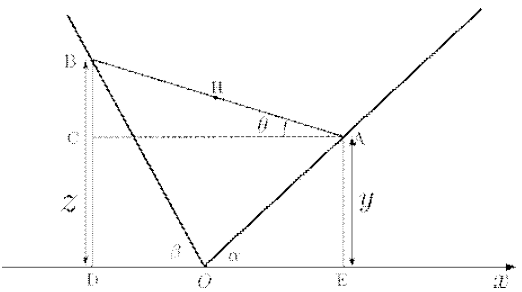
두 반직선 위의 점 A, B와 수선의 발 D, E
+5점 · y\displaystyle yz\displaystyle zθ\displaystyle \theta에 관한 함수 y=4cos(θ)4cot(β)sin(θ)cot(α)+cot(β)\displaystyle y=\frac{4\cos(\theta)-4\cot(\beta)\sin(\theta)}{\cot(\alpha)+\cot(\beta)}z=y+4sin(θ)\displaystyle z=y+4\sin(\theta)으로 표현한다.

오른쪽 그림처럼 A와 B에서 x\displaystyle x축에 내린 수선의 발을 각각 E와 D라 하고, y=AE\displaystyle y=\overline{AE}z=BD\displaystyle z=\overline{BD}라 하자. 그러면 OE=ycot(α)\displaystyle \overline{OE}=y\cot(\alpha)이고 OD=zcot(β)\displaystyle \overline{OD}=z\cot(\beta)이기 때문에, AC=4cos(θ)=OE+OD=ycot(α)+zcot(β)\displaystyle \overline{AC}=4\cos(\theta)=\overline{OE}+\overline{OD}=y\cot(\alpha)+z\cot(\beta)이 된다. 이 식과 z=y+4sin(θ)\displaystyle z=y+4\sin(\theta)로부터 y=4cos(θ)4cot(β)sin(θ)cot(α)+cot(β)\displaystyle y=\frac{4\cos(\theta)-4\cot(\beta)\sin(\theta)}{\cot(\alpha)+\cot(\beta)}를 얻을 수 있다.

+5점 · f(θ)=4cos(θ)+2cot(α)cot(β)cot(α)+cot(β)sin(θ)\displaystyle f(\theta)=4\cos(\theta)+2\frac{\cot(\alpha)-\cot(\beta)}{\cot(\alpha)+\cot(\beta)}\sin(\theta)

따라서 점 H로부터 x\displaystyle x축과의 최단거리는f(θ)=y+z2=4cos(θ)+2cot(α)cot(β)cot(α)+cot(β)sin(θ)\displaystyle f(\theta)=\frac{y+z}2=4\cos(\theta)+2\frac{\cot(\alpha)-\cot(\beta)}{\cot(\alpha)+\cot(\beta)}\sin(\theta)Correction. f(θ)\displaystyle f(\theta)의 첫 항 4cosθ\displaystyle 4\cos\theta에는 분모 cotα+cotβ\displaystyle \cot\alpha+\cot\beta가 빠졌다. 채점기준에도 같은 오류가 있다. 그러나 원칙에 따라 원문 표기를 그대로 실었다.이 된다.

+2점 · f(θ)\displaystyle f(\theta)의 도함수 f(θ)=43sin(θ)+2(31)cos(θ)3+1\displaystyle f^{\prime}(\theta)=\frac{-4\sqrt3\sin(\theta)+2(\sqrt3-1)\cos(\theta)}{\sqrt3+1}를 구한다.

[논제 Ⅰ-2]α=π4\displaystyle \alpha=\frac\pi4이고 β=π3\displaystyle \beta=\frac\pi3이면, f(θ)=43cos(θ)+2(31)sin(θ)3+1\displaystyle f(\theta)=\frac{4\sqrt3\cos(\theta)+2(\sqrt3-1)\sin(\theta)}{\sqrt3+1}f(θ)\displaystyle f(\theta)가 최대가 되는 θ\displaystyle \theta를 찾기 위해 f(θ)=0\displaystyle f^{\prime}(\theta)=0의 해를 찾아야 한다. 따라서, 방정식f(θ)=43sin(θ)+2(31)cos(θ)3+1=cos(θ)3+1(43tan(θ)+2(31))=0\displaystyle f^{\prime}(\theta)=\frac{-4\sqrt3\sin(\theta)+2(\sqrt3-1)\cos(\theta)}{\sqrt3+1}=\frac{\cos(\theta)}{\sqrt3+1}(-4\sqrt3\tan(\theta)+2(\sqrt3-1))=0

+3점 · tan(θ)\displaystyle \tan(\theta)가 증가함수임을 이용하여 함수 f(θ)\displaystyle f(\theta)가 극값을 갖는 θ0\displaystyle \theta_0θ\displaystyle \theta의 범위인 π4θπ3\displaystyle -\frac\pi4\le\theta\le\frac\pi3에 있음을 보인다.

로부터 tan(θ)=3123\displaystyle \tan(\theta)=\frac{\sqrt3-1}{2\sqrt3}을 만족하는 θ\displaystyle \theta에서 극값을 갖는다는 것을 알 수 있다. tan(θ)\displaystyle \tan(\theta)는 증가함수이고 1=tan(α)<3123<tan(β)=3\displaystyle -1=-\tan(\alpha)<\frac{\sqrt3-1}{2\sqrt3}<\tan(\beta)=\sqrt3이어서 f(θ)=0\displaystyle f^{\prime}(\theta)=0의 해 θ0\displaystyle \theta_0θ\displaystyle \theta의 범위인 π4θπ3\displaystyle -\frac\pi4\le\theta\le\frac\pi3에 있게 된다.

+3점 · tan(θ0)=3123\displaystyle \tan(\theta_0)=\frac{\sqrt3-1}{2\sqrt3}임을 보인다.

또한 f(θ)\displaystyle f^{\prime}(\theta)θ=θ0\displaystyle \theta=\theta_0의 좌우에서 부호가 양에서 음으로 바뀌게 되어 f(θ)\displaystyle f(\theta)θ=θ0\displaystyle \theta=\theta_0에서 최댓값을 갖는다는 것을 알 수 있다. 그러므로 f(θ)\displaystyle f(\theta)가 최대가 되는 θ=θ0\displaystyle \theta=\theta_0에서의 tan(θ0)=3123\displaystyle \tan(\theta_0)=\frac{\sqrt3-1}{2\sqrt3}이 된다.

+2점 · 기울기가 tan(θ0)=1323\displaystyle -\tan(\theta_0)=\frac{1-\sqrt3}{2\sqrt3}임을 보인다.

따라서 선분 AB의 기울기는 tan(πθ0)=tan(θ0)=1323\displaystyle \tan(\pi-\theta_0)=-\tan(\theta_0)=\frac{1-\sqrt3}{2\sqrt3}이다.

+5점 · 접점 B의 x\displaystyle x좌표가 a\displaystyle -a임을 보인다.

[논제 Ⅰ-3]y=g(x)\displaystyle y=g(x)2\displaystyle \ell_2와의 접점을 B라 하자. 선분 OA는 직선 y=tan(α)x\displaystyle y=\tan(\alpha)x 위에 있고, 선분 OB는 직선 y=tan(β)x\displaystyle y=-\tan(\beta)x 위에 있다. 접점 A의 x\displaystyle x좌표를 a\displaystyle a, 접점 B의 x\displaystyle x좌표를 b\displaystyle b라 하자. 그리고 이차함수 y=g(x)\displaystyle y=g(x)의 이차항의 계수를 c\displaystyle c라 하자. 이때, y=g(x)\displaystyle y=g(x)y=tan(α)x\displaystyle y=\tan(\alpha)xx=a\displaystyle x=a에서 접하므로 g(x)tan(α)x=c(xa)2\displaystyle g(x)-\tan(\alpha)x=c(x-a)^2이 된다. 마찬가지로 y=g(x)\displaystyle y=g(x)y=tan(β)x\displaystyle y=-\tan(\beta)xx=b\displaystyle x=b에서 접하므로, g(x)+tan(β)x=c(xb)2\displaystyle g(x)+\tan(\beta)x=c(x-b)^2이 된다. 위의 두 식으로부터 g(x)=c(xa)2+tan(α)x=c(xb)2tan(β)x\displaystyle g(x)=c(x-a)^2+\tan(\alpha)x=c(x-b)^2-\tan(\beta)x을 얻을 수가 있다. 이때, 양변의 계수를 비교하면, 일차항으로부터 2actan(α)=2ac+tan(β)\displaystyle 2ac-\tan(\alpha)=-2ac+\tan(\beta)를 얻고, 상수항으로부터 c(a2b2)=0\displaystyle c(a^2-b^2)=0을 얻을 수 있게 된다.

+5점 · 이차항의 계수가 tan(α)+tan(β)4a\displaystyle \frac{\tan(\alpha)+\tan(\beta)}{4a}임을 보인다.

따라서 b=a\displaystyle b=-a이고, c=tan(α)+tan(β)4a\displaystyle c=\frac{\tan(\alpha)+\tan(\beta)}{4a}가 됨을 알 수 있다.

+5점 · 구하고자 하는 이차함수가 g(x)=tan(α)+tan(β)4a(xa)2+tan(α)x\displaystyle g(x)=\frac{\tan(\alpha)+\tan(\beta)}{4a}(x-a)^2+\tan(\alpha)x임을 보인다.

따라서 구하고자 하는 이차함수는 g(x)=tan(α)+tan(β)4a(xa)2+tan(α)x\displaystyle g(x)=\frac{\tan(\alpha)+\tan(\beta)}{4a}(x-a)^2+\tan(\alpha)x이다.

[논제 Ⅰ-4]

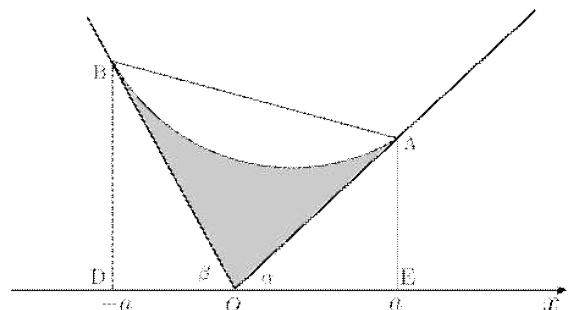
포물선과 두 반직선으로 둘러싸인 영역
+8점 · S1=16(tan(α)+tan(β))a2\displaystyle S_1=\frac16(\tan(\alpha)+\tan(\beta))a^2임을 보인다.

점 A와 점 B에서 x\displaystyle x축에 내린 수선의 발을 각각 E와 D라 하자. y=g(x)\displaystyle y=g(x)와 선분 OA와 선분 OB로 둘러싸인 영역은 오른쪽 그림에서 색칠된 영역이다. 이 영역의 넓이 S1\displaystyle S_1을 구하기 위해서는 axa\displaystyle -a\le x\le a에서의 y=g(x)\displaystyle y=g(x)의 그래프와 x\displaystyle x축 사이의 넓이에서 삼각형 OAE와 삼각형 OBD의 넓이를 빼면 된다. 따라서S1=aa[tan(α)+tan(β)4a(xa)2+tan(α)x]dx12a2tan(α)12a2tan(β)=23(tan(α)+tan(β))a212(tan(α)+tan(β))a2=16(tan(α)+tan(β))a2\displaystyle \begin{aligned}S_1&=\int_{-a}^a\left[\frac{\tan(\alpha)+\tan(\beta)}{4a}(x-a)^2+\tan(\alpha)x\right]dx-\frac12a^2\tan(\alpha)-\frac12a^2\tan(\beta)\\&=\frac23(\tan(\alpha)+\tan(\beta))a^2-\frac12(\tan(\alpha)+\tan(\beta))a^2=\frac16(\tan(\alpha)+\tan(\beta))a^2\end{aligned}즉, S1=16(tan(α)+tan(β))a2\displaystyle S_1=\frac16(\tan(\alpha)+\tan(\beta))a^2임을 얻을 수 있다.

+8점 · S2=14(tan(α)+tan(β))a2\displaystyle S_2=\frac14(\tan(\alpha)+\tan(\beta))a^2임을 보인다.

한편, 삼각형 ABP의 넓이가 최대가 되는 점 P는 선분 AB와 평행한 y=g(x)\displaystyle y=g(x)의 접선의 접점이다. 선분 AB의 기울기가 tan(α)tan(β)2\displaystyle \frac{\tan(\alpha)-\tan(\beta)}2이므로, 방정식g(x)=tan(α)+tan(β)2a(xa)+tan(α)=tan(α)tan(β)2\displaystyle g^{\prime}(x)=\frac{\tan(\alpha)+\tan(\beta)}{2a}(x-a)+\tan(\alpha)=\frac{\tan(\alpha)-\tan(\beta)}2를 풀어서 점 P의 x\displaystyle x좌표가 x=0\displaystyle x=0임을 알아낸다.그러면 점 P(0,tan(α)+tan(β)4a)\displaystyle P\left(0,\frac{\tan(\alpha)+\tan(\beta)}4a\right)로부터 선분 AB를 지나는 직선 (tan(α)tan(β))x2y+tan(α)+tan(β)=0\displaystyle (\tan(\alpha)-\tan(\beta))x-2y+\tan(\alpha)+\tan(\beta)=0까지의 거리는 h=tan(α)+tan(β)24+(tan(α)tan(β))2a\displaystyle h=\frac{\tan(\alpha)+\tan(\beta)}{2\sqrt{4+(\tan(\alpha)-\tan(\beta))^2}}a이 된다.Correction. 직선 AB\displaystyle AB의 방정식에서 상수항은 a(tanα+tanβ)\displaystyle a(\tan\alpha+\tan\beta)이어야 한다. 그러나 원칙에 따라 원문 표기를 그대로 실었다.따라서 삼각형 ABP는 선분 AB를 밑변으로 h\displaystyle h를 높이로 하는 삼각형이므로, 삼각형 ABP의 최대 넓이는S2=12hAB=12tan(α)+tan(β)24+(tan(α)tan(β))2a4+(tan(α)tan(β))2a=tan(α)+tan(β)4a2\displaystyle S_2=\frac12h\overline{AB}=\frac12\frac{\tan(\alpha)+\tan(\beta)}{2\sqrt{4+(\tan(\alpha)-\tan(\beta))^2}}a\sqrt{4+(\tan(\alpha)-\tan(\beta))^2}\,a=\frac{\tan(\alpha)+\tan(\beta)}4a^2이 된다.

+4점 · S2S1=32\displaystyle \frac{S_2}{S_1}=\frac32임을 보인다.

따라서 S2S1=32\displaystyle \frac{S_2}{S_1}=\frac32임을 보일 수 있다.

첨삭 사례

아직 등록된 첨삭 사례가 없습니다.

질문과 답변 · 0개질문과 답변 · 고정 0개

아직 등록된 질문이 없습니다. 질문 작성은 멤버십 회원만 가능합니다.