수리논술, 배움에서 논증의 완성까지.

의·약학계 1-2(1)번

문제

[나] 좌표평면의 원점 O와 점 P(x,y)\displaystyle \mathrm P(x,y)에 대하여, 동경 OP가 나타내는 각의 크기를 θ\displaystyle \theta, OP‾\displaystyle \overline{\mathrm{OP}}를 r\displaystyle r이라 하면sin⁡θ=yr, cos⁡θ=xr, tan⁡θ=yx (x≠0),\displaystyle \sin\theta=\frac yr,\ \cos\theta=\frac xr,\ \tan\theta=\frac yx\ (x\ne0),csc⁡θ=ry (y≠0), sec⁡θ=rx (x≠0), cot⁡θ=xy (y≠0)\displaystyle \csc\theta=\frac ry\ (y\ne0),\ \sec\theta=\frac rx\ (x\ne0),\ \cot\theta=\frac xy\ (y\ne0)[다] 삼각함수의 덧셈정리sin⁡(α+β)=sin⁡αcos⁡β+cos⁡αsin⁡β, sin⁡(α−β)=sin⁡αcos⁡β−cos⁡αsin⁡β,\displaystyle \sin(\alpha+\beta)=\sin\alpha\cos\beta+\cos\alpha\sin\beta,\ \sin(\alpha-\beta)=\sin\alpha\cos\beta-\cos\alpha\sin\beta,cos⁡(α+β)=cos⁡αcos⁡β−sin⁡αsin⁡β, cos⁡(α−β)=cos⁡αcos⁡β+sin⁡αsin⁡β\displaystyle \cos(\alpha+\beta)=\cos\alpha\cos\beta-\sin\alpha\sin\beta,\ \cos(\alpha-\beta)=\cos\alpha\cos\beta+\sin\alpha\sin\beta[라] 매개변수 t\displaystyle t로 나타낸 함수 x=f(t), y=g(t)\displaystyle x=f(t),\ y=g(t)가 t\displaystyle t에 대하여 미분가능하고 f′(t)≠0\displaystyle f^{\prime}(t)\ne0이면 dydx=dydtdxdt=g′(t)f′(t)\displaystyle \frac{dy}{dx}=\frac{\frac{dy}{dt}}{\frac{dx}{dt}}=\frac{g^{\prime}(t)}{f^{\prime}(t)}이다.[마] 좌표평면 위를 움직이는 점 P(x,y)\displaystyle \mathrm P(x,y)의 위치를 매개변수 t\displaystyle t에 관한 함수 x=f(t), y=g(t)\displaystyle x=f(t),\ y=g(t)로 나타내면, t=a\displaystyle t=a에서 t=b\displaystyle t=b까지 점 P가 움직인 거리는 ∫ab{f′(t)}2+{g′(t)}2 dt\displaystyle \int_a^b\sqrt{\{f^{\prime}(t)\}^2+\{g^{\prime}(t)\}^2}\,dt이다.

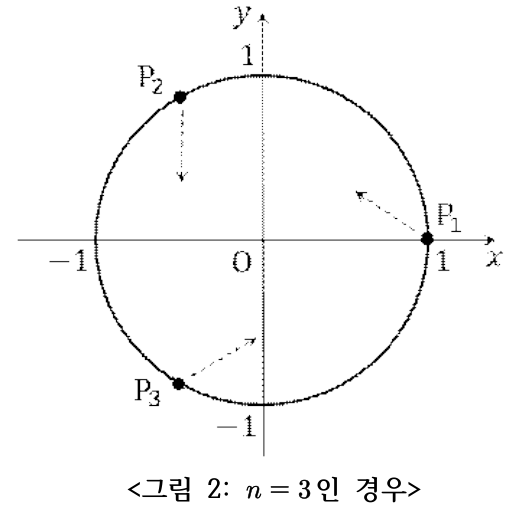
[논제 Ⅰ-2](1) <그림 2>와 같이 중심이 원점 O이고 반지름이 1인 원 위에 같은 간격으로 놓여 있는 세 개 이상의 점 P1,⋯ ,Pn\displaystyle \mathrm P_1,\cdots,\mathrm P_n이 있다. 매순간 점 Pk (k<n)\displaystyle \mathrm P_k\ (k<n)는 점 Pk+1\displaystyle \mathrm P_{k+1}을 향하여 움직이고, 점 Pn\displaystyle \mathrm P_n은 점 P1\displaystyle \mathrm P_1을 향하여 움직인다. OP1‾=OP2‾=⋯=OPn‾>0\displaystyle \overline{\mathrm{OP}_1}=\overline{\mathrm{OP}_2}=\cdots=\overline{\mathrm{OP}_n}>0와 ∠P1OP2=⋯=∠Pn−1OPn=∠PnOP1\displaystyle \angle\mathrm P_1\mathrm O\mathrm P_2=\cdots=\angle\mathrm P_{n-1}\mathrm O\mathrm P_n=\angle\mathrm P_n\mathrm O\mathrm P_1는 항상 성립한다고 할 때, 점 P1\displaystyle \mathrm P_1이 점 (1,0)\displaystyle (1,0)에서 출발하여 처음으로 y\displaystyle y축을 만날 때까지 움직인 거리를 α=1−cos⁡2πnsin⁡2πn\displaystyle \alpha=\frac{1-\cos\frac{2\pi}n}{\sin\frac{2\pi}n}를 이용하여 나타내고, 그 근거를 논술하시오. (15점)

그림 2: n=3인 경우 원 위의 세 점
해설강의 준비중

논술 나선

관련 개념강의 준비중

[논제 Ⅰ-2]

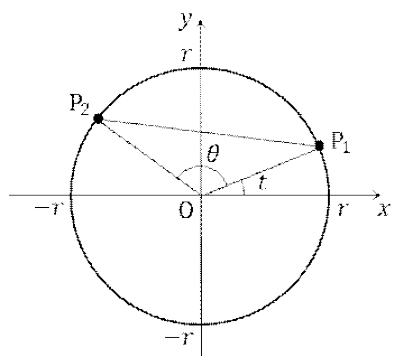
움직이는 두 점 P1, P2와 각 t, θ
+5점 · 점 P1\displaystyle \mathrm P_1이 만족하는 조건을 찾는다.

(1) θ=2πn=∠P1OP2=⋯=∠Pn−1OPn=∠PnOP1\displaystyle \theta=\frac{2\pi}n=\angle\mathrm P_1\mathrm O\mathrm P_2=\cdots=\angle\mathrm P_{n-1}\mathrm O\mathrm P_n=\angle\mathrm P_n\mathrm O\mathrm P_1이라 하자. 매개변수 t\displaystyle t가 동경 OP1\displaystyle \mathrm{OP}_1이 나타내는 각의 크기일 때, 점 P1\displaystyle \mathrm P_1의 좌표 (x1,y1)\displaystyle (x_1,y_1)을 나타내는 함수는 x1=f1(t), y1=g1(t)\displaystyle x_1=f_1(t),\ y_1=g_1(t)이고, 점 P2\displaystyle \mathrm P_2의 좌표 (x2,y2)\displaystyle (x_2,y_2)를 나타내는 함수는 x2=f2(t), y2=g2(t)\displaystyle x_2=f_2(t),\ y_2=g_2(t)이다. 그림과 같이 r=OP1‾=OP2‾\displaystyle r=\overline{\mathrm{OP}_1}=\overline{\mathrm{OP}_2}이라 하면 f1(t)=rcos⁡t, g1(t)=rsin⁡t, f2(t)=rcos⁡(t+θ), g2(t)=rsin⁡(t+θ)\displaystyle f_1(t)=r\cos t,\ g_1(t)=r\sin t,\ f_2(t)=r\cos(t+\theta),\ g_2(t)=r\sin(t+\theta)이다.

+5점 · 점 P1\displaystyle \mathrm P_1의 위치를 매개변수로 나타낸 함수로 표시한다.

삼각함수의 덧셈정리에 의해,f2=rcos⁡tcos⁡θ−rsin⁡tsin⁡θ=f1cos⁡θ−g1sin⁡θ, g2=rsin⁡tcos⁡θ+rcos⁡tsin⁡θ=g1cos⁡θ+f1sin⁡θ\displaystyle f_2=r\cos t\cos\theta-r\sin t\sin\theta=f_1\cos\theta-g_1\sin\theta,\ g_2=r\sin t\cos\theta+r\cos t\sin\theta=g_1\cos\theta+f_1\sin\theta이다.dy1dx1=g1′f1′\displaystyle \frac{dy_1}{dx_1}=\frac{g_1^{\prime}}{f_1^{\prime}}이 직선 P1P2\displaystyle \mathrm P_1\mathrm P_2의 기울기 −g1(1−cos⁡θ)+f1sin⁡θ−f1(1−cos⁡θ)−g1sin⁡θ\displaystyle \frac{-g_1(1-\cos\theta)+f_1\sin\theta}{-f_1(1-\cos\theta)-g_1\sin\theta}와 같으므로,(f1′g1−f1g1′)(1−cos⁡θ)=(f1f1′+g1g1′)sin⁡θ\displaystyle (f_1^{\prime}g_1-f_1g_1^{\prime})(1-\cos\theta)=(f_1f_1^{\prime}+g_1g_1^{\prime})\sin\theta이다.

f1′(t)=r′cos⁡t−rsin⁡t, g1′(t)=r′sin⁡t+rcos⁡t\displaystyle f_1^{\prime}(t)=r^{\prime}\cos t-r\sin t,\ g_1^{\prime}(t)=r^{\prime}\sin t+r\cos t이므로f1′g1−f1g1′=−r2\displaystyle f_1^{\prime}g_1-f_1g_1^{\prime}=-r^2이고 f1f1′+g1g1′=r′r\displaystyle f_1f_1^{\prime}+g_1g_1^{\prime}=r^{\prime}r이므로, −r2(1−cos⁡θ)=r′rsin⁡θ\displaystyle -r^2(1-\cos\theta)=r^{\prime}r\sin\theta이다.r>0\displaystyle r>0이므로, r′r=−1−cos⁡θsin⁡θ\displaystyle \frac{r^{\prime}}r=-\frac{1-\cos\theta}{\sin\theta}이고, 1−cos⁡θsin⁡θ=1−cos⁡2πnsin⁡2πn=α\displaystyle \frac{1-\cos\theta}{\sin\theta}=\frac{1-\cos\frac{2\pi}n}{\sin\frac{2\pi}n}=\alpha이므로 양변을 치환적분하면 r=ke−αt\displaystyle r=ke^{-\alpha t}이고, t=0\displaystyle t=0일 때 r=1\displaystyle r=1이므로, k=1\displaystyle k=1이다. 따라서, f1(t)=e−αtcos⁡t, g1(t)=e−αtsin⁡t\displaystyle f_1(t)=e^{-\alpha t}\cos t,\ g_1(t)=e^{-\alpha t}\sin t이다.

+5점 · 점 P1\displaystyle \mathrm P_1이 움직인 거리를 구한다.

점 P1\displaystyle \mathrm P_1이 y\displaystyle y축과 처음으로 만날 때는 t=π2\displaystyle t=\frac\pi2일 때이므로, 점 P1\displaystyle \mathrm P_1이 움직인 거리는∫0π2{f1′(t)}2+{g1′(t)}2 dt=∫0π2α2+1 e−αt dt=α2+1α(1−e−πα2)\displaystyle \int_0^{\frac\pi2}\sqrt{\{f_1^{\prime}(t)\}^2+\{g_1^{\prime}(t)\}^2}\,dt=\int_0^{\frac\pi2}\sqrt{\alpha^2+1}\,e^{-\alpha t}\,dt=\frac{\sqrt{\alpha^2+1}}\alpha\left(1-e^{-\frac{\pi\alpha}2}\right)이다.

첨삭 사례

아직 등록된 첨삭 사례가 없습니다.

질문과 답변 · 0개질문과 답변 · 고정 0개

아직 등록된 질문이 없습니다. 질문 작성은 멤버십 회원만 가능합니다.