수리논술, 배움에서 논증의 완성까지.

의·약학계 1번

문제

🔒
짧은 시간에 너무 많은 문제를 여셔서 열람을 잠시 제한했습니다. 잠시 후 다시 시도하시거나 로그인해 주세요.
해설강의 준비중

논술 나선

관련 개념강의 준비중
+5점 · 첫째항, 공비를 찾는다.

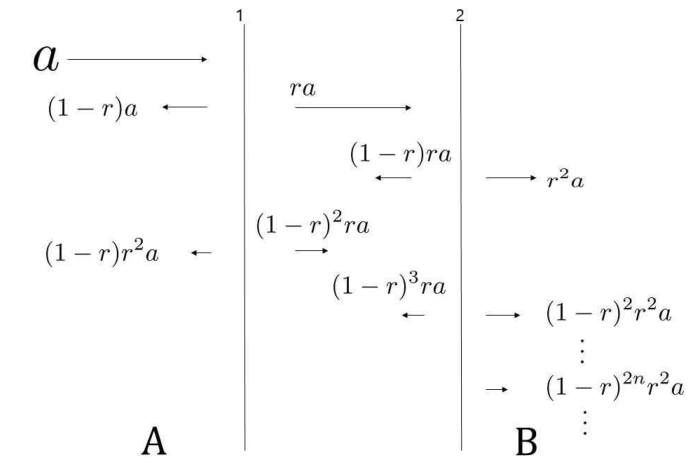
[논제Ⅰ-1](1) 아래 그림과 같이 유리창1로 빛이 들어오는 구역을 A, 유리창2에서 빛이 통과하여 나가는 구역을 B라 두자. 유리창1로 들어오는 빛의 양 a\displaystyle a(1r)a\displaystyle (1-r)a는 A로 반사되고, ra\displaystyle ra는 유리창1을 통과한다. 유리창2에 ra\displaystyle ra가 들어가면 (1r)ra\displaystyle (1-r)ra는 반사되고, r2a\displaystyle r^2a는 통과하여 B쪽으로 간다. 유리창2에서 반사된 (1r)ra\displaystyle (1-r)ra는 다시 유리창1로 들어가고, (1r)r2a\displaystyle (1-r)r^2a는 유리창1을 통과하여 A쪽으로 가고, (1r)2ra\displaystyle (1-r)^2ra는 반사된다. 반사된 (1r)2ra\displaystyle (1-r)^2ra는 다시 유리창2로 들어가고, (1r)2r2a\displaystyle (1-r)^2r^2a는 유리창2를 통과하여 B쪽으로 가고, (1r)3ra\displaystyle (1-r)^3ra는 반사된다. 이 과정을 계속 반복하면, 유리창2를 통과한 빛의 양은 첫째항이 r2a\displaystyle r^2a이고 공비가 (1r)2\displaystyle (1-r)^2인 등비급수이 된다.

+5점 · 주어진 조건에 맞는 빛을 통과시키는 비율 r\displaystyle r을 구한다.

따라서, B에서 빛의 양 S\displaystyle SS=r2a1(1r)2\displaystyle S=\frac{r^2a}{1-(1-r)^2}이고 S=12a\displaystyle S=\frac12a를 풀면, r=23\displaystyle r=\frac23이다.

유리창 사이에서 반복되는 투과와 반사
+6점 · 빛을 통과시키는 비율이 q1, q2\displaystyle q_1,\ q_2인 두 장의 유리창을 한 장으로 보았을 때, 통과시키는 비율을 구한다.

(2) 빛을 통과시키는 비율이 q1, q2\displaystyle q_1,\ q_2인 유리창 2개가 있다고 하자. (논제Ⅰ-1)에서와 같은 방법을 적용하여 빛의 양 a\displaystyle a가 빛을 통과시키는 비율이 q1, q2\displaystyle q_1,\ q_2인 유리창을 통과하여, B에 도달하는 양을 구할 수 있다. 즉, B에 도달하는 빛의 양 S\displaystyle S는 첫째항이 q1q2a\displaystyle q_1q_2a, 공비가 (1q1)(1q2)\displaystyle (1-q_1)(1-q_2)인 등비급수의 합이 된다.S=q1q21(1q1)(1q2)a=q1q2q1+q2q1q2a=11q1+1q21a\displaystyle S=\frac{q_1q_2}{1-(1-q_1)(1-q_2)}a=\frac{q_1q_2}{q_1+q_2-q_1q_2}a=\frac1{\frac1{q_1}+\frac1{q_2}-1}a즉, 빛을 통과시키는 비율이 q1, q2\displaystyle q_1,\ q_2인 두 개의 유리창을 하나로 보았을 때, 이 유리창이 빛을 통과시키는 비율 r\displaystyle rr=11q1+1q21\displaystyle r=\frac1{\frac1{q_1}+\frac1{q_2}-1}이 된다.

+6점 · 일반적으로 n\displaystyle n장의 유리창이 있을 때, 두 장의 유리창인 경우처럼 나누어서 일반항의 규칙을 구한다.

n\displaystyle n개의 유리창이 있을 때, 첫 번째 유리창이 빛을 통과시키는 비율을 q1\displaystyle q_1이라두고, 두 번째에서 n\displaystyle n번째까지 n1\displaystyle n-1개의 유리창을 하나로 보고 빛을 통과시키는 비율을 q2\displaystyle q_2로 둘 수 있다. q1=23\displaystyle q_1=\frac23이고 q2=rn1\displaystyle q_2=r_{n-1}이므로, (rn1\displaystyle r_{n-1}을 유리창 n1\displaystyle n-1개를 하나로 보았을 때 빛을 통과시키는 비율이라 하자.) 위에서 계산한 식에 q1, q2\displaystyle q_1,\ q_2를 대입하여 rn\displaystyle r_n을 구하면rn=132+1rn11=112+1rn1\displaystyle r_n=\frac1{\frac32+\frac1{r_{n-1}}-1}=\frac1{\frac12+\frac1{r_{n-1}}}이다.

+8점 · 등차수열의 일반항을 구하고, 이로부터 n\displaystyle n장의 유리창의 통과시키는 비율을 찾아 답을 구한다.

이 식을 이용하면, 1rn=12+1rn1\displaystyle \frac1{r_n}=\frac12+\frac1{r_{n-1}}이고, an=1rn\displaystyle a_n=\frac1{r_n}은 첫째항이 a1=32\displaystyle a_1=\frac32이고 공차가 12\displaystyle \frac12인 등차수열이다. 즉, an=n+22\displaystyle a_n=\frac{n+2}2이고 rn=2n+2\displaystyle r_n=\frac2{n+2}이다. rn\displaystyle r_nn\displaystyle n개의 유리창을 하나로 보았을 때 빛을 통과시키는 비율이므로, 빛의 양 a\displaystyle an\displaystyle n개의 유리창을 통과한 후의 양 pn=rna=2n+2a\displaystyle p_n=r_na=\frac2{n+2}a이다.

[논제 Ⅰ-2]

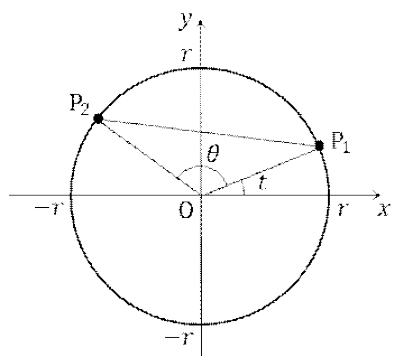
움직이는 두 점 P1, P2와 각 t, θ
+5점 · 점 P1\displaystyle \mathrm P_1이 만족하는 조건을 찾는다.

(1) θ=2πn=P1OP2==Pn1OPn=PnOP1\displaystyle \theta=\frac{2\pi}n=\angle\mathrm P_1\mathrm O\mathrm P_2=\cdots=\angle\mathrm P_{n-1}\mathrm O\mathrm P_n=\angle\mathrm P_n\mathrm O\mathrm P_1이라 하자. 매개변수 t\displaystyle t가 동경 OP1\displaystyle \mathrm{OP}_1이 나타내는 각의 크기일 때, 점 P1\displaystyle \mathrm P_1의 좌표 (x1,y1)\displaystyle (x_1,y_1)을 나타내는 함수는 x1=f1(t), y1=g1(t)\displaystyle x_1=f_1(t),\ y_1=g_1(t)이고, 점 P2\displaystyle \mathrm P_2의 좌표 (x2,y2)\displaystyle (x_2,y_2)를 나타내는 함수는 x2=f2(t), y2=g2(t)\displaystyle x_2=f_2(t),\ y_2=g_2(t)이다. 그림과 같이 r=OP1=OP2\displaystyle r=\overline{\mathrm{OP}_1}=\overline{\mathrm{OP}_2}이라 하면 f1(t)=rcost, g1(t)=rsint, f2(t)=rcos(t+θ), g2(t)=rsin(t+θ)\displaystyle f_1(t)=r\cos t,\ g_1(t)=r\sin t,\ f_2(t)=r\cos(t+\theta),\ g_2(t)=r\sin(t+\theta)이다.

+5점 · 점 P1\displaystyle \mathrm P_1의 위치를 매개변수로 나타낸 함수로 표시한다.

삼각함수의 덧셈정리에 의해,f2=rcostcosθrsintsinθ=f1cosθg1sinθ, g2=rsintcosθ+rcostsinθ=g1cosθ+f1sinθ\displaystyle f_2=r\cos t\cos\theta-r\sin t\sin\theta=f_1\cos\theta-g_1\sin\theta,\ g_2=r\sin t\cos\theta+r\cos t\sin\theta=g_1\cos\theta+f_1\sin\theta이다.dy1dx1=g1f1\displaystyle \frac{dy_1}{dx_1}=\frac{g_1^{\prime}}{f_1^{\prime}}이 직선 P1P2\displaystyle \mathrm P_1\mathrm P_2의 기울기 g1(1cosθ)+f1sinθf1(1cosθ)g1sinθ\displaystyle \frac{-g_1(1-\cos\theta)+f_1\sin\theta}{-f_1(1-\cos\theta)-g_1\sin\theta}와 같으므로,(f1g1f1g1)(1cosθ)=(f1f1+g1g1)sinθ\displaystyle (f_1^{\prime}g_1-f_1g_1^{\prime})(1-\cos\theta)=(f_1f_1^{\prime}+g_1g_1^{\prime})\sin\theta이다.

f1(t)=rcostrsint, g1(t)=rsint+rcost\displaystyle f_1^{\prime}(t)=r^{\prime}\cos t-r\sin t,\ g_1^{\prime}(t)=r^{\prime}\sin t+r\cos t이므로f1g1f1g1=r2\displaystyle f_1^{\prime}g_1-f_1g_1^{\prime}=-r^2이고 f1f1+g1g1=rr\displaystyle f_1f_1^{\prime}+g_1g_1^{\prime}=r^{\prime}r이므로, r2(1cosθ)=rrsinθ\displaystyle -r^2(1-\cos\theta)=r^{\prime}r\sin\theta이다.r>0\displaystyle r>0이므로, rr=1cosθsinθ\displaystyle \frac{r^{\prime}}r=-\frac{1-\cos\theta}{\sin\theta}이고, 1cosθsinθ=1cos2πnsin2πn=α\displaystyle \frac{1-\cos\theta}{\sin\theta}=\frac{1-\cos\frac{2\pi}n}{\sin\frac{2\pi}n}=\alpha이므로 양변을 치환적분하면 r=keαt\displaystyle r=ke^{-\alpha t}이고, t=0\displaystyle t=0일 때 r=1\displaystyle r=1이므로, k=1\displaystyle k=1이다. 따라서, f1(t)=eαtcost, g1(t)=eαtsint\displaystyle f_1(t)=e^{-\alpha t}\cos t,\ g_1(t)=e^{-\alpha t}\sin t이다.

+5점 · 점 P1\displaystyle \mathrm P_1이 움직인 거리를 구한다.

P1\displaystyle \mathrm P_1y\displaystyle y축과 처음으로 만날 때는 t=π2\displaystyle t=\frac\pi2일 때이므로, 점 P1\displaystyle \mathrm P_1이 움직인 거리는0π2{f1(t)}2+{g1(t)}2dt=0π2α2+1eαtdt=α2+1α(1eπα2)\displaystyle \int_0^{\frac\pi2}\sqrt{\{f_1^{\prime}(t)\}^2+\{g_1^{\prime}(t)\}^2}\,dt=\int_0^{\frac\pi2}\sqrt{\alpha^2+1}\,e^{-\alpha t}\,dt=\frac{\sqrt{\alpha^2+1}}\alpha\left(1-e^{-\frac{\pi\alpha}2}\right)이다.

+5점 · 직선의 방정식을 구할 수 있고 이를 이용하여 점 P와 점 Q의 좌표를 구할 수 있다.

(2) 점 B의 좌표를 B(b,1b)\displaystyle \mathrm B\left(b,\frac1b\right)라 하자. 점 A와 B를 지나는 직선의 방정식은y=1abx+1a+1b\displaystyle y=-\frac1{ab}x+\frac1a+\frac1b이다. 따라서 점들의 좌표 P(0,1a+1b)\displaystyle \mathrm P\left(0,\frac1a+\frac1b\right)Q(a+b,0)\displaystyle \mathrm Q(a+b,0)을 얻을 수 있다.따라서AB=(ab)2+(1a1b)2=abab1+a2b2\displaystyle \overline{\mathrm{AB}}=\sqrt{(a-b)^2+\left(\frac1a-\frac1b\right)^2}=\frac{|a-b|}{ab}\sqrt{1+a^2b^2}이고, 점 B가 AB=1\displaystyle \overline{\mathrm{AB}}=1을 만족하는 경우,ab=ab1+a2b2\displaystyle |a-b|=\frac{ab}{\sqrt{1+a^2b^2}}를 얻는다.

+10점 · a\displaystyle ab\displaystyle b 사이의 관계와 극한의 대소관계를 이용하여 극한값을 구할 수 있다.

이때 a>b\displaystyle a>b이면 a=b+ab1+a2b2\displaystyle a=b+\frac{ab}{\sqrt{1+a^2b^2}}이고, a<b\displaystyle a<b이면 b=a+ab1+a2b2\displaystyle b=a+\frac{ab}{\sqrt{1+a^2b^2}}이므로, 이를 다시 쓰면ba={1b1+a2b2(a>b)1+b1+a2b2(a<b)\displaystyle \frac ba=\begin{cases}1-\frac b{\sqrt{1+a^2b^2}}&(a>b)\\1+\frac b{\sqrt{1+a^2b^2}}&(a<b)\end{cases}이다. 여기서 0<ab1+a2b2<1\displaystyle 0<\frac{ab}{\sqrt{1+a^2b^2}}<1이므로, 0<b1+a2b2<1a\displaystyle 0<\frac b{\sqrt{1+a^2b^2}}<\frac1a이고, 극한값 limab1+a2b2=0\displaystyle \lim_{a\to\infty}\frac b{\sqrt{1+a^2b^2}}=0을 얻는다. 따라서 극한값 limaba=1\displaystyle \lim_{a\to\infty}\frac ba=1을 얻을 수 있고, 삼각형 OPQ의 넓이는S(a)=12(1a+1b)(a+b)=(a+b)22ab=(1+ba)22ba\displaystyle S(a)=\frac12\left(\frac1a+\frac1b\right)(a+b)=\frac{(a+b)^2}{2ab}=\frac{\left(1+\frac ba\right)^2}{2\frac ba}이므로, 극한값 limaS(a)=2\displaystyle \lim_{a\to\infty}S(a)=2를 얻는다. 위 식을 ab\displaystyle \frac ab에 대해서 정리하면ab={1+a1+a2b2(a>b)1a1+a2b2(a<b)\displaystyle \frac ab=\begin{cases}1+\frac a{\sqrt{1+a^2b^2}}&(a>b)\\1-\frac a{\sqrt{1+a^2b^2}}&(a<b)\end{cases}이다. 여기서 0<11+a2b2<1\displaystyle 0<\frac1{\sqrt{1+a^2b^2}}<1이므로, 0<a1+a2b2<a\displaystyle 0<\frac a{\sqrt{1+a^2b^2}}<a이고, 극한값 lima0a1+a2b2=0\displaystyle \lim_{a\to0}\frac a{\sqrt{1+a^2b^2}}=0을 얻는다. 따라서 극한값 lima0ab=1\displaystyle \lim_{a\to0}\frac ab=1을 얻을 수 있고, 이를 이용하면lima0S(a)=lima0(1+ab)22ab=2\displaystyle \lim_{a\to0}S(a)=\lim_{a\to0}\frac{\left(1+\frac ab\right)^2}{2\frac ab}=2를 얻는다.

첨삭 사례

아직 등록된 첨삭 사례가 없습니다.

질문과 답변 · 0개질문과 답변 · 고정 0개

아직 등록된 질문이 없습니다. 질문 작성은 멤버십 회원만 가능합니다.