수리논술, 배움에서 논증의 완성까지.

의·약학계 1-2번

문제

Ⅰ. 다음 제시문을 읽고 논제에 답하시오. (60점)

[나] 등비급수 ∑n=1∞arn−1=a+ar+ar2+⋯+arn−1+⋯ (a≠0)\displaystyle \sum_{n=1}^{\infty}ar^{n-1}=a+ar+ar^2+\cdots+ar^{n-1}+\cdots\ (a\ne0)은(1) ∣r∣<1\displaystyle |r|<1일 때, 수렴하고 그 합은 a1−r\displaystyle \frac a{1-r}이다.(2) ∣r∣≥1\displaystyle |r|\ge1일 때, 발산한다.

[다] 미분가능한 두 함수 f(x)\displaystyle f(x)와 g(x) (g(x)≠0)\displaystyle g(x)\ (g(x)\ne0)에 대하여(1) {1g(x)}′=−g′(x){g(x)}2\displaystyle \left\{\frac1{g(x)}\right\}^{\prime}=-\frac{g^{\prime}(x)}{\{g(x)\}^2}(2) {f(x)g(x)}′=f′(x)g(x)−f(x)g′(x){g(x)}2\displaystyle \left\{\frac{f(x)}{g(x)}\right\}^{\prime}=\frac{f^{\prime}(x)g(x)-f(x)g^{\prime}(x)}{\{g(x)\}^2}

[라] 미분가능한 함수 f(x)\displaystyle f(x)에 대하여 f′(a)=0\displaystyle f^{\prime}(a)=0이고, x=a\displaystyle x=a의 좌우에서(1) f′(x)\displaystyle f^{\prime}(x)의 부호가 양에서 음으로 바뀌면 f(x)\displaystyle f(x)는 x=a\displaystyle x=a에서 극대이다.(2) f′(x)\displaystyle f^{\prime}(x)의 부호가 음에서 양으로 바뀌면 f(x)\displaystyle f(x)는 x=a\displaystyle x=a에서 극소이다.

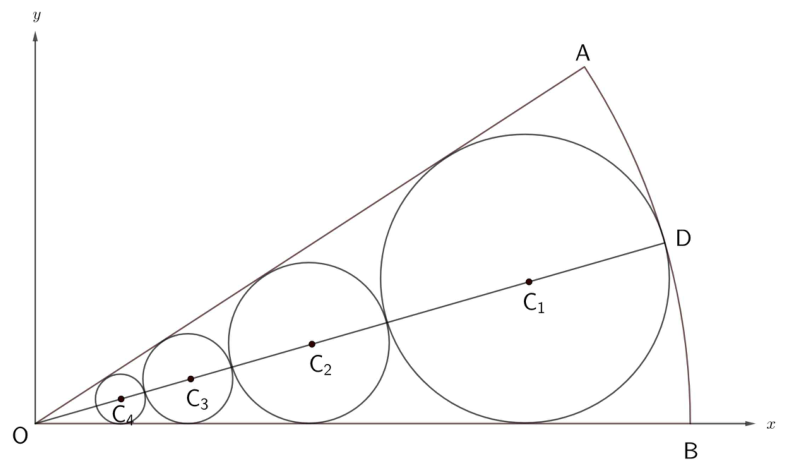
[논제 Ⅰ-2] 원점이 O이고 점 B가 x\displaystyle x축에 있다고 하자. OA‾=1\displaystyle \overline{\mathrm{OA}}=1이고, 중심각이 ∠AOB=2θ\displaystyle \angle\mathrm{AOB}=2\theta인 부채꼴 OAB 안에 그림과 같이 내접하는 원을 그리고, 그 중심을 C1\displaystyle \mathrm C_1이라 하자. 선분 OA, 선분 OB와 중심이 C1\displaystyle \mathrm C_1인 원과 그림과 같이 접하는 두 번째 원의 중심을 C2\displaystyle \mathrm C_2라 하자. 같은 방법으로 그림과 같이 인접하는 원들끼리 서로 접하는 원들을 무한히 그리고, 각각의 중심을 C3,C4,⋯\displaystyle \mathrm C_3,\mathrm C_4,\cdots라고 하자. 이때, 중심이 Cn\displaystyle \mathrm C_n인 원의 반지름을 rn\displaystyle r_n이라 하자. 단, 0<θ<π2\displaystyle 0<\theta<\frac\pi2이다.

부채꼴 OAB에 내접하는 원 C₁, C₂, C₃, C₄

(1) 부채꼴 OAB 안에 접하는 모든 원들의 넓이의 합을 구하고, 그 근거를 논술하시오. (15점)

(2) 0<θ<π2\displaystyle 0<\theta<\frac\pi2에서 θ\displaystyle \theta의 값이 변하면, 모든 원들의 크기가 변한다. r100=f(θ)\displaystyle r_{100}=f(\theta)라 할 때, f(θ)\displaystyle f(\theta)가 최대가 되는 경우의 θ\displaystyle \theta에 대해서 r1\displaystyle r_1의 값을 구하고, 그 근거를 논술하시오. (15점)

해설강의 준비중

논술 직선에 접하는 원의 배치

관련 개념강의 준비중

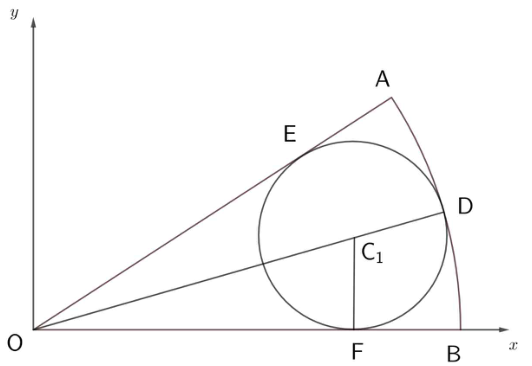
[논제 Ⅰ-2](1) 중심이 C1\displaystyle \mathrm C_1인 원이 부채꼴과 접하는 점들을 그림과 같이 각각 D, E, F라 하면, 선분 OC1\displaystyle \mathrm{OC}_1의 연장선과 호 AB가 D에서 만난다.

부채꼴과 첫 번째 원의 접점 D, E, F

C1D‾=C1F‾=r1\displaystyle \overline{\mathrm C_1\mathrm D}=\overline{\mathrm C_1\mathrm F}=r_1이고, ∠BOD=θ\displaystyle \angle\mathrm{BOD}=\theta이므로, 삼각형 C1OF\displaystyle \mathrm C_1\mathrm{OF}에서 sin⁡θ=C1F‾OC1‾=r11−r1\displaystyle \sin\theta=\frac{\overline{\mathrm C_1\mathrm F}}{\overline{\mathrm{OC}_1}}=\frac{r_1}{1-r_1}을 만족하므로, r1=sin⁡θ1+sin⁡θ\displaystyle r_1=\frac{\sin\theta}{1+\sin\theta}가 된다.

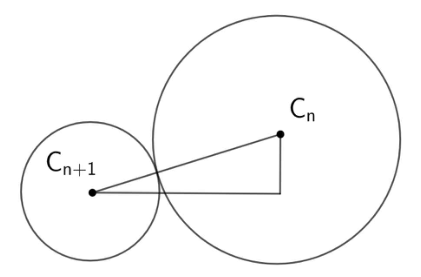
이웃한 두 원의 반지름과 중심선

자연수 n\displaystyle n에 대해서, 중심이 Cn+1\displaystyle \mathrm C_{n+1}인 원은 중심이 Cn\displaystyle \mathrm C_n인 원과 접하므로, sin⁡θ=rn−rn+1rn+rn+1\displaystyle \sin\theta=\frac{r_n-r_{n+1}}{r_n+r_{n+1}}을 만족한다. 따라서, rn+1=1−sin⁡θ1+sin⁡θrn\displaystyle r_{n+1}=\frac{1-\sin\theta}{1+\sin\theta}r_n을 만족한다. 중심이 Cn\displaystyle \mathrm C_n인 원의 넓이를 An\displaystyle A_n이라 하면, 수열 {An}\displaystyle \{A_n\}은 첫째항이 πr12=π(sin⁡θ1+sin⁡θ)2\displaystyle \pi r_1^2=\pi\left(\frac{\sin\theta}{1+\sin\theta}\right)^2이고 공비가 (1−sin⁡θ1+sin⁡θ)2\displaystyle \left(\frac{1-\sin\theta}{1+\sin\theta}\right)^2인 등비수열이 된다.따라서, 모든 원의 넓이의 합은 ∑n=1∞An=π(sin⁡θ1+sin⁡θ)21−(1−sin⁡θ1+sin⁡θ)2=π4sin⁡θ\displaystyle \sum_{n=1}^{\infty}A_n=\frac{\pi\left(\frac{\sin\theta}{1+\sin\theta}\right)^2}{1-\left(\frac{1-\sin\theta}{1+\sin\theta}\right)^2}=\frac\pi4\sin\theta가 된다.

(2) 수열 {rn}\displaystyle \{r_n\}은 첫째항이 r1\displaystyle r_1이고 공비가 1−sin⁡θ1+sin⁡θ\displaystyle \frac{1-\sin\theta}{1+\sin\theta}인 등비수열이므로, rn=r1(1−sin⁡θ1+sin⁡θ)n−1=sin⁡θ(1−sin⁡θ)n−1(1+sin⁡θ)n\displaystyle r_n=r_1\left(\frac{1-\sin\theta}{1+\sin\theta}\right)^{n-1}=\frac{\sin\theta(1-\sin\theta)^{n-1}}{(1+\sin\theta)^n}이다. 따라서, r100=sin⁡θ(1−sin⁡θ)99(1+sin⁡θ)100=f(θ)\displaystyle r_{100}=\frac{\sin\theta(1-\sin\theta)^{99}}{(1+\sin\theta)^{100}}=f(\theta)이다.x=sin⁡θ\displaystyle x=\sin\theta라 하고, g(x)=x(1−x)99(1+x)100\displaystyle g(x)=\frac{x(1-x)^{99}}{(1+x)^{100}}라 하면, f(θ)=g(sin⁡θ)\displaystyle f(\theta)=g(\sin\theta)이다. 그러면, f′(θ)=g′(sin⁡θ)cos⁡θ\displaystyle f^{\prime}(\theta)=g^{\prime}(\sin\theta)\cos\theta이고, 0<θ<π2\displaystyle 0<\theta<\frac\pi2에서 cos⁡θ>0\displaystyle \cos\theta>0이므로, f′(θ)=0\displaystyle f^{\prime}(\theta)=0이면 g′(sin⁡θ)=0\displaystyle g^{\prime}(\sin\theta)=0이다. 0<θ<π2\displaystyle 0<\theta<\frac\pi2에서 x=sin⁡θ\displaystyle x=\sin\theta는 0<x<1\displaystyle 0<x<1을 만족하므로, g′(x)=0\displaystyle g^{\prime}(x)=0이 되는 x\displaystyle x를 계산하자.g′(x)=ddx(x(1−x)99(1+x)100)=((1−x)99−99x(1−x)98)(1+x)100−100x(1−x)99(1+x)99(1+x)200\displaystyle g^{\prime}(x)=\frac d{dx}\left(\frac{x(1-x)^{99}}{(1+x)^{100}}\right)=\frac{\big((1-x)^{99}-99x(1-x)^{98}\big)(1+x)^{100}-100x(1-x)^{99}(1+x)^{99}}{(1+x)^{200}}가 되어 이를 정리하면, g′(x)=(1−x)98{(1+x)(1−100x)−100x(1−x)}(1+x)101=(1−x)98{1−199x}(1+x)101\displaystyle g^{\prime}(x)=\frac{(1-x)^{98}\{(1+x)(1-100x)-100x(1-x)\}}{(1+x)^{101}}=\frac{(1-x)^{98}\{1-199x\}}{(1+x)^{101}}가 된다. sin⁡θ=1199\displaystyle \sin\theta=\frac1{199}를 만족하는 0<θ<π2\displaystyle 0<\theta<\frac\pi2는 sin⁡θ\displaystyle \sin\theta가 증가함수이므로 유일하게 존재하고, 이를 θ0\displaystyle \theta_0이라 하자. θ<θ0\displaystyle \theta<\theta_0이면, f′(θ)>0\displaystyle f^{\prime}(\theta)>0이고, θ>θ0\displaystyle \theta>\theta_0이면, f′(θ)<0\displaystyle f^{\prime}(\theta)<0이므로, f(θ)\displaystyle f(\theta)는 θ=θ0\displaystyle \theta=\theta_0에서 극댓값을 갖고 이는 최댓값이 된다.즉, r100\displaystyle r_{100}은 sin⁡θ=1199\displaystyle \sin\theta=\frac1{199}일 때 최대가 된다. 이때, r1=sin⁡θ1+sin⁡θ=11991+1199=1200\displaystyle r_1=\frac{\sin\theta}{1+\sin\theta}=\frac{\frac1{199}}{1+\frac1{199}}=\frac1{200}이 된다.

첨삭 사례

아직 등록된 첨삭 사례가 없습니다.

질문과 답변 · 0개질문과 답변 · 고정 0개

아직 등록된 질문이 없습니다. 질문 작성은 멤버십 회원만 가능합니다.