수리논술, 배움에서 논증의 완성까지.

자연계열 (일요일) 1-2번

문제

[가] 이차함수 y=ax2+bx+c\displaystyle y = a x^{2} + b x + c는 완전제곱식을 이용하여 y=a(x−p)2+q\displaystyle y = a ( x - p )^{2} + q의 꼴로 나타낼 수 있으므로 이차함수의 최댓값과 최솟값에 대하여 다음을 알 수 있다.

이차함수 y=a(x−p)2+q\displaystyle y = a ( x - p )^{2} + q는

① a>0\displaystyle a > 0이면 x=p\displaystyle x = p일 때 최솟값 q\displaystyle q를 가진다.

② a<0\displaystyle a < 0이면 x=p\displaystyle x = p일 때 최댓값 q\displaystyle q를 가진다.

[나] 두 함수 f(x)\displaystyle f ( x ), g(x)\displaystyle g ( x )가 미분가능할 때 다음 성질이 성립한다.

① {cf(x)}′=cf′(x)\displaystyle \left\{ c f ( x ) \right\}^{\prime} = c f^{\prime} ( x ) (단, c\displaystyle c는 상수)

② {f(x)+g(x)}′=f′(x)+g′(x)\displaystyle \left\{ f ( x ) + g ( x ) \right\}^{\prime} = f^{\prime} ( x ) + g^{\prime} ( x )

③ {f(x)−g(x)}′=f′(x)−g′(x)\displaystyle \left\{ f ( x ) - g ( x ) \right\}^{\prime} = f^{\prime} ( x ) - g^{\prime} ( x )

④ {f(x)g(x)}′=f′(x)g(x)+f(x)g′(x)\displaystyle \left\{ f ( x ) g ( x ) \right\}^{\prime} = f^{\prime} ( x ) g ( x ) + f ( x ) g^{\prime} ( x )

[다] 호도법을 이용하여 부채꼴의 호의 길이와 넓이를 구하여 보자.

반지름의 길이가 r\displaystyle r, 중심각의 크기가 θ\displaystyle \theta(라디안)인 부채꼴에서 호의 길이를 l\displaystyle l이라고 하면 호의 길이는 중심각의 크기에 정비례하므로 l:2πr=θ:2π\displaystyle l : 2 \pi r = \theta : 2 \pi, 즉 l=rθ\displaystyle l = r \theta이다. 또 부채꼴의 넓이를 S\displaystyle S라고 하면 부채꼴의 넓이도 중심각의 크기에 정비례하므로 S:πr2=θ:2π\displaystyle S : \pi r^{2} = \theta : 2 \pi, 즉 S=12r2θ=12rl\displaystyle S = \frac{1}{2} r^{2} \theta = \frac{1}{2} r l이다.

[라] 최대⋅\displaystyle \cdot최소 정리에 의하여 함수 f(x)\displaystyle f ( x )가 구간 [a,b]\displaystyle [ a , b ]에서 연속이면 함수 f(x)\displaystyle f ( x )는 이 구간에서 반드시 최댓값과 최솟값을 가진다. 특히 함수 f(x)\displaystyle f ( x )의 극값과 구간 [a,b]\displaystyle [ a , b ]에서 양 끝 점의 함숫값 f(a)\displaystyle f ( a ), f(b)\displaystyle f ( b )를 이용하면 함수 f(x)\displaystyle f ( x )의 최댓값과 최솟값을 구할 수 있다. 즉, 극댓값, f(a)\displaystyle f ( a ), f(b)\displaystyle f ( b ) 중에서 가장 큰 값이 최댓값이고, 극솟값, f(a)\displaystyle f ( a ), f(b)\displaystyle f ( b ) 중에서 가장 작은 값이 최솟값이다.

[논제 I] 제시문 [가]~[라]를 읽고 다음 질문에 답하시오.

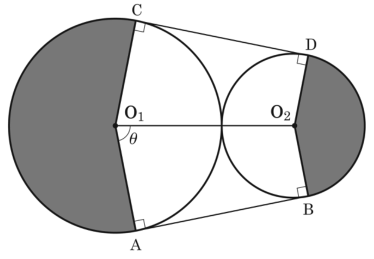
[논제 I-2] <그림 2>에서 두 원 O1\displaystyle \mathrm{O}_{1}과 O2\displaystyle \mathrm{O}_{2}는 서로 외접하고 중심 사이의 거리가 1\displaystyle 1이다. 점 A\displaystyle \mathrm{A}, B\displaystyle \mathrm{B},C\displaystyle \mathrm{C}, D\displaystyle \mathrm{D}는 두 원의 공통접선과 접점이다. 각 AO1O2\displaystyle \mathrm{AO}_{1} \mathrm{O}_{2}의 크기는 θ\displaystyle \theta이다. 부채꼴 O1CA\displaystyle \mathrm{O}_{1} \mathrm{CA}(색칠된 부분)의 호, 선분 AB\displaystyle \mathrm{AB}, 부채꼴 O2BD\displaystyle \mathrm{O}_{2} \mathrm{BD}(색칠된 부분)의 호, 선분 DC\displaystyle \mathrm{DC}로 둘러싸인 도형의 둘레의 길이를 l\displaystyle l, 넓이를 S\displaystyle S라고 하자. (단, π6≤θ≤2π3\displaystyle \frac{\pi}{6} \le \theta \le \frac{2\pi}{3})

외접하는 두 원과 공통접선
<그림 2>

(1) l\displaystyle l을 θ\displaystyle \theta의 함수 l(θ)\displaystyle l ( \theta )로 나타내고, l(θ)\displaystyle l ( \theta )의 최댓값을 구하시오. 그리고 그 근거를 논술하시오. (24점)

(2) S\displaystyle S를 θ\displaystyle \theta의 함수 S(θ)\displaystyle S ( \theta )로 나타내고, S(θ)\displaystyle S ( \theta )의 최솟값을 구하시오. 그리고 그 근거를 논술하시오. (16점)

해설강의 준비중
+6점 · 도형의 둘레의 길이를 함수로 나타낼 수 있다.

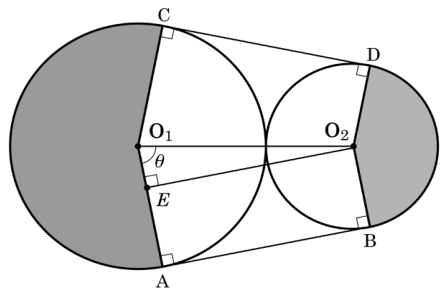
[논제 I-2](1) 둘레의 길이 l\displaystyle l은 부채꼴 O1CA\displaystyle O_1CA의 호의 길이, 선분 AB\displaystyle AB의 길이, 부채꼴 O2BD\displaystyle O_2BD의 호의 길이, 선분 DC\displaystyle DC의 길이의 합이다.

두 원의 공통접선과 반지름 및 보조선 O₂E
+8점 · 두 부채꼴의 반지름과 중심각을 구할 수 있다.

사다리꼴 O1ABO2\displaystyle O_1ABO_2와 O1CDO2\displaystyle O_1CDO_2는 합동이므로 각 CO1O2\displaystyle CO_1O_2의 크기도 θ\displaystyle \theta이다.따라서 부채꼴 O1CA\displaystyle O_1CA의 중심각의 크기는 2π−2θ\displaystyle 2\pi-2\theta이다.선분 O1A\displaystyle O_1A와 O2B\displaystyle O_2B가 평행이고, 선분 O1C\displaystyle O_1C와 O2D\displaystyle O_2D가 평행이므로부채꼴 O2BD\displaystyle O_2BD의 중심각의 크기는 2θ\displaystyle 2\theta이다.원 O1\displaystyle O_1의 반지름의 길이(O1A‾)\displaystyle (\overline{O_1A})를 r1\displaystyle r_1, 원 O2\displaystyle O_2의 반지름의 길이(O2B‾)\displaystyle (\overline{O_2B})를 r2\displaystyle r_2라 하면r1+r2=1\displaystyle r_1+r_2=1, r1−r2=O1O2‾cos⁡θ=cos⁡θ\displaystyle r_1-r_2=\overline{O_1O_2}\cos\theta=\cos\theta이므로 r1=1+cos⁡θ2\displaystyle r_1=\frac{1+\cos\theta}2, r2=1−cos⁡θ2\displaystyle r_2=\frac{1-\cos\theta}2이다.

+6점 · 도형의 둘레의 길이를 함수로 나타낼 수 있다.

따라서 부채꼴 O1CA\displaystyle O_1CA의 호의 길이 l1=r1(2π−2θ)=(π−θ)(1+cos⁡θ)\displaystyle l_1=r_1(2\pi-2\theta)=(\pi-\theta)(1+\cos\theta)이고,부채꼴 O2BD\displaystyle O_2BD의 호의 길이 l2=r2(2θ)=θ(1−cos⁡θ)\displaystyle l_2=r_2(2\theta)=\theta(1-\cos\theta)이다.선분 AB\displaystyle AB와 DC\displaystyle DC의 길이는 모두 O1O2‾sin⁡θ=sin⁡θ\displaystyle \overline{O_1O_2}\sin\theta=\sin\theta이다.그러므로 l(θ)=(π−θ)(1+cos⁡θ)+θ(1−cos⁡θ)+2sin⁡θ=π+2sin⁡θ+(π−2θ)cos⁡θ\displaystyle l(\theta)=(\pi-\theta)(1+\cos\theta)+\theta(1-\cos\theta)+2\sin\theta=\pi+2\sin\theta+(\pi-2\theta)\cos\theta.

+4점 · 둘레의 길이의 도함수를 구하고, 증가, 감소를 찾을 수 있다.

l′(θ)=2cos⁡θ−2cos⁡θ−(π−2θ)sin⁡θ=(2θ−π)sin⁡θ\displaystyle l^{\prime}(\theta)=2\cos\theta-2\cos\theta-(\pi-2\theta)\sin\theta=(2\theta-\pi)\sin\theta이고 π6≤θ≤2π3\displaystyle \frac\pi6\le\theta\le\frac{2\pi}3이므로 sin⁡θ>0\displaystyle \sin\theta>0이다.따라서 π6≤θ<π2\displaystyle \frac\pi6\le\theta<\frac\pi2일 때 l′(θ)<0\displaystyle l^{\prime}(\theta)<0, θ=π2\displaystyle \theta=\frac\pi2일 때 l′(θ)=0\displaystyle l^{\prime}(\theta)=0, π2<θ≤2π3\displaystyle \frac\pi2<\theta\le\frac{2\pi}3일 때 l′(θ)>0\displaystyle l^{\prime}(\theta)>0이다.그러므로 l(θ)\displaystyle l(\theta)는 θ=π2\displaystyle \theta=\frac\pi2일 때 최소가 되고,

+6점 · 둘레의 길이의 최댓값을 구하고 그 근거를 논술할 수 있다.

l(π6)=π+1+3π3\displaystyle l\left(\frac\pi6\right)=\pi+1+\frac{\sqrt3\pi}3, l(2π3)=π+3+π6\displaystyle l\left(\frac{2\pi}3\right)=\pi+\sqrt3+\frac\pi6 중에서 더 큰 값이 최대가 된다.π>3\displaystyle \pi>3을 이용하면 l(2π3)−l(π6)=3−1−23−16π<3−1−23−16×3=−12<0\displaystyle \begin{aligned}l\left(\frac{2\pi}3\right)-l\left(\frac\pi6\right)&=\sqrt3-1-\frac{2\sqrt3-1}6\pi\\&<\sqrt3-1-\frac{2\sqrt3-1}6\times3=-\frac12<0\end{aligned}이므로l(θ)\displaystyle l(\theta)는 θ=π6\displaystyle \theta=\frac\pi6일 때 최대가 되고, 그 최댓값은 π+1+3π3\displaystyle \pi+1+\frac{\sqrt3\pi}3이다.

+6점 · 도형의 넓이를 함수로 나타낼 수 있다.

(2) 넓이 S\displaystyle S는 부채꼴 O1CA\displaystyle O_1CA와 O2BD\displaystyle O_2BD의 넓이, 사다리꼴 O1ABO2\displaystyle O_1ABO_2와 O1CDO2\displaystyle O_1CDO_2의 넓이의 합이다.(1)에서 구한 부채꼴의 반지름과 중심각의 크기를 이용하면부채꼴 O1CA\displaystyle O_1CA의 넓이는 12r12(2π−2θ)=14(π−θ)(1+cos⁡θ)2\displaystyle \frac12r_1^2(2\pi-2\theta)=\frac14(\pi-\theta)(1+\cos\theta)^2이고,부채꼴 O2BD\displaystyle O_2BD의 넓이는 12r22(2θ)=14θ(1−cos⁡θ)2\displaystyle \frac12r_2^2(2\theta)=\frac14\theta(1-\cos\theta)^2이다.사다리꼴 O1ABO2\displaystyle O_1ABO_2와 O1CDO2\displaystyle O_1CDO_2의 넓이는 모두 12(r1+r2)AB‾=12sin⁡θ\displaystyle \frac12(r_1+r_2)\overline{AB}=\frac12\sin\theta이다.그러므로 S(θ)=14(π−θ)(1+cos⁡θ)2+12sin⁡θ+12sin⁡θ+14θ(1−cos⁡θ)2=π4+sin⁡θ+π2cos⁡θ+π4cos⁡2θ−θcos⁡θ.\displaystyle \begin{aligned}S(\theta)&=\frac14(\pi-\theta)(1+\cos\theta)^2+\frac12\sin\theta+\frac12\sin\theta+\frac14\theta(1-\cos\theta)^2\\&=\frac\pi4+\sin\theta+\frac\pi2\cos\theta+\frac\pi4\cos^2\theta-\theta\cos\theta.\end{aligned}

+8점 · 넓이의 도함수를 구하고, 증가, 감소를 찾을 수 있다.

S′(θ)=cos⁡θ−π2sin⁡θ−π2cos⁡θsin⁡θ−cos⁡θ+θsin⁡θ=(θ−π2−π2cos⁡θ)sin⁡θ=(θ−π2)sin⁡θ−π2cos⁡θsin⁡θ.\displaystyle \begin{aligned}S^{\prime}(\theta)&=\cos\theta-\frac\pi2\sin\theta-\frac\pi2\cos\theta\sin\theta-\cos\theta+\theta\sin\theta\\&=\left(\theta-\frac\pi2-\frac\pi2\cos\theta\right)\sin\theta=\left(\theta-\frac\pi2\right)\sin\theta-\frac\pi2\cos\theta\sin\theta.\end{aligned}θ=π2\displaystyle \theta=\frac\pi2일 때, S′(π2)=0\displaystyle S^{\prime}\left(\frac\pi2\right)=0이다.π6≤θ<π2\displaystyle \frac\pi6\le\theta<\frac\pi2일 때 θ−π2<0\displaystyle \theta-\frac\pi2<0, −π2cos⁡θ<0\displaystyle -\frac\pi2\cos\theta<0, sin⁡θ>0\displaystyle \sin\theta>0이므로 S′(θ)<0\displaystyle S^{\prime}(\theta)<0이고,π2<θ≤2π3\displaystyle \frac\pi2<\theta\le\frac{2\pi}3일 때 θ−π2>0\displaystyle \theta-\frac\pi2>0, −π2cos⁡θ>0\displaystyle -\frac\pi2\cos\theta>0, sin⁡θ>0\displaystyle \sin\theta>0이므로 S′(θ)>0\displaystyle S^{\prime}(\theta)>0이다.

+2점 · 넓이의 최솟값을 구하고 그 근거를 논술할 수 있다.

따라서 S(θ)\displaystyle S(\theta)는 θ=π2\displaystyle \theta=\frac\pi2일 때 최소가 되고, 그 최솟값은 π4+1\displaystyle \frac\pi4+1이다.

첨삭 사례

아직 등록된 첨삭 사례가 없습니다.

질문과 답변 · 0개질문과 답변 · 고정 0개

아직 등록된 질문이 없습니다. 질문 작성은 멤버십 회원만 가능합니다.