+6점 · 도형의 넓이를 함수로 나타낼 수 있다. [논제 I-1] (1) 육각형 B C D E F G \displaystyle BCDEFG B C D E F G S 1 ( x ) \displaystyle S_1(x) S 1 ( x ) 삼각형 B C D \displaystyle BCD B C D B D E G \displaystyle BDEG B D E G E F G \displaystyle EFG E F G S 1 ( x ) = 1 2 × 2 x × x + 1 2 × { 2 x + 2 ( 1 − x ) } × 1 + 1 2 × 2 ( 1 − x ) × ( 1 − x ) = x 2 + 1 + ( 1 − x ) 2 = 2 x 2 − 2 x + 2 = 2 ( x − 1 2 ) 2 + 3 2 . \displaystyle \begin{aligned}S_1(x)&=\frac12\times2x\times x+\frac12\times\{2x+2(1-x)\}\times1+\frac12\times2(1-x)\times(1-x)=x^2+1+(1-x)^2\\&=2x^2-2x+2=2\left(x-\frac12\right)^2+\frac32.\end{aligned} S 1 ( x ) = 2 1 × 2 x × x + 2 1 × { 2 x + 2 ( 1 − x )} × 1 + 2 1 × 2 ( 1 − x ) × ( 1 − x ) = x 2 + 1 + ( 1 − x ) 2 = 2 x 2 − 2 x + 2 = 2 ( x − 2 1 ) 2 + 2 3 .
+4점 · 넓이가 최소가 되는 경우를 논술할 수 있다. 따라서 x = 1 2 \displaystyle x=\frac12 x = 2 1
+6점 · 육각형의 넓이를 함수로 나타낼 수 있다. (2) (1)에서와 같은 방법으로 넓이 S 2 ( x ) \displaystyle S_2(x) S 2 ( x ) S 2 ( x ) = 1 2 × 2 x × x + 1 2 × { 2 x + 2 ( a x + b ) } × 1 + 1 2 × 2 ( a x + b ) × ( 1 − x ) = ( 1 − a ) x 2 + ( 2 a − b + 1 ) x + 2 b \displaystyle \begin{aligned}S_2(x)&=\frac12\times2x\times x+\frac12\times\{2x+2(ax+b)\}\times1+\frac12\times2(ax+b)\times(1-x)\\&=(1-a)x^2+(2a-b+1)x+2b\end{aligned} S 2 ( x ) = 2 1 × 2 x × x + 2 1 × { 2 x + 2 ( a x + b )} × 1 + 2 1 × 2 ( a x + b ) × ( 1 − x ) = ( 1 − a ) x 2 + ( 2 a − b + 1 ) x + 2 b
+4점 · 주어진 조건을 만족하는 상수를 구할 수 있다. S 2 ( x ) = k \displaystyle S_2(x)=k S 2 ( x ) = k 1 − a = 0 \displaystyle 1-a=0 1 − a = 0 2 a − b + 1 = 0 \displaystyle 2a-b+1=0 2 a − b + 1 = 0 2 b = k \displaystyle 2b=k 2 b = k 따라서 a = 1 \displaystyle a=1 a = 1 b = 3 \displaystyle b=3 b = 3 k = 6 \displaystyle k=6 k = 6
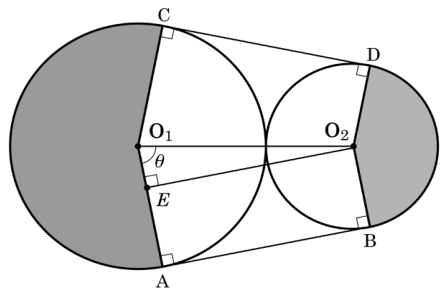
+6점 · 도형의 둘레의 길이를 함수로 나타낼 수 있다. [논제 I-2] (1) 둘레의 길이 l \displaystyle l l O 1 C A \displaystyle O_1CA O 1 C A A B \displaystyle AB A B O 2 B D \displaystyle O_2BD O 2 B D D C \displaystyle DC D C
+8점 · 두 부채꼴의 반지름과 중심각을 구할 수 있다. 사다리꼴 O 1 A B O 2 \displaystyle O_1ABO_2 O 1 A B O 2 O 1 C D O 2 \displaystyle O_1CDO_2 O 1 C D O 2 C O 1 O 2 \displaystyle CO_1O_2 C O 1 O 2 θ \displaystyle \theta θ 따라서 부채꼴 O 1 C A \displaystyle O_1CA O 1 C A 2 π − 2 θ \displaystyle 2\pi-2\theta 2 π − 2 θ 선분 O 1 A \displaystyle O_1A O 1 A O 2 B \displaystyle O_2B O 2 B O 1 C \displaystyle O_1C O 1 C O 2 D \displaystyle O_2D O 2 D 부채꼴 O 2 B D \displaystyle O_2BD O 2 B D 2 θ \displaystyle 2\theta 2 θ 원 O 1 \displaystyle O_1 O 1 ( O 1 A ‾ ) \displaystyle (\overline{O_1A}) ( O 1 A ) r 1 \displaystyle r_1 r 1 O 2 \displaystyle O_2 O 2 ( O 2 B ‾ ) \displaystyle (\overline{O_2B}) ( O 2 B ) r 2 \displaystyle r_2 r 2 r 1 + r 2 = 1 \displaystyle r_1+r_2=1 r 1 + r 2 = 1 r 1 − r 2 = O 1 O 2 ‾ cos θ = cos θ \displaystyle r_1-r_2=\overline{O_1O_2}\cos\theta=\cos\theta r 1 − r 2 = O 1 O 2 cos θ = cos θ r 1 = 1 + cos θ 2 \displaystyle r_1=\frac{1+\cos\theta}2 r 1 = 2 1 + cos θ r 2 = 1 − cos θ 2 \displaystyle r_2=\frac{1-\cos\theta}2 r 2 = 2 1 − cos θ
+6점 · 도형의 둘레의 길이를 함수로 나타낼 수 있다. 따라서 부채꼴 O 1 C A \displaystyle O_1CA O 1 C A l 1 = r 1 ( 2 π − 2 θ ) = ( π − θ ) ( 1 + cos θ ) \displaystyle l_1=r_1(2\pi-2\theta)=(\pi-\theta)(1+\cos\theta) l 1 = r 1 ( 2 π − 2 θ ) = ( π − θ ) ( 1 + cos θ ) 부채꼴 O 2 B D \displaystyle O_2BD O 2 B D l 2 = r 2 ( 2 θ ) = θ ( 1 − cos θ ) \displaystyle l_2=r_2(2\theta)=\theta(1-\cos\theta) l 2 = r 2 ( 2 θ ) = θ ( 1 − cos θ ) 선분 A B \displaystyle AB A B D C \displaystyle DC D C O 1 O 2 ‾ sin θ = sin θ \displaystyle \overline{O_1O_2}\sin\theta=\sin\theta O 1 O 2 sin θ = sin θ 그러므로 l ( θ ) = ( π − θ ) ( 1 + cos θ ) + θ ( 1 − cos θ ) + 2 sin θ = π + 2 sin θ + ( π − 2 θ ) cos θ \displaystyle l(\theta)=(\pi-\theta)(1+\cos\theta)+\theta(1-\cos\theta)+2\sin\theta=\pi+2\sin\theta+(\pi-2\theta)\cos\theta l ( θ ) = ( π − θ ) ( 1 + cos θ ) + θ ( 1 − cos θ ) + 2 sin θ = π + 2 sin θ + ( π − 2 θ ) cos θ
+4점 · 둘레의 길이의 도함수를 구하고, 증가, 감소를 찾을 수 있다. l ′ ( θ ) = 2 cos θ − 2 cos θ − ( π − 2 θ ) sin θ = ( 2 θ − π ) sin θ \displaystyle l^{\prime}(\theta)=2\cos\theta-2\cos\theta-(\pi-2\theta)\sin\theta=(2\theta-\pi)\sin\theta l ′ ( θ ) = 2 cos θ − 2 cos θ − ( π − 2 θ ) sin θ = ( 2 θ − π ) sin θ π 6 ≤ θ ≤ 2 π 3 \displaystyle \frac\pi6\le\theta\le\frac{2\pi}3 6 π ≤ θ ≤ 3 2 π sin θ > 0 \displaystyle \sin\theta>0 sin θ > 0 따라서 π 6 ≤ θ < π 2 \displaystyle \frac\pi6\le\theta<\frac\pi2 6 π ≤ θ < 2 π l ′ ( θ ) < 0 \displaystyle l^{\prime}(\theta)<0 l ′ ( θ ) < 0 θ = π 2 \displaystyle \theta=\frac\pi2 θ = 2 π l ′ ( θ ) = 0 \displaystyle l^{\prime}(\theta)=0 l ′ ( θ ) = 0 π 2 < θ ≤ 2 π 3 \displaystyle \frac\pi2<\theta\le\frac{2\pi}3 2 π < θ ≤ 3 2 π l ′ ( θ ) > 0 \displaystyle l^{\prime}(\theta)>0 l ′ ( θ ) > 0 그러므로 l ( θ ) \displaystyle l(\theta) l ( θ ) θ = π 2 \displaystyle \theta=\frac\pi2 θ = 2 π
+6점 · 둘레의 길이의 최댓값을 구하고 그 근거를 논술할 수 있다. l ( π 6 ) = π + 1 + 3 π 3 \displaystyle l\left(\frac\pi6\right)=\pi+1+\frac{\sqrt3\pi}3 l ( 6 π ) = π + 1 + 3 3 π l ( 2 π 3 ) = π + 3 + π 6 \displaystyle l\left(\frac{2\pi}3\right)=\pi+\sqrt3+\frac\pi6 l ( 3 2 π ) = π + 3 + 6 π π > 3 \displaystyle \pi>3 π > 3 l ( 2 π 3 ) − l ( π 6 ) = 3 − 1 − 2 3 − 1 6 π < 3 − 1 − 2 3 − 1 6 × 3 = − 1 2 < 0 \displaystyle \begin{aligned}l\left(\frac{2\pi}3\right)-l\left(\frac\pi6\right)&=\sqrt3-1-\frac{2\sqrt3-1}6\pi\\&<\sqrt3-1-\frac{2\sqrt3-1}6\times3=-\frac12<0\end{aligned} l ( 3 2 π ) − l ( 6 π ) = 3 − 1 − 6 2 3 − 1 π < 3 − 1 − 6 2 3 − 1 × 3 = − 2 1 < 0 l ( θ ) \displaystyle l(\theta) l ( θ ) θ = π 6 \displaystyle \theta=\frac\pi6 θ = 6 π π + 1 + 3 π 3 \displaystyle \pi+1+\frac{\sqrt3\pi}3 π + 1 + 3 3 π
+6점 · 도형의 넓이를 함수로 나타낼 수 있다. (2) 넓이 S \displaystyle S S O 1 C A \displaystyle O_1CA O 1 C A O 2 B D \displaystyle O_2BD O 2 B D O 1 A B O 2 \displaystyle O_1ABO_2 O 1 A B O 2 O 1 C D O 2 \displaystyle O_1CDO_2 O 1 C D O 2 (1)에서 구한 부채꼴의 반지름과 중심각의 크기를 이용하면 부채꼴 O 1 C A \displaystyle O_1CA O 1 C A 1 2 r 1 2 ( 2 π − 2 θ ) = 1 4 ( π − θ ) ( 1 + cos θ ) 2 \displaystyle \frac12r_1^2(2\pi-2\theta)=\frac14(\pi-\theta)(1+\cos\theta)^2 2 1 r 1 2 ( 2 π − 2 θ ) = 4 1 ( π − θ ) ( 1 + cos θ ) 2 부채꼴 O 2 B D \displaystyle O_2BD O 2 B D 1 2 r 2 2 ( 2 θ ) = 1 4 θ ( 1 − cos θ ) 2 \displaystyle \frac12r_2^2(2\theta)=\frac14\theta(1-\cos\theta)^2 2 1 r 2 2 ( 2 θ ) = 4 1 θ ( 1 − cos θ ) 2 사다리꼴 O 1 A B O 2 \displaystyle O_1ABO_2 O 1 A B O 2 O 1 C D O 2 \displaystyle O_1CDO_2 O 1 C D O 2 1 2 ( r 1 + r 2 ) A B ‾ = 1 2 sin θ \displaystyle \frac12(r_1+r_2)\overline{AB}=\frac12\sin\theta 2 1 ( r 1 + r 2 ) A B = 2 1 sin θ 그러므로 S ( θ ) = 1 4 ( π − θ ) ( 1 + cos θ ) 2 + 1 2 sin θ + 1 2 sin θ + 1 4 θ ( 1 − cos θ ) 2 = π 4 + sin θ + π 2 cos θ + π 4 cos 2 θ − θ cos θ . \displaystyle \begin{aligned}S(\theta)&=\frac14(\pi-\theta)(1+\cos\theta)^2+\frac12\sin\theta+\frac12\sin\theta+\frac14\theta(1-\cos\theta)^2\\&=\frac\pi4+\sin\theta+\frac\pi2\cos\theta+\frac\pi4\cos^2\theta-\theta\cos\theta.\end{aligned} S ( θ ) = 4 1 ( π − θ ) ( 1 + cos θ ) 2 + 2 1 sin θ + 2 1 sin θ + 4 1 θ ( 1 − cos θ ) 2 = 4 π + sin θ + 2 π cos θ + 4 π cos 2 θ − θ cos θ .
+8점 · 넓이의 도함수를 구하고, 증가, 감소를 찾을 수 있다. S ′ ( θ ) = cos θ − π 2 sin θ − π 2 cos θ sin θ − cos θ + θ sin θ = ( θ − π 2 − π 2 cos θ ) sin θ = ( θ − π 2 ) sin θ − π 2 cos θ sin θ . \displaystyle \begin{aligned}S^{\prime}(\theta)&=\cos\theta-\frac\pi2\sin\theta-\frac\pi2\cos\theta\sin\theta-\cos\theta+\theta\sin\theta\\&=\left(\theta-\frac\pi2-\frac\pi2\cos\theta\right)\sin\theta=\left(\theta-\frac\pi2\right)\sin\theta-\frac\pi2\cos\theta\sin\theta.\end{aligned} S ′ ( θ ) = cos θ − 2 π sin θ − 2 π cos θ sin θ − cos θ + θ sin θ = ( θ − 2 π − 2 π cos θ ) sin θ = ( θ − 2 π ) sin θ − 2 π cos θ sin θ . θ = π 2 \displaystyle \theta=\frac\pi2 θ = 2 π S ′ ( π 2 ) = 0 \displaystyle S^{\prime}\left(\frac\pi2\right)=0 S ′ ( 2 π ) = 0 π 6 ≤ θ < π 2 \displaystyle \frac\pi6\le\theta<\frac\pi2 6 π ≤ θ < 2 π θ − π 2 < 0 \displaystyle \theta-\frac\pi2<0 θ − 2 π < 0 − π 2 cos θ < 0 \displaystyle -\frac\pi2\cos\theta<0 − 2 π cos θ < 0 sin θ > 0 \displaystyle \sin\theta>0 sin θ > 0 S ′ ( θ ) < 0 \displaystyle S^{\prime}(\theta)<0 S ′ ( θ ) < 0 π 2 < θ ≤ 2 π 3 \displaystyle \frac\pi2<\theta\le\frac{2\pi}3 2 π < θ ≤ 3 2 π θ − π 2 > 0 \displaystyle \theta-\frac\pi2>0 θ − 2 π > 0 − π 2 cos θ > 0 \displaystyle -\frac\pi2\cos\theta>0 − 2 π cos θ > 0 sin θ > 0 \displaystyle \sin\theta>0 sin θ > 0 S ′ ( θ ) > 0 \displaystyle S^{\prime}(\theta)>0 S ′ ( θ ) > 0
+2점 · 넓이의 최솟값을 구하고 그 근거를 논술할 수 있다. 따라서 S ( θ ) \displaystyle S(\theta) S ( θ ) θ = π 2 \displaystyle \theta=\frac\pi2 θ = 2 π π 4 + 1 \displaystyle \frac\pi4+1 4 π + 1
 수리논술, 배움에서 논증의 완성까지.