수리논술, 배움에서 논증의 완성까지.

자연계열 (토요일) 1-2번

문제

[가] 점 (x1,y1)\displaystyle ( x_{1} , y_{1} )을 지나고 기울기가 m\displaystyle m인 직선의 방정식은y−y1=m(x−x1)\displaystyle y - y_{1} = m ( x - x_{1} )[나] 함수 f(x)\displaystyle f ( x )가 임의의 세 실수 a\displaystyle a, b\displaystyle b, c\displaystyle c를 포함하는 닫힌구간에서 연속일 때,∫acf(x)dx+∫cbf(x)dx=∫abf(x)dx\displaystyle \int_{a}^{c} f ( x ) d x + \int_{c}^{b} f ( x ) d x = \int_{a}^{b} f ( x ) d x[다] 삼각함수의 도함수(sin⁡x)′=cos⁡x\displaystyle ( \sin x )^{\prime} = \cos x, (cos⁡x)′=−sin⁡x\displaystyle ( \cos x )^{\prime} = - \sin x, (tan⁡x)′=sec⁡2x\displaystyle ( \tan x )^{\prime} = \sec^{2} x(csc⁡x)′=−csc⁡xcot⁡x\displaystyle ( \csc x )^{\prime} = - \csc x \cot x, (sec⁡x)′=sec⁡xtan⁡x\displaystyle ( \sec x )^{\prime} = \sec x \tan x, (cot⁡x)′=−csc⁡2x\displaystyle ( \cot x )^{\prime} = - \csc^{2} x[라] 삼각함수의 덧셈정리(1) sin⁡(α+β)=sin⁡αcos⁡β+cos⁡αsin⁡β\displaystyle \sin ( \alpha + \beta ) = \sin \alpha \cos \beta + \cos \alpha \sin \beta, sin⁡(α−β)=sin⁡αcos⁡β−cos⁡αsin⁡β\displaystyle \sin ( \alpha - \beta ) = \sin \alpha \cos \beta - \cos \alpha \sin \beta(2) cos⁡(α+β)=cos⁡αcos⁡β−sin⁡αsin⁡β\displaystyle \cos ( \alpha + \beta ) = \cos \alpha \cos \beta - \sin \alpha \sin \beta, cos⁡(α−β)=cos⁡αcos⁡β+sin⁡αsin⁡β\displaystyle \cos ( \alpha - \beta ) = \cos \alpha \cos \beta + \sin \alpha \sin \beta(3) tan⁡(α+β)=tan⁡α+tan⁡β1−tan⁡αtan⁡β\displaystyle \tan ( \alpha + \beta )=\frac{{\tan \alpha + \tan \beta}}{1 - \tan \alpha \tan \beta}, tan⁡(α−β)=tan⁡α−tan⁡β1+tan⁡αtan⁡β\displaystyle \tan ( \alpha - \beta ) =\frac{{\tan \alpha - \tan \beta}}{1 + \tan \alpha \tan \beta}[마] 함수 f(x)\displaystyle f ( x )가 어떤 구간에 속하는 임의의 두 실수 x1\displaystyle x_{1}, x2\displaystyle x_{2}에 대하여 x1<x2\displaystyle x_{1} < x_{2}일 때 f(x1)<f(x2)\displaystyle f ( x_{1} ) < f ( x_{2} )이면 함수 f(x)\displaystyle f ( x )는 그 구간에서 증가한다고 한다. 또, x1<x2\displaystyle x_{1} < x_{2}일 때 f(x1)>f(x2)\displaystyle f ( x_{1} ) > f ( x_{2} )이면 함수 f(x)\displaystyle f ( x )는 그 구간에서 감소한다고 한다. 함수 f(x)\displaystyle f ( x )가 어떤 열린구간에서 미분가능할 때, 그 열린구간에 속하는 모든 x\displaystyle x에 대하여(1) f′(x)>0\displaystyle f^{\prime} ( x ) > 0이면 f(x)\displaystyle f ( x )는 그 열린구간에서 증가한다.(2) f′(x)<0\displaystyle f^{\prime} ( x ) < 0이면 f(x)\displaystyle f ( x )는 그 열린구간에서 감소한다.

[논제 I] 제시문 [가]~[마]를 읽고 다음 질문에 답하시오.

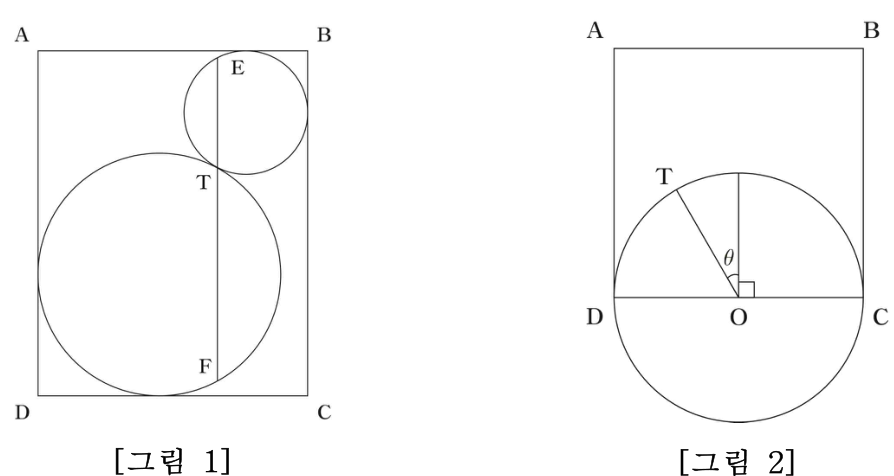
그림 1: 직사각형과 두 원, 그림 2: 정사각형과 원의 접선

[논제 I-2] 넓이가 4인 정사각형 ABCD와 변 CD의 중점 O를 중심으로 하고 반지름의 길이가 1인 원이 있다. [그림 2]와 같이 사각형 ABCD의 내부에 있는 원 위의 한 점을 T라 하자. 점 O에서 시작하고 선분 AB의 중점을 지나는 반직선으로부터 반시계방향으로 선분 OT까지의 각을 θ\displaystyle \theta라 하고, 점 T에서 원에 접하는 직선을 l\displaystyle l이라 할 때, 다음 물음에 답하시오. (단, 0≤θ<π2\displaystyle 0 \leq \theta < \frac{{\pi}}{2})

(1) 직선 l\displaystyle l이 점 B를 지날 때, sin⁡θ\displaystyle \sin \theta, cos⁡θ\displaystyle \cos \theta, tan⁡θ\displaystyle \tan \theta를 각각 구하고, 그 근거를 논술하시오. (5점)

(2) 직선 l\displaystyle l이 정사각형 ABCD와 만나는 두 점 사이의 거리를 θ\displaystyle \theta에 관한 함수 f(θ)\displaystyle f ( \theta )로 나타내고, 그 근거를 논술하시오. (15점)

(3) [논제 I-2] (2)에서의 f(θ)\displaystyle f ( \theta )에 대하여J=∫0π4(f(θ)sin⁡θcos⁡θ−cos⁡θ)dθ\displaystyle J = \int_{0}^{\frac{\pi}{4}} ( f ( \theta ) \sin \theta \cos \theta - \cos \theta ) d \theta일 때, sin⁡J\displaystyle \sin J의 값을 계산하고, 그 과정을 논술하시오. (10점)

해설강의 준비중
+5점 · 접선의 방정식을 통해 삼각함수의 값을 정확히 제시한다.

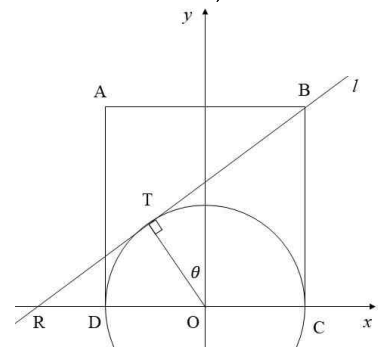
[논제 I-2](1) 오른쪽 그림과 같이 좌표평면의 원점에 원의 중심 O가 위치하고, 네 점 A(−1,2), B(1,2), C(1,0), D(−1,0)\displaystyle A(-1,2),\ B(1,2),\ C(1,0),\ D(-1,0)인 상황을 생각하면, 점 T는 T(−sin⁡θ,cos⁡θ)\displaystyle T(-\sin\theta,\cos\theta)이다.

정사각형과 접선의 좌표

T에서 원에 접하는 직선 l\displaystyle l이 x\displaystyle x축과 만나는 점을 R이라 하면, ∠ROT=π2−θ\displaystyle \angle ROT=\frac\pi2-\theta이므로 ∠ORT=θ\displaystyle \angle ORT=\theta이다.Comment. θ=0\displaystyle \theta=0이면 접선은 y=1\displaystyle y=1이므로 x\displaystyle x축과 만나는 점 R\displaystyle R은 존재하지 않는다. 이 경우는 직접 확인하면 접선의 식과 f(0)=2\displaystyle f(0)=2를 얻는다.따라서 직선 l\displaystyle l의 방정식은l: y=(tan⁡θ)x+sec⁡θ\displaystyle l:\ y=(\tan\theta)x+\sec\theta …… ①이다.직선 l\displaystyle l이 B(1,2)\displaystyle B(1,2)를 지날 때의 θ\displaystyle \theta를 α(0≤α<π2)\displaystyle \alpha\left(0\le\alpha<\frac\pi2\right)라 하면, ①에 의해 2=tan⁡α+sec⁡α\displaystyle 2=\tan\alpha+\sec\alpha이므로 2cos⁡α=sin⁡α+1\displaystyle 2\cos\alpha=\sin\alpha+1이다. 21−sin⁡2α=sin⁡α+1\displaystyle 2\sqrt{1-\sin^2\alpha}=\sin\alpha+1에 의해 sin⁡α=35,cos⁡α=45,tan⁡α=34\displaystyle \sin\alpha=\frac35,\quad\cos\alpha=\frac45,\quad\tan\alpha=\frac34이다.

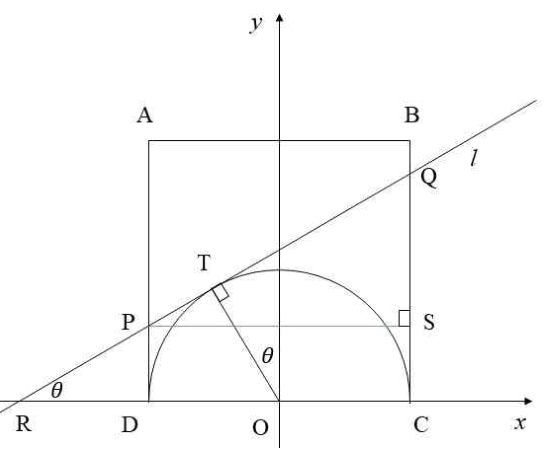
(2) 직선 l\displaystyle l이 정사각형 ABCD와 만나는 두 점 중에서 선분 AD와 만나는 점을 P라 하고, 나머지 한 점을 Q라 하자.

접선이 선분 BC와 만나는 경우
+5점 · 접선이 선분 BC와 만날 때의 f(θ)\displaystyle f(\theta)를 정확히 제시한다.

i) 직선 l\displaystyle l이 선분 BC와 만날 때, [논제 I-2] (1)의 결과에 의해 θ\displaystyle \theta의 범위는 0≤θ≤α\displaystyle 0\le\theta\le\alpha이다.오른쪽 그림과 같이 점 P를 지나고 선분 AB에 평행한 직선이 선분 BC와 만나는 점을 S라 하면, 삼각형 PQS는 선분 PS의 길이가 2이고 ∠QPS\displaystyle \angle QPS가 θ\displaystyle \theta이며 ∠PSQ\displaystyle \angle PSQ가 π2\displaystyle \frac\pi2인 직각삼각형이다.cos⁡θ=2PQ‾\displaystyle \cos\theta=\frac2{\overline{PQ}}이므로, 선분 PQ의 길이는 2sec⁡θ\displaystyle 2\sec\theta이다.

+10점 · 접선이 선분 AB와 만날 때의 f(θ)\displaystyle f(\theta)를 정확히 제시한다.

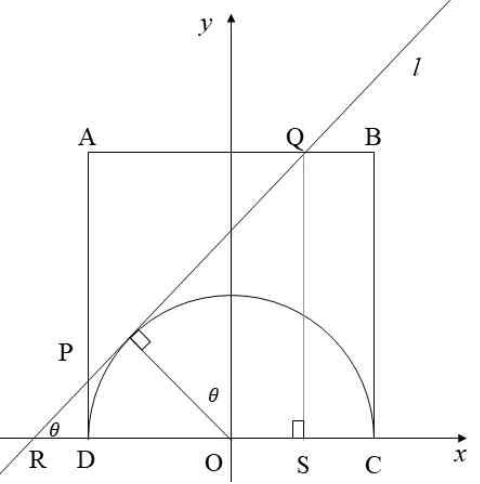
ii) 직선 l\displaystyle l이 선분 AB와 만날 때, [논제 I-2] (1)의 결과에 의해 θ\displaystyle \theta의 범위는 α≤θ<π2\displaystyle \alpha\le\theta<\frac\pi2이다.T에서 원에 접하는 직선 l\displaystyle l의 방정식 y=(tan⁡θ)x+sec⁡θ\displaystyle y=(\tan\theta)x+\sec\theta에 의해 직선 l\displaystyle l이 x\displaystyle x축과 만나는 점 R의 좌표는 (−csc⁡θ,0)\displaystyle (-\csc\theta,0)이다.

접선이 선분 AB와 만나는 경우

점 Q를 지나고 선분 BC에 평행한 직선이 선분 CD와 만나는 점을 S라 하면, 삼각형 QRS는 선분 QS의 길이가 2이고, ∠QRS\displaystyle \angle QRS가 θ\displaystyle \theta이며 ∠QSR\displaystyle \angle QSR이 π2\displaystyle \frac\pi2인 직각삼각형이다. 따라서 sin⁡θ=QS‾QR‾=2QR‾\displaystyle \sin\theta=\frac{\overline{QS}}{\overline{QR}}=\frac2{\overline{QR}}로부터QR‾=2csc⁡θ\displaystyle \overline{QR}=2\csc\theta …… ①이다.삼각형 RPD는 선분 DR의 길이가 csc⁡θ−1\displaystyle \csc\theta-1이고 ∠PRD\displaystyle \angle PRD가 θ\displaystyle \theta이며 ∠RDP\displaystyle \angle RDP가 π2\displaystyle \frac\pi2인 직각삼각형이다. 따라서 cos⁡θ=DR‾PR‾=csc⁡θ−1PR‾\displaystyle \cos\theta=\frac{\overline{DR}}{\overline{PR}}=\frac{\csc\theta-1}{\overline{PR}}로부터PR‾=csc⁡θsec⁡θ−sec⁡θ\displaystyle \overline{PR}=\csc\theta\sec\theta-\sec\theta …… ②이며, ①과 ②에 의해 PQ‾=QR‾−PR‾=2csc⁡θ+sec⁡θ−csc⁡θsec⁡θ\displaystyle \overline{PQ}=\overline{QR}-\overline{PR}=2\csc\theta+\sec\theta-\csc\theta\sec\theta이다.i)과 ii)에 의해, 함수 f(θ)\displaystyle f(\theta)는f(θ)={2sec⁡θ(0≤θ≤α)2csc⁡θ+sec⁡θ−csc⁡θsec⁡θ(α≤θ<π2)\displaystyle f(\theta)=\begin{cases}2\sec\theta&(0\le\theta\le\alpha)\\2\csc\theta+\sec\theta-\csc\theta\sec\theta&\left(\alpha\le\theta<\frac\pi2\right)\end{cases}이다.

+6점 · 적분구간을 명시하고 적분을 삼각함수를 이용하여 정확히 표현한다.

(3) tan⁡θ\displaystyle \tan\theta는 0≤θ<π2\displaystyle 0\le\theta<\frac\pi2에서 증가함수이고, [논제 I-2]의 (1)에 의해 tan⁡α=34, tan⁡π4=1\displaystyle \tan\alpha=\frac34,\ \tan\frac\pi4=1이므로 0≤α≤π4\displaystyle 0\le\alpha\le\frac\pi4이다. 따라서J=∫0π4(f(θ)sin⁡θcos⁡θ−cos⁡θ) dθ=∫0α(f(θ)sin⁡θcos⁡θ−cos⁡θ) dθ+∫απ4(f(θ)sin⁡θcos⁡θ−cos⁡θ) dθ=∫0α(2sin⁡θ−cos⁡θ) dθ+∫απ4(cos⁡θ+sin⁡θ−1) dθ=2−cos⁡α−2sin⁡α+α−π4\displaystyle \begin{aligned}J&=\int_0^{\frac\pi4}(f(\theta)\sin\theta\cos\theta-\cos\theta)\,d\theta\\&=\int_0^\alpha(f(\theta)\sin\theta\cos\theta-\cos\theta)\,d\theta+\int_\alpha^{\frac\pi4}(f(\theta)\sin\theta\cos\theta-\cos\theta)\,d\theta\\&=\int_0^\alpha(2\sin\theta-\cos\theta)\,d\theta+\int_\alpha^{\frac\pi4}(\cos\theta+\sin\theta-1)\,d\theta\\&=2-\cos\alpha-2\sin\alpha+\alpha-\frac\pi4\end{aligned}이다.

+4점 · 접선이 점 B를 지날 때의 삼각비를 이용하여 적분의 싸인값을 정확히 계산한다.

[논제 I-2] (1)에서 sin⁡α=35, cos⁡α=45\displaystyle \sin\alpha=\frac35,\ \cos\alpha=\frac45이므로 J=α−π4\displaystyle J=\alpha-\frac\pi4이고, 따라서sin⁡J=sin⁡(α−π4)=sin⁡αcos⁡π4−cos⁡αsin⁡π4=−210\displaystyle \sin J=\sin\left(\alpha-\frac\pi4\right)=\sin\alpha\cos\frac\pi4-\cos\alpha\sin\frac\pi4=-\frac{\sqrt2}{10}이다.

첨삭 사례

아직 등록된 첨삭 사례가 없습니다.

질문과 답변 · 0개질문과 답변 · 고정 0개

아직 등록된 질문이 없습니다. 질문 작성은 멤버십 회원만 가능합니다.