수리논술, 배움에서 논증의 완성까지.

의·약학계 1-1번

문제

[가] 두 벡터 a⃗,b⃗\displaystyle \vec a,\vec b의 크기와 방향이 각각 같을 때, 두 벡터 a⃗,b⃗\displaystyle \vec a,\vec b는 서로 같다고 하며, 이것을 기호로 a⃗=b⃗\displaystyle \vec a=\vec b와 같이 나타낸다.[나] 두 평면벡터 a⃗,b⃗\displaystyle \vec a,\vec b가 이루는 각의 크기가 θ (0∘≤θ≤180∘)\displaystyle \theta\ (0^\circ\le\theta\le180^\circ)일 때, 두 벡터의 내적 a⃗⋅b⃗\displaystyle \vec a\cdot\vec b를 다음과 같이 정의한다.a⃗⋅b⃗=∣a⃗∣∣b⃗∣cos⁡θ\displaystyle \vec a\cdot\vec b=|\vec a||\vec b|\cos\theta[다] 좌표평면 위의 두 점 A(x1,y1), B(x2,y2)\displaystyle \mathrm A(x_1,y_1),\ \mathrm B(x_2,y_2) 사이의 거리는AB‾=(x2−x1)2+(y2−y1)2\displaystyle \overline{\mathrm{AB}}=\sqrt{(x_2-x_1)^2+(y_2-y_1)^2}

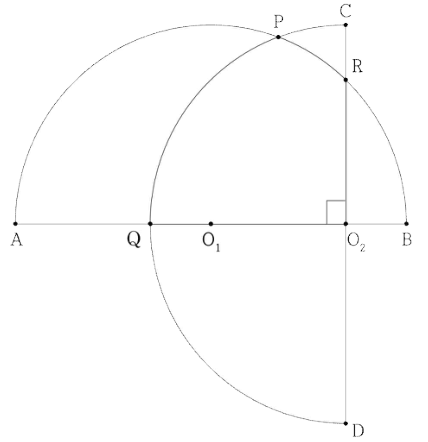
[논제 Ⅰ-1] 아래 그림과 같이 중심이 O1\displaystyle \mathrm O_1이고 선분 AB를 지름으로 하는 반원과 중심이 O2\displaystyle \mathrm O_2이고 선분 CD를 지름으로 하는 반원이 있다. 선분 AB와 선분 CD는 수직이고, AB‾=CD‾=2\displaystyle \overline{\mathrm{AB}}=\overline{\mathrm{CD}}=2이다. 호 AP와 호 QP 위에서 각각 움직이고 있는 점 M과 점 N에 대하여 ∣O1M→+O2N→∣\displaystyle \left|\overrightarrow{\mathrm O_1\mathrm M}+\overrightarrow{\mathrm O_2\mathrm N}\right|의 최솟값이 233\displaystyle \frac{2\sqrt3}3이다. 다음 물음에 답하시오. (단, 점 O2\displaystyle \mathrm O_2는 선분 AB 위에 있다.)

수직인 두 지름의 반원과 점 P, Q, R

(1) 선분 O1O2\displaystyle \mathrm O_1\mathrm O_2의 길이를 구하고, 그 근거를 논술하시오. (16점)

(2) ∣O1M→+O2N→∣\displaystyle \left|\overrightarrow{\mathrm O_1\mathrm M}+\overrightarrow{\mathrm O_2\mathrm N}\right|이 최소일 때 MR‾2\displaystyle \overline{\mathrm{MR}}^2의 값을 구하고, 그 근거를 논술하시오. (12점)

해설강의 준비중
+8점 · ∣O1M→+O2N→∣\displaystyle \left|\overrightarrow{\mathrm O_1\mathrm M}+\overrightarrow{\mathrm O_2\mathrm N}\right|이 최소가 되는 점 M과 점 N의 위치를 파악한다.

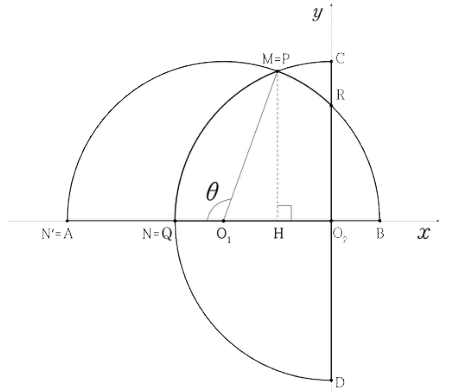
[논제 Ⅰ-1](1) ∣O1M→+O2N→∣\displaystyle \left|\overrightarrow{\mathrm O_1\mathrm M}+\overrightarrow{\mathrm O_2\mathrm N}\right|의 최솟값 233\displaystyle \frac{2\sqrt3}3은 ∣O1M→+O2N→∣2\displaystyle \left|\overrightarrow{\mathrm O_1\mathrm M}+\overrightarrow{\mathrm O_2\mathrm N}\right|^2의 값이 최소일 때 구할 수 있다. 따라서 다음의 식에 따라∣O1M→+O2N→∣2=∣O1M→∣2+2(O1M→⋅O2N→)+∣O2N→∣2=43\displaystyle \left|\overrightarrow{\mathrm O_1\mathrm M}+\overrightarrow{\mathrm O_2\mathrm N}\right|^2=|\overrightarrow{\mathrm O_1\mathrm M}|^2+2(\overrightarrow{\mathrm O_1\mathrm M}\cdot\overrightarrow{\mathrm O_2\mathrm N})+|\overrightarrow{\mathrm O_2\mathrm N}|^2=\frac43두 벡터의 내적 O1M→⋅O2N→\displaystyle \overrightarrow{\mathrm O_1\mathrm M}\cdot\overrightarrow{\mathrm O_2\mathrm N}의 최솟값이 −13\displaystyle -\frac13이 되도록 하는 점 M과 점 N의 위치를 찾도록 한다. 벡터 O2N→\displaystyle \overrightarrow{\mathrm O_2\mathrm N}을 점 O1\displaystyle \mathrm O_1이 시점이 되도록 평행이동한 벡터를 O1N′→\displaystyle \overrightarrow{\mathrm O_1\mathrm N^{\prime}}이라고 하면 O2N→=O1N′→\displaystyle \overrightarrow{\mathrm O_2\mathrm N}=\overrightarrow{\mathrm O_1\mathrm N^{\prime}}이고, 두 벡터 O1M→\displaystyle \overrightarrow{\mathrm O_1\mathrm M}과 O1N′→\displaystyle \overrightarrow{\mathrm O_1\mathrm N^{\prime}}이 이루는 각을 θ\displaystyle \theta라고 할 때, 다음의 식을 얻을 수 있으므로O1M→⋅O2N→=O1M→⋅O1N′→=∣O1M→∣∣O1N′→∣cos⁡θ=cos⁡θ\displaystyle \overrightarrow{\mathrm O_1\mathrm M}\cdot\overrightarrow{\mathrm O_2\mathrm N}=\overrightarrow{\mathrm O_1\mathrm M}\cdot\overrightarrow{\mathrm O_1\mathrm N^{\prime}}=|\overrightarrow{\mathrm O_1\mathrm M}||\overrightarrow{\mathrm O_1\mathrm N^{\prime}}|\cos\theta=\cos\thetaO1M→⋅O2N→\displaystyle \overrightarrow{\mathrm O_1\mathrm M}\cdot\overrightarrow{\mathrm O_2\mathrm N}의 최솟값 −13\displaystyle -\frac13은 cos⁡θ\displaystyle \cos\theta가 최소일 때 구할 수 있다. 이는 θ\displaystyle \theta가 최대일 때이므로, 점 M이 점 P와 일치하고, 점 N′\displaystyle \mathrm N^{\prime}이 점 A와 일치할 때, (즉, 점 N이 점 Q와 일치할 때) 얻을 수 있다. 따라서 두 벡터 O1P→\displaystyle \overrightarrow{\mathrm O_1\mathrm P}와 O1A→\displaystyle \overrightarrow{\mathrm O_1\mathrm A}가 이루는 각이 θ\displaystyle \theta가 되고, cos⁡θ=−13\displaystyle \cos\theta=-\frac13을 만족한다.

+8점 · O1O2‾\displaystyle \overline{\mathrm O_1\mathrm O_2}를 구한다.

이때, 점 P로부터 선분 AB에 내린 수선의 발을 H라고 하면 ∠PO1H=π−θ\displaystyle \angle\mathrm{PO}_1\mathrm H=\pi-\theta이므로 선분 O1H\displaystyle \mathrm O_1\mathrm H의 길이는O1H‾=cos⁡(π−θ)=−cos⁡θ=13\displaystyle \overline{\mathrm O_1\mathrm H}=\cos(\pi-\theta)=-\cos\theta=\frac13따라서 O1H‾=HO2‾\displaystyle \overline{\mathrm O_1\mathrm H}=\overline{\mathrm{HO}_2}이므로O1O2‾=O1H‾+HO2‾=23\displaystyle \overline{\mathrm O_1\mathrm O_2}=\overline{\mathrm O_1\mathrm H}+\overline{\mathrm{HO}_2}=\frac23

+2점 · 주어진 도형을 좌표평면 위에 놓는다.

(2) 아래 그림과 같이 선분 AB를 x\displaystyle x축, 선분 CD를 y\displaystyle y축으로 하는 좌표평면을 잡으면 점 O2\displaystyle \mathrm O_2는 원점이다.

반원과 좌표축 위의 점 O₁, O₂, M, R, H
+6점 · 점 M과 점 R의 좌표를 구한다.

(1)에 의해 직각삼각형 O1O2R\displaystyle \mathrm O_1\mathrm O_2\mathrm R에서 O1(−23,0), O2(0,0)\displaystyle \mathrm O_1\left(-\frac23,0\right),\ \mathrm O_2(0,0)이고, 선분 O2R\displaystyle \mathrm O_2\mathrm R의 길이는O2R‾=1−O1O2‾2=53\displaystyle \overline{\mathrm O_2\mathrm R}=\sqrt{1-\overline{\mathrm O_1\mathrm O_2}^2}=\frac{\sqrt5}3이므로 R(0,53)\displaystyle \mathrm R\left(0,\frac{\sqrt5}3\right)이다.또한 (1)에서 점 M은 점 P와 일치하고, O1H‾=HO2‾=13\displaystyle \overline{\mathrm O_1\mathrm H}=\overline{\mathrm{HO}_2}=\frac13이므로 H(−13,0)\displaystyle \mathrm H\left(-\frac13,0\right)이다. 선분 MH의 길이는MH‾=sin⁡(π−θ)=1−cos⁡2(π−θ)=223\displaystyle \overline{\mathrm{MH}}=\sin(\pi-\theta)=\sqrt{1-\cos^2(\pi-\theta)}=\frac{2\sqrt2}3이므로 M(−13,223)\displaystyle \mathrm M\left(-\frac13,\frac{2\sqrt2}3\right)이다.

+4점 · MR‾2\displaystyle \overline{\mathrm{MR}}^2을 구한다.

따라서 MR‾2=(13)2+(53−223)2=149−4109\displaystyle \overline{\mathrm{MR}}^2=\left(\frac13\right)^2+\left(\frac{\sqrt5}3-\frac{2\sqrt2}3\right)^2=\frac{14}9-\frac{4\sqrt{10}}9.

첨삭 사례

아직 등록된 첨삭 사례가 없습니다.

질문과 답변 · 0개질문과 답변 · 고정 0개

아직 등록된 질문이 없습니다. 질문 작성은 멤버십 회원만 가능합니다.