1. 상수함수와 지수함수는 R \displaystyle R R x ≠ 0 \displaystyle x\ne0 x = 0 f \displaystyle f f x = 0 \displaystyle x=0 x = 0
f ′ ( 0 ) = lim t → 0 f ( t ) − f ( 0 ) t = lim t → 0 f ( t ) t \displaystyle f^{\prime}(0)=\lim_{t\to0}\frac{f(t)-f(0)}t=\lim_{t\to0}\frac{f(t)}t f ′ ( 0 ) = t → 0 lim t f ( t ) − f ( 0 ) = t → 0 lim t f ( t )
에서 주어진 조건으로부터
lim t → − 0 f ( t ) t = lim t → 0 − 0 t = 0 , \displaystyle \lim_{t\to-0}\frac{f(t)}t=\lim_{t\to0^-}\frac0t=0, t → − 0 lim t f ( t ) = t → 0 − lim t 0 = 0 ,
lim t → + 0 f ( t ) t = lim t → + 0 e − 1 / t t = lim t → + 0 1 / t e 1 / t = lim s → ∞ 1 e s = 0 \displaystyle \lim_{t\to+0}\frac{f(t)}t=\lim_{t\to+0}\frac{e^{-1/t}}t=\lim_{t\to+0}\frac{1/t}{e^{1/t}}=\lim_{s\to\infty}\frac1{e^s}=0 t → + 0 lim t f ( t ) = t → + 0 lim t e − 1/ t = t → + 0 lim e 1/ t 1/ t = s → ∞ lim e s 1 = 0
이다. 따라서 f ′ ( 0 ) \displaystyle f^{\prime}(0) f ′ ( 0 ) f ′ ( 0 ) = 0 \displaystyle f^{\prime}(0)=0 f ′ ( 0 ) = 0 f ( x ) \displaystyle f(x) f ( x ) x = 0 \displaystyle x=0 x = 0
2. 수학적 귀납법을 사용하자.
먼저 f ′ ( 0 ) = 0 \displaystyle f^{\prime}(0)=0 f ′ ( 0 ) = 0 f \displaystyle f f n − 1 \displaystyle n-1 n − 1 f ( n − 1 ) ( x ) \displaystyle f^{(n-1)}(x) f ( n − 1 ) ( x ) f ( n − 1 ) ( 0 ) = 0 \displaystyle f^{(n-1)}(0)=0 f ( n − 1 ) ( 0 ) = 0
f ( n ) ( 0 ) = lim t → 0 f ( n − 1 ) ( t ) − f ( n − 1 ) ( 0 ) t = lim t → 0 f ( n − 1 ) ( t ) t \displaystyle f^{(n)}(0)=\lim_{t\to0}\frac{f^{(n-1)}(t)-f^{(n-1)}(0)}t=\lim_{t\to0}\frac{f^{(n-1)}(t)}t f ( n ) ( 0 ) = t → 0 lim t f ( n − 1 ) ( t ) − f ( n − 1 ) ( 0 ) = t → 0 lim t f ( n − 1 ) ( t )
를 구하는 계산에 있어, t < 0 \displaystyle t<0 t < 0 f ( n − 1 ) ( t ) = 0 \displaystyle f^{(n-1)}(t)=0 f ( n − 1 ) ( t ) = 0 lim t → − 0 f ( n − 1 ) ( t ) t = lim t → − 0 0 t = 0 \displaystyle \lim_{t\to-0}\frac{f^{(n-1)}(t)}t=\lim_{t\to-0}\frac0t=0 t → − 0 lim t f ( n − 1 ) ( t ) = t → − 0 lim t 0 = 0 t > 0 \displaystyle t>0 t > 0
f ′ ( t ) = 1 t 2 e − 1 / t , \displaystyle f^{\prime}(t)=\frac1{t^2}e^{-1/t}, f ′ ( t ) = t 2 1 e − 1/ t ,
f ′ ′ ( t ) = ( − 2 t 3 + 1 t 4 ) e − 1 / t , \displaystyle f^{\prime\prime}(t)=\left(-\frac2{t^3}+\frac1{t^4}\right)e^{-1/t}, f ′′ ( t ) = ( − t 3 2 + t 4 1 ) e − 1/ t ,
...
f ( n − 1 ) ( t ) = P ( 1 t ) e − 1 / t \displaystyle f^{(n-1)}(t)=P\left(\frac1t\right)e^{-1/t} f ( n − 1 ) ( t ) = P ( t 1 ) e − 1/ t P ( t ) \displaystyle P(t) P ( t ) t \displaystyle t t
이 됨을 알 수 있다.
따라서 로피탈의 정리를 사용하면
lim t → + 0 f ( n − 1 ) ( t ) t = lim t → + 0 P ( 1 / t ) e − 1 / t t = lim s → ∞ s P ( s ) e s = 0 \displaystyle \lim_{t\to+0}\frac{f^{(n-1)}(t)}t=\lim_{t\to+0}\frac{P(1/t)e^{-1/t}}t=\lim_{s\to\infty}\frac{sP(s)}{e^s}=0 t → + 0 lim t f ( n − 1 ) ( t ) = t → + 0 lim t P ( 1/ t ) e − 1/ t = s → ∞ lim e s s P ( s ) = 0
이 됨을 알수 있다. 따라서 f ( n ) ( 0 ) = 0 \displaystyle f^{(n)}(0)=0 f ( n ) ( 0 ) = 0
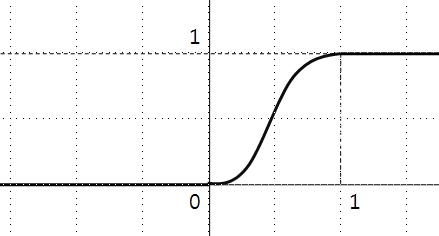
3. f \displaystyle f f h \displaystyle h h 0 \displaystyle 0 0 f \displaystyle f f h \displaystyle h h
또한 f ≥ 0 \displaystyle f\ge0 f ≥ 0 0 ≤ h ( x ) ≤ 1 \displaystyle 0\le h(x)\le1 0 ≤ h ( x ) ≤ 1
x ≤ 0 \displaystyle x\le0 x ≤ 0 f ( x ) = 0 \displaystyle f(x)=0 f ( x ) = 0 h ( x ) = 0 \displaystyle h(x)=0 h ( x ) = 0
그리고 x ≥ 1 \displaystyle x\ge1 x ≥ 1 f ( 1 − x ) = 0 \displaystyle f(1-x)=0 f ( 1 − x ) = 0 h ( x ) = 1 \displaystyle h(x)=1 h ( x ) = 1
또한 0 ≤ x ≤ 1 \displaystyle 0\le x\le1 0 ≤ x ≤ 1 h ′ ( x ) ≥ 0 \displaystyle h^{\prime}(x)\ge0 h ′ ( x ) ≥ 0 h \displaystyle h h
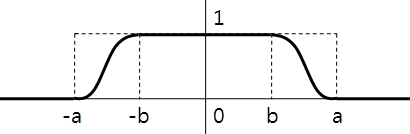
4. 함수 h \displaystyle h h g \displaystyle g g ∣ x ∣ ≥ a \displaystyle |x|\ge a ∣ x ∣ ≥ a g ( x ) = 0 \displaystyle g(x)=0 g ( x ) = 0 h \displaystyle h h g \displaystyle g g ∣ x ∣ ≥ b \displaystyle |x|\ge b ∣ x ∣ ≥ b g ( x ) = 1 \displaystyle g(x)=1 g ( x ) = 1 g \displaystyle g g Correction. g ( x ) = 1 \displaystyle g(x)=1 g ( x ) = 1 ∣ x ∣ ≥ b \displaystyle |x|\ge b ∣ x ∣ ≥ b ∣ x ∣ ≤ b \displaystyle |x|\le b ∣ x ∣ ≤ b
실제로 g \displaystyle g g ( − ∞ , − a ) \displaystyle (-\infty,-a) ( − ∞ , − a ) ( − b , b ) \displaystyle (-b,b) ( − b , b ) ( a , ∞ ) \displaystyle (a,\infty) ( a , ∞ ) g \displaystyle g g 0 \displaystyle 0 0 1 \displaystyle 1 1 g ′ ( x ) = 0 \displaystyle g^{\prime}(x)=0 g ′ ( x ) = 0 ( − a , − b ) \displaystyle (-a,-b) ( − a , − b ) ( b , a ) \displaystyle (b,a) ( b , a ) g \displaystyle g g g \displaystyle g g
g ′ ( x ) = 1 a − b [ h ′ ( x + a a − b ) h ( − x + a a − b ) − h ( x + a a − b ) h ′ ( − x + a a − b ) ] . \displaystyle g^{\prime}(x)=\frac1{a-b}\left[h^{\prime}\left(\frac{x+a}{a-b}\right)h\left(\frac{-x+a}{a-b}\right)-h\left(\frac{x+a}{a-b}\right)h^{\prime}\left(\frac{-x+a}{a-b}\right)\right]. g ′ ( x ) = a − b 1 [ h ′ ( a − b x + a ) h ( a − b − x + a ) − h ( a − b x + a ) h ′ ( a − b − x + a ) ] .
한편 구간 ( − a , − b ) \displaystyle (-a,-b) ( − a , − b ) 0 < x + a a − b < 1 \displaystyle 0<\frac{x+a}{a-b}<1 0 < a − b x + a < 1 − x + a a − b > 1 \displaystyle \frac{-x+a}{a-b}>1 a − b − x + a > 1 ( b , a ) \displaystyle (b,a) ( b , a ) x + a a − b > 1 \displaystyle \frac{x+a}{a-b}>1 a − b x + a > 1 0 < − x + a a − b < 1 \displaystyle 0<\frac{-x+a}{a-b}<1 0 < a − b − x + a < 1 h \displaystyle h h ( − ∞ , 0 ) \displaystyle (-\infty,0) ( − ∞ , 0 ) ( 1 , ∞ ) \displaystyle (1,\infty) ( 1 , ∞ ) 0 \displaystyle 0 0 ( 0 , 1 ) \displaystyle (0,1) ( 0 , 1 ) ( − a , − b ) \displaystyle (-a,-b) ( − a , − b )
g ′ ( x ) = 1 a − b h ′ ( x + a a − b ) h ( − x + a a − b ) ≥ 0 \displaystyle g^{\prime}(x)=\frac1{a-b}h^{\prime}\left(\frac{x+a}{a-b}\right)h\left(\frac{-x+a}{a-b}\right)\ge0 g ′ ( x ) = a − b 1 h ′ ( a − b x + a ) h ( a − b − x + a ) ≥ 0
구간 ( b , a ) \displaystyle (b,a) ( b , a )
g ′ ( x ) = − 1 a − b h ( x + a a − b ) h ′ ( − x + a a − b ) ≤ 0 \displaystyle g^{\prime}(x)=-\frac1{a-b}h\left(\frac{x+a}{a-b}\right)h^{\prime}\left(\frac{-x+a}{a-b}\right)\le0 g ′ ( x ) = − a − b 1 h ( a − b x + a ) h ′ ( a − b − x + a ) ≤ 0 g \displaystyle g g ( − a , − b ) \displaystyle (-a,-b) ( − a , − b ) ( b , a ) \displaystyle (b,a) ( b , a )
 수리논술, 배움에서 논증의 완성까지.