수리논술, 배움에서 논증의 완성까지.

자연계열 2번

문제

🔒
짧은 시간에 너무 많은 문제를 여셔서 열람을 잠시 제한했습니다. 잠시 후 다시 시도하시거나 로그인해 주세요.
해설강의 준비중
+2점 · 코사인법칙에 의하여 PQ2=22cos(αβ)\displaystyle \overline{{PQ}}^{2}=2-2 \cos (\alpha -\beta )을 보이면

[1]

(1) 삼각형 POQ\displaystyle \mathrm{POQ} 에서 코사인법칙에 의하여 PQ2=OP2+OQ22×OP×OQ×cos(POQ)\displaystyle \overline{{PQ}}^{2}=\overline{{OP}}^{2}+\overline{{OQ}}^{2}-2 \times \overline{{OP}} \times \overline{{OQ}} \times \cos (\angle {POQ})이고 OP=OQ=1, POQ=αβ\displaystyle \overline{{OP}}=\overline{{OQ}}=1,~ \angle {POQ}=\alpha -\beta이므로 PQ2=1+12×1×1×cos(αβ)=22cos(αβ)\displaystyle \overline{{PQ}}^{2}=1+1-2 \times 1 \times 1 \times \cos (\alpha -\beta )=2-2 \cos (\alpha -\beta )이다. 또, 좌표평면 위의 두 점 사이의 거리 공식에 의하여

+2점 · 두 점 사이의 거리 공식에 의하여 PQ2=22(cosαcosβ+sinαsinβ)\displaystyle \overline{{PQ}}^{2}=2-2( \cos \alpha \cos \beta + \sin \alpha \sin \beta )을 보이면

PQ2=(cosβcosα)2+(sinβsinα)2=22(cosαcosβ+sinαsinβ)\displaystyle \begin{aligned}\overline{\mathrm{PQ}}^2&=(\cos\beta-\cos\alpha)^2+(\sin\beta-\sin\alpha)^2\\&=2-2(\cos\alpha\cos\beta+\sin\alpha\sin\beta)\end{aligned}이므로

+2점 · cos(αβ)=cosαcosβ+sinαsinβ\displaystyle \cos (\alpha -\beta )= \cos \alpha \cos \beta + \sin \alpha \sin \beta을 보이면

22cos(αβ)=22(cosαcosβ+sinαsinβ)\displaystyle 2-2 \cos (\alpha -\beta )=2-2( \cos \alpha \cos \beta + \sin \alpha \sin \beta )이다. 이 식을 정리하면

cos(αβ)=cosαcosβ+sinαsinβ\displaystyle \cos (\alpha -\beta )= \cos \alpha \cos \beta + \sin \alpha \sin \beta가 성립한다. ⋯⋯①

+2점 · β\displaystyle \beta대신 β\displaystyle -\beta를 대입하여 정리하면 cos(α+β)=cosαcosβsinαsinβ\displaystyle \cos (\alpha +\beta )= \cos \alpha \cos \beta - \sin \alpha \sin \beta을 보이면

①에 β\displaystyle \beta대신 β\displaystyle -\beta를 대입하여 정리하면 cos(α+β)=cosαcosβsinαsinβ\displaystyle \cos (\alpha +\beta )= \cos \alpha \cos \beta - \sin \alpha \sin \beta

+2점 · (cosx)=limh0cos(x+h)cosxh\displaystyle ( \cos x)^{\prime}=\lim _{h \to 0} \frac{ \cos (x+h)- \cos x}{h}을 보이면 +2점 · (cosx)=limh0cosxcoshsinxsinhcosxh\displaystyle ( \cos x)^{\prime}=\lim _{h \to 0} \frac{ \cos x \cos h- \sin x \sin h- \cos x}{h}을 보이면

(2) (cosx)=limh0cos(x+h)cosxh=limh0cosxcoshsinxsinhcosxh=cosx×limh0cosh1hsinx×limh0sinhh\displaystyle \begin{aligned}(\cos x)^{\prime}&=\lim_{h\to0}\dfrac{\cos(x+h)-\cos x}h=\lim_{h\to0}\dfrac{\cos x\cos h-\sin x\sin h-\cos x}h\\&=\cos x\times\lim_{h\to0}\dfrac{\cos h-1}h-\sin x\times\lim_{h\to0}\dfrac{\sin h}h\end{aligned}

+4점 · limh0cosh1h=limh0cos2h1h(cosh+1)=limh0sin2hh2×limh0h(cosh+1)=0\displaystyle \lim _{h \to 0} \frac{ \cos h-1}{h}=\lim _{h \to 0} \frac{ \cos ^{2} h-1}{h( \cos h+1)}=-\lim _{h \to 0} \frac{ \sin ^{2} h}{h^{2}} \times \lim _{h \to 0} \frac{h}{( \cos h+1)}=0을 보이면

제시문에서 limh0sinhh=1\displaystyle \lim _{h \to 0} \frac{ \sin h}{h}=1이므로 다음을 얻는다.

limh0cosh1h=limh0cos2h1h(cosh+1)=limh0sin2hh2×limh0h(cosh+1)=0\displaystyle \lim _{h \to 0} \frac{ \cos h-1}{h}=\lim _{h \to 0} \frac{ \cos ^{2} h-1}{h( \cos h+1)}=-\lim _{h \to 0} \frac{ \sin ^{2} h}{h^{2}} \times \lim _{h \to 0} \frac{h}{( \cos h+1)}=0

따라서 (cosx)=sinx\displaystyle ( \cos x)^{\prime}=- \sin x

+4점 · z=21012(1+i2ai)\displaystyle z=2^{1012}(1+i-2 a i)을 구하면

[2]

z=(1+i)2025+a(i1)2026=(1+i)2025+a(1i)2026\displaystyle z=(1+i)^{2025}+a(i-1)^{2026}=(1+i)^{2025}+a(1-i)^{2026}

1+i=α, 1i=β\displaystyle 1+i=\alpha ,~ 1-i=\beta라고 하면 α, β\displaystyle \alpha ,~ \betax22x+2=0\displaystyle x^{2}-2 x+2=0의 두 근이다.

x4=x2×2=(2x2)2=22(x22x+1)=22\displaystyle x^{4}=x^{2 \times 2}=(2 x-2)^{2}=2^{2} \left (x^{2}-2 x+1 \right )=-2^{2}, x8=24\displaystyle x^{8}=2^{4}이므로 다음을 얻는다.

(참고. (1+i)8=(i1)8=24\displaystyle (1+i)^{8}=(i-1)^{8}=2^{4}을 직접 계산해도 됨.)

(1+i)2025=α8×253+1=21012α=21012(1+i)\displaystyle (1+i)^{2025}=\alpha ^{8 \times 253+1}=2^{1012} \alpha =2^{1012}(1+i), (1i)2026=β8×253+2=21012β2=21012(2i)\displaystyle (1-i)^{2026}=\beta ^{8 \times 253+2}=2^{1012} \beta ^{2}=2^{1012}(-2 i)

이로부터 z=21012(1+i2ai)\displaystyle z=2^{1012}(1+i-2 a i)

+4점 · a=12\displaystyle a=\frac{1}{2}을 구하고 z=21012=222×11×23\displaystyle z=2^{1012}=2^{2^{2} \times 11 \times 23}을 보이면

z\displaystyle z가 실수가 되게 하는 a\displaystyle a12\displaystyle \frac{1}{2}이며 그때 z=21012=222×11×23\displaystyle z=2^{1012}=2^{2^{2} \times 11 \times 23}

+4점 · 두 자연수의 관계b=222×11×23p\displaystyle b=2^{\frac{2^{2} \times 11 \times 23}{p}}을 보이고b\displaystyle b의 개수3×2×2=12\displaystyle 3 \times 2 \times 2=12개를 구하면

logb222×11×23=p\displaystyle \log _{b} 2^{2^{2} \times 11 \times 23}=p라 놓으면 logbz=logb222×11×23=p    b=222×11×23p\displaystyle \log _{b} z= \log _{b} 2^{2^{2} \times 11 \times 23}=p ~ ~\Leftrightarrow ~ ~ b=2^{\frac{2^{2} \times 11 \times 23}{p}}

b\displaystyle b가 자연수이면서 p\displaystyle p도 자연수가 되려면 p\displaystyle p22×11×23(=1012)\displaystyle 2^{2} \times 11 \times 23(=1012)의 약수이면 된다.

b\displaystyle b의 개수는 22×11×23(=1012)\displaystyle 2^{2} \times 11 \times 23(=1012)의 약수의 개수와 같다.

(참고. 22\displaystyle 2^2의 약수: 1,2,22\displaystyle 1,2,2^2, 11\displaystyle 11의 약수: 1,11\displaystyle 1,11, 23\displaystyle 23의 약수: 1,23\displaystyle 1,23을 이용하여 약수의 개수를 구한다.)

22×11×23(=1012)\displaystyle 2^{2} \times 11 \times 23(=1012)의 약수의 개수는 3×2×2=12\displaystyle 3 \times 2 \times 2=12

따라서 b\displaystyle b의 개수는 3×2×2=12\displaystyle 3 \times 2 \times 2=12

+4점 · OP=2a1a2+1\displaystyle \overline{{OP}}=\frac{2|a-1|}{\sqrt {a^{2}+1}}혹은OQ=522\displaystyle \overline{{OQ}}=\frac{5 \sqrt {2}}{2}을 구하면

[3]

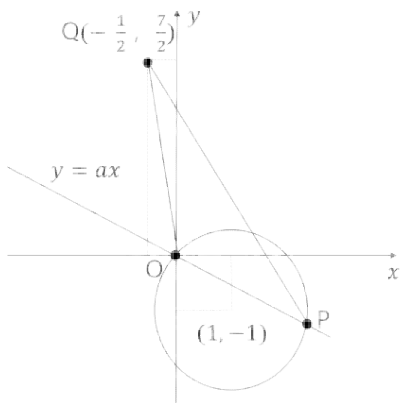
(1) 삼각형 OPQ\displaystyle \mathrm{OPQ} 의 넓이 =12×OP×\displaystyle =\frac{1}{2} \times \overline{{OP}} \times(점 Q\displaystyle \mathrm{Q} 와 직선 y=ax\displaystyle y=a x와의 거리) ⋯⋯①

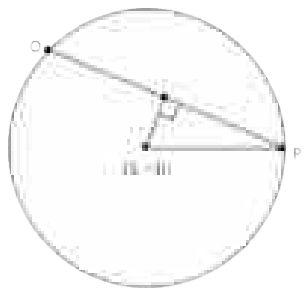
OP\displaystyle \overline{{OP}}는 오른쪽 그림과 같이 점과 직선과의 거리 공식과 피타고라스 정리를 이용하여 구할 수 있다. 원의 중심 (1, 1)\displaystyle (1,~-1)과 직선 y=ax\displaystyle y=a x와의 거리는 a+1a2+1\displaystyle \frac{|a+1|}{\sqrt {a^{2}+1}}이므로

OP=22(a+1)2a2+1=2a1a2+1\displaystyle \overline{{OP}}=2 \sqrt {2-\frac{(a+1)^{2}}{a^{2}+1}}=\frac{2|a-1|}{\sqrt {a^{2}+1}} ⋯⋯②

대학 원본의 원의 현과 중심에서 직선까지의 거리

(참고. 직선 y=ax\displaystyle y=a x와 원 (x1)2+(y+1)2=2\displaystyle (x-1)^{2}+(y+1)^{2}=2의 교점을 구하여 OP\displaystyle \overline{{OP}}의 거리를 구해도 됨)

+4점 · Q(12, 72)\displaystyle {Q} \left (-\frac{1}{2},~ \frac{7}{2} \right )와 직선y=ax\displaystyle y=a x와의 거리a+72a2+1\displaystyle \frac{|a+7|}{2 \sqrt {a^{2}+1}}을 구하면, 혹은P(2(a1)a2+1, 2a(a1)a2+1)\displaystyle {P} \left (\frac{-2(a-1)}{a^{2}+1},~ \frac{-2 a(a-1)}{a^{2}+1} \right )와 직선y=7x\displaystyle y=-7 x와의 거리2(a1)(a+7)52(a2+1)\displaystyle \frac{2 \left |(a-1)(a+7) \right |}{5 \sqrt {2} \left (a^{2}+1 \right )}을 구하면

Q(12, 72)\displaystyle {Q} \left (-\frac{1}{2},~ \frac{7}{2} \right )와 직선 y=ax\displaystyle y=a x와의 거리는 a+72a2+1\displaystyle \frac{|a+7|}{2 \sqrt {a^{2}+1}} ⋯⋯③

+2점 · f(a)=(a1)(a+7)2(a2+1)\displaystyle f(a)=\dfrac{|(a-1)(a+7)|}{2(a^2+1)} (단, a1,7\displaystyle a\ne1,-7)을 구하면

②와 ③을 ①에 대입하면 삼각형 OPQ\displaystyle \mathrm{OPQ} 의 넓이, 즉 f(a)\displaystyle f(a)를 얻는다.

f(a)=(a1)(a+7)2(a2+1)\displaystyle f(a)=\dfrac{|(a-1)(a+7)|}{2(a^2+1)} (단, a1,7\displaystyle a\ne1,-7)

대학 원본의 삼각형 OPQ와 원
+4점 · f(a)=g(a)\displaystyle f(a)= \left |g(a) \right |라 놓고g(a)=(3a+1)(a3)(a2+1)2\displaystyle g^{\prime}(a)=\frac{-(3 a+1)(a-3)}{ \left (a^{2}+1 \right )^{2}}을 구하면

(2) g(a)=(a1)(a+7)2(a2+1)\displaystyle g(a)=\frac{(a-1)(a+7)}{2 \left (a^{2}+1 \right )}라고 하자.

g(a)=(2a+6)(a2+1)(a2+6a7)2a2(a2+1)2=(3a28a3)(a2+1)2=(3a+1)(a3)(a2+1)2\displaystyle \begin{aligned}g^{\prime}(a)&=\dfrac{(2a+6)(a^2+1)-(a^2+6a-7)2a}{2(a^2+1)^2}=\dfrac{-(3a^2-8a-3)}{(a^2+1)^2}\\&=\dfrac{-(3a+1)(a-3)}{(a^2+1)^2}\end{aligned}

f(a)=g(a)\displaystyle f(a)=|g(a)|이므로

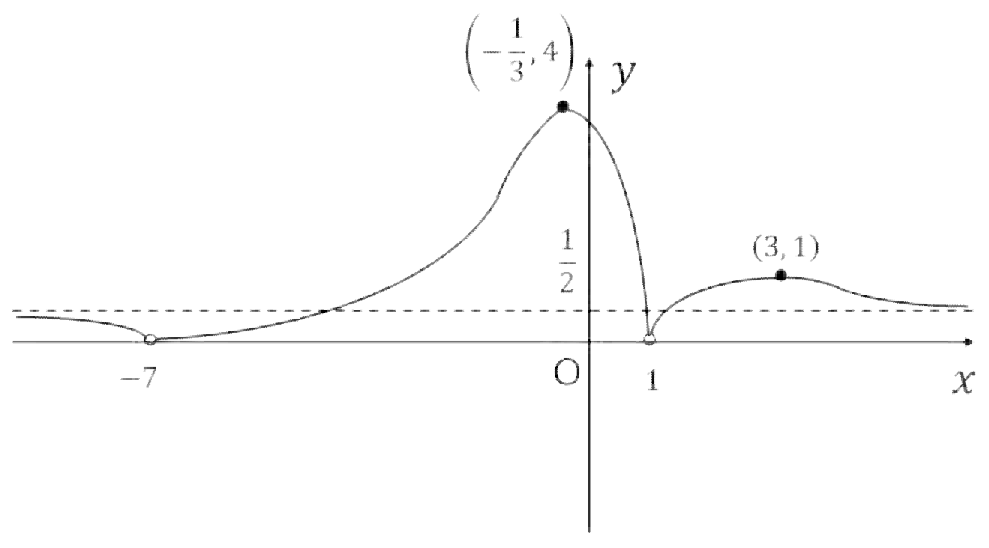
+4점 · a=13\displaystyle a=-\frac{1}{3}에서f(a)\displaystyle f(a)의 극댓값은 4\displaystyle 4, a=3\displaystyle a=3에서 f(a)\displaystyle f(a)의 극댓값은 1\displaystyle 1

a=13\displaystyle a= - \frac{1}{3}에서 g(a)\displaystyle g(a)는 극소이며 f(a)\displaystyle f(a)는 극대이고 극댓값은 4\displaystyle 4

a=3\displaystyle a=3에서 g(a)\displaystyle g(a)f(a)\displaystyle f(a)는 극대이고 극댓값은 1\displaystyle 1

+4점 · 함수 f(a)\displaystyle f(a)의 증가와 감소를 표로 나타내면

함수 f(a)\displaystyle f(a)의 증가와 감소를 표로 나타내면 아래와 같다.

대학 원본의 넓이 함수 증감표

(참고. y=f(x)\displaystyle y=f(x)의 그래프 개형은 아래와 같다.)

대학 원본의 넓이 함수 그래프

첨삭 사례

아직 등록된 첨삭 사례가 없습니다.

질문과 답변 · 0개질문과 답변 · 고정 0개

아직 등록된 질문이 없습니다. 질문 작성은 멤버십 회원만 가능합니다.