수리논술, 이게 다다.

자연계열 1번

오류 제보

문제

[가] 함수 y=f(x)\displaystyle y=f(x)의 그래프의 개형은 다음과 같은 사항을 조사하여 그릴 수 있다① 함수의 정의역과 치역 ② 곡선과 좌표축의 교점③ 곡선의 대칭성과 주기 ④ 함수의 증가와 감소⑤ 곡선의 오목과 볼록, 변곡점 ⑥ lim⁡x→∞f(x)\displaystyle \lim_{x\to\infty}f(x), lim⁡x→−∞f(x)\displaystyle \lim_{x\to-\infty}f(x), 점근선

[나] 사인함수와 코사인함수의 덧셈정리① sin⁡(α+β)=sin⁡αcos⁡β+cos⁡αsin⁡β\displaystyle \sin(\alpha+\beta)=\sin\alpha\cos\beta+\cos\alpha\sin\beta  sin⁡(α−β)=sin⁡αcos⁡β−cos⁡αsin⁡β\displaystyle \sin(\alpha-\beta)=\sin\alpha\cos\beta-\cos\alpha\sin\beta② cos⁡(α+β)=cos⁡αcos⁡β−sin⁡αsin⁡β\displaystyle \cos(\alpha+\beta)=\cos\alpha\cos\beta-\sin\alpha\sin\beta  cos⁡(α−β)=cos⁡αcos⁡β+sin⁡αsin⁡β\displaystyle \cos(\alpha-\beta)=\cos\alpha\cos\beta+\sin\alpha\sin\beta

[다] 무리수 e\displaystyle elim⁡x→0(1+x)1x=e\displaystyle \lim_{x\to0}(1+x)^{\frac1x}=e

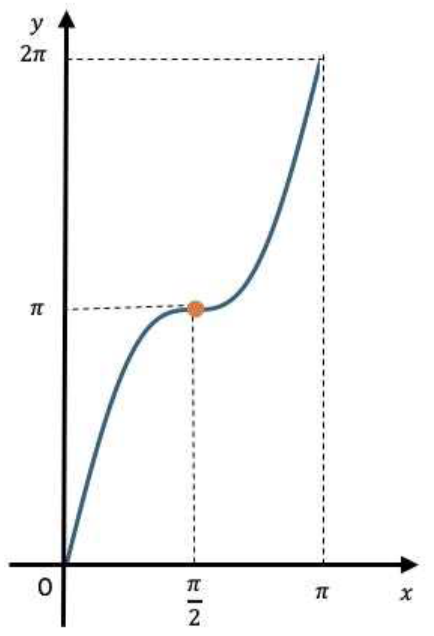
【1-1】 함수 f(x)=2x+sin⁡2x (0≤x≤π)\displaystyle f(x)=2x+\sin2x\ (0\le x\le\pi)의 그래프의 개형을 그리시오.

【1-2】 A=(π2,0)\displaystyle \mathrm{A}=\left(\frac\pi2,0\right)이고, 곡선 y=tan⁡x (0≤x<π2)\displaystyle y=\tan x\ \left(0\le x<\frac\pi2\right) 위의 점 (t,tan⁡t)\displaystyle (t,\tan t)에서 접하는 접선이 x\displaystyle x축과 만나는 점을 B\displaystyle \mathrm{B}, 직선 x=π2\displaystyle x=\frac\pi2와 만나는 점을 C\displaystyle \mathrm{C}라 하자. 삼각형 ABC\displaystyle \mathrm{ABC}의 넓이를 S(t)\displaystyle S(t)라 할 때, 함수 S(t)\displaystyle S(t)가 구간 [0,π2)\displaystyle \left[0,\frac\pi2\right)에서 최댓값과 최솟값을 갖는지 조사하시오.

A=(a,0)\displaystyle \mathrm{A}=(a,0)이고, 곡선 y=tan⁡x (0<x<a)\displaystyle y=\tan x\ (0<x<a) 위를 움직이는 점 C(t,tan⁡t)\displaystyle \mathrm{C}(t,\tan t)에 대하여 B=(t,0)\displaystyle \mathrm{B}=(t,0), D=(a,tan⁡t)\displaystyle \mathrm{D}=(a,\tan t)라 할 때, 사각형 ABCD\displaystyle \mathrm{ABCD}의 넓이의 최댓값을 g(a)\displaystyle g(a)라 하자.문항 【1-3】과 【1-4】에 답하시오. (단, 0<a<π2\displaystyle 0<a<\frac\pi2)

【1-3】 사각형 ABCD\displaystyle \mathrm{ABCD}의 넓이가 최대가 되는 t\displaystyle t가 유일함을 보이고, g(a)=12\displaystyle g(a)=\frac12일 때 a\displaystyle a의 값을 구하시오.

【1-4】 사각형 ABCD\displaystyle \mathrm{ABCD}의 넓이가 최대가 되는 t\displaystyle t의 값을 t0\displaystyle t_0라 하자. 곡선 y=tan⁡x (0≤x<π2)\displaystyle y=\tan x\ \left(0\le x<\frac\pi2\right)와 x\displaystyle x축 및 x=t0\displaystyle x=t_0로 둘러싸인 도형의 넓이를 h(a)\displaystyle h(a)라 할 때, 극한 lim⁡a→0+h(a)g(a)\displaystyle \lim_{a\to0^+}\frac{h(a)}{g(a)}을 조사하시오.

해설강의 준비중

【1-1】 f′(x)=2(1+cos⁡2x)\displaystyle f^{\prime}(x)=2(1+\cos2x)이고 f′′(x)=−4sin⁡2x\displaystyle f^{\prime\prime}(x)=-4\sin2x이므로, 함수 f(x)\displaystyle f(x)의 증가와 감소를 표로 나타내면 다음과 같다.

xx0⋯π2\frac\pi2⋯π\pi
f′(x)f^{\prime}(x)4+0+4
f′′(x)f^{\prime\prime}(x)−4−0+−4
f(x)f(x)0π\pi2π2\pi

Correction. 증감표에서 f′′(0)\displaystyle f^{\prime\prime}(0), f′′(π)\displaystyle f^{\prime\prime}(\pi)는 모두 0\displaystyle 0이다. 두 곳의 −4\displaystyle -4는 오기다. 그러나 원칙에 따라 원문 표기를 그대로 실었다.

· 제시문 [가]에 주어진 그래프 개형을 그리는 방법을 바탕으로, 도함수와 이계도함수를 이용하여 그래프의 개형을 그릴 수 있다.

따라서 f(x)\displaystyle f(x)는 증가함수이고 0<x<π2\displaystyle 0<x<\frac\pi2일 때 위로 볼록, π2<x<π\displaystyle \frac\pi2<x<\pi일 때 아래로 볼록이다.함수 f(x)\displaystyle f(x)의 그래프의 개형을 그리면 다음과 같다.

함수 f(x)=2x+sin2x의 그래프
· 접선의 방정식을 이용하여 삼각형의 넓이를 t\displaystyle t로 나타낼 수 있다.

【1-2】 점 (t,tan⁡t)\displaystyle (t,\tan t)에서 접선의 방정식은 y=sec⁡2t(x−t)+tan⁡t\displaystyle y=\sec^2t(x-t)+\tan t이다.B=(t−sin⁡tcos⁡t,0)\displaystyle \mathrm{B}=(t-\sin t\cos t,0)이므로 AB‾=π2+sin⁡tcos⁡t−t\displaystyle \overline{\mathrm{AB}}=\frac\pi2+\sin t\cos t-t이다. 삼각형 ABC\displaystyle \mathrm{ABC}는 각 A\displaystyle \mathrm{A}가 직각인 직각삼각형이고 접선의 기울기가 sec⁡2t\displaystyle \sec^2t이므로 BC‾=sec⁡2t×AB‾\displaystyle \overline{\mathrm{BC}}=\sec^2t\times\overline{\mathrm{AB}}이다. 따라서Correction. BC‾=sec⁡2t⋅AB‾\displaystyle \overline{\mathrm{BC}}=\sec^2t\cdot\overline{\mathrm{AB}}에서 BC‾\displaystyle \overline{\mathrm{BC}}는 AC‾\displaystyle \overline{\mathrm{AC}}의 오기다. 그러나 원칙에 따라 원문 표기를 그대로 실었다.S(t)=12sec⁡2t(π2+sin⁡tcos⁡t−t)2,0≤t<π2\displaystyle S(t)=\frac12\sec^2t\left(\frac\pi2+\sin t\cos t-t\right)^2,\quad 0\le t<\frac\pi2

· 도함수의 부호를 이용하여 삼각형의 넓이의 최대, 최소를 판정할 수 있다.

p(t)=sec⁡t(π2+sin⁡tcos⁡t−t)\displaystyle p(t)=\sec t\left(\frac\pi2+\sin t\cos t-t\right)라 하면p′(t)=sin⁡tsec⁡2t(π2−sin⁡tcos⁡t−t)=12sin⁡tsec⁡2t(π−sin⁡2t−2t)\displaystyle p^{\prime}(t)=\sin t\sec^2t\left(\frac\pi2-\sin t\cos t-t\right)=\frac12\sin t\sec^2t(\pi-\sin2t-2t)이다. 문항 【1-1】에 의해, 모든 0<t<π2\displaystyle 0<t<\frac\pi2에서 p′(t)>0\displaystyle p^{\prime}(t)>0임고 p(t)\displaystyle p(t)는 0≤t<π2\displaystyle 0\le t<\frac\pi2에서 증가함수이다.S(t)=12{p(t)}2\displaystyle S(t)=\frac12\{p(t)\}^2이므로, S(t)\displaystyle S(t)도 0≤t<π2\displaystyle 0\le t<\frac\pi2에서 증가함수이다. 따라서 S(t)\displaystyle S(t)의 최솟값은 S(0)=π28\displaystyle S(0)=\frac{\pi^2}{8}이고, 최댓값은 존재하지 않는다.

· 문항 【1-1】을 이용하여 최대가 되는 t\displaystyle t가 유일함을 보일 수 있다.

【1-3】 사각형 ABCD\displaystyle \mathrm{ABCD}의 넓이를 점 B\displaystyle \mathrm{B}의 좌표 t\displaystyle t로 표현하면 S(t)=(a−t)tan⁡t\displaystyle S(t)=(a-t)\tan t이다.S′(t)=sec⁡2t(a−t−sin⁡tcos⁡t)=12sec⁡2t(2a−2t−sin⁡2t)\displaystyle S^{\prime}(t)=\sec^2t(a-t-\sin t\cos t)=\frac12\sec^2t(2a-2t-\sin2t)이므로, 문항 【1-1】에 의해 함수 f(x)=2a−2x−sin⁡2x\displaystyle f(x)=2a-2x-\sin2x는 구간 (0,π2)\displaystyle \left(0,\frac\pi2\right)의 오직 한 점에서만 0\displaystyle 0이 된다. 따라서 S′(t)\displaystyle S^{\prime}(t)는 구간 (0,π2)\displaystyle \left(0,\frac\pi2\right)의 오직 한 점 t=t0\displaystyle t=t_0에서 0\displaystyle 0이고, t=t0\displaystyle t=t_0일 때 S(t)\displaystyle S(t)의 값이 최대가 된다.

· 함수 g(a)\displaystyle g(a)를 점 B\displaystyle \mathrm{B}의 x\displaystyle x좌표 t=t0\displaystyle t=t_0로 나타내고, t0\displaystyle t_0와 a\displaystyle a의 관계를 이용하여 a\displaystyle a를 구할 수 있다.

S′(t0)=0\displaystyle S^{\prime}(t_0)=0으로부터 a−t0=12sin⁡2t0=cos⁡t0sin⁡t0\displaystyle a-t_0=\frac12\sin2t_0=\cos t_0\sin t_0이므로 g(a)=S(t0)=sin⁡2t0\displaystyle g(a)=S(t_0)=\sin^2t_0이다. 따라서g(a)=12\displaystyle g(a)=\frac12이면 t0=π4\displaystyle t_0=\frac\pi4이고 a=t0+sin⁡t0cos⁡t0=π4+12\displaystyle a=t_0+\sin t_0\cos t_0=\frac\pi4+\frac12이다.

· 함수 g(a)\displaystyle g(a)와 h(a)\displaystyle h(a)를 점 B\displaystyle \mathrm{B}의 x\displaystyle x좌표로 나타낼 수 있다.

【1-4】 문제 3의 풀이에 의해 g(a)=sin⁡2t0\displaystyle g(a)=\sin^2t_0이고 h(a)=∫0t0tan⁡x dx=−ln⁡(cos⁡t0)\displaystyle h(a)=\int_0^{t_0}\tan x\,dx=-\ln(\cos t_0)이다.0<t0<a\displaystyle 0<t_0<a이므로lim⁡a→0+h(a)g(a)=lim⁡t0→0+−ln⁡(cos⁡t0)sin⁡2t0=lim⁡t0→0+ln⁡(cos⁡t0)(1+cos⁡t0)(cos⁡t0−1)\displaystyle \lim_{a\to0^+}\frac{h(a)}{g(a)}=\lim_{t_0\to0^+}\frac{-\ln(\cos t_0)}{\sin^2t_0}=\lim_{t_0\to0^+}\frac{\ln(\cos t_0)}{(1+\cos t_0)(\cos t_0-1)}

· 제시문 [다]를 이용하여 극한값을 구할 수 있다.

cos⁡t0−1=k\displaystyle \cos t_0-1=k로 놓으면, t0→0+\displaystyle t_0\to0^+일 때 k→0−\displaystyle k\to0^-이므로lim⁡a→0+h(a)g(a)=lim⁡k→0−ln⁡(1+k)(2+k)k\displaystyle \lim_{a\to0^+}\frac{h(a)}{g(a)}=\lim_{k\to0^-}\frac{\ln(1+k)}{(2+k)k}제시문 [다]에 의해 lim⁡k→0−ln⁡(1+k)k=1\displaystyle \lim_{k\to0^-}\frac{\ln(1+k)}k=1이므로, lim⁡a→0+h(a)g(a)=12\displaystyle \lim_{a\to0^+}\frac{h(a)}{g(a)}=\frac12이다.

첨삭 사례

아직 등록된 첨삭 사례가 없습니다.

질문과 답변 · 0개질문과 답변 · 고정 0개

아직 등록된 질문이 없습니다. 질문 작성은 멤버십 회원만 가능합니다.