수리논술, 이게 다다.

자연계열 1번

오류 제보

문제

[문항 1] (50점) 다음 제시문을 읽고 논제에 답하라.

(가) 함수 y=f(x)\displaystyle y=f(x)의 그래프의 개형을 그려보면 f(x)\displaystyle f(x)의 최댓값 또는 최솟값을 구할 수 있다. 특히 함수 f(x)\displaystyle f(x)가 미분가능하면, 도함수 f′(x)\displaystyle f^{\prime}(x)를 이용하여 y=f(x)\displaystyle y=f(x)의 그래프의 개형을 알 수 있다. 함수 f(x)\displaystyle f(x)가 닫힌구간 [p,q]\displaystyle [p,q]에서 연속이면 이 구간에서 반드시 최댓값과 최솟값을 가지며, 이는 극솟값, 극댓값, f(p)\displaystyle f(p), f(q)\displaystyle f(q)의 값을 비교하여 구할 수 있다.

(나) 미분가능한 함수 f(x)\displaystyle f(x)에 대하여, 곡선 y=f(x)\displaystyle y=f(x) 위의 점 (t,f(t))\displaystyle (t,f(t))에서 접선의 방정식은 y−f(t)=f′(t)(x−t)\displaystyle y-f(t)=f^{\prime}(t)(x-t)이다. 이 접선이 점 (x0,y0)\displaystyle (x_0,y_0)를 지나면 다음을 만족한다.(y0−f(t))=f′(t)(x0−t)\displaystyle (y_0-f(t))=f^{\prime}(t)(x_0-t)

(다) 미분가능한 함수 f(x)\displaystyle f(x)에 대하여, 곡선 y=f(x)\displaystyle y=f(x) 위의 서로 다른 두 점 (p,f(p))\displaystyle (p,f(p))와 (q,f(q))\displaystyle (q,f(q))를 각 접점으로 가지는 두 접선이 일치하는 경우, 그 접선의 기울기를 생각하여 보면 다음의 식을 얻을 수 있다.f′(p)=f′(q)=f(q)−f(p)q−p\displaystyle f^{\prime}(p)=f^{\prime}(q)=\frac{f(q)-f(p)}{q-p}

[문제 1-1] (20점)제시문 (가)를 읽고 물음에 답하여라.(1) 닫힌구간 [a−2,a+2]\displaystyle [a-2,a+2]에서 이차함수 y=2x2−4x+a\displaystyle y=2x^2-4x+a가 최솟값 20을 갖도록 하는 실수 a\displaystyle a의 값을 모두 구하여라.(2) 닫힌구간 [0,π2]\displaystyle \left[0,\frac\pi2\right]에서 함수 f(x)=x+sin⁡4x−1\displaystyle f(x)=x+\sin4x-1의 최솟값을 구하여라.

[문제 1-2] (30점)제시문 (나)와 (다)를 읽고 물음에 답하여라.(1) 곡선 y=2x2−3x−5\displaystyle y=2x^2-3x-5에 대한 서로 다른 두 접선이 모두 점 (−1,−2)\displaystyle (-1,-2)를 지날 때, 이 곡선과 두 접선으로 둘러싸인 영역의 넓이를 구하여라.(2) 삼차함수 f(x)=ax3+bx2+cx+d\displaystyle f(x)=ax^3+bx^2+cx+d (a≠0\displaystyle a\ne0)라 할 때, 곡선 y=f(x)\displaystyle y=f(x) 위의 서로 다른 두 점에서의 접선은 일치할 수 없음을 보여라.(3) 곡선 y=x3−3x2−2\displaystyle y=x^3-3x^2-2에 대한 서로 다른 세 접선이 모두 점 (x0,y0)\displaystyle (x_0,y_0)를 지난다. 자연수 x0,y0\displaystyle x_0,y_0에 대하여, x0+y0\displaystyle x_0+y_0의 최솟값을 구하여라.

해설강의 준비중
+10점

[1-1] (20점)(1) (10점) y=2x2−4x+a=2(x−1)2+a−2\displaystyle y=2x^2-4x+a=2(x-1)^2+a-2이므로, 꼭짓점의 x\displaystyle x좌표는 1이고 이것이 구간 [a−2,a+2]\displaystyle [a-2,a+2]에 포함되는지에 따라 최솟값을 아래와 같이 구할 수 있다.① −1≤a≤3\displaystyle -1\le a\le3인 경우: 구간 [a−2,a+2]\displaystyle [a-2,a+2]에 꼭짓점의 x\displaystyle x좌표 1이 포함되므로 x=1\displaystyle x=1일 때 최솟값 a−2=20\displaystyle a-2=20을 갖는다. 이때, a=22\displaystyle a=22이므로 −1≤a≤3\displaystyle -1\le a\le3에 모순이다.② a<−1\displaystyle a<-1인 경우: a+2<1\displaystyle a+2<1이므로 구간 [a−2,a+2]\displaystyle [a-2,a+2]에서 주어진 함수는 감소하고, x=a+2\displaystyle x=a+2일 때 최솟값 2(a+1)2+a−2=20\displaystyle 2(a+1)^2+a-2=20을 갖는다. 2a2+5a=20\displaystyle 2a^2+5a=20이므로 근의 공식에 의해 a=−5±1854\displaystyle a=\frac{-5\pm\sqrt{185}}4이고, a<−1\displaystyle a<-1이므로 a=−5−1854\displaystyle a=\frac{-5-\sqrt{185}}4이다.③ a>3\displaystyle a>3인 경우: a−2>1\displaystyle a-2>1이므로 구간 [a−2,a+2]\displaystyle [a-2,a+2]에서 주어진 함수는 증가하고, x=a−2\displaystyle x=a-2일 때 최솟값 2(a−3)2+a−2=20\displaystyle 2(a-3)^2+a-2=20을 갖는다. 2a2−11a+16=20\displaystyle 2a^2-11a+16=20이고 근의 공식에 의해 a=11±3174\displaystyle a=\frac{11\pm3\sqrt{17}}4이고, a>3\displaystyle a>3이므로 a=11+3174\displaystyle a=\frac{11+3\sqrt{17}}4이다.따라서, a=−5−1854\displaystyle a=\frac{-5-\sqrt{185}}4 또는 a=11+3174\displaystyle a=\frac{11+3\sqrt{17}}4이다.

+10점

(2) (10점) f′(x)=1+4cos⁡4x\displaystyle f^{\prime}(x)=1+4\cos4x이므로, 0<x<π2\displaystyle 0<x<\frac\pi2에서 cos⁡4x=−14\displaystyle \cos4x=-\frac14를 만족하는 x\displaystyle x를 θ1,θ2\displaystyle \theta_1,\theta_2 (θ1<θ2\displaystyle \theta_1<\theta_2)라 두자. 이때, 닫힌구간 [0,π2]\displaystyle \left[0,\frac\pi2\right]에서 함수 f(x)\displaystyle f(x)의 증가와 감소를 표로 나타내면 아래와 같다.

xx0⋯θ1\theta_1⋯θ2\theta_2⋯π2\frac{\pi}{2}
f′(x)f^{\prime}(x) +0−0+ 
f(x)f(x)−1-1↗극댓값↘극솟값↗π2\frac{\pi}{2}

Correction. f(x)=x+sin⁡4x−1\displaystyle f(x)=x+\sin4x-1이므로 증감표의 f(π2)\displaystyle f(\frac\pi2)는 π2−1\displaystyle \frac\pi2-1이다. 최솟값에는 영향이 없다. 원칙에 따라 원문 표기를 그대로 실었다.

x=θ2\displaystyle x=\theta_2일 때 f(x)=x+sin⁡4x−1\displaystyle f(x)=x+\sin4x-1가 극솟값을 가지므로 f(0)\displaystyle f(0)과 f(θ2)\displaystyle f(\theta_2) 중 작은 값이 최솟값이 된다.한편, π4<θ2<π2\displaystyle \frac\pi4<\theta_2<\frac\pi2이고 cos⁡4θ2=−14\displaystyle \cos4\theta_2=-\frac14이므로 sin⁡4θ2=−154\displaystyle \sin4\theta_2=-\frac{\sqrt{15}}4이며, sin⁡4θ2=−154<−32=sin⁡4π3\displaystyle \sin4\theta_2=-\frac{\sqrt{15}}4<-\frac{\sqrt3}2=\sin\frac{4\pi}3이므로 θ2>π3\displaystyle \theta_2>\frac\pi3임을 알 수 있다. 따라서, f(θ2)=θ2+sin⁡4θ2−1>π3−154−1>−1=f(0)\displaystyle f(\theta_2)=\theta_2+\sin4\theta_2-1>\frac\pi3-\frac{\sqrt{15}}4-1>-1=f(0)이므로 닫힌구간 [0,π2]\displaystyle \left[0,\frac\pi2\right]에서 함수 f(x)\displaystyle f(x)의 최솟값은 f(0)=−1\displaystyle f(0)=-1이다.

+10점

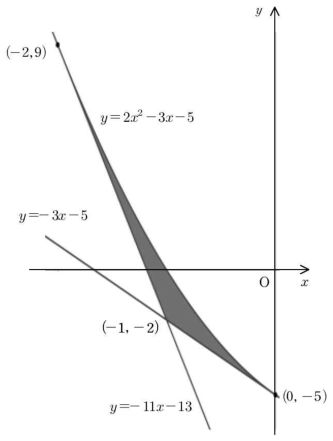
[1-2] (30점)(1) (10점) 제시문 (나)에 의해, 주어진 곡선 위의 점 (t,2t2−3t−5)\displaystyle (t,2t^2-3t-5)가 접점인 접선의 방정식이 점 (−1,−2)\displaystyle (-1,-2)를 지나면 −2−(2t2−3t−5)=(4t−3)(−1−t)\displaystyle -2-(2t^2-3t-5)=(4t-3)(-1-t)를 만족한다. 이것을 풀면 t=0,−2\displaystyle t=0,-2이므로, t=0\displaystyle t=0일 때 접점 (0,−5)\displaystyle (0,-5)에서의 접선의 방정식은 y=−3x−5\displaystyle y=-3x-5이고, t=−2\displaystyle t=-2일 때 접점 (−2,9)\displaystyle (-2,9)에서의 접선의 방정식은 y=−11x−13\displaystyle y=-11x-13이다. 따라서, 구하고자 하는 영역은 아래 색칠된 영역과 같다.

포물선과 두 접선으로 둘러싸인 영역

색칠된 영역의 넓이를 적분으로 나타내고 계산하면,∫−2−1(2x2−3x−5)−(−11x−13) dx+∫−10(2x2−3x−5)−(−3x−5) dx=43\displaystyle \int_{-2}^{-1}(2x^2-3x-5)-(-11x-13)\,dx+\int_{-1}^0(2x^2-3x-5)-(-3x-5)\,dx=\frac43이므로 구하고자 하는 영역의 넓이는 43\displaystyle \frac43이다.

+10점

(2) (10점)주어진 삼차함수 f(x)\displaystyle f(x)에 대하여, 제시문 (다)에서와 같이 곡선 y=f(x)\displaystyle y=f(x) 위의 서로 다른 두 점 (p,f(p))\displaystyle (p,f(p))와 (q,f(q))\displaystyle (q,f(q))에서의 두 접선이 일치한다고 가정하자. 따라서 f′(p)=f′(q)=f(q)−f(p)q−p\displaystyle f^{\prime}(p)=f^{\prime}(q)=\frac{f(q)-f(p)}{q-p}를 만족한다. 이때, p\displaystyle p와 q\displaystyle q는 서로 다르므로 p<q\displaystyle p<q라 하자. 삼차함수 f(x)\displaystyle f(x)는 닫힌구간 [p,q]\displaystyle [p,q]에서 연속이고 열린구간 (p,q)\displaystyle (p,q)에서 미분가능하므로, 평균값 정리에 의해 f(q)−f(p)q−p=f′(c)\displaystyle \frac{f(q)-f(p)}{q-p}=f^{\prime}(c)이고 p<c<q\displaystyle p<c<q인 c\displaystyle c가 적어도 하나 존재한다. 따라서, 제시문 (다)와 평균값 정리에 의해 p<c<q\displaystyle p<c<q인 어떤 c\displaystyle c에 대하여 f′(p)=f′(c)=f′(q)\displaystyle f^{\prime}(p)=f^{\prime}(c)=f^{\prime}(q)가 성립한다.한편, f′(x)\displaystyle f^{\prime}(x)는 이차함수이고 f′(p)=f′(c)=f′(q)\displaystyle f^{\prime}(p)=f^{\prime}(c)=f^{\prime}(q)을 만족하는 서로 다른 세 실수 p,c,q\displaystyle p,c,q가 존재할 수 없으므로, 삼차함수 f(x)\displaystyle f(x)에 대하여 곡선 y=f(x)\displaystyle y=f(x)위의 서로 다른 두 점에서의 접선이 일치한다는 가정에 모순이다.

+10점

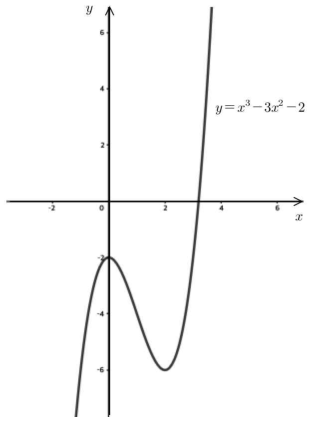
(3) (10점)곡선 y=x3−3x2−2\displaystyle y=x^3-3x^2-2에 대한 접선이 점 (t,t3−3t2−2)\displaystyle (t,t^3-3t^2-2)에서 접하며 점 (x0,y0)\displaystyle (x_0,y_0)를 지난다고 하자.제시문 (나)에 의해, y0−t3+3t2+2=(3t2−6t)(x0−t)\displaystyle y_0-t^3+3t^2+2=(3t^2-6t)(x_0-t)이므로 이를 t\displaystyle t에 대해 정리하면 2t3−(3+3x0)t2+6x0t+(y0+2)=0\displaystyle 2t^3-(3+3x_0)t^2+6x_0t+(y_0+2)=0이다. g(t)=2t3−(3+3x0)t2+6x0t+(y0+2)\displaystyle g(t)=2t^3-(3+3x_0)t^2+6x_0t+(y_0+2)라 두자. 앞의 문항 (2)의 결과로부터 삼차함수의 그래프에 대한 각 접선은 정확히 하나의 접점만을 가져야 하므로, t\displaystyle t에 대한 방정식 g(t)=0\displaystyle g(t)=0이 서로 다른 세 실근을 갖도록 하는 자연수 x0,y0\displaystyle x_0,y_0를 구하면 된다.g′(t)=6t2−(6+6x0)t+6x0=(6t−6)(t−x0)\displaystyle g^{\prime}(t)=6t^2-(6+6x_0)t+6x_0=(6t-6)(t-x_0)이므로 함수 g(t)\displaystyle g(t)는 t=1,x0\displaystyle t=1,x_0일 때 극값을 갖는다. 또한 x0,y0\displaystyle x_0,y_0는 자연수이므로, g(1)=3x0+y0+1>0\displaystyle g(1)=3x_0+y_0+1>0이다.함수 g(t)\displaystyle g(t)는 서로 다른 부호의 극값을 가져야 하므로, g(x0)=2x03−(3+3x0)x02+6x02+(y0+2)=−x03+3x02+2+y0<0\displaystyle g(x_0)=2x_0^3-(3+3x_0)x_0^2+6x_0^2+(y_0+2)=-x_0^3+3x_0^2+2+y_0<0이다. 이때, x0=3\displaystyle x_0=3이면 g(x0)=−x03+3x02+2+y0=2+y0>0\displaystyle g(x_0)=-x_0^3+3x_0^2+2+y_0=2+y_0>0이므로, x0≥4\displaystyle x_0\ge4이다. 따라서, x0+y0≥5\displaystyle x_0+y_0\ge5이므로 구하고자 하는 답은 5이다.

삼차함수 y=x³−3x²−2의 그래프

첨삭 사례

아직 등록된 첨삭 사례가 없습니다.

질문과 답변 · 0개질문과 답변 · 고정 0개

아직 등록된 질문이 없습니다. 질문 작성은 멤버십 회원만 가능합니다.