수리논술, 이게 다다.

자연계열 1번

오류 제보

문제

[문항 1] 【제시문】을 읽고 물음에 답하시오.

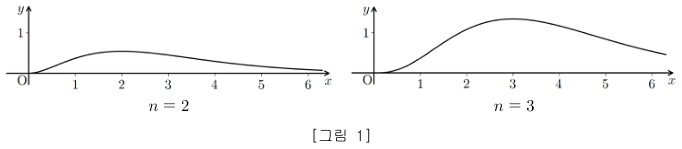
(가) n≥2\displaystyle n\ge2인 자연수에 대하여 함수 f(x)=xne−x (x≥0)\displaystyle f(x)=x^ne^{-x}\ (x\ge0)를 생각하자. [그림 1]은 n=2\displaystyle n=2와 n=3\displaystyle n=3인 경우의 곡선 y=f(x)\displaystyle y=f(x)를 나타낸다.

n=2와 n=3일 때 함수 f(x)=xⁿe⁻ˣ의 그래프

곡선 y=f(x)\displaystyle y=f(x)는 두 개의 변곡점을 가진다. 이때 두 변곡점의 x\displaystyle x좌표를 an\displaystyle a_n, bn\displaystyle b_n(단, an<bn\displaystyle a_n<b_n)이라고 하자. 곡선 y=f(x)\displaystyle y=f(x)는 열린구간 (an,bn)\displaystyle (a_n,b_n)에서 위로 볼록이고, 열린구간 (0,an)\displaystyle (0,a_n)과 (bn,∞)\displaystyle (b_n,\infty)에서 아래로 볼록이다.

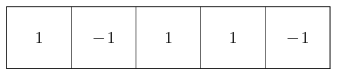
(나) 자연수 n\displaystyle n에 대하여 아래와 같은 n\displaystyle n개의 칸에 각각 1\displaystyle 1 또는 −1\displaystyle -1을 적은 것을 ‘기록’이라 하자.

①부터 n번째까지 나란히 놓인 n개의 기록 칸

이때 만들 수 있는 서로 다른 ‘기록’의 개수는 2n\displaystyle 2^n이다. 하나의 ‘기록’을 구성하는 숫자들의 합을 ‘기록값’이라고 정의하고, 이 값을 m\displaystyle m으로 표시하자. 예를 들어 n=5\displaystyle n=5일 때 아래의 ‘기록값’은

다섯 칸에 차례로 1, -1, 1, 1, -1을 적은 기록

m=1+(−1)+1+1+(−1)=1\displaystyle m=1+(-1)+1+1+(-1)=1이다.

[문제 1-1] (30점)제시문 (가)에 대한 다음 물음에 답하시오.(1) (5점) 곡선 y=f(x)\displaystyle y=f(x)의 두 변곡점 A, B의 x\displaystyle x좌표 an,bn\displaystyle a_n,b_n과 함수 f(x)\displaystyle f(x)의 최댓값을 y\displaystyle y좌표로 가지는 곡선 위의 점 C의 x\displaystyle x좌표 cn\displaystyle c_n을 구하시오.(2) (8점) [문제 1-1]의 (1)과 제시문을 이용하여, 곡선 y=f(x)\displaystyle y=f(x)와 x\displaystyle x축 및 두 직선 x=an\displaystyle x=a_n, x=bn\displaystyle x=b_n으로 둘러싸인 도형의 넓이가 선분 AC, 선분 CB와 x\displaystyle x축 및 두 직선 x=an\displaystyle x=a_n, x=bn\displaystyle x=b_n으로 둘러싸인 도형의 넓이 Sn\displaystyle S_n보다 큼을 보이고, n\displaystyle n의 값이 한없이 커질 때 수열 {Sn}\displaystyle \{S_n\}의 수렴과 발산을 조사하시오.(3) (4점) n≥3\displaystyle n\ge3인 자연수에 대하여 an≥1\displaystyle a_n\ge1이 성립함을 보이시오.(4) (5점) 곡선 y=f(x)\displaystyle y=f(x) 위의 점 A에서의 접선이 x\displaystyle x축과 만나는 점의 x\displaystyle x좌표 dn\displaystyle d_n을 구하시오.(5) (8점) [문제 1-1]의 (3), (4)와 제시문을 이용하여, 곡선 y=f(x)\displaystyle y=f(x)와 x\displaystyle x축 및 직선 x=an\displaystyle x=a_n으로 둘러싸인 도형의 넓이가 곡선 y=f(x)\displaystyle y=f(x) 위의 점 A에서의 접선과 x\displaystyle x축 및 직선 x=an\displaystyle x=a_n으로 둘러싸인 도형의 넓이 Tn\displaystyle T_n보다 큼을 보이고, n\displaystyle n의 값이 한없이 커질 때 수열 {Tn}\displaystyle \{T_n\}의 수렴과 발산을 조사하시오.

[문제 1-2] (20점)제시문 (나)에 대한 다음 물음에 답하시오.(1) (6점) 자연수 n\displaystyle n에 대하여, 가능한 ‘기록값’ m\displaystyle m을 모두 구하시오. 또한 각 m\displaystyle m을 ‘기록값’으로 가지는 서로 다른 ‘기록’의 개수를 m\displaystyle m, n\displaystyle n만을 이용하여 나타내시오.(2) (14점) n\displaystyle n이 어떤 짝수의 제곱이라고 하자. 이때 이차방정식 x2+mx+n=0\displaystyle x^2+mx+n=0의 근이 중근 또는 서로 다른 두 허근이 되는 m\displaystyle m 중에서 가장 큰 m\displaystyle m을 ‘기록값’으로 가지는 서로 다른 ‘기록’의 개수를 pn\displaystyle p_n, 절댓값이 가장 작은 m\displaystyle m을 ‘기록값’으로 가지는 서로 다른 ‘기록’의 개수를 qn\displaystyle q_n이라고 하자. n\displaystyle n이 짝수의 제곱으로써 한없이 커질 때 수열 {pnqn}\displaystyle \left\{\frac{p_n}{q_n}\right\}의 수렴과 발산을 조사하시오.

해설강의 준비중
+2점 · 함수 f(x)\displaystyle f(x)의 도함수와 이계도함수를 바르게 구하면

[문제 1-1](1) 함수 f(x) (x>0)\displaystyle f(x)\ (x>0)의 도함수와 이계도함수는 다음과 같다.f′(x)=(nxn−1−xn)e−x=(n−x)xn−1e−x,\displaystyle f^{\prime}(x)=(nx^{n-1}-x^n)e^{-x}=(n-x)x^{n-1}e^{-x},f′′(x)=(n(n−1)xn−2−2nxn−1+xn)e−x=(n(n−1)−2nx+x2)xn−2e−x.\displaystyle f^{\prime\prime}(x)=(n(n-1)x^{n-2}-2nx^{n-1}+x^n)e^{-x}=(n(n-1)-2nx+x^2)x^{n-2}e^{-x}.

+3점 · cn,an,bn\displaystyle c_n,a_n,b_n을 바르게 구하면

f′(x)=0\displaystyle f^{\prime}(x)=0과 f′′(x)=0\displaystyle f^{\prime\prime}(x)=0을 만족하는 양수 x\displaystyle x를 구하면 cn=n\displaystyle c_n=n, an=n−n\displaystyle a_n=n-\sqrt n, bn=n+n\displaystyle b_n=n+\sqrt n이다.

(2) [문제 1-1]의 (1)의 풀이를 이용하면 다음의 표를 얻는다.

xxx=0x=0⋯x=anx=a_n⋯x=cnx=c_n⋯x=bnx=b_n⋯
f(x)f(x)0↗↗↗(극대)↘↘↘
f′(x)f^{\prime}(x)0+++0−−−
f′′(x)f^{\prime\prime}(x)++0−−−0+

Caution. 양수와 음이 아닌 수, 음수와 양이 아닌 수를 구별해야 한다: 표에서 f′′(0)\displaystyle f^{\prime\prime}(0)은 n=2\displaystyle n=2일 때만 양수이고, n≥3\displaystyle n\ge3일 때는 0\displaystyle 0이다. 그러나 원칙에 따라 원문 표기를 그대로 실었다.

+2점 · 곡선 y=f(x)\displaystyle y=f(x)와 x\displaystyle x축 및 두 직선 x=an\displaystyle x=a_n, x=bn\displaystyle x=b_n으로 둘러싸인 도형의 넓이가 Sn\displaystyle S_n보다 큼을 바르게 보이면

제시문에 주어진 것처럼 곡선 y=f(x)\displaystyle y=f(x)는 열린구간 (an,bn)\displaystyle (a_n,b_n)에서 위로 볼록이고, 따라서 선분 AC와 선분 CB은 곡선의 아래에 있다. 그러므로 곡선 y=f(x)\displaystyle y=f(x)와 x\displaystyle x축 및 두 직선 x=an\displaystyle x=a_n, x=bn\displaystyle x=b_n으로 둘러싸인 도형의 넓이는 선분 AC, 선분 CB 와 x\displaystyle x축 및 두 직선 x=an\displaystyle x=a_n, x=bn\displaystyle x=b_n으로 둘러싸인 오각형 도형의 넓이 Sn\displaystyle S_n보다 크다.

+2점 · Sn\displaystyle S_n의 식을 바르게 서술하면

한편 Sn\displaystyle S_n은 다음과 같다.Sn=12(f(an)+f(cn))(bn−cn)+12(f(cn)+f(bn))(cn−an)=12(f(an)+2f(cn)+f(bn))n.\displaystyle S_n=\frac12(f(a_n)+f(c_n))(b_n-c_n)+\frac12(f(c_n)+f(b_n))(c_n-a_n)=\frac12(f(a_n)+2f(c_n)+f(b_n))\sqrt n.Correction. 대학은 2026년 10월 15일자 수정사항에서 [문제 1-1] (2)의 Sn\displaystyle S_n 표현식을 수정했다. 수정본에서는 두 사다리꼴에 대응하는 폭을 각각 cn−an\displaystyle c_n-a_n, bn−cn\displaystyle b_n-c_n으로 써서 Sn=12(f(an)+f(cn))(cn−an)+12(f(cn)+f(bn))(bn−cn)\displaystyle S_n=\frac12\bigl(f(a_n)+f(c_n)\bigr)(c_n-a_n)+\frac12\bigl(f(c_n)+f(b_n)\bigr)(b_n-c_n)으로 나타냈다. 두 폭은 모두 n\displaystyle \sqrt n이므로 식의 값과 이후의 결론은 같다.아주대학교 입학처 · 2027학년도 모의논술 수정사항

+4점 · 수열 {Sn}\displaystyle \{S_n\}이 발산함을 논리적으로 잘 서술하면

이 식을 관찰하면 n≥4\displaystyle n\ge4인 자연수에 대하여 Sn≥f(cn)n=(ne)nn≥(43)n\displaystyle S_n\ge f(c_n)\sqrt n=\left(\frac ne\right)^n\sqrt n\ge\left(\frac43\right)^n임을 알 수 있다. 따라서 n\displaystyle n의 값이 한없이 커질 때 수열 {Sn}\displaystyle \{S_n\}은 발산한다.

+3점 · an\displaystyle a_n이 n\displaystyle n이 커지면서 증가함을 보이면

(3) an=n−n=(n−12)2−14\displaystyle a_n=n-\sqrt n=\left(\sqrt n-\frac12\right)^2-\frac14이다. 이차함수 g(x)=(x−12)2−14\displaystyle g(x)=\left(x-\frac12\right)^2-\frac14가 열린구간 (12,∞)\displaystyle \left(\frac12,\infty\right)에서 증가하고 n≥3\displaystyle n\ge3인 자연수에 대하여 n>12\displaystyle \sqrt n>\frac12이므로

+1점 · n≥3\displaystyle n\ge3인 자연수에 대하여 an≥1\displaystyle a_n\ge1을 보이면

an≥a3=3−3≥3−2=1\displaystyle a_n\ge a_3=3-\sqrt3\ge3-2=1이다.

+2점 · 접선의 식을 바르게 서술하고 dn\displaystyle d_n에 대한 공식을 찾으면

(4) 함수 f(x)\displaystyle f(x)의 그래프 위의 점 A(an,f(an))\displaystyle \mathrm{A}(a_n,f(a_n))에서의 접선의 방정식은y−f(an)=f′(an)(x−an)\displaystyle y-f(a_n)=f^{\prime}(a_n)(x-a_n)이다. 따라서 이 접선과 x\displaystyle x축이 만나는 점의 x\displaystyle x좌표 dn\displaystyle d_n은

+3점 · dn\displaystyle d_n을 논리적으로 정확하게 구하면

dn=an−f(an)f′(an)=an−anne−an(n−an)ann−1e−an=an−ann−an=(n−n)−n−nn=n−2n+1\displaystyle d_n=a_n-\frac{f(a_n)}{f^{\prime}(a_n)}=a_n-\frac{a_n^ne^{-a_n}}{(n-a_n)a_n^{n-1}e^{-a_n}}=a_n-\frac{a_n}{n-a_n}=(n-\sqrt n)-\frac{n-\sqrt n}{\sqrt n}=n-2\sqrt n+1또는 (n−1)2\displaystyle (\sqrt n-1)^2이다.

+2점 · 곡선 y=f(x)\displaystyle y=f(x)와 x\displaystyle x축 및 직선 x=an\displaystyle x=a_n으로 둘러싸인 도형의 넓이가 Tn\displaystyle T_n 보다 큼을 바르게 보이면

(5) [문제 1-1]의 (2)의 풀이에 있는 표를 참고하면 제시문에 주어진 것처럼 곡선 y=f(x)\displaystyle y=f(x)는 열린구간 (0,an)\displaystyle (0,a_n)에서 아래로 볼록이다. 따라서 곡선 y=f(x)\displaystyle y=f(x) 위의 점 A에서의 접선은 곡선의 아래에 있다. 그러므로 곡선 y=f(x)\displaystyle y=f(x)와 x\displaystyle x축 및 직선 x=an\displaystyle x=a_n으로 둘러싸인 도형의 넓이가 Tn\displaystyle T_n보다 크다.

+1점 · Tn\displaystyle T_n의 식을 바르게 서술하면

한편 Tn\displaystyle T_n은 다음과 같다.Tn=12f(an)(an−dn).\displaystyle T_n=\frac12f(a_n)(a_n-d_n).

+5점 · 수열 {Tn}\displaystyle \{T_n\}이 발산함을 논리적으로 잘 보이면

함수 f(x)\displaystyle f(x)가 열린구간 (0,cn)\displaystyle (0,c_n)에서 증가하므로 [문제 1-1]의 (3)과 (4)를 이용하면Tn≥12f(1)(n−1)=121ne−1(n−1)\displaystyle T_n\ge\frac12f(1)(\sqrt n-1)=\frac12 1^ne^{-1}(\sqrt n-1)이고 n\displaystyle n의 값이 한없이 커질 때 수열 {Tn}\displaystyle \{T_n\}은 발산한다.

+3점 · m\displaystyle m의 값을 논리적으로 잘 찾아내면

[문제 1-2](1) 하나의 ‘기록’에서 n\displaystyle n개의 칸 중 1\displaystyle 1이 적힌 칸의 개수 k\displaystyle k는 0\displaystyle 0과 n\displaystyle n이하의 자연수 중 하나이다. 따라서 나머지 n−k\displaystyle n-k개의 칸에는 −1\displaystyle -1이 적혀 있고 이때 m=k+(−1)(n−k)\displaystyle m=k+(-1)(n-k)가 된다. 그러므로 자연수 n\displaystyle n에 대하여 가능한 ‘기록값’ m\displaystyle m은 m=2k−n\displaystyle m=2k-n이다. (단, 0≤k≤n\displaystyle 0\le k\le n) 즉 −n\displaystyle -n에서 2\displaystyle 2씩 더해 나간 n+1\displaystyle n+1개의 값이다. 특히 n\displaystyle n이 짝수인 경우 m=0\displaystyle m=0이 가능한 기록값에 포함된다.

+3점 · 각 m\displaystyle m을 ‘기록값’으로 가지는 서로 다른 ‘기록’의 개수를 m\displaystyle m, n\displaystyle n만의 표현으로 논리적으로 찾아내면

각 m=2k−n\displaystyle m=2k-n을 ‘기록값’으로 가지는 서로 다른 ‘기록’의 개수는 n\displaystyle n개의 칸에서 순서를 생각하지 않고 k\displaystyle k개를 선택하는 조합의 수 nCk=n!k!(n−k)!\displaystyle {}_{n}\mathrm{C}_{k}=\frac{n!}{k!(n-k)!}와 같고, k=n+m2\displaystyle k=\frac{n+m}{2}이므로n!(n+m2)!(n−m2)!\displaystyle \frac{n!}{\left(\frac{n+m}{2}\right)!\left(\frac{n-m}{2}\right)!}이다.

+1점 · n=4l2\displaystyle n=4l^2으로 표현해 내면

(2) n\displaystyle n이 어떤 짝수의 제곱이므로 n=4l2\displaystyle n=4l^2의 꼴로 표현할 수 있다. (단, l\displaystyle l은 자연수)

+2점 · pnqn\displaystyle \frac{p_n}{q_n}에 대한 l\displaystyle l만의 표현식을 구하면

이차방정식 x2+mx+n=0\displaystyle x^2+mx+n=0의 근이 중근 또는 서로 다른 두 허근이 되려면 m2−4n≤0\displaystyle m^2-4n\le0 또는 ∣m∣≤4l\displaystyle |m|\le4l이어야 한다. m\displaystyle m의 가장 큰 값 4l\displaystyle 4l을 ‘기록값’으로 가지는 서로 다른 ‘기록’의 개수 pn\displaystyle p_n은 [문제 1-2]의 (1)의 풀이를 이용하면pn=(4l2)!(2l2+2l)!(2l2−2l)!\displaystyle p_n=\frac{(4l^2)!}{(2l^2+2l)!(2l^2-2l)!}으로 표현할 수 있다. (단, n=4l2\displaystyle n=4l^2) 한편 n\displaystyle n이 짝수이므로 절댓값이 가장 작은 m\displaystyle m의 값은 0\displaystyle 0이다. 따라서 m=0\displaystyle m=0을 ‘기록값’으로 가지는 서로 다른 ‘기록’의 개수 qn\displaystyle q_n은qn=(4l2)!(2l2)!(2l2)!\displaystyle q_n=\frac{(4l^2)!}{(2l^2)!(2l^2)!}이다. 그러므로pnqn=(2l2)!(2l2)!(2l2+2l)!(2l2−2l)!\displaystyle \frac{p_n}{q_n}=\frac{(2l^2)!(2l^2)!}{(2l^2+2l)!(2l^2-2l)!}이며 계승의 정의에 의하여pnqn=(2l2)(2l2−1)⋯(2l2−2l+1)(2l2+2l)(2l2+2l−1)⋯(2l2+1)=2l2+2l−2l2l2+2l×2l2+2l−1−2l2l2+2l−1×⋯×2l2+1−2l2l2+1\displaystyle \begin{aligned}\frac{p_n}{q_n}&=\frac{(2l^2)(2l^2-1)\cdots(2l^2-2l+1)}{(2l^2+2l)(2l^2+2l-1)\cdots(2l^2+1)}\\&=\frac{2l^2+2l-2l}{2l^2+2l}\times\frac{2l^2+2l-1-2l}{2l^2+2l-1}\times\cdots\times\frac{2l^2+1-2l}{2l^2+1}\end{aligned}과 같이 2l\displaystyle 2l개의 1\displaystyle 1보다 작은 분수의 곱으로 정리할 수 있다.

+8점 · (1−1l)2l≤pnqn≤1(1+1l)2l\displaystyle \left(1-\frac1l\right)^{2l}\le\frac{p_n}{q_n}\le\frac1{\left(1+\frac1l\right)^{2l}}의 부등식을 논리적으로 유도하면

이제 부등식 a+1−ba+1≥a−ba\displaystyle \frac{a+1-b}{a+1}\ge\frac{a-b}{a} (단, a>0,b>0\displaystyle a>0,b>0)을 이용하면 다음을 관찰할 수 있다.(2l2+1−2l2l2+1)2l≤pnqn≤(2l2+2l−2l2l2+2l)2l.\displaystyle \left(\frac{2l^2+1-2l}{2l^2+1}\right)^{2l}\le\frac{p_n}{q_n}\le\left(\frac{2l^2+2l-2l}{2l^2+2l}\right)^{2l}. (단, n=4l2\displaystyle n=4l^2)또한(2l2+1−2l2l2+1)2l=(1−2l2l2+1)2l≥(1−2l2l2)2l=(1−1l)2l,\displaystyle \left(\frac{2l^2+1-2l}{2l^2+1}\right)^{2l}=\left(1-\frac{2l}{2l^2+1}\right)^{2l}\ge\left(1-\frac{2l}{2l^2}\right)^{2l}=\left(1-\frac1l\right)^{2l},(2l2+2l−2l2l2+2l)2l=(ll+1)2l=1(1+1l)2l\displaystyle \left(\frac{2l^2+2l-2l}{2l^2+2l}\right)^{2l}=\left(\frac{l}{l+1}\right)^{2l}=\frac{1}{\left(1+\frac1l\right)^{2l}}의 관찰을 이용하면(1−1l)2l≤pnqn≤1(1+1l)2l\displaystyle \left(1-\frac1l\right)^{2l}\le\frac{p_n}{q_n}\le\frac1{\left(1+\frac1l\right)^{2l}}이 성립함을 알 수 있다.

+3점 · lim⁡l→∞(1−1l)2l=e−2\displaystyle \lim_{l\to\infty}\left(1-\frac1l\right)^{2l}=e^{-2}, lim⁡l→∞(1+1l)2l=e2\displaystyle \lim_{l\to\infty}\left(1+\frac1l\right)^{2l}=e^2을 관찰하여서 n\displaystyle n이 짝수의 제곱으로써 한없이 커질 때 수열 {pnqn}\displaystyle \left\{\frac{p_n}{q_n}\right\}이 e−2\displaystyle e^{-2}로 수렴함을 보이면

이제 lim⁡x→0(1+ax)bx=eab\displaystyle \lim_{x\to0}(1+ax)^{\frac bx}=e^{ab} (단, a≠0,b≠0\displaystyle a\ne0,b\ne0)를 이용하면lim⁡l→∞(1−1l)2l=e−2,lim⁡l→∞(1+1l)2l=e2\displaystyle \lim_{l\to\infty}\left(1-\frac1l\right)^{2l}=e^{-2},\quad\lim_{l\to\infty}\left(1+\frac1l\right)^{2l}=e^2이므로 n\displaystyle n이 짝수의 제곱으로써 한없이 커질 때 수열 {pnqn}\displaystyle \left\{\frac{p_n}{q_n}\right\}은 e−2\displaystyle e^{-2}로 수렴함을 알 수 있다.

첨삭 사례

아직 등록된 첨삭 사례가 없습니다.

질문과 답변 · 0개질문과 답변 · 고정 0개

아직 등록된 질문이 없습니다. 질문 작성은 멤버십 회원만 가능합니다.