+5점 · 첫째항 ( g ∘ f ) ( 1 ) = 2 \displaystyle (g\circ f)(1)=2 ( g ∘ f ) ( 1 ) = 2 +5점 · 공차 2 \displaystyle 2 2 [논제 1] 자연수 n \displaystyle n n ( g ∘ f ) ( n + 1 ) = g ( f ( n ) f ( 1 ) ) = ( g ∘ f ) ( n ) + ( g ∘ f ) ( 1 ) = ( g ∘ f ) ( n ) + 2 \displaystyle \begin{aligned}(g\circ f)(n+1)&=g(f(n)f(1))\\&=(g\circ f)(n)+(g\circ f)(1)\\&=(g\circ f)(n)+2\end{aligned} ( g ∘ f ) ( n + 1 ) = g ( f ( n ) f ( 1 )) = ( g ∘ f ) ( n ) + ( g ∘ f ) ( 1 ) = ( g ∘ f ) ( n ) + 2 이므로 { ( g ∘ f ) ( n ) } \displaystyle \{(g\circ f)(n)\} {( g ∘ f ) ( n )} ( g ∘ f ) ( 1 ) = 2 \displaystyle (g\circ f)(1)=2 ( g ∘ f ) ( 1 ) = 2 2 \displaystyle 2 2
+5점 · a = 9 \displaystyle a=9 a = 9 1470 = ∑ k = 1 30 ( g ∘ f ) ( a + k ) = ∑ k = 1 30 ( 2 a + 2 k ) = 60 a + 2 ∑ k = 1 30 k = 60 a + 930 \displaystyle 1470=\sum_{k=1}^{30}(g\circ f)(a+k)=\sum_{k=1}^{30}(2a+2k)=60a+2\sum_{k=1}^{30}k=60a+930 1470 = k = 1 ∑ 30 ( g ∘ f ) ( a + k ) = k = 1 ∑ 30 ( 2 a + 2 k ) = 60 a + 2 k = 1 ∑ 30 k = 60 a + 930 이므로 a = 9 \displaystyle a=9 a = 9 a = 9 \displaystyle a=9 a = 9
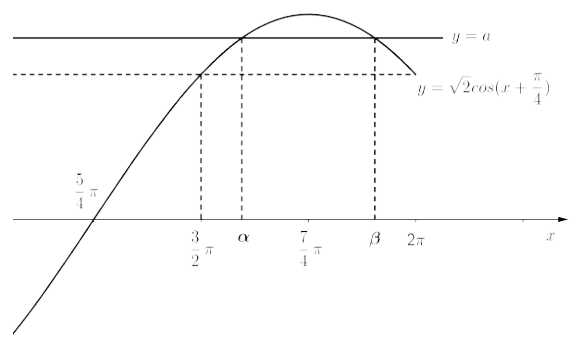
+6점 · a \displaystyle a a [논제 2] 함수 f \displaystyle f f f ′ ( x ) = e x ( a + sin x ) − e x cos x ( a + sin x ) 2 = e x { a − ( cos x − sin x ) } ( a + sin x ) 2 \displaystyle f^{\prime}(x)=\frac{e^x(a+\sin x)-e^x\cos x}{(a+\sin x)^2}=\frac{e^x\{a-(\cos x-\sin x)\}}{(a+\sin x)^2} f ′ ( x ) = ( a + sin x ) 2 e x ( a + sin x ) − e x cos x = ( a + sin x ) 2 e x { a − ( cos x − sin x )} 이므로 f ′ ( x ) = 0 \displaystyle f^{\prime}(x)=0 f ′ ( x ) = 0 a − ( cos x − sin x ) = 0 \displaystyle a-(\cos x-\sin x)=0 a − ( cos x − sin x ) = 0 을 얻는다. 한편 cos x − sin x = 2 cos ( x + π 4 ) \displaystyle \cos x-\sin x=\sqrt2\cos\left(x+\frac\pi4\right) cos x − sin x = 2 cos ( x + 4 π ) a − ( cos x − sin x ) \displaystyle a-(\cos x-\sin x) a − ( cos x − sin x ) 의 부호는 같다. 따라서 제시문 (나)에 의하여 a − 2 cos ( x + π 4 ) \displaystyle a-\sqrt2\cos\left(x+\frac\pi4\right) a − 2 cos ( x + 4 π ) 의 부호를 조사하면 f ( x ) \displaystyle f(x) f ( x ) 모두 가질 a \displaystyle a a 1 < a < 2 \displaystyle 1<a<\sqrt2 1 < a < 2
+7점 · α < β \displaystyle \alpha<\beta α < β 이고 α \displaystyle \alpha α β \displaystyle \beta β 3 π 2 < α < β < 2 π \displaystyle \frac{3\pi}2<\alpha<\beta<2\pi 2 3 π < α < β < 2 π 임을 알 수 있다(그림 참조).
+7점 · sin α , sin β \displaystyle \sin\alpha,\sin\beta sin α , sin β 한편 (**)식의 양변을 제곱하여 정리하면 2 sin 2 x + 2 a sin x + ( a 2 − 1 ) = 0 \displaystyle 2\sin^2x+2a\sin x+(a^2-1)=0 2 sin 2 x + 2 a sin x + ( a 2 − 1 ) = 0 이므로 sin x = − a ± 2 − a 2 2 \displaystyle \sin x=\frac{-a\pm\sqrt{2-a^2}}2 sin x = 2 − a ± 2 − a 2 ( 3 π 2 , 2 π ) \displaystyle \left(\frac{3\pi}2,2\pi\right) ( 2 3 π , 2 π ) sin x \displaystyle \sin x sin x sin α = − a − 2 − a 2 2 , sin β = − a + 2 − a 2 2 \displaystyle \sin\alpha=\frac{-a-\sqrt{2-a^2}}2,\quad\sin\beta=\frac{-a+\sqrt{2-a^2}}2 sin α = 2 − a − 2 − a 2 , sin β = 2 − a + 2 − a 2 이어야 한다. 답 : 1 < a < 2 \displaystyle 1<a<\sqrt2 1 < a < 2 sin α = − a − 2 − a 2 2 , sin β = − a + 2 − a 2 2 \displaystyle \sin\alpha=\frac{-a-\sqrt{2-a^2}}2,\sin\beta=\frac{-a+\sqrt{2-a^2}}2 sin α = 2 − a − 2 − a 2 , sin β = 2 − a + 2 − a 2
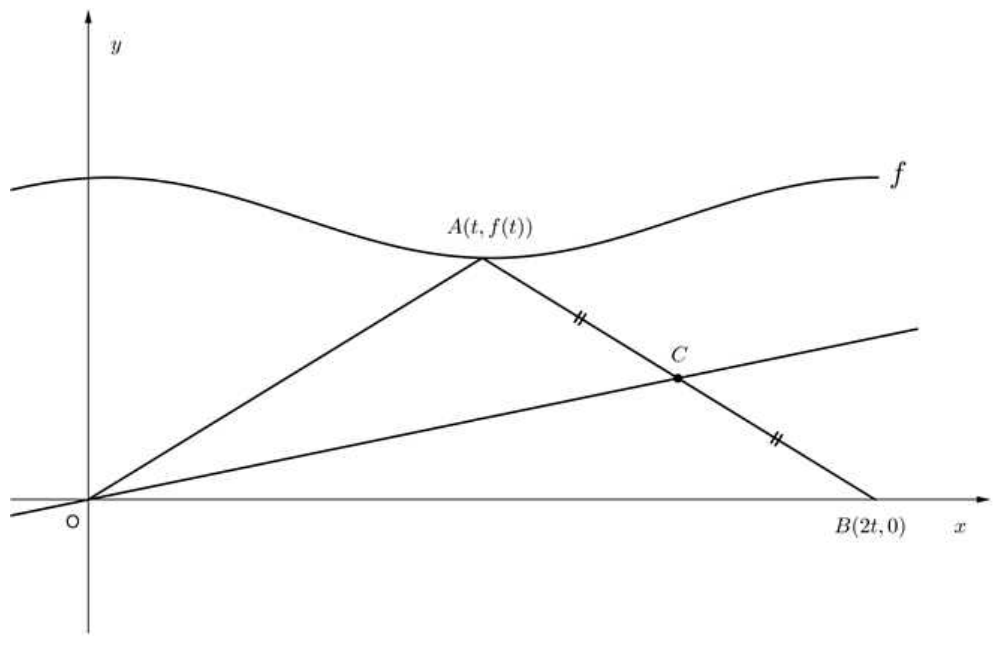
+5점 · 함수 y = g ( x ) \displaystyle y=g(x) y = g ( x ) [논제 3] 원점 O \displaystyle \mathrm{O} O O A B \displaystyle \mathrm{OAB} OAB A B \displaystyle \mathrm{AB} AB 중점을 지나야 한다.
따라서 C \displaystyle \mathrm{C} C A B \displaystyle \mathrm{AB} AB C \displaystyle \mathrm{C} C ( x , y ) \displaystyle (x,y) ( x , y ) x = 3 t 2 , y = f ( t ) 2 \displaystyle x=\frac{3t}2,y=\frac{f(t)}2 x = 2 3 t , y = 2 f ( t ) 구하는 곡선의 방정식은 y = 1 2 f ( 2 3 x ) \displaystyle y=\frac12f\left(\frac23x\right) y = 2 1 f ( 3 2 x ) g ( x ) = 1 2 f ( 2 3 x ) \displaystyle g(x)=\frac12f\left(\frac23x\right) g ( x ) = 2 1 f ( 3 2 x )
+10점 · 치환을 사용하여 a G ( 1 ) + ∫ 0 G ( 1 ) sin ( 2 3 G − 1 ( x ) ) d x = 3 4 ∫ 0 2 / 3 e t d t \displaystyle aG(1)+\int_0^{G(1)}\sin\left(\frac23G^{-1}(x)\right)\,dx=\frac34\int_0^{2/3}e^t\,dt a G ( 1 ) + ∫ 0 G ( 1 ) sin ( 3 2 G − 1 ( x ) ) d x = 4 3 ∫ 0 2/3 e t d t 이다. 이제, 문제에 주어진 적분을 구하기 위해서 2 3 G − 1 ( x ) = t \displaystyle \frac23G^{-1}(x)=t 3 2 G − 1 ( x ) = t G ′ ( x ) = g ( x ) = 1 2 f ( 2 3 x ) \displaystyle G^{\prime}(x)=g(x)=\frac12f\left(\frac23x\right) G ′ ( x ) = g ( x ) = 2 1 f ( 3 2 x ) x = G ( 3 2 t ) \displaystyle x=G\left(\frac32t\right) x = G ( 2 3 t ) d x = 3 2 G ′ ( 3 2 t ) d t = 3 4 f ( t ) d t \displaystyle dx=\frac32G^{\prime}\left(\frac32t\right)dt=\frac34f(t)dt d x = 2 3 G ′ ( 2 3 t ) d t = 4 3 f ( t ) d t 이다. 따라서 ∫ 0 G ( 1 ) sin ( 2 3 G − 1 ( x ) ) d x = 3 4 ∫ 0 2 / 3 ( sin t ) f ( t ) d t = 3 4 ∫ 0 2 / 3 sin t e t a + sin t d t \displaystyle \int_0^{G(1)}\sin\left(\frac23G^{-1}(x)\right)\,dx=\frac34\int_0^{2/3}(\sin t)f(t)\,dt=\frac34\int_0^{2/3}\sin t\frac{e^t}{a+\sin t}\,dt ∫ 0 G ( 1 ) sin ( 3 2 G − 1 ( x ) ) d x = 4 3 ∫ 0 2/3 ( sin t ) f ( t ) d t = 4 3 ∫ 0 2/3 sin t a + sin t e t d t 이므로 a G ( 1 ) + ∫ 0 G ( 1 ) sin ( 2 3 G − 1 ( x ) ) d x = a G ( 1 ) + 3 4 ∫ 0 2 / 3 [ ( a + sin t ) e t a + sin t − a e t a + sin t ] d t \displaystyle aG(1)+\int_0^{G(1)}\sin\left(\frac23G^{-1}(x)\right)\,dx=aG(1)+\frac34\int_0^{2/3}\left[(a+\sin t)\frac{e^t}{a+\sin t}-a\frac{e^t}{a+\sin t}\right]\,dt a G ( 1 ) + ∫ 0 G ( 1 ) sin ( 3 2 G − 1 ( x ) ) d x = a G ( 1 ) + 4 3 ∫ 0 2/3 [ ( a + sin t ) a + sin t e t − a a + sin t e t ] d t 이다. 그런데 3 4 ∫ 0 2 / 3 [ e t a + sin t ] d t = 3 4 ∫ 0 2 / 3 f ( t ) d t = ∫ 0 1 1 2 f ( 2 3 u ) d u = G ( 1 ) \displaystyle \frac34\int_0^{2/3}\left[\frac{e^t}{a+\sin t}\right]\,dt=\frac34\int_0^{2/3}f(t)\,dt=\int_0^1\frac12f\left(\frac23u\right)\,du=G(1) 4 3 ∫ 0 2/3 [ a + sin t e t ] d t = 4 3 ∫ 0 2/3 f ( t ) d t = ∫ 0 1 2 1 f ( 3 2 u ) d u = G ( 1 )
+5점 · 답 3 4 ( e 2 3 − 1 ) \displaystyle \frac34(e^{\frac23}-1) 4 3 ( e 3 2 − 1 ) 이므로 a G ( 1 ) + ∫ 0 G ( 1 ) sin ( 2 3 G − 1 ( x ) ) d x = a G ( 1 ) + 3 4 ∫ 0 2 / 3 e t d t − a G ( 1 ) = 3 4 ( e 2 3 − 1 ) \displaystyle \begin{aligned}aG(1)+\int_0^{G(1)}\sin\left(\frac23G^{-1}(x)\right)\,dx&=aG(1)+\frac34\int_0^{2/3}e^t\,dt-aG(1)\\&=\frac34(e^{\frac23}-1)\end{aligned} a G ( 1 ) + ∫ 0 G ( 1 ) sin ( 3 2 G − 1 ( x ) ) d x = a G ( 1 ) + 4 3 ∫ 0 2/3 e t d t − a G ( 1 ) = 4 3 ( e 3 2 − 1 ) 이다. 답 : 3 4 ( e 2 3 − 1 ) \displaystyle \frac34(e^{\frac23}-1) 4 3 ( e 3 2 − 1 )
예시 답안의 내용 및 평가 기준의 내용과는 일치하지 않더라도 기술한 내용이 논리적으로 타당한 경우에는 평가위원의 판단에 따라 점수를 부여할 수 있음.
 수리논술, 배움에서 논증의 완성까지.