[문제 2-1] a = 1 2 \displaystyle a=\frac12 a = 2 1 f ( x ) = { 1 2 x 2 ( x < 0 ) − 1 2 x 2 ( x ≥ 0 ) \displaystyle f(x)=\begin{cases}\frac12x^2&(x<0)\\-\frac12x^2&(x\geq0)\end{cases} f ( x ) = { 2 1 x 2 − 2 1 x 2 ( x < 0 ) ( x ≥ 0 )
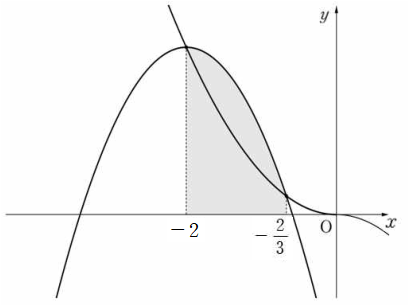
+4점 · t = − 2 \displaystyle t=-2 t = − 2 y = f ( x ) \displaystyle y=f(x) y = f ( x ) y = − ( x + 2 ) 2 + 2 \displaystyle y=-(x+2)^2+2 y = − ( x + 2 ) 2 + 2 x \displaystyle x x x = x 1 \displaystyle x=x_1 x = x 1 x = x 2 \displaystyle x=x_2 x = x 2 x \displaystyle x x y = − ( x + 2 ) 2 + 2 \displaystyle y=-(x+2)^2+2 y = − ( x + 2 ) 2 + 2 x \displaystyle x x − 2 \displaystyle -2 − 2 − 2 3 \displaystyle -\frac23 − 3 2 곡선 y = − ( x − t ) 2 + f ( t ) \displaystyle y=-(x-t)^2+f(t) y = − ( x − t ) 2 + f ( t ) y = f ( x ) \displaystyle y=f(x) y = f ( x ) x \displaystyle x x t < 0 \displaystyle t<0 t < 0 − ( x − t ) 2 + 1 2 t 2 = 1 2 x 2 \displaystyle -(x-t)^2+\frac12t^2=\frac12x^2 − ( x − t ) 2 + 2 1 t 2 = 2 1 x 2 3 2 x 2 − 2 t x + 1 2 t 2 = 0 \displaystyle \frac32x^2-2tx+\frac12t^2=0 2 3 x 2 − 2 t x + 2 1 t 2 = 0 x = t \displaystyle x=t x = t x = t 3 \displaystyle x=\frac t3 x = 3 t t = − 2 \displaystyle t=-2 t = − 2 x = − 2 \displaystyle x=-2 x = − 2 x = − 2 3 ( 1 ) \displaystyle x=-\frac23\qquad(1) x = − 3 2 ( 1 ) 이다.
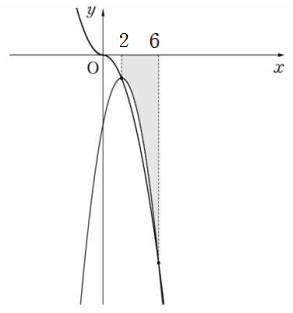
+4점 · t = 2 \displaystyle t=2 t = 2 y = f ( x ) \displaystyle y=f(x) y = f ( x ) y = − ( x − 2 ) 2 − 2 \displaystyle y=-(x-2)^2-2 y = − ( x − 2 ) 2 − 2 x \displaystyle x x x = x 1 \displaystyle x=x_1 x = x 1 x = x 2 \displaystyle x=x_2 x = x 2 x \displaystyle x x y = − ( x − 2 ) 2 − 2 \displaystyle y=-(x-2)^2-2 y = − ( x − 2 ) 2 − 2 x \displaystyle x x 2 \displaystyle 2 2 6 \displaystyle 6 6 곡선 y = − ( x − t ) 2 + f ( t ) \displaystyle y=-(x-t)^2+f(t) y = − ( x − t ) 2 + f ( t ) y = f ( x ) \displaystyle y=f(x) y = f ( x ) x \displaystyle x x t > 0 \displaystyle t>0 t > 0 − ( x − t ) 2 − 1 2 t 2 = − 1 2 x 2 \displaystyle -(x-t)^2-\frac12t^2=-\frac12x^2 − ( x − t ) 2 − 2 1 t 2 = − 2 1 x 2 1 2 x 2 − 2 t x + 3 2 t 2 = 0 \displaystyle \frac12x^2-2tx+\frac32t^2=0 2 1 x 2 − 2 t x + 2 3 t 2 = 0 x = t \displaystyle x=t x = t x = 3 t \displaystyle x=3t x = 3 t t = 2 \displaystyle t=2 t = 2 x = 2 \displaystyle x=2 x = 2 x = 6 ( 2 ) \displaystyle x=6\qquad(2) x = 6 ( 2 ) 이다.
+4점 · t = − 2 \displaystyle t=-2 t = − 2 y = f ( x ) \displaystyle y=f(x) y = f ( x ) y = − ( x + 2 ) 2 + 2 \displaystyle y=-(x+2)^2+2 y = − ( x + 2 ) 2 + 2 x \displaystyle x x x = x 1 \displaystyle x=x_1 x = x 1 x = x 2 \displaystyle x=x_2 x = x 2 x \displaystyle x x y = − ( x + 2 ) 2 + 2 \displaystyle y=-(x+2)^2+2 y = − ( x + 2 ) 2 + 2 x \displaystyle x x − 2 \displaystyle -2 − 2 − 2 3 \displaystyle -\frac23 − 3 2 따라서 S ( − 2 ) = ∫ − 2 − 2 3 ∣ − ( x + 2 ) 2 + 2 ∣ d x (3) = [ − 1 3 x 3 − 2 x 2 − 2 x ] − 2 − 2 3 = 152 81 (4) \displaystyle \begin{aligned}S(-2)&=\int_{-2}^{-\frac23}|-(x+2)^2+2|\,dx&&\text{(3)}\\&=\Biggl[-\frac13x^3-2x^2-2x\Biggr]_{-2}^{-\frac23}=\frac{152}{81}&&\text{(4)}\end{aligned} S ( − 2 ) = ∫ − 2 − 3 2 ∣ − ( x + 2 ) 2 + 2∣ d x = [ − 3 1 x 3 − 2 x 2 − 2 x ] − 2 − 3 2 = 81 152 (3) (4) 이고,
[그림 5] S ( 2 ) = ∫ 2 6 ∣ − ( x − 2 ) 2 − 2 ∣ d x (5) = [ 1 3 x 3 − 2 x 2 + 6 x ] 2 6 = 88 3 (6) \displaystyle \begin{aligned}S(2)&=\int_2^6|-(x-2)^2-2|\,dx&&\text{(5)}\\&=\Biggl[\frac13x^3-2x^2+6x\Biggr]_2^6=\frac{88}{3}&&\text{(6)}\end{aligned} S ( 2 ) = ∫ 2 6 ∣ − ( x − 2 ) 2 − 2∣ d x = [ 3 1 x 3 − 2 x 2 + 6 x ] 2 6 = 3 88 (5) (6) 이다.
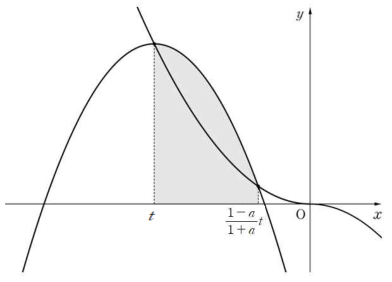
[그림 6] +4점 · t < 0 \displaystyle t<0 t < 0 y = f ( x ) \displaystyle y=f(x) y = f ( x ) y = − ( x − t ) 2 + a t 2 \displaystyle y=-(x-t)^2+at^2 y = − ( x − t ) 2 + a t 2 x \displaystyle x x a x 2 = − ( x − t ) 2 + a t 2 \displaystyle ax^2=-(x-t)^2+at^2 a x 2 = − ( x − t ) 2 + a t 2 x \displaystyle x x [문제 2-2] t < 0 \displaystyle t<0 t < 0 y = − ( x − t ) 2 + f ( t ) \displaystyle y=-(x-t)^2+f(t) y = − ( x − t ) 2 + f ( t ) y = f ( x ) \displaystyle y=f(x) y = f ( x ) x \displaystyle x x − ( x − t ) 2 + a t 2 = a x 2 \displaystyle -(x-t)^2+at^2=ax^2 − ( x − t ) 2 + a t 2 = a x 2 ( a + 1 ) x 2 − 2 t x + t 2 − a t 2 = 0 \displaystyle (a+1)x^2-2tx+t^2-at^2=0 ( a + 1 ) x 2 − 2 t x + t 2 − a t 2 = 0 x = t \displaystyle x=t x = t x = 1 − a 1 + a t ( 7 ) \displaystyle x=\frac{1-a}{1+a}t\qquad(7) x = 1 + a 1 − a t ( 7 ) 이때 t < 0 \displaystyle t<0 t < 0 0 < a < 1 \displaystyle 0<a<1 0 < a < 1 t < 1 − a 1 + a t ( 8 ) \displaystyle t<\frac{1-a}{1+a}t\qquad(8) t < 1 + a 1 − a t ( 8 ) 이다.
[그림 7] +5점 · 곡선 y = − ( x − t ) 2 + a t 2 \displaystyle y=-(x-t)^2+at^2 y = − ( x − t ) 2 + a t 2 x \displaystyle x x x = x 1 \displaystyle x=x_1 x = x 1 x = x 2 \displaystyle x=x_2 x = x 2 S ( t ) \displaystyle S(t) S ( t ) x \displaystyle x x 따라서 S ( t ) = ∫ t 1 − a 1 + a t ∣ − ( x − t ) 2 + a t 2 ∣ d x = ∫ t 1 − a 1 + a t { − ( x − t ) 2 + a t 2 } d x (9) = [ − 1 3 x 3 + t x 2 + ( a t 2 − t 2 ) x ] t 1 − a 1 + a t = − 1 3 { ( 1 − a ) 3 ( 1 + a ) 3 t 3 − t 3 } + t { ( 1 − a ) 2 ( 1 + a ) 2 t 2 − t 2 } + ( a − 1 ) t 2 ( 1 − a 1 + a t − t ) = t 3 × { − 1 3 × − 2 a 3 − 6 a ( 1 + a ) 3 + − 4 a ( 1 + a ) 2 + − 2 a 2 + 2 a 1 + a } (10) = − t 3 3 × { − 2 a 3 − 6 a ( 1 + a ) 3 + ( − 3 ) × − 4 a ( 1 + a ) ( 1 + a ) 3 + ( − 3 ) × ( − 2 a 2 + 2 a ) ( 1 + a ) 2 ( 1 + a ) 3 } = − t 3 3 × { − 2 a 3 − 6 a ( 1 + a ) 3 + 12 a 2 + 12 a ( 1 + a ) 3 + 6 a 4 + 6 a 3 − 6 a 2 − 6 a ( 1 + a ) 3 } = − t 3 3 × 6 a 4 + 4 a 3 + 6 a 2 ( 1 + a ) 3 (11) \displaystyle \begin{aligned}S(t)&=\int_t^{\frac{1-a}{1+a}t}|-(x-t)^2+at^2|\,dx\\&=\int_t^{\frac{1-a}{1+a}t}\{-(x-t)^2+at^2\}\,dx&&\text{(9)}\\&=\Biggl[-\frac13x^3+tx^2+(at^2-t^2)x\Biggr]_t^{\frac{1-a}{1+a}t}\\&=-\frac13\left\{\frac{(1-a)^3}{(1+a)^3}t^3-t^3\right\}+t\left\{\frac{(1-a)^2}{(1+a)^2}t^2-t^2\right\}+(a-1)t^2\left(\frac{1-a}{1+a}t-t\right)\\&=t^3\times\left\{-\frac13\times\frac{-2a^3-6a}{(1+a)^3}+\frac{-4a}{(1+a)^2}+\frac{-2a^2+2a}{1+a}\right\}&&\text{(10)}\\&=-\frac{t^3}{3}\times\left\{\frac{-2a^3-6a}{(1+a)^3}+(-3)\times\frac{-4a(1+a)}{(1+a)^3}+(-3)\times\frac{(-2a^2+2a)(1+a)^2}{(1+a)^3}\right\}\\&=-\frac{t^3}{3}\times\left\{\frac{-2a^3-6a}{(1+a)^3}+\frac{12a^2+12a}{(1+a)^3}+\frac{6a^4+6a^3-6a^2-6a}{(1+a)^3}\right\}\\&=-\frac{t^3}{3}\times\frac{6a^4+4a^3+6a^2}{(1+a)^3}&&\text{(11)}\end{aligned} S ( t ) = ∫ t 1 + a 1 − a t ∣ − ( x − t ) 2 + a t 2 ∣ d x = ∫ t 1 + a 1 − a t { − ( x − t ) 2 + a t 2 } d x = [ − 3 1 x 3 + t x 2 + ( a t 2 − t 2 ) x ] t 1 + a 1 − a t = − 3 1 { ( 1 + a ) 3 ( 1 − a ) 3 t 3 − t 3 } + t { ( 1 + a ) 2 ( 1 − a ) 2 t 2 − t 2 } + ( a − 1 ) t 2 ( 1 + a 1 − a t − t ) = t 3 × { − 3 1 × ( 1 + a ) 3 − 2 a 3 − 6 a + ( 1 + a ) 2 − 4 a + 1 + a − 2 a 2 + 2 a } = − 3 t 3 × { ( 1 + a ) 3 − 2 a 3 − 6 a + ( − 3 ) × ( 1 + a ) 3 − 4 a ( 1 + a ) + ( − 3 ) × ( 1 + a ) 3 ( − 2 a 2 + 2 a ) ( 1 + a ) 2 } = − 3 t 3 × { ( 1 + a ) 3 − 2 a 3 − 6 a + ( 1 + a ) 3 12 a 2 + 12 a + ( 1 + a ) 3 6 a 4 + 6 a 3 − 6 a 2 − 6 a } = − 3 t 3 × ( 1 + a ) 3 6 a 4 + 4 a 3 + 6 a 2 (9) (10) (11) 이고
+4점 · S ( t ) \displaystyle S(t) S ( t ) g ( a ) \displaystyle g(a) g ( a ) p \displaystyle p p q \displaystyle q q r \displaystyle r r s \displaystyle s s p \displaystyle p p q \displaystyle q q r \displaystyle r r s \displaystyle s s 1 \displaystyle 1 1 p \displaystyle p p q \displaystyle q q r \displaystyle r r s \displaystyle s s 2 \displaystyle 2 2 p \displaystyle p p q \displaystyle q q r \displaystyle r r s \displaystyle s s 3 \displaystyle 3 3 p \displaystyle p p q \displaystyle q q r \displaystyle r r s \displaystyle s s 4 \displaystyle 4 4 S ( t ) t 3 = − g ( a ) = − 6 a 4 + 4 a 3 + 6 a 2 3 ( 1 + a ) 3 ( t < 0 ) ( 12 ) \displaystyle \frac{S(t)}{t^3}=-g(a)=-\frac{6a^4+4a^3+6a^2}{3(1+a)^3}\quad(t<0)\qquad(12) t 3 S ( t ) = − g ( a ) = − 3 ( 1 + a ) 3 6 a 4 + 4 a 3 + 6 a 2 ( t < 0 ) ( 12 ) 이므로 g ( a ) = 6 a 4 + 4 a 3 + 6 a 2 3 ( 1 + a ) 3 ( 13 ) \displaystyle g(a)=\frac{6a^4+4a^3+6a^2}{3(1+a)^3}\qquad(13) g ( a ) = 3 ( 1 + a ) 3 6 a 4 + 4 a 3 + 6 a 2 ( 13 ) 에서 p = 4 , q = 6 , r = 0 , s = 0 ( 14 ) \displaystyle p=4,\ q=6,\ r=0,\ s=0\qquad(14) p = 4 , q = 6 , r = 0 , s = 0 ( 14 ) 이다.
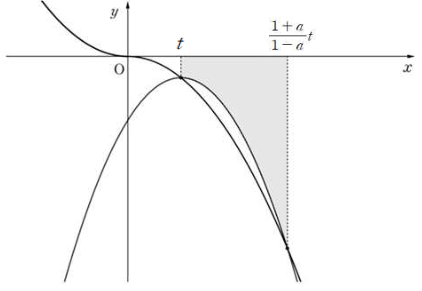
+4점 · t < 0 \displaystyle t<0 t < 0 g ( a ) \displaystyle g(a) g ( a ) t > 0 \displaystyle t>0 t > 0 h ( a ) \displaystyle h(a) h ( a ) g ( a ) \displaystyle g(a) g ( a ) h ( a ) \displaystyle h(a) h ( a ) g ( a ) \displaystyle g(a) g ( a ) h ( a ) \displaystyle h(a) h ( a ) [문제 2-3] t > 0 \displaystyle t>0 t > 0 y = − ( x − t ) 2 + f ( t ) \displaystyle y=-(x-t)^2+f(t) y = − ( x − t ) 2 + f ( t ) y = f ( x ) \displaystyle y=f(x) y = f ( x ) x \displaystyle x x − ( x − t ) 2 − a t 2 = − a x 2 \displaystyle -(x-t)^2-at^2=-ax^2 − ( x − t ) 2 − a t 2 = − a x 2 ( a − 1 ) x 2 + 2 t x − t 2 − a t 2 = 0 \displaystyle (a-1)x^2+2tx-t^2-at^2=0 ( a − 1 ) x 2 + 2 t x − t 2 − a t 2 = 0 x = t \displaystyle x=t x = t x = 1 + a 1 − a t ( 15 ) \displaystyle x=\frac{1+a}{1-a}t\qquad(15) x = 1 − a 1 + a t ( 15 ) 이때 t > 0 \displaystyle t>0 t > 0 0 < a < 1 \displaystyle 0<a<1 0 < a < 1 t < 1 + a 1 − a t ( 16 ) \displaystyle t<\frac{1+a}{1-a}t\qquad(16) t < 1 − a 1 + a t ( 16 ) 이다.
[그림 8] 따라서 S ( t ) = ∫ t 1 + a 1 − a t ∣ − ( x − t ) 2 − a t 2 ∣ d x = ∫ t 1 + a 1 − a t { ( x − t ) 2 + a t 2 } d x (17) = [ 1 3 x 3 − t x 2 + ( a t 2 + t 2 ) x ] t 1 + a 1 − a t = 1 3 { ( 1 + a ) 3 ( 1 − a ) 3 t 3 − t 3 } − t { ( 1 + a ) 2 ( 1 − a ) 2 t 2 − t 2 } + ( a + 1 ) t 2 ( 1 + a 1 − a t − t ) (18) = t 3 × { 1 3 × 2 a 3 + 6 a ( 1 − a ) 3 − 4 a ( 1 − a ) 2 + 2 a 2 + 2 a 1 − a } = t 3 3 × { 2 a 3 + 6 a ( 1 − a ) 3 − 3 × 4 a ( 1 − a ) ( 1 − a ) 3 + 3 × ( 2 a 2 + 2 a ) ( 1 − a ) 2 ( 1 − a ) 3 } = t 3 3 × { 2 a 3 + 6 a ( 1 − a ) 3 + 12 a 2 − 12 a ( 1 − a ) 3 + 6 a 4 − 6 a 3 − 6 a 2 + 6 a ( 1 − a ) 3 } = t 3 3 × 6 a 4 − 4 a 3 + 6 a 2 ( 1 − a ) 3 (19) \displaystyle \begin{aligned}S(t)&=\int_t^{\frac{1+a}{1-a}t}|-(x-t)^2-at^2|\,dx\\&=\int_t^{\frac{1+a}{1-a}t}\{(x-t)^2+at^2\}\,dx&&\text{(17)}\\&=\Biggl[\frac13x^3-tx^2+(at^2+t^2)x\Biggr]_t^{\frac{1+a}{1-a}t}\\&=\frac13\left\{\frac{(1+a)^3}{(1-a)^3}t^3-t^3\right\}-t\left\{\frac{(1+a)^2}{(1-a)^2}t^2-t^2\right\}+(a+1)t^2\left(\frac{1+a}{1-a}t-t\right)&&\text{(18)}\\&=t^3\times\left\{\frac13\times\frac{2a^3+6a}{(1-a)^3}-\frac{4a}{(1-a)^2}+\frac{2a^2+2a}{1-a}\right\}\\&=\frac{t^3}{3}\times\left\{\frac{2a^3+6a}{(1-a)^3}-3\times\frac{4a(1-a)}{(1-a)^3}+3\times\frac{(2a^2+2a)(1-a)^2}{(1-a)^3}\right\}\\&=\frac{t^3}{3}\times\left\{\frac{2a^3+6a}{(1-a)^3}+\frac{12a^2-12a}{(1-a)^3}+\frac{6a^4-6a^3-6a^2+6a}{(1-a)^3}\right\}\\&=\frac{t^3}{3}\times\frac{6a^4-4a^3+6a^2}{(1-a)^3}&&\text{(19)}\end{aligned} S ( t ) = ∫ t 1 − a 1 + a t ∣ − ( x − t ) 2 − a t 2 ∣ d x = ∫ t 1 − a 1 + a t {( x − t ) 2 + a t 2 } d x = [ 3 1 x 3 − t x 2 + ( a t 2 + t 2 ) x ] t 1 − a 1 + a t = 3 1 { ( 1 − a ) 3 ( 1 + a ) 3 t 3 − t 3 } − t { ( 1 − a ) 2 ( 1 + a ) 2 t 2 − t 2 } + ( a + 1 ) t 2 ( 1 − a 1 + a t − t ) = t 3 × { 3 1 × ( 1 − a ) 3 2 a 3 + 6 a − ( 1 − a ) 2 4 a + 1 − a 2 a 2 + 2 a } = 3 t 3 × { ( 1 − a ) 3 2 a 3 + 6 a − 3 × ( 1 − a ) 3 4 a ( 1 − a ) + 3 × ( 1 − a ) 3 ( 2 a 2 + 2 a ) ( 1 − a ) 2 } = 3 t 3 × { ( 1 − a ) 3 2 a 3 + 6 a + ( 1 − a ) 3 12 a 2 − 12 a + ( 1 − a ) 3 6 a 4 − 6 a 3 − 6 a 2 + 6 a } = 3 t 3 × ( 1 − a ) 3 6 a 4 − 4 a 3 + 6 a 2 (17) (18) (19) 이고 S ( t ) t 3 = h ( a ) = 6 a 4 − 4 a 3 + 6 a 2 3 ( 1 − a ) 3 ( t > 0 ) ( 20 ) \displaystyle \frac{S(t)}{t^3}=h(a)=\frac{6a^4-4a^3+6a^2}{3(1-a)^3}\ (t>0)\qquad(20) t 3 S ( t ) = h ( a ) = 3 ( 1 − a ) 3 6 a 4 − 4 a 3 + 6 a 2 ( t > 0 ) ( 20 ) 이다.
+10점 · g ( a ) \displaystyle g(a) g ( a ) h ( a ) \displaystyle h(a) h ( a ) lim a → 0 + g ( a ) h ( a ) \displaystyle \lim_{a\to0+}\frac{g(a)}{h(a)} a → 0 + lim h ( a ) g ( a ) lim a → 1 − g ( a ) ( 1 − a ) 3 h ( a ) \displaystyle \lim_{a\to1-}\frac{g(a)}{(1-a)^3h(a)} a → 1 − lim ( 1 − a ) 3 h ( a ) g ( a ) [문제 2-2] 에서 g ( a ) = 6 a 4 + 4 a 3 + 6 a 2 3 ( 1 + a ) 3 \displaystyle g(a)=\frac{6a^4+4a^3+6a^2}{3(1+a)^3} g ( a ) = 3 ( 1 + a ) 3 6 a 4 + 4 a 3 + 6 a 2 lim a → 0 + g ( a ) h ( a ) = lim a → 0 + ( 6 a 4 + 4 a 3 + 6 a 2 ) ( 1 − a ) 3 ( 6 a 4 − 4 a 3 + 6 a 2 ) ( 1 + a ) 3 = lim a → 0 + ( 6 a 2 + 4 a + 6 ) ( 1 − a ) 3 ( 6 a 2 − 4 a + 6 ) ( 1 + a ) 3 (21) = 6 × 1 6 × 1 = 1 \displaystyle \begin{aligned}\lim_{a\to0+}\frac{g(a)}{h(a)}&=\lim_{a\to0+}\frac{(6a^4+4a^3+6a^2)(1-a)^3}{(6a^4-4a^3+6a^2)(1+a)^3}\\&=\lim_{a\to0+}\frac{(6a^2+4a+6)(1-a)^3}{(6a^2-4a+6)(1+a)^3}&&\text{(21)}\\&=\frac{6\times1}{6\times1}=1\end{aligned} a → 0 + lim h ( a ) g ( a ) = a → 0 + lim ( 6 a 4 − 4 a 3 + 6 a 2 ) ( 1 + a ) 3 ( 6 a 4 + 4 a 3 + 6 a 2 ) ( 1 − a ) 3 = a → 0 + lim ( 6 a 2 − 4 a + 6 ) ( 1 + a ) 3 ( 6 a 2 + 4 a + 6 ) ( 1 − a ) 3 = 6 × 1 6 × 1 = 1 (21) 이고
lim a → 1 − g ( a ) ( 1 − a ) 3 h ( a ) = lim a → 1 − ( 6 a 4 + 4 a 3 + 6 a 2 ) ( 6 a 4 − 4 a 3 + 6 a 2 ) ( 1 + a ) 3 = 16 8 × 8 = 1 4 ( 22 ) \displaystyle \lim_{a\to1-}\frac{g(a)}{(1-a)^3h(a)}=\lim_{a\to1-}\frac{(6a^4+4a^3+6a^2)}{(6a^4-4a^3+6a^2)(1+a)^3}=\frac{16}{8\times8}=\frac14\qquad(22) a → 1 − lim ( 1 − a ) 3 h ( a ) g ( a ) = a → 1 − lim ( 6 a 4 − 4 a 3 + 6 a 2 ) ( 1 + a ) 3 ( 6 a 4 + 4 a 3 + 6 a 2 ) = 8 × 8 16 = 4 1 ( 22 ) 이다.
 수리논술, 배움에서 논증의 완성까지.