수리논술, 이게 다다.

자연계열 (오전) 2-3번

오류 제보

문제

[문제 2] 다음 제시문을 읽고 물음에 답하시오. (50점)

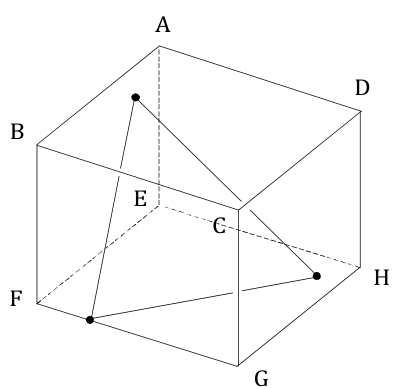
<다> 한 변의 길이가 1\displaystyle 1인 정사각형을 밑면으로 하고, 높이가 3−1\displaystyle \sqrt{3} - 1인 직육면체 ABCD−EFGH\displaystyle \mathrm{ABCD} - \mathrm{EFGH} 안에 삼각형 T\displaystyle T가 놓여 있다. T\displaystyle T의 한 꼭짓점은 면 ABCD\displaystyle \mathrm{ABCD}에, 다른 두 꼭짓점은 면 EFGH\displaystyle \mathrm{EFGH}에 있다.

직육면체 ABCD-EFGH 안에 놓인 삼각형 T

3. 제시문 <다>에서 주어진 삼각형 T\displaystyle T의 면 EFGH\displaystyle \mathrm{EFGH} 위로의 정사영을 S\displaystyle S라 할 때, S\displaystyle S는 면 EFGH\displaystyle \mathrm{EFGH}에 있는 정삼각형 중에서 넓이가 최대인 정삼각형이다. 이러한 삼각형 T\displaystyle T의 개수를 구하고 각각의 넓이를 구하시오.

해설강의 준비중

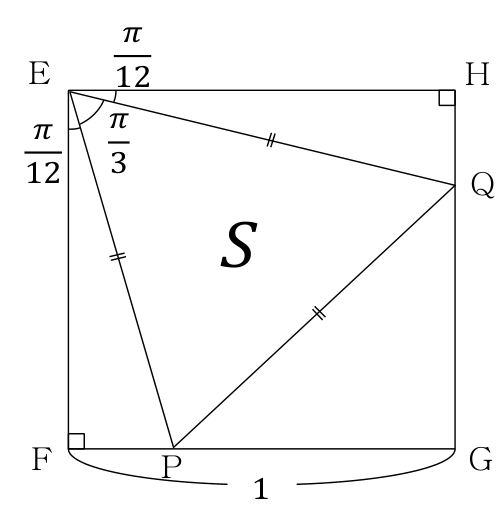
3. S\displaystyle S를 정사각형 EFGH\displaystyle \mathrm{EFGH}에 들어있는 넓이가 최대인 정삼각형이라 하면, S\displaystyle S를 적당히 이동해 의해 S\displaystyle S의 두 꼭짓점 P\displaystyle \mathrm{P}, Q\displaystyle \mathrm{Q}는 정사각형 EFGH\displaystyle \mathrm{EFGH}의 인접한 두 변에 놓여있다고 할 수 있다. 이 두 변을 변 FG\displaystyle \mathrm{FG}와 변 GH\displaystyle \mathrm{GH}라 가정하자.S\displaystyle \mathrm{S}의 다른 한 꼭짓점이 정사각형 EFGH\displaystyle \mathrm{EFGH}의 내부에 있다면, S\displaystyle S보다 넓이가 더 큰 정삼각형을 찾을 수 있으므로 모순이다.따라서 S\displaystyle S의 다른 한 꼭짓점은 변 EF\displaystyle \mathrm{EF} 또는 변 HE\displaystyle \mathrm{HE} 위에 있다.이 꼭짓점이 변 EF\displaystyle \mathrm{EF} 또는 변 HE\displaystyle \mathrm{HE} 위에 있고 점 E\displaystyle \mathrm{E}가 아니라면, 평행이동에 의해 꼭짓점 P\displaystyle \mathrm{P} 또는 Q\displaystyle \mathrm{Q}를 정사각형 EFGH\displaystyle \mathrm{EFGH}의 내부에 있도록 할 수 있어 모순이다.따라서 정삼각형 S\displaystyle S의 다른 한 꼭짓점은 점 E\displaystyle \mathrm{E}이다.이때, 삼각형 EPF\displaystyle \mathrm{EPF}와 삼각형 EQH\displaystyle \mathrm{EQH}는 합동이고, 1EP‾=cos⁡(π12)\displaystyle \frac{1}{\overline{\mathrm{EP}}} = \cos \left( \frac{\pi}{12} \right)이므로 EP‾=6−2\displaystyle \overline{\mathrm{EP}} = \sqrt{6} - \sqrt{2}이다.따라서 S\displaystyle S의 넓이=34(6−2)2=23−3\displaystyle = \frac{\sqrt{3}}{4} ( \sqrt{6} - \sqrt{2} )^{2} = 2 \sqrt{3} - 3이다.

정사각형 EFGH 안의 넓이가 최대인 정삼각형 S

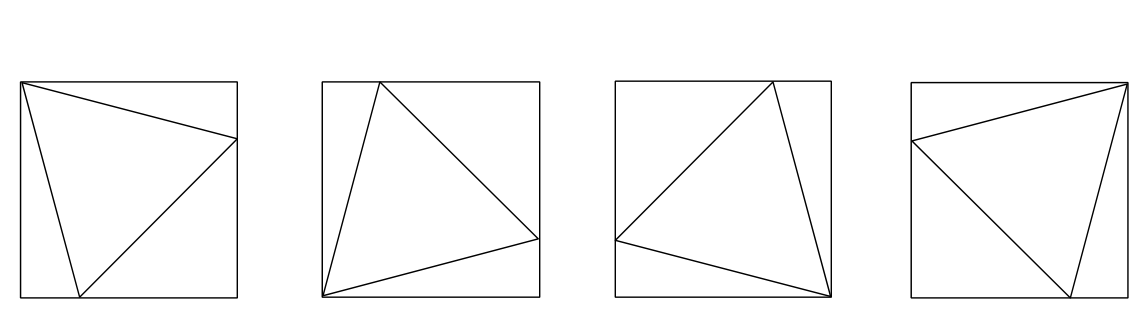
정사영 S\displaystyle S의 한 꼭짓점이 정사각형 EFGH\displaystyle \mathrm{EFGH}의 한 꼭짓점이 되므로 이 꼭짓점의 선택에 따라 정사영 S\displaystyle S는 다음 4\displaystyle 4가지 경우 중 하나가 되고, 각 경우 3\displaystyle 3개의 T\displaystyle T가 존재하므로 구하는 T\displaystyle T는 모두 12\displaystyle 12개이다.

정사영 S가 될 수 있는 네 가지 경우

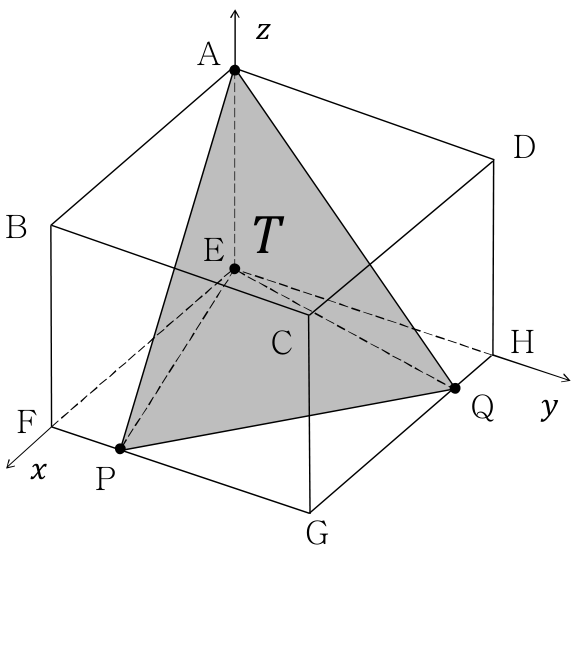
12\displaystyle 12개의 삼각형 T\displaystyle T는 모두 합동임을 쉽게 알 수 있다. 따라서 그 중 하나인 삼각형 APQ\displaystyle \mathrm{APQ}의 넓이를 구하자. T\displaystyle T를 포함하는 평면의 방정식은 x+y+3z=3−3\displaystyle x + y + \sqrt{3} z = 3 - \sqrt{3}이고, 이 평면과 xy−\displaystyle x y -평면이 이루는 각을 θ\displaystyle \theta라 하면,cos⁡θ=1⋅0+1⋅0+3⋅112+12+32⋅02+02+12=35\displaystyle \cos \theta = \frac{{1 \cdot 0 + 1 \cdot 0 + \sqrt{3} \cdot 1}}{\sqrt{1^{2} + 1^{2} + \sqrt{3}^{2}} \cdot \sqrt{0^{2} + 0^{2} + 1^{2}}} = \frac{\sqrt{3}}{\sqrt{5}}이다.따라서 (T\displaystyle T의 넓이)×cos⁡θ\displaystyle \times \cos \theta=\displaystyle =(S\displaystyle S의 넓이)이므로T\displaystyle T의 넓이=1cos⁡θ⋅(23−3)=25−15\displaystyle = \frac{1}{\cos \theta} \cdot ( 2 \sqrt{3} - 3 ) = 2 \sqrt{5} - \sqrt{15}이다.

삼각형 APQ와 좌표축 및 밑면 정사영

첨삭 사례

아직 등록된 첨삭 사례가 없습니다.

질문과 답변 · 0개질문과 답변 · 고정 0개

아직 등록된 질문이 없습니다. 질문 작성은 멤버십 회원만 가능합니다.