수리논술, 배움에서 논증의 완성까지.

자연계열 (오전) 2번

문제

🔒
짧은 시간에 너무 많은 문제를 여셔서 열람을 잠시 제한했습니다. 잠시 후 다시 시도하시거나 로그인해 주세요.
해설강의 준비중

1. 문제에서 주어진 이차방정식을 h(x)=x22(stab)x+1\displaystyle h ( x ) = x^{2} - 2 ( s t - \overrightarrow{a} \bullet \overrightarrow{b} ) x + 1으로 나타내자.두 부등식 βstα\displaystyle \beta \le \frac{s}{t} \le \alpha, βtsα\displaystyle \beta \le \frac{t}{s} \le \alpha를 보이기 위하여 이차함수 h(x)\displaystyle h ( x )의 그래프를 생각하면, h(ts)0\displaystyle h \left( \frac{t}{s} \right) \le 0, h(st)0\displaystyle h \left( \frac{s}{t} \right) \le 0임을 보이면 된다.우선 h(ts)\displaystyle h \left( \frac{t}{s} \right), h(st)\displaystyle h \left( \frac{s}{t} \right)를 계산하면 다음과 같다.h(ts)=t2s22(stab)ts+1\displaystyle h \left( \frac{t}{s} \right) = \frac{t^{2}}{s^{2}} - 2 ( s t - \overrightarrow{a} \bullet \overrightarrow{b} ) \frac{t}{s} + 1=1s2(t22st(stab)+s2)\displaystyle = \frac{1}{s^{2}} ( t^{2} - 2 s t ( s t - \overrightarrow{a} \bullet \overrightarrow{b} ) + s^{2} )h(st)=s2t22(stab)st+1\displaystyle h \left( \frac{s}{t} \right) = \frac{s^{2}}{t^{2}} - 2 ( s t - \overrightarrow{a} \bullet \overrightarrow{b} ) \frac{s}{t} + 1=1t2(s22st(stab)+t2)\displaystyle = \frac{1}{t^{2}} ( s^{2} - 2 s t ( s t - \overrightarrow{a} \bullet \overrightarrow{b} ) + t^{2} )그런데, 양수 s\displaystyle s, t\displaystyle t에 대하여 다음 부등식이 성립한다.2st(ab)2stabs2b2+t2a2=2s2t2s2t2\displaystyle 2 s t ( \overrightarrow{a} \bullet \overrightarrow{b} ) \le 2 s t | \overrightarrow{a} | | \overrightarrow{b} | \le s^{2} | \overrightarrow{b} |^{2} + t^{2} | \overrightarrow{a} |^{2} = 2 s^{2} t^{2} - s^{2} - t^{2}\displaystyle \cdots \cdots①의 부등식을 정리하면, t2+2st(ab)+s22s2t2=t22st(st(ab))+s20\displaystyle t^{2} + 2 s t ( \overrightarrow{a} \bullet \overrightarrow{b} ) + s^{2} - 2 s^{2} t^{2} = t^{2} - 2 s t ( s t - ( \overrightarrow{a} \bullet \overrightarrow{b} ) ) + s^{2} \le 0이다.그러므로 h(ts)0\displaystyle h \left( \frac{t}{s} \right) \le 0, h(st)0\displaystyle h \left( \frac{s}{t} \right) \le 0이다.

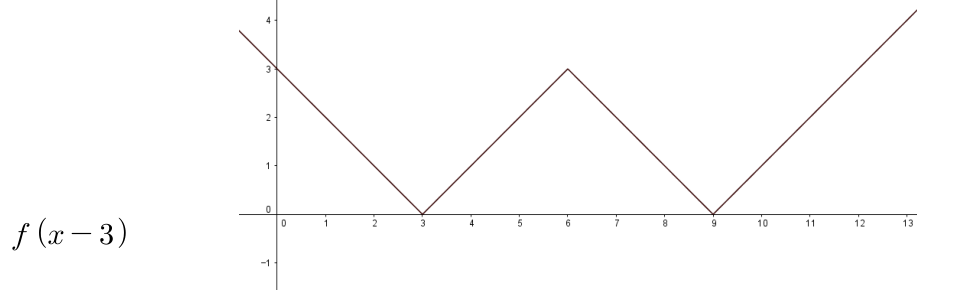
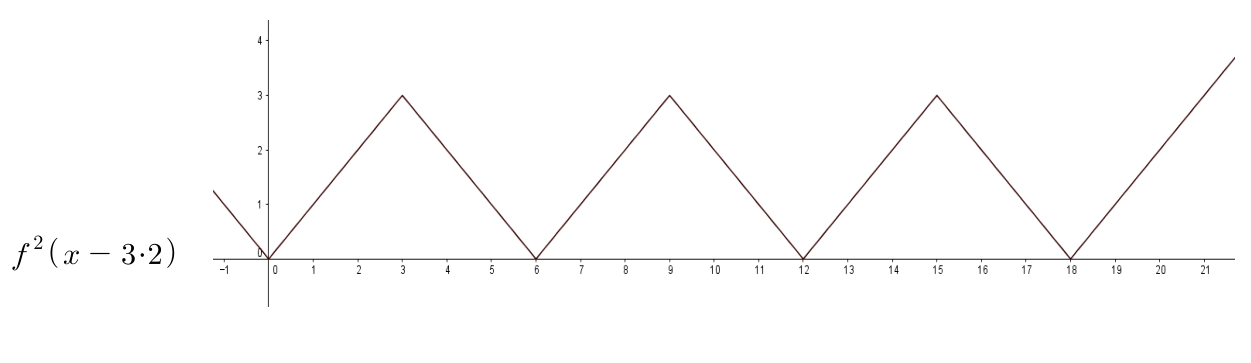
2. f(x3)=x63\displaystyle f ( x - 3 ) = | | x - 6 | - 3 |f2(x32)\displaystyle f^{2} ( x - 3 \cdot 2 )의 그래프는 다음과 같다.

f(x−3)의 그래프
f²(x−3·2)의 그래프

A1\displaystyle A_1의 넓이는 S1=π[k=12(24k12)]=48π\displaystyle S_1=\pi\left[\sum_{k=1}^2(24k-12)\right]=48\pi이다.같은 방법으로 n\displaystyle n이 홀수, 짝수인 경우를 나누어 생각하여 넓이를 구할 수 있다.A2n1\displaystyle A_{2n-1}의 넓이를 계산하면, S2n1=π{27(2n1)2+18(2n1)+3}\displaystyle S_{2n-1}=\pi\{27(2n-1)^2+18(2n-1)+3\}이다.A2n\displaystyle A_{2n}의 넓이를 계산하면, S2n=π{27(2n)2+18(2n)+1}\displaystyle S_{2n}=\pi\{27(2n)^2+18(2n)+1\}이다.An\displaystyle A_n의 넓이를 구해보면, Sn=π{27n2+18n+(1)n+1+2}\displaystyle S_n=\pi\{27n^2+18n+(-1)^{n+1}+2\}이다.그러므로 극한값은 limnSnn2=27π\displaystyle \lim_{n\to\infty}\frac{S_n}{n^2}=27\pi이다.

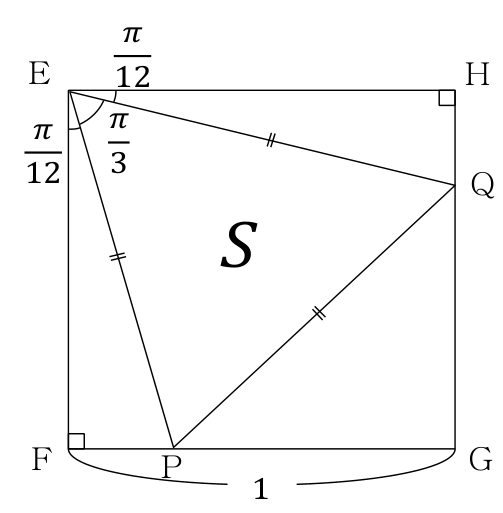
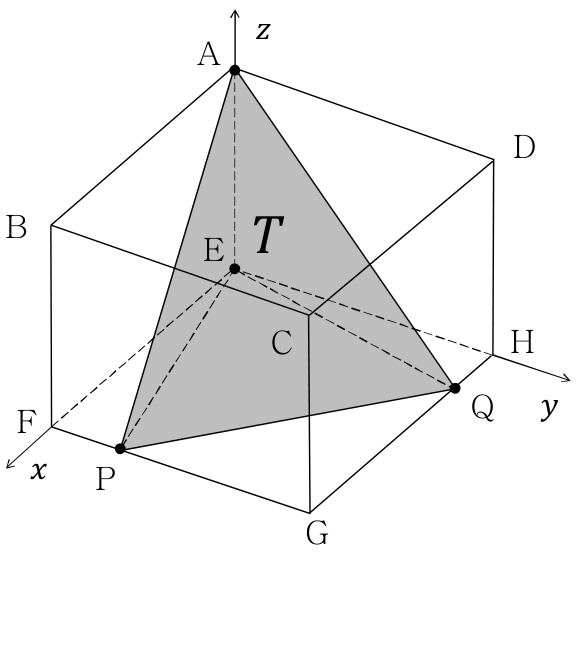
3. S\displaystyle S를 정사각형 EFGH\displaystyle \mathrm{EFGH}에 들어있는 넓이가 최대인 정삼각형이라 하면, S\displaystyle S를 적당히 이동해 의해 S\displaystyle S의 두 꼭짓점 P\displaystyle \mathrm{P}, Q\displaystyle \mathrm{Q}는 정사각형 EFGH\displaystyle \mathrm{EFGH}의 인접한 두 변에 놓여있다고 할 수 있다. 이 두 변을 변 FG\displaystyle \mathrm{FG}와 변 GH\displaystyle \mathrm{GH}라 가정하자.S\displaystyle \mathrm{S}의 다른 한 꼭짓점이 정사각형 EFGH\displaystyle \mathrm{EFGH}의 내부에 있다면, S\displaystyle S보다 넓이가 더 큰 정삼각형을 찾을 수 있으므로 모순이다.따라서 S\displaystyle S의 다른 한 꼭짓점은 변 EF\displaystyle \mathrm{EF} 또는 변 HE\displaystyle \mathrm{HE} 위에 있다.이 꼭짓점이 변 EF\displaystyle \mathrm{EF} 또는 변 HE\displaystyle \mathrm{HE} 위에 있고 점 E\displaystyle \mathrm{E}가 아니라면, 평행이동에 의해 꼭짓점 P\displaystyle \mathrm{P} 또는 Q\displaystyle \mathrm{Q}를 정사각형 EFGH\displaystyle \mathrm{EFGH}의 내부에 있도록 할 수 있어 모순이다.따라서 정삼각형 S\displaystyle S의 다른 한 꼭짓점은 점 E\displaystyle \mathrm{E}이다.이때, 삼각형 EPF\displaystyle \mathrm{EPF}와 삼각형 EQH\displaystyle \mathrm{EQH}는 합동이고, 1EP=cos(π12)\displaystyle \frac{1}{\overline{\mathrm{EP}}} = \cos \left( \frac{\pi}{12} \right)이므로 EP=62\displaystyle \overline{\mathrm{EP}} = \sqrt{6} - \sqrt{2}이다.따라서 S\displaystyle S의 넓이=34(62)2=233\displaystyle = \frac{\sqrt{3}}{4} ( \sqrt{6} - \sqrt{2} )^{2} = 2 \sqrt{3} - 3이다.

정사각형 EFGH 안의 넓이가 최대인 정삼각형 S

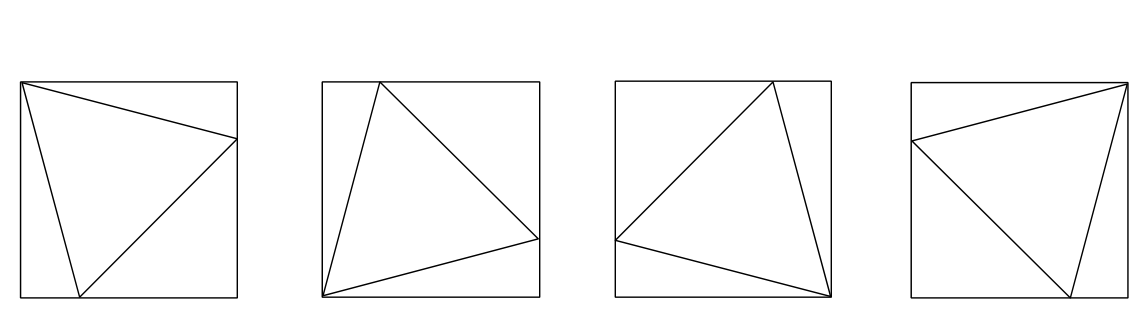
정사영 S\displaystyle S의 한 꼭짓점이 정사각형 EFGH\displaystyle \mathrm{EFGH}의 한 꼭짓점이 되므로 이 꼭짓점의 선택에 따라 정사영 S\displaystyle S는 다음 4\displaystyle 4가지 경우 중 하나가 되고, 각 경우 3\displaystyle 3개의 T\displaystyle T가 존재하므로 구하는 T\displaystyle T는 모두 12\displaystyle 12개이다.

정사영 S가 될 수 있는 네 가지 경우

12\displaystyle 12개의 삼각형 T\displaystyle T는 모두 합동임을 쉽게 알 수 있다. 따라서 그 중 하나인 삼각형 APQ\displaystyle \mathrm{APQ}의 넓이를 구하자. T\displaystyle T를 포함하는 평면의 방정식은 x+y+3z=33\displaystyle x + y + \sqrt{3} z = 3 - \sqrt{3}이고, 이 평면과 xy\displaystyle x y -평면이 이루는 각을 θ\displaystyle \theta라 하면,cosθ=10+10+3112+12+3202+02+12=35\displaystyle \cos \theta = \frac{{1 \cdot 0 + 1 \cdot 0 + \sqrt{3} \cdot 1}}{\sqrt{1^{2} + 1^{2} + \sqrt{3}^{2}} \cdot \sqrt{0^{2} + 0^{2} + 1^{2}}} = \frac{\sqrt{3}}{\sqrt{5}}이다.따라서 (T\displaystyle T의 넓이)×cosθ\displaystyle \times \cos \theta=\displaystyle =(S\displaystyle S의 넓이)이므로T\displaystyle T의 넓이=1cosθ(233)=2515\displaystyle = \frac{1}{\cos \theta} \cdot ( 2 \sqrt{3} - 3 ) = 2 \sqrt{5} - \sqrt{15}이다.

삼각형 APQ와 좌표축 및 밑면 정사영

첨삭 사례

아직 등록된 첨삭 사례가 없습니다.

질문과 답변 · 0개질문과 답변 · 고정 0개

아직 등록된 질문이 없습니다. 질문 작성은 멤버십 회원만 가능합니다.