+4점 · 함수 f ( x ) \displaystyle f(x) f ( x ) × n \displaystyle \times n × n (1) f ( x ) = ( x 2 − 2 a 1 x + a 1 2 ) + ⋯ + ( x 2 − 2 a n x + a n 2 ) = n x 2 − 2 ( a 1 + ⋯ + a n ) x + ( a 1 2 + ⋯ + a n 2 ) \displaystyle f(x)=(x^2-2a_1x+a_1^2)+\cdots+(x^2-2a_nx+a_n^2)=nx^2-2(a_1+\cdots+a_n)x+(a_1^2+\cdots+a_n^2) f ( x ) = ( x 2 − 2 a 1 x + a 1 2 ) + ⋯ + ( x 2 − 2 a n x + a n 2 ) = n x 2 − 2 ( a 1 + ⋯ + a n ) x + ( a 1 2 + ⋯ + a n 2 )
최고차항계수가 양수인 이차함수이므로 f ′ ( x ) = 2 n x − 2 ( a 1 + ⋯ + a n ) = 0 \displaystyle f^{\prime}(x)=2nx-2(a_1+\cdots+a_n)=0 f ′ ( x ) = 2 n x − 2 ( a 1 + ⋯ + a n ) = 0 x = a = 1 n ( a 1 + a 2 + ⋯ + a n ) \displaystyle x=a=\frac1n(a_1+a_2+\cdots+a_n) x = a = n 1 ( a 1 + a 2 + ⋯ + a n )
a \displaystyle a a a 1 , a 2 , ⋯ , a n \displaystyle a_1,a_2,\cdots,a_n a 1 , a 2 , ⋯ , a n
f ( a ) = ( a 1 − a ) 2 + ( a 2 − a ) 2 + ⋯ + ( a n − a ) 2 \displaystyle f(a)=(a_1-a)^2+(a_2-a)^2+\cdots+(a_n-a)^2 f ( a ) = ( a 1 − a ) 2 + ( a 2 − a ) 2 + ⋯ + ( a n − a ) 2 a 1 , a 2 , ⋯ , a n \displaystyle a_1,a_2,\cdots,a_n a 1 , a 2 , ⋯ , a n × n \displaystyle \times n × n
+7점 · 거리의 제곱의 합이 최소가 되는 점 P 0 \displaystyle P_0 P 0 O P 0 → \displaystyle \overrightarrow{OP_0} O P 0 O P 1 → , O P 2 → , ⋯ , O P n → \displaystyle \overrightarrow{OP_1},\overrightarrow{OP_2},\cdots,\overrightarrow{OP_n} O P 1 , O P 2 , ⋯ , O P n P 0 P 1 → + P 0 P 2 → + ⋯ + P 0 P n → = 0 ⃗ \displaystyle \overrightarrow{P_0P_1}+\overrightarrow{P_0P_2}+\cdots+\overrightarrow{P_0P_n}=\vec0 P 0 P 1 + P 0 P 2 + ⋯ + P 0 P n = 0 (2) 주어진 점들의 좌표를 P 1 ( a 1 , b 1 ) , P 2 ( a 2 , b 2 ) , ⋯ , P n ( a n , b n ) \displaystyle P_1(a_1,b_1),P_2(a_2,b_2),\cdots,P_n(a_n,b_n) P 1 ( a 1 , b 1 ) , P 2 ( a 2 , b 2 ) , ⋯ , P n ( a n , b n )
P P 1 ‾ 2 + P P 2 ‾ 2 + ⋯ + P P n ‾ 2 = { ( x − a 1 ) 2 + ( y − b 1 ) 2 } + { ( x − a 2 ) 2 + ( y − b 2 ) 2 } + ⋯ + { ( x − a n ) 2 + ( y − b n ) 2 } = { ( x − a 1 ) 2 + ( x − a 2 ) 2 + ⋯ + ( x − a n ) 2 } + { ( y − b 1 ) 2 + ( y − b 2 ) 2 + ⋯ + ( y − b n ) 2 } \displaystyle \begin{aligned}\overline{PP_1}^{\,2}+\overline{PP_2}^{\,2}+\cdots+\overline{PP_n}^{\,2}&=\{(x-a_1)^2+(y-b_1)^2\}+\{(x-a_2)^2+(y-b_2)^2\}+\cdots+\{(x-a_n)^2+(y-b_n)^2\}\\&=\{(x-a_1)^2+(x-a_2)^2+\cdots+(x-a_n)^2\}+\{(y-b_1)^2+(y-b_2)^2+\cdots+(y-b_n)^2\}\end{aligned} P P 1 2 + P P 2 2 + ⋯ + P P n 2 = {( x − a 1 ) 2 + ( y − b 1 ) 2 } + {( x − a 2 ) 2 + ( y − b 2 ) 2 } + ⋯ + {( x − a n ) 2 + ( y − b n ) 2 } = {( x − a 1 ) 2 + ( x − a 2 ) 2 + ⋯ + ( x − a n ) 2 } + {( y − b 1 ) 2 + ( y − b 2 ) 2 + ⋯ + ( y − b n ) 2 }
(1)의 풀이에 의해서 첫 번째 대괄호 안의 식은 x = 1 n ( a 1 + a 2 + ⋯ + a n ) \displaystyle x=\frac1n(a_1+a_2+\cdots+a_n) x = n 1 ( a 1 + a 2 + ⋯ + a n ) y = 1 n ( b 1 + b 2 + ⋯ + b n ) \displaystyle y=\frac1n(b_1+b_2+\cdots+b_n) y = n 1 ( b 1 + b 2 + ⋯ + b n ) P 0 \displaystyle P_0 P 0
O P 0 → = ( a 1 + a 2 + ⋯ + a n n , b 1 + b 2 + ⋯ + b n n ) = 1 n ( O P 1 → + O P 2 → + ⋯ + O P n → ) \displaystyle \overrightarrow{OP_0}=\left(\frac{a_1+a_2+\cdots+a_n}n,\frac{b_1+b_2+\cdots+b_n}n\right)=\frac1n(\overrightarrow{OP_1}+\overrightarrow{OP_2}+\cdots+\overrightarrow{OP_n}) O P 0 = ( n a 1 + a 2 + ⋯ + a n , n b 1 + b 2 + ⋯ + b n ) = n 1 ( O P 1 + O P 2 + ⋯ + O P n )
이때,
P 0 P 1 → + P 0 P 2 → + ⋯ + P 0 P n → = ( O P 1 → − O P 0 → ) + ( O P 2 → − O P 0 → ) + ⋯ + ( O P n → − O P 0 → ) = ( O P 1 → + O P 2 → + ⋯ + O P n → ) − n O P 0 → = n O P 0 → − n O P 0 → = 0 ⃗ \displaystyle \begin{aligned}\overrightarrow{P_0P_1}+\overrightarrow{P_0P_2}+\cdots+\overrightarrow{P_0P_n}&=(\overrightarrow{OP_1}-\overrightarrow{OP_0})+(\overrightarrow{OP_2}-\overrightarrow{OP_0})+\cdots+(\overrightarrow{OP_n}-\overrightarrow{OP_0})\\&=(\overrightarrow{OP_1}+\overrightarrow{OP_2}+\cdots+\overrightarrow{OP_n})-n\overrightarrow{OP_0}=n\overrightarrow{OP_0}-n\overrightarrow{OP_0}=\vec0\end{aligned} P 0 P 1 + P 0 P 2 + ⋯ + P 0 P n = ( O P 1 − O P 0 ) + ( O P 2 − O P 0 ) + ⋯ + ( O P n − O P 0 ) = ( O P 1 + O P 2 + ⋯ + O P n ) − n O P 0 = n O P 0 − n O P 0 = 0
+9점 · n + 1 \displaystyle n+1 n + 1 ( − ∞ , a 1 ) , ( a 1 , a 2 ) , ( a 2 , a 3 ) , ⋯ , ( a n − 1 , a n ) , ( a n , ∞ ) \displaystyle (-\infty,a_1),(a_1,a_2),(a_2,a_3),\cdots,(a_{n-1},a_n),(a_n,\infty) ( − ∞ , a 1 ) , ( a 1 , a 2 ) , ( a 2 , a 3 ) , ⋯ , ( a n − 1 , a n ) , ( a n , ∞ ) g ( x ) \displaystyle g(x) g ( x ) n \displaystyle n n g ( x ) \displaystyle g(x) g ( x ) n \displaystyle n n g ( x ) \displaystyle g(x) g ( x ) (3) x ≤ c \displaystyle x\le c x ≤ c ∣ x − c ∣ = − ( x − c ) \displaystyle |x-c|=-(x-c) ∣ x − c ∣ = − ( x − c ) c ≤ x \displaystyle c\le x c ≤ x ∣ x − c ∣ = ( x − c ) \displaystyle |x-c|=(x-c) ∣ x − c ∣ = ( x − c )
x ≤ a 1 < a 2 < ⋯ < a n \displaystyle x\le a_1<a_2<\cdots<a_n x ≤ a 1 < a 2 < ⋯ < a n g ( x ) = ∣ x − a 1 ∣ + ∣ x − a 2 ∣ + ⋯ + ∣ x − a n ∣ \displaystyle g(x)=|x-a_1|+|x-a_2|+\cdots+|x-a_n| g ( x ) = ∣ x − a 1 ∣ + ∣ x − a 2 ∣ + ⋯ + ∣ x − a n ∣
= − ( x − a 1 ) − ( x − a 2 ) − ⋯ − ( x − a n ) = − n x + ( a 1 + ⋯ + a n ) \displaystyle =-(x-a_1)-(x-a_2)-\cdots-(x-a_n)=-nx+(a_1+\cdots+a_n) = − ( x − a 1 ) − ( x − a 2 ) − ⋯ − ( x − a n ) = − n x + ( a 1 + ⋯ + a n )
a 1 ≤ x ≤ a 2 < ⋯ < a n \displaystyle a_1\le x\le a_2<\cdots<a_n a 1 ≤ x ≤ a 2 < ⋯ < a n
g ( x ) = ( x − a 1 ) − ( x − a 2 ) − ⋯ − ( x − a n ) = ( − n + 2 ) x + ( − a 1 + ⋯ + a n ) \displaystyle g(x)=(x-a_1)-(x-a_2)-\cdots-(x-a_n)=(-n+2)x+(-a_1+\cdots+a_n) g ( x ) = ( x − a 1 ) − ( x − a 2 ) − ⋯ − ( x − a n ) = ( − n + 2 ) x + ( − a 1 + ⋯ + a n )
a 1 < a 2 < ⋯ < a k ≤ x ≤ a k + 1 < ⋯ < a n \displaystyle a_1<a_2<\cdots<a_k\le x\le a_{k+1}<\cdots<a_n a 1 < a 2 < ⋯ < a k ≤ x ≤ a k + 1 < ⋯ < a n 1 ≤ k ≤ n − 1 \displaystyle 1\le k\le n-1 1 ≤ k ≤ n − 1
g ( x ) = ( x − a 1 ) + ⋯ + ( x − a k ) − ( x − a k + 1 ) − ⋯ − ( x − a n ) = ( − n + 2 k ) x + ( − a 1 − ⋯ + a n ) \displaystyle g(x)=(x-a_1)+\cdots+(x-a_k)-(x-a_{k+1})-\cdots-(x-a_n)=(-n+2k)x+(-a_1-\cdots+a_n) g ( x ) = ( x − a 1 ) + ⋯ + ( x − a k ) − ( x − a k + 1 ) − ⋯ − ( x − a n ) = ( − n + 2 k ) x + ( − a 1 − ⋯ + a n )
a 1 < a 2 < ⋯ < a n ≤ x \displaystyle a_1<a_2<\cdots<a_n\le x a 1 < a 2 < ⋯ < a n ≤ x
g ( x ) = ( x − a 1 ) + ( x − a 2 ) + ⋯ + ( x − a n ) = n x + ( − a 1 − ⋯ − a n ) \displaystyle g(x)=(x-a_1)+(x-a_2)+\cdots+(x-a_n)=nx+(-a_1-\cdots-a_n) g ( x ) = ( x − a 1 ) + ( x − a 2 ) + ⋯ + ( x − a n ) = n x + ( − a 1 − ⋯ − a n )
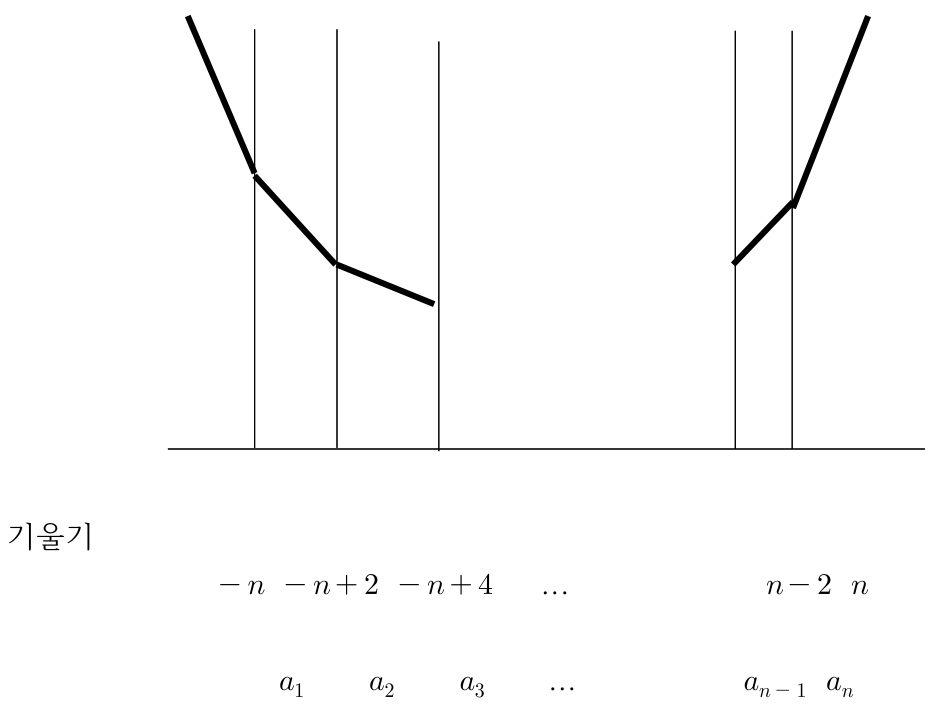
즉, y = g ( x ) \displaystyle y=g(x) y = g ( x )
각 구간 ( − ∞ , a 1 ) , ( a 1 , a 2 ) , ( a 2 , a 3 ) , ⋯ , ( a n − 1 , a n ) , ( a n , ∞ ) \displaystyle (-\infty,a_1),(a_1,a_2),(a_2,a_3),\cdots,(a_{n-1},a_n),(a_n,\infty) ( − ∞ , a 1 ) , ( a 1 , a 2 ) , ( a 2 , a 3 ) , ⋯ , ( a n − 1 , a n ) , ( a n , ∞ )
− n , − n + 2 , − n + 4 , ⋯ , n \displaystyle -n,-n+2,-n+4,\cdots,n − n , − n + 2 , − n + 4 , ⋯ , n − n \displaystyle -n − n n \displaystyle n n
전체적인 그래프의 개형은 다음과 같다.
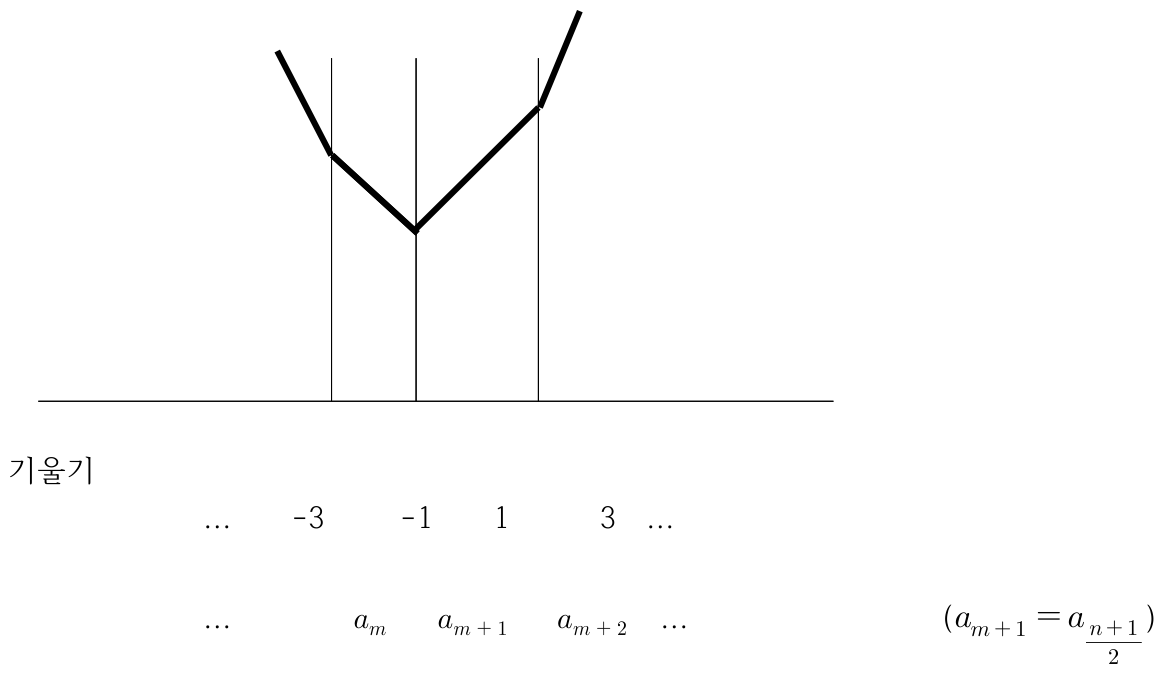
n = 2 m + 1 \displaystyle n=2m+1 n = 2 m + 1 − n , − n + 2 , ⋯ , − 1 , 1 , ⋯ , n \displaystyle -n,-n+2,\cdots,-1,1,\cdots,n − n , − n + 2 , ⋯ , − 1 , 1 , ⋯ , n ( a m , a m + 1 ) , ( a m + 1 , a m + 2 ) \displaystyle (a_m,a_{m+1}),(a_{m+1},a_{m+2}) ( a m , a m + 1 ) , ( a m + 1 , a m + 2 ) − 1 , 1 \displaystyle -1,1 − 1 , 1 g ( x ) \displaystyle g(x) g ( x ) x = a m + 1 = a n + 1 2 \displaystyle x=a_{m+1}=a_{\frac{n+1}2} x = a m + 1 = a 2 n + 1
최솟점 근방에서 그래프의 개형은 다음과 같다.
(※ 만약 홀수 n \displaystyle n n n = 2 m + 1 \displaystyle n=2m+1 n = 2 m + 1 n = 2 m − 1 \displaystyle n=2m-1 n = 2 m − 1 g ( x ) \displaystyle g(x) g ( x ) x = a m = a n + 1 2 \displaystyle x=a_m=a_{\frac{n+1}2} x = a m = a 2 n + 1
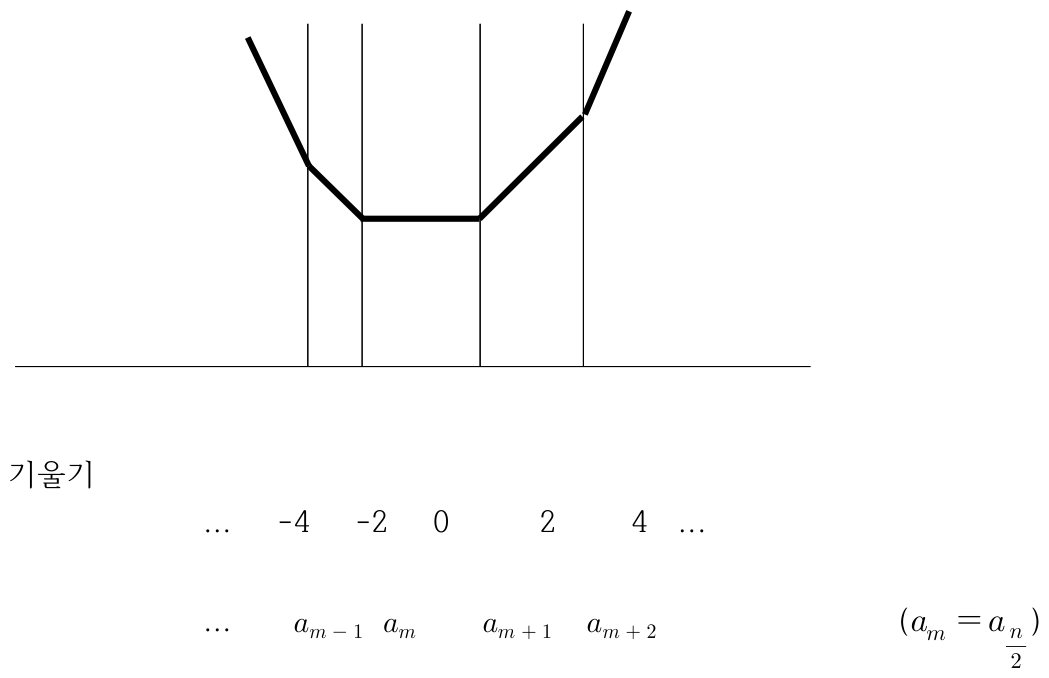
n = 2 m \displaystyle n=2m n = 2 m − n , − n + 2 , ⋯ , − 2 , 0 , 2 , ⋯ , n \displaystyle -n,-n+2,\cdots,-2,0,2,\cdots,n − n , − n + 2 , ⋯ , − 2 , 0 , 2 , ⋯ , n ( a m , a m + 1 ) \displaystyle (a_m,a_{m+1}) ( a m , a m + 1 ) 0 , − 2 , 2 \displaystyle 0,-2,2 0 , − 2 , 2 g ( x ) \displaystyle g(x) g ( x ) a m ≤ x ≤ a m + 1 \displaystyle a_m\le x\le a_{m+1} a m ≤ x ≤ a m + 1 x \displaystyle x x
 수리논술, 배움에서 논증의 완성까지.