
수리논술, 배움에서 논증의 완성까지.

자연계열 1번

문제

【제시문 1】

닫힌 구간 [a,b]\displaystyle [a,b]에서 연속인 함수 f(x)\displaystyle f(x)f(a)\displaystyle f(a)f(b)\displaystyle f(b) 사이의 값 k\displaystyle k에 대하여 방정식 f(x)k=0\displaystyle f(x)-k=0을 만족하는 근을 구간 [a,b]\displaystyle [a,b]에서 적어도 하나 가진다.

【제시문 2】

함수 f(x)\displaystyle f(x)가 미분가능할 때, 방정식 f(x)=0\displaystyle f(x)=0을 만족하는 근 α\displaystyle \alpha를 구하는 뉴턴의 방법은 다음과 같다. 먼저 α\displaystyle \alpha에 대한 적당한 근삿값 x0\displaystyle x_0을 선택한다. 곡선 y=f(x)\displaystyle y=f(x) 위의 점 (x0,f(x0))\displaystyle (x_0,f(x_0))에서 접선을 구하고 접선의 x\displaystyle x절편 x1\displaystyle x_1을 계산한다. x1\displaystyle x_1x0\displaystyle x_0보다 α\displaystyle \alpha에 더 가까운 값이 되며 제1차 근삿값이라 한다. x1\displaystyle x_1x0\displaystyle x_0대신 사용하여 위의 과정을 따라가면, x1\displaystyle x_1보다 α\displaystyle \alpha에 더 가까운 값 x2\displaystyle x_2를 구할 수 있고 이를 제2차 근삿값이라 한다. 이러한 과정을 계속 반복하면 근에 수렴하는 수열 x0,x1,x2,\displaystyle x_0,x_1,x_2,\cdots을 얻을 수 있고, 이를 통해 근에 보다 가까운 근삿값을 구할 수 있다.

【제시문 3】

아래 그림은 길이와 밀도가 똑같은 두 개의 나무기둥 A, B의 수평 단면에 좌표축을 설정하여 살펴 본 그래프이다. A의 무게가 B의 무게보다 훨씬 가벼울 경우 무게가 같아지도록 나무기둥 B를 절단하는 방법을 알아보자. A의 단면은 y=f(x)\displaystyle y=f(x)x\displaystyle x축으로 둘러싸여 있고, B의 단면은 y=g(x)\displaystyle y=g(x)x\displaystyle x축으로 둘러싸여 있다. a0\displaystyle a_0는 A의 단면적이고, a(t)\displaystyle a(t)는 B단면의 빗금 친 부분의 면적이다. S(t)=a(t)a0\displaystyle S(t)=a(t)-a_0이라 하면, S(t)\displaystyle S(t)는 닫힌 구간 [1,1]\displaystyle [-1,1]에서 연속인 함수가 된다. 방정식 S(t)=0\displaystyle S(t)=0을 만족하는 근 α\displaystyle \alpha를 구하고 절단선 x=α\displaystyle x=\alpha를 따라 나무기둥 B를 잘라내면, 무게가 A와 같은 나무기둥을 얻을 수 있다.
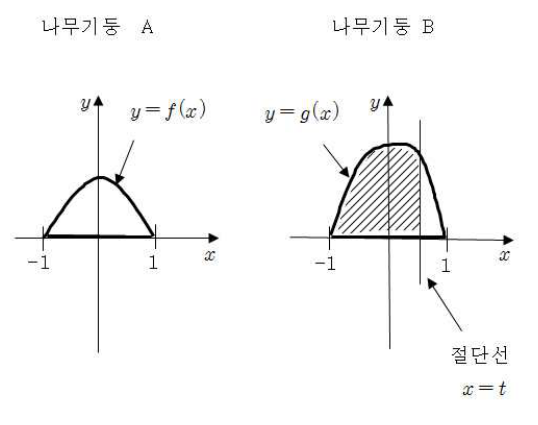
두 나무기둥 A, B의 단면과 B의 절단선 x=t

【물음 1】【제시문 2】에서 점 (x0,f(x0))\displaystyle (x_0,f(x_0))을 지나는 접선의 방정식은 ( ㉠ )이다. 또한 제1차 근삿값 x1\displaystyle x_1은 이 접선의 x\displaystyle x절편이므로 x1\displaystyle x_1x0\displaystyle x_0사이의 관계식 x1=x0\displaystyle x_1=x_0-( ㉡ )을 유도할 수 있다. 괄호 안의 ㉠, ㉡을 구하시오. (단, f(x0)0\displaystyle f^{\prime}(x_0)\ne0이다.) (30점)

【물음 2】【제시문 3】에서 정의한 연속함수 S(t)\displaystyle S(t)에 대하여 방정식 S(t)=0\displaystyle S(t)=0을 만족하는 근이 닫힌 구간 [1,1]\displaystyle [-1,1]에 적어도 하나 존재한다. 그 이유를【제시문 1】에 근거하여 설명하시오. (30점)

【물음 3】【제시문 3】에서 a0=1\displaystyle a_0=1, g(x)=1x2\displaystyle g(x)=1-x^2인 경우 【제시문 2】에 근거하여 방정식 S(t)=0\displaystyle S(t)=0을 만족하는 근의 제2차 근삿값 t2\displaystyle t_2를 구하시오. (단, t0=12\displaystyle t_0=\frac{1}{2}이다.) (40점)

해설강의 준비중
+30점

【물음 1】기울기가 f(x0)\displaystyle f^{\prime}(x_0)이고 점 (x0,f(x0))\displaystyle (x_0,f(x_0))을 지나는 접선의 방정식은 yf(x0)=f(x0)(xx0)\displaystyle y-f(x_0)=f^{\prime}(x_0)(x-x_0)이다.이 접선의 x\displaystyle x절편 x1\displaystyle x_1x1=x0f(x0)f(x0)\displaystyle x_1=x_0-\frac{f(x_0)}{f^{\prime}(x_0)}이다.

+30점

【물음 2】① [제시문 3]의 사실로부터 a(1)=0\displaystyle a(-1)=0임을 알 수 있다. 따라서 S(1)=a(1)a0=a0<0\displaystyle S(-1)=a(-1)-a_0=-a_0<0이다.S(1)\displaystyle S(1)B\displaystyle BA\displaystyle A의 단면적차이이므로 S(1)>0\displaystyle S(1)>0이다.③ 따라서 0\displaystyle 0은 연속함수 S(t)\displaystyle S(t)의 함수값 S(1)\displaystyle S(1)S(1)\displaystyle S(-1)사이에 존재하므로 [제시문 1]에 의하여 방정식 0=S(t)0=S(t)\displaystyle 0=S(t)-0=S(t)는 닫힌 구간 [1,1]\displaystyle [-1,1]에서 적어도 하나의 근을 가진다.

+40점

【물음 3】① [제시문 3]으로부터 S(t)=1t(1x2)dx1=tt3313\displaystyle S(t)=\int_{-1}^t(1-x^2)dx-1=t-\frac{t^3}{3}-\frac{1}{3}이다. 또한 S(t)=1t2\displaystyle S^{\prime}(t)=1-t^2이다.② 따라서 [물음 1]로부터 tk=tk1S(tk1)S(tk1)=12tk133(1tk12)\displaystyle t_k=t_{k-1}-\frac{S(t_{k-1})}{S^{\prime}(t_{k-1})}=\frac{1-2t_{k-1}^3}{3(1-t_{k-1}^2)}임을 알 수 있다.③ 위의 공식으로부터 제1차 근삿값은 t1=t0S(t0)S(t0)=13\displaystyle t_1=t_0-\frac{S(t_0)}{S^{\prime}(t_0)}=\frac{1}{3}이다.t1\displaystyle t_1의 값으로부터 제2차 근삿값은 t2=t1S(t1)S(t1)=2572\displaystyle t_2=t_1-\frac{S(t_1)}{S^{\prime}(t_1)}=\frac{25}{72}이다.

첨삭 사례

아직 등록된 첨삭 사례가 없습니다.

질문과 답변 · 0개질문과 답변 · 고정 0개

아직 등록된 질문이 없습니다. 질문 작성은 멤버십 회원만 가능합니다.