수리논술, 배움에서 논증의 완성까지.

자연계열 3번

문제

[문제 3] 다음 제시문을 읽고 각 물음에 답하시오.

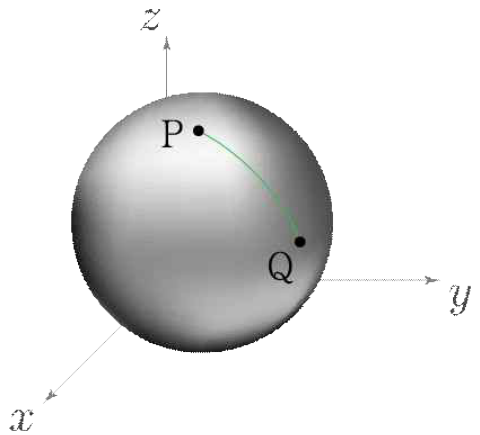
좌표공간에 쇠공이 놓여 있는데, 쇠공의 겉면을 S\displaystyle S라 할 때, S\displaystyle S는 구의 방정식 (x1)2+(y1)2+(z1)2=1\displaystyle (x-1)^2+(y-1)^2+(z-1)^2=1로 주어진다. 좌표공간에서 쇠공 내부에 있지 않은 두 점 P\displaystyle \mathrm{P}Q\displaystyle \mathrm{Q}를 실로 연결할 때 실의 길이의 최솟값을 d(P,Q)\displaystyle d(\mathrm{P,Q})라고 정의하자. (단, 실은 쇠공을 통과하지 않는다.) 만일 두 점 P,Q\displaystyle \mathrm{P,Q}가 아래 그림처럼 모두 쇠공의 겉면 S\displaystyle S에 있을 때는 두 점을 연결하는 대원의 호 중 짧은 쪽의 길이가 d(P,Q)\displaystyle d(\mathrm{P,Q})가 된다. (여기서 대원이란 구 S\displaystyle S의 중심을 지나는 평면과 S\displaystyle S가 만나 이루어지는 원을 말한다.)

쇠공 표면의 두 점 P Q를 연결한 짧은 호

(3-1) S\displaystyle S에 있는 두 점 P(1,2,1)\displaystyle \mathrm{P}(1,2,1), Q(32,32,1+22)\displaystyle \mathrm{Q}\left(\frac32,\frac32,1+\frac{\sqrt2}2\right)에 대하여 d(P,Q)\displaystyle d(\mathrm{P,Q})의 값을 구하시오. (10점)

(3-2) A(2,2,12)\displaystyle \mathrm{A}(2,2,1-\sqrt2)와 구 S\displaystyle S의 중심 B(1,1,1)\displaystyle \mathrm{B}(1,1,1)을 연결하는 직선이 구 S\displaystyle S와 만나는 두 점 중 A\displaystyle \mathrm{A}에서 더 멀리 떨어져 있는 점을 C\displaystyle \mathrm{C}라 할 때, C\displaystyle \mathrm{C}의 좌표를 구하시오. (10점)

(3-3) d(A,C)\displaystyle d(\mathrm{A,C})의 값을 구하시오. (10점)

(3-4) 평면 z=32\displaystyle z=\frac32과 구 S\displaystyle S가 만나는 원 위의 점을 D\displaystyle \mathrm{D}라 할 때, d(A,D)\displaystyle d(\mathrm{A,D})의 최솟값을 구하시오. (10점)

해설강의 준비중
4점 · cosθ=12\displaystyle \cos\theta=\frac12임을 구하면

(3-1) S\displaystyle S의 중심을 B(1,1,1)\displaystyle \mathrm{B}(1,1,1)이라 두고, BP=(0,1,0)\displaystyle \overrightarrow{\mathrm{BP}}=(0,1,0)BQ=(12,12,22)\displaystyle \overrightarrow{\mathrm{BQ}}=\left(\frac12,\frac12,\frac{\sqrt2}2\right)가 이루는 각을 θ\displaystyle \theta라 하면 cosθ=BPBQBPBQ=12\displaystyle \cos\theta=\frac{\overrightarrow{\mathrm{BP}}\cdot\overrightarrow{\mathrm{BQ}}}{|\overrightarrow{\mathrm{BP}}||\overrightarrow{\mathrm{BQ}}|}=\frac12이므로

6점 · θ=π3\displaystyle \theta=\frac\pi3까지 구하면

θ=π3\displaystyle \theta=\frac\pi3이다.

10점 · d(P,Q)=π3\displaystyle d(\mathrm{P,Q})=\frac\pi3임을 구하면

그런데 S\displaystyle S의 반지름이 1이므로 다음을 얻는다.d(P,Q)=1π3=π3\displaystyle d(\mathrm{P,Q})=1\cdot\frac\pi3=\frac\pi3

4점 · 점 A\displaystyle \mathrm{A}와 점 B\displaystyle \mathrm{B}를 지나는 직선의 벡터 방정식을 구하면

(3-2) 점 A\displaystyle \mathrm{A}와 점 B\displaystyle \mathrm{B}를 지나는 직선의 벡터 방정식은(x,y,z)=(1,1,1)+tAB=(1,1,1)+t(1,1,2)\displaystyle (x,y,z)=(1,1,1)+t\overrightarrow{\mathrm{AB}}=(1,1,1)+t(-1,-1,\sqrt2)이다.

7점 · t=12\displaystyle t=\frac12까지 구하면

이 식을 구의 방정식 (x1)2+(y1)2+(z1)2=1\displaystyle (x-1)^2+(y-1)^2+(z-1)^2=1에 대입하면 4t2=1\displaystyle 4t^2=1인데 이중 양의 근을 구하면 t=12\displaystyle t=\frac12이다.

10점 · 점 C\displaystyle \mathrm{C}의 좌표까지 정확히 구하면

이를 다시 직선의 방정식에 대입하면 점 C\displaystyle \mathrm{C}의 좌표는 (12,12,1+22)\displaystyle \left(\frac12,\frac12,1+\frac{\sqrt2}2\right)이다.

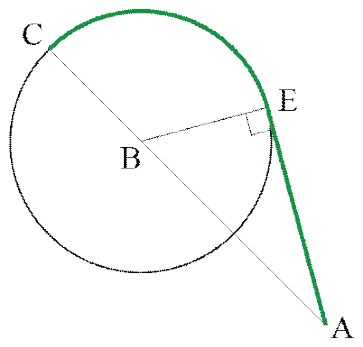
(3-3) 실의 길이를 최소가 되도록 점 A\displaystyle \mathrm{A}와 점 C\displaystyle \mathrm{C}를 실로 연결하는 경우, 이 실을 포함하는 평면 위로 내린 구 S\displaystyle S와 실의 정사영은 그림 4가 된다. (점 A\displaystyle \mathrm{A}와 점 C\displaystyle \mathrm{C}를 연결하는 실은 초록색으로 표시된 부분이다.)

점 A에서 접점 E를 지나 C로 향하는 실
그림 4: 실을 포함하는 평면 위로 내린 구와 실의 정사영
5점 · AE=3\displaystyle \overline{\mathrm{AE}}=\sqrt3임을 구하면

그림 4에서 선분 AE\displaystyle \mathrm{AE}는 원에 접하므로 AEB\displaystyle \angle\mathrm{AEB}는 직각이고 AB=2\displaystyle \overline{\mathrm{AB}}=2, BE=1\displaystyle \overline{\mathrm{BE}}=1이므로 피타고라스 정리에 의하여 AE=3\displaystyle \overline{\mathrm{AE}}=\sqrt3이다.

또한 ABE=π3\displaystyle \angle\mathrm{ABE}=\frac\pi3이므로d(C,E)=CBE=ππ3=2π3\displaystyle d(\mathrm{C,E})=\angle\mathrm{CBE}=\pi-\frac\pi3=\frac{2\pi}3이다.

10점 · 답까지 정확히 구하면

따라서 다음을 얻는다.d(A,C)=AE+d(C,E)=3+23π\displaystyle d(\mathrm{A,C})=\overline{\mathrm{AE}}+d(\mathrm{C,E})=\sqrt3+\frac23\pi

(3-4) 점 D(x,y,32)\displaystyle \mathrm{D}\left(x,y,\frac32\right)를 구 S\displaystyle S의 방정식에 대입하면(x1)2+(y1)2+14=1\displaystyle (x-1)^2+(y-1)^2+\frac14=1이 되는데, 점 D\displaystyle \mathrm{D}가 평면 x=y\displaystyle x=y 위에 위치할 때 d(A,D)\displaystyle d(\mathrm{A,D})가 최소가 됨을 알 수 있고, 이 때 x=y=1+64\displaystyle x=y=1+\frac{\sqrt6}4이며, 점 D\displaystyle \mathrm{D}의 좌표는 (1+64,1+64,32)\displaystyle \left(1+\frac{\sqrt6}4,1+\frac{\sqrt6}4,\frac32\right)이다.

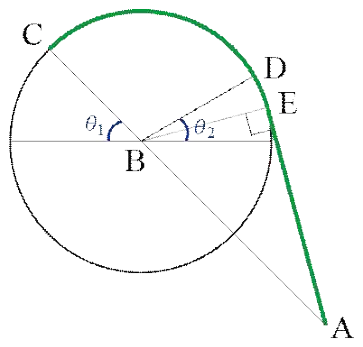
이제 BC=(12,12,22)\displaystyle \overrightarrow{\mathrm{BC}}=\left(-\frac12,-\frac12,\frac{\sqrt2}2\right)xy\displaystyle xy평면과 이루는 각을 θ1\displaystyle \theta_1이라하자. BC\displaystyle \overrightarrow{\mathrm{BC}}xy\displaystyle xy평면 위로의 정사영인 u=(12,12,0)\displaystyle \vec u=\left(-\frac12,-\frac12,0\right)을 이용하면cosθ1=BCuBCu=22\displaystyle \cos\theta_1=\frac{\overrightarrow{\mathrm{BC}}\cdot\vec u}{|\overrightarrow{\mathrm{BC}}||\vec u|}=\frac{\sqrt2}2에서 θ1=π4\displaystyle \theta_1=\frac\pi4이다.

이제 BD=(64,64,12)\displaystyle \overrightarrow{\mathrm{BD}}=\left(\frac{\sqrt6}4,\frac{\sqrt6}4,\frac12\right)xy\displaystyle xy평면과 이루는 각을 θ2\displaystyle \theta_2라 하자. BD\displaystyle \overrightarrow{\mathrm{BD}}xy\displaystyle xy평면 위로의 정사영인 v=(64,64,0)\displaystyle \vec v=\left(\frac{\sqrt6}4,\frac{\sqrt6}4,0\right)을 이용하면cosθ2=BDvBDv=32\displaystyle \cos\theta_2=\frac{\overrightarrow{\mathrm{BD}}\cdot\vec v}{|\overrightarrow{\mathrm{BD}}||\vec v|}=\frac{\sqrt3}2에서 θ2=π6\displaystyle \theta_2=\frac\pi6이다.

구의 단면에서 점 D와 두 경사각
그림 5: 점 A, B, C, D, E의 위치관계
7점 · CBD=712π\displaystyle \angle\mathrm{CBD}=\frac7{12}\pi임을 구하면

결국 그림 5로부터 CBD=π(θ1+θ2)=7π12\displaystyle \angle\mathrm{CBD}=\pi-(\theta_1+\theta_2)=\frac{7\pi}{12}이므로

10점 · 답까지 정확히 구하면

다음을 얻는다.d(A,D)=d(A,C)7π12=3+23π7π12=3+π12\displaystyle d(\mathrm{A,D})=d(\mathrm{A,C})-\frac{7\pi}{12}=\sqrt3+\frac23\pi-\frac{7\pi}{12}=\sqrt3+\frac\pi{12}

첨삭 사례

아직 등록된 첨삭 사례가 없습니다.

질문과 답변 · 0개질문과 답변 · 고정 0개

아직 등록된 질문이 없습니다. 질문 작성은 멤버십 회원만 가능합니다.