수리논술, 이게 다다.

자연계열 수학2

오류 제보

문제

[수학2] 다음 <제시문1> ~ <제시문4>을 읽고 [수학2-ⅰ] ~ [수학2-ⅲ]을 문항별로 풀이와 함께 답하시오.

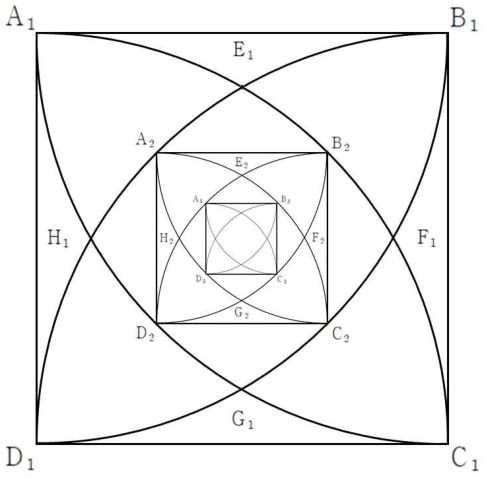
<제시문1>오른쪽 그림과 같이 한 변의 길이가 1\displaystyle 1인 정사각형 A1B1C1D1\displaystyle \mathrm{A}_1\mathrm{B}_1\mathrm{C}_1\mathrm{D}_1의 각 꼭짓점에서 사분원을 그리고 이 사분원들이 서로 만나는 점을 각각 E1\displaystyle \mathrm{E}_1, F1\displaystyle \mathrm{F}_1, G1\displaystyle \mathrm{G}_1, H1\displaystyle \mathrm{H}_1라 한다. 도형 E1F1G1H1\displaystyle \mathrm{E}_1\mathrm{F}_1\mathrm{G}_1\mathrm{H}_1에 내접하고, 각 변이 각각 선분 A1B1‾\displaystyle \overline{\mathrm{A}_1\mathrm{B}_1}, B1C1‾\displaystyle \overline{\mathrm{B}_1\mathrm{C}_1}, C1D1‾\displaystyle \overline{\mathrm{C}_1\mathrm{D}_1}, D1A1‾\displaystyle \overline{\mathrm{D}_1\mathrm{A}_1}에 평행한 정사각형 A2B2C2D2\displaystyle \mathrm{A}_2\mathrm{B}_2\mathrm{C}_2\mathrm{D}_2를 오른쪽 그림과 같이 정의한다.

정사각형 안의 사분원들이 이루는 도형에 정사각형을 반복해 내접시키는 그림

<제시문2>정사각형 A2B2C2D2\displaystyle \mathrm{A}_2\mathrm{B}_2\mathrm{C}_2\mathrm{D}_2의 각 꼭짓점에서 사분원을 그리고 이 사분원들이 서로 만나는 점을 위의 그림과 같이 각각 E2\displaystyle \mathrm{E}_2, F2\displaystyle \mathrm{F}_2, G2\displaystyle \mathrm{G}_2, H2\displaystyle \mathrm{H}_2라 한다. 도형 E2F2G2H2\displaystyle \mathrm{E}_2\mathrm{F}_2\mathrm{G}_2\mathrm{H}_2에 내접하고, 각 변이 각각 선분 A2B2‾\displaystyle \overline{\mathrm{A}_2\mathrm{B}_2}, B2C2‾\displaystyle \overline{\mathrm{B}_2\mathrm{C}_2}, C2D2‾\displaystyle \overline{\mathrm{C}_2\mathrm{D}_2}, D2A2‾\displaystyle \overline{\mathrm{D}_2\mathrm{A}_2}에 평행한 정사각형 A3B3C3D3\displaystyle \mathrm{A}_3\mathrm{B}_3\mathrm{C}_3\mathrm{D}_3를 위의 그림과 같이 정의한다.

<제시문3>이와 같은 방법으로 정사각형을 한 없이 그려 나갈 때 정사각형 AnBnCnDn\displaystyle \mathrm{A}_n\mathrm{B}_n\mathrm{C}_n\mathrm{D}_n의 넓이를 Sn\displaystyle S_n이라 하고, S=∑n=1∞Sn\displaystyle S=\sum_{n=1}^{\infty}S_n라 한다.

<제시문4>첫째항이 a\displaystyle a (a≠0)\displaystyle (a\ne0), 공비가 r\displaystyle r인 등비급수 ∑n=1∞arn−1\displaystyle \sum_{n=1}^{\infty}ar^{n-1}은 −1<r<1\displaystyle -1<r<1일 때 수렴하고 그 합은 a1−r\displaystyle \frac{a}{1-r}이다.

[수학2-ⅰ]도형 E1F1G1H1\displaystyle \mathrm{E}_1\mathrm{F}_1\mathrm{G}_1\mathrm{H}_1의 둘레의 길이를 구하고 그 이유를 논하시오.

[수학2-ⅱ]정사각형 A2B2C2D2\displaystyle \mathrm{A}_2\mathrm{B}_2\mathrm{C}_2\mathrm{D}_2의 한 변의 길이를 구하고 그 이유를 논하시오.

[수학2-ⅲ]S\displaystyle S의 값을 구하고 그 이유를 논하시오.

해설강의 준비중
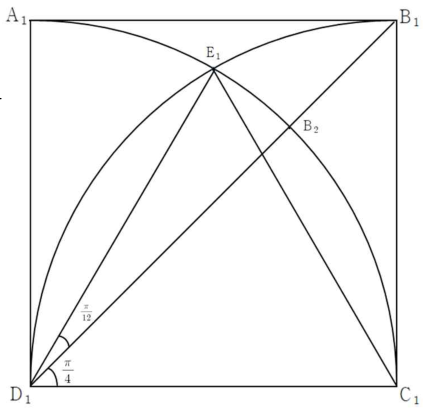
+4점 · ∠E1D1B2\displaystyle \angle\mathrm{E}_1\mathrm{D}_1\mathrm{B}_2를 구하고 이 이유를 제시할 수 있다.

[수학2-ⅰ]삼각형 E1D1C1\displaystyle \mathrm{E}_1\mathrm{D}_1\mathrm{C}_1은 정삼각형이므로 ∠E1D1C1=π3\displaystyle \angle\mathrm{E}_1\mathrm{D}_1\mathrm{C}_1=\frac\pi3이다. 한편 ∠B1D1C1=π4\displaystyle \angle\mathrm{B}_1\mathrm{D}_1\mathrm{C}_1=\frac\pi4이고 B2\displaystyle \mathrm{B}_2는 선분 D1B1‾\displaystyle \overline{\mathrm{D}_1\mathrm{B}_1}와 원호 A1C1⌢\displaystyle \overset{\frown}{\mathrm{A}_1\mathrm{C}_1}의 교점이므로∠E1D1B2=π4−π3=π12\displaystyle \angle\mathrm{E}_1\mathrm{D}_1\mathrm{B}_2=\frac\pi4-\frac\pi3=\frac\pi{12}Correction. 각도 차를 구한 식에서 π/4−π/3\displaystyle \pi/4-\pi/3은 π/3−π/4\displaystyle \pi/3-\pi/4의 오기이다. 그러나 원칙에 따라 원문 표기를 그대로 실었다.임을 알 수 있다.

E1D1C1은 정삼각형이며 대각선 D1B1과 원호의 교점이 B2인 도형
+2점 · 도형 E1F1G1H1\displaystyle \mathrm{E}_1\mathrm{F}_1\mathrm{G}_1\mathrm{H}_1 둘레의 길이를 구하고 그 이유를 제시 할 수 있다.

따라서 원호 E1B2⌢\displaystyle \overset{\frown}{\mathrm{E}_1\mathrm{B}_2}의 길이는1×π12=π12\displaystyle 1\times\frac\pi{12}=\frac\pi{12}이고, 도형 E1F1G1H1\displaystyle \mathrm{E}_1\mathrm{F}_1\mathrm{G}_1\mathrm{H}_1의 둘레의 길이는8×π12=23π\displaystyle 8\times\frac\pi{12}=\frac23\pi이다.

+4점 · OD2‾\displaystyle \overline{\mathrm{OD}_2}의 길이를 구하고 그 이유를 제시할 수 있다.

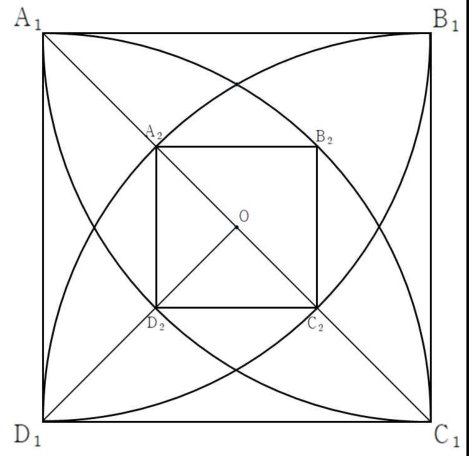
[수학2-ⅱ]대각선 A1C1‾\displaystyle \overline{\mathrm{A}_1\mathrm{C}_1}와 B1D1‾\displaystyle \overline{\mathrm{B}_1\mathrm{D}_1}가 만나는 점을 O\displaystyle \mathrm{O}라 하자.오른쪽 그림에서D1O‾=12D1B1‾=22\displaystyle \overline{\mathrm{D}_1\mathrm{O}}=\frac12\overline{\mathrm{D}_1\mathrm{B}_1}=\frac{\sqrt2}2 - (1)D2O‾=OB2‾=D1B2‾−D1O‾=1−22\displaystyle \overline{\mathrm{D}_2\mathrm{O}}=\overline{\mathrm{OB}_2}=\overline{\mathrm{D}_1\mathrm{B}_2}-\overline{\mathrm{D}_1\mathrm{O}}=1-\frac{\sqrt2}2 -(2)임을 알 수 있다.

대각선의 교점 O와 정사각형 A2B2C2D2 및 서로 닮은 삼각형 OD2C2, OD1C1
+4점 · D2C2‾\displaystyle \overline{\mathrm{D}_2\mathrm{C}_2}의 길이를 구하고 그 이유를 제시할 수 있다.

삼각형 OD2C2\displaystyle \mathrm{OD}_2\mathrm{C}_2와 삼각형 OD1C1\displaystyle \mathrm{OD}_1\mathrm{C}_1이 닮은 삼각형이므로OD2‾:OD1‾=D2C2‾:D1C1‾\displaystyle \overline{\mathrm{OD}_2}:\overline{\mathrm{OD}_1}=\overline{\mathrm{D}_2\mathrm{C}_2}:\overline{\mathrm{D}_1\mathrm{C}_1}가 성립하고, (1)과 (2)를 대입하면1−22:22=D2C2‾:1\displaystyle 1-\frac{\sqrt2}2:\frac{\sqrt2}2=\overline{\mathrm{D}_2\mathrm{C}_2}:1을 얻는다. 이로부터D2C2‾=2−1\displaystyle \overline{\mathrm{D}_2\mathrm{C}_2}=\sqrt2-1임을 알 수 있다.

+3점 · 1. Sn\displaystyle S_n을 구하고 이 이유를 제시할 수 있다.

[수학2-ⅲ][수학2-ⅱ] 로부터Sn+1=(2−1)2Sn=(3−22)Sn\displaystyle S_{n+1}=(\sqrt2-1)^2S_n=(3-2\sqrt2)S_n가 성립함을 알 수 있다.따라서 Sn\displaystyle S_n은 첫째항이 1\displaystyle 1이고 공비가 3−22\displaystyle 3-2\sqrt2인 등비수열이므로Sn=(3−22)n−1\displaystyle S_n=(3-2\sqrt2)^{n-1}

+3점 · 2. S\displaystyle S의 값을 구하고 그 이유를 제시할 수 있다.

이고, <제시문4>로 부터S=∑n=1∞(3−22)n−1=11−(3−22)=122−2=2+12\displaystyle S=\sum_{n=1}^{\infty}(3-2\sqrt2)^{n-1}=\frac1{1-(3-2\sqrt2)}=\frac1{2\sqrt2-2}=\frac{\sqrt2+1}2를 얻는다.

첨삭 사례

아직 등록된 첨삭 사례가 없습니다.

질문과 답변 · 0개질문과 답변 · 고정 0개

아직 등록된 질문이 없습니다. 질문 작성은 멤버십 회원만 가능합니다.