수리논술, 이게 다다.

자연계열 2번

오류 제보

문제

[ 문제 2\displaystyle 2] [60\displaystyle 60점]

(가) △ABC\displaystyle \triangle \mathrm{ABC}에서 a=BCˉ,b=CAˉ,c=ABˉ\displaystyle a = {\bar{\mathrm{BC}}} , b = {\bar{\mathrm{CA}}} , c = {\bar{\mathrm{AB}}}라 하고 외접원의 반지름의 길이를 R\displaystyle R라고 하면

asin⁡A=bsin⁡B=csin⁡C=2R\displaystyle \frac{a}{\sin A} = \frac{b}{\sin B} = \frac{c}{\sin C} = 2 R

이다. 이것을 사인법칙이라고 한다.

a2=b2+c2−2bccos⁡A\displaystyle a^{2} = b^{2} + c^{2} - 2 b c \cos A

b2=c2+a2−2cacos⁡B\displaystyle b^{2} = c^{2} + a^{2} - 2 c a \cos B

c2=a2+b2−2abcos⁡C\displaystyle c^{2} = a^{2} + b^{2} - 2 a b \cos C

이고 이것을 코사인법칙이라고 한다.

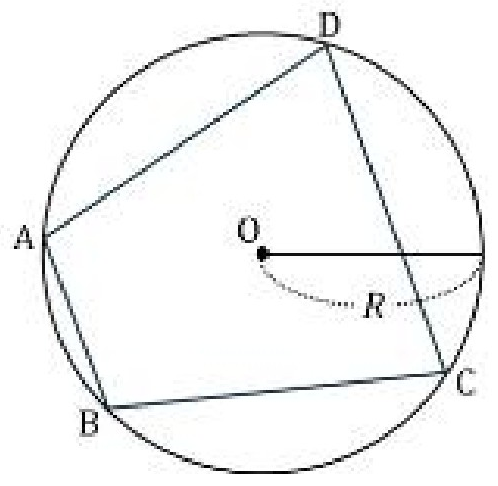
(나) 아래 그림과 같이 □ABCD\displaystyle \mathrm{ABCD} 는 중심이 O\displaystyle \mathrm{O} 이고 반지름의 길이가 R\displaystyle R인 원에 내접한다.이때, □ABCD\displaystyle \square \mathrm{ABCD}의 넓이는 S\displaystyle S이고 ABˉ=2,CDˉ=4,ADˉ+BCˉ=8\displaystyle {\bar{\mathrm{AB}}} = 2 , {\bar{\mathrm{CD}}} = 4 , {\bar{\mathrm{AD}}} + {\bar{\mathrm{BC}}} = 8을 만족한다. (단, 1<ADˉ<7\displaystyle 1 < {\bar{\mathrm{AD}}} < 7)

원에 내접하는 사각형 ABCD와 중심 O

(나) 에 제시된 □ABCD\displaystyle \mathrm{ABCD} 의 넓이 S\displaystyle S가 최대가 될 때의 반지름 길이 R\displaystyle R과 넓이 S\displaystyle S를 활용하여 (SR)2\displaystyle ( S R )^{2}의 값을 구하시오.

해설강의 준비중
+12점 · [문제 2] (1)의 과정과 같이 각의 크기와 변의 길이를 변수로 두고 코사인법칙을 적용하여 대각선의 길이를 표현한 경우

(1) ∠BAD=θ,ADˉ=x\displaystyle \angle \mathrm{BAD} = \theta , {\bar{\mathrm{AD}}} = x라 하면, 코사인법칙에 의하여 BDˉ\displaystyle {\bar{\mathrm{BD}}}의 길이는

△ABD\displaystyle \triangle \mathrm{ABD}에 대해 BDˉ2=22+x2−2×2×x×cos⁡θ\displaystyle {\bar{\mathrm{BD}}}^{2} = 2^{2} + x^{2} - 2 \times 2 \times x \times \cos \theta이고,

△BCD\displaystyle \triangle \mathrm{BCD}에 대해 BDˉ2=42+(8−x)2−2×4×(8−x)×cos⁡(π−θ)\displaystyle {\bar{\mathrm{BD}}}^{2} = 4^{2} + ( 8 - x )^{2} - 2 \times 4 \times ( 8 - x ) \times \cos ( \pi - \theta )이다.

+8점 · [문제 2] (2)의 과정과 같이 두 삼각형이 공유하는 대각선의 길이가 같다는 점을 활용하여 코사인 값을 표현한 경우

(2) 따라서, 4+x2−4xcos⁡θ=16+(8−x)2+8(8−x)cos⁡θ\displaystyle 4 + x^{2} - 4 x \cos \theta = 16 + ( 8 - x )^{2} + 8 ( 8 - x ) \cos \theta이다.

(64−4x)cos⁡θ=16x−76\displaystyle ( 64 - 4 x ) \cos \theta = 16 x - 76이고 16−x≠0\displaystyle 16 - x \ne 0이므로 cos⁡θ=4x−1916−x\displaystyle \cos \theta = \frac{4 x - 19}{16 - x}이다.

+8점 · [문제 2] (3)의 과정과 같이 삼각함수를 활용하여 □ABCD\displaystyle \mathrm{ABCD} 의 넓이를 표현한 경우

(3) □ABCD\displaystyle \square \mathrm{ABCD}의 넓이를 S\displaystyle S라 하면, S=12×2x×sin⁡θ+12×4(8−x)sin⁡(π−θ)=(16−x)sin⁡θ\displaystyle S = \frac{1}{2} \times 2 x \times \sin \theta + \frac{1}{2} \times 4 ( 8 - x ) \sin ( \pi - \theta ) = ( 16 - x ) \sin \theta

+12점 · [문제 2] (4)의 과정과 같이 삼각함수의 관계를 활용하여 □ABCD\displaystyle \mathrm{ABCD} 넓이의 제곱을 이차함수로 표현한 경우

(4) S2=(16−x)2sin⁡2θ=(16−x)2(1−cos⁡2θ)\displaystyle S^{2} = ( 16 - x )^{2} \sin^{2} \theta = ( 16 - x )^{2} \left( 1 - \cos^{2} \theta \right)이므로, S2\displaystyle S^{2}을 x\displaystyle x에 대한 식으로 정리하면,

S2=(16−x)2sin⁡2θ=(16−x)2{1−(4x−1916−x)2}=(16−x)2{(16−x)2−(4x−19)2(16−x)2}\displaystyle S^{2} = ( 16 - x )^{2} \sin^{2} \theta = ( 16 - x )^{2} \left\{ 1 - \left( \frac{4 x - 19}{16 - x} \right)^{2} \right\} = ( 16 - x )^{2} \left\{ \frac{( 16 - x )^{2} - ( 4 x - 19 )^{2}}{( 16 - x )^{2}} \right\}

=(16−x)2−(4x−19)2=(16−x+4x−19)(16−x−4x+19)=−15(x−1)(x−7)\displaystyle = ( 16 - x )^{2} - ( 4 x - 19 )^{2} = ( 16 - x + 4 x - 19 ) ( 16 - x - 4 x + 19 ) = - 15 ( x - 1 ) ( x - 7 ) 이다 .

+4점 · [문제 2] (5)의 과정과 같이 이차함수의 최대 조건을 활용하여 S\displaystyle S의 최댓값 또는 S2\displaystyle S^{2}의 최댓값을 도출한 경우

(5) 따라서, x=4\displaystyle x = 4에서 □ABCD\displaystyle \square \mathrm{ABCD}의 넓이는 최대가 되고, S2=135\displaystyle S^{2} = 135이다. (S=315)\displaystyle ( S = 3 \sqrt{15} )

+12점 · [문제 2] (6)의 과정과 같이 사인법칙을 활용하여 □ABCD\displaystyle \mathrm{ABCD} 의 넓이가 최대일 때의 R\displaystyle R또는 R2\displaystyle R^{2}을 도출한 경우

(6) 사인법칙에 의하여 2R=BDˉsin⁡θ\displaystyle 2 R = \frac{{\bar{\mathrm{BD}}}}{\sin \theta}이고, R2=BDˉ24sin⁡2θ\displaystyle R^{2} = \frac{{\bar{\mathrm{BD}}}^{2}}{4 \sin^{2} \theta}이다.

x=4\displaystyle x = 4일 때 BDˉ2\displaystyle {\bar{\mathrm{BD}}}^{2}와 sin⁡2θ\displaystyle \sin^{2} \theta를 구하면,

BDˉ2=22+x2−2×2×x×cos⁡θ=22+42−2×2×4×4×4−1916−4=24이고\displaystyle {\bar{\mathrm{BD}}}^{2} = 2^{2} + x^{2} - 2 \times 2 \times x \times \cos \theta = 2^{2} + 4^{2} - 2 \times 2 \times 4 \times \frac{4 \times 4 - 19}{16 - 4} = 24 \text{이고}

sin⁡2θ={1−(4x−1916−x)2}=1−(−14)2=1516\displaystyle \sin^{2} \theta = \left\{ 1 - \left( \frac{4 x - 19}{16 - x} \right)^{2} \right\} = 1 - \left( - \frac{1}{4} \right)^{2} = \frac{15}{16} 이다 .

R2=244×1516=325이다 .(R=4105)\displaystyle R^{2} = \frac{24}{4 \times \frac{15}{16}} = \frac{32}{5} \text{이다 .} \left( R = \frac{4 \sqrt{10}}{5} \right)

+4점 · [문제 2] (7)의 과정과 같이 문제의 답을 도출한 경우

(7) 따라서, (SR)2=135×325=864\displaystyle ( S R )^{2} = 135 \times \frac{32}{5} = 864이다.

※ 채점 기준은 문항의 출제의도에 대한 평가를 위한 것이어야 함.

첨삭 사례

아직 등록된 첨삭 사례가 없습니다.

질문과 답변 · 0개질문과 답변 · 고정 0개

아직 등록된 질문이 없습니다. 질문 작성은 멤버십 회원만 가능합니다.