수리논술, 배움에서 논증의 완성까지.

자연계열 3번

문제

🔒
짧은 시간에 너무 많은 문제를 여셔서 열람을 잠시 제한했습니다. 잠시 후 다시 시도하시거나 로그인해 주세요.
해설강의 준비중
1단계 · A\displaystyle \mathrm A의 좌표를 (a,0)\displaystyle (a,0)이라 하자. 점 Q\displaystyle \mathrm Q는 원 위를 움직이므로, 시각 t\displaystyle t일 때, 점 Q\displaystyle \mathrm Q의 좌표는 (cos(t+θ),sin(t+θ))\displaystyle (\cos(t+\theta),\sin(t+\theta))이다. 점 Q,P\displaystyle \mathrm{Q,P}로부터 각각 x\displaystyle x축에 내린 수선의 발을 hQ,hP\displaystyle \mathrm h_Q,\mathrm h_P라 하면, QAhQ=PAhP\displaystyle \angle\mathrm{QAh}_Q=\angle\mathrm{PAh}_P이므로, tan(QAhQ)=tan(PAhP)\displaystyle \tan(\angle\mathrm{QAh}_Q)=\tan(\angle\mathrm{PAh}_P)이고, 다음을 얻는다.sin(t+θ)acos(t+θ)=sinθacosθ.\displaystyle \frac{\sin(t+\theta)}{a-\cos(t+\theta)}=\frac{\sin\theta}{a-\cos\theta}.

Comment. θ=0\displaystyle \theta=0이면 점 A\displaystyle AP=(1,0)\displaystyle P=(1,0)에 고정되어 속력은 0\displaystyle 0이다. 이 경우 위 기울기 식은 사용할 수 없으므로, 따로 처리하고 0<θπ3\displaystyle 0<\theta\le\frac{\pi}{3}에서 계산한다.

2단계 · 이를 정리하면 (acosθ)sin(t+θ)sinθ(acos(t+θ))=0\displaystyle (a-\cos\theta)\sin(t+\theta)-\sin\theta(a-\cos(t+\theta))=0이고, 음함수의 미분법을 적용하여 t\displaystyle t에 대해 미분하면,dadtsin(t+θ)+(acosθ)cos(t+θ)sinθ(dadt+sin(t+θ))=0.\displaystyle \frac{da}{dt}\sin(t+\theta)+(a-\cos\theta)\cos(t+\theta)-\sin\theta\left(\frac{da}{dt}+\sin(t+\theta)\right)=0.Q\displaystyle \mathrm Q가 점 (0,1)\displaystyle (0,1)을 지날 때, t+θ=π2\displaystyle t+\theta=\frac\pi2이므로 sin(t+θ)=1, cos(t+θ)=0\displaystyle \sin(t+\theta)=1,\ \cos(t+\theta)=0이다.이를 위 식에 대입하고 정리하면 vA=dadt=sinθ1sinθ (0θπ3이므로)\displaystyle |v_{\mathrm A}|=\left|\frac{da}{dt}\right|=\frac{\sin\theta}{1-\sin\theta}\ \left(0\le\theta\le\frac\pi3\text{이므로}\right). 「문항(1) 답」

[(1) 풀이]A\displaystyle \mathrm A의 좌표를 (a,0)\displaystyle (a,0)이라 하자. 점 Q\displaystyle \mathrm Q는 원 위를 움직이므로, 시각 t\displaystyle t일 때, 점 Q\displaystyle \mathrm Q의 좌표는 (cos(t+θ),sin(t+θ))\displaystyle (\cos(t+\theta),\sin(t+\theta))이다. 점 Q,P\displaystyle \mathrm{Q,P}로부터 각각 x\displaystyle x축에 내린 수선의 발을 hQ,hP\displaystyle \mathrm h_Q,\mathrm h_P라 하면, QAhQ=PAhP\displaystyle \angle\mathrm{QAh}_Q=\angle\mathrm{PAh}_P이므로, tan(QAhQ)=tan(PAhP)\displaystyle \tan(\angle\mathrm{QAh}_Q)=\tan(\angle\mathrm{PAh}_P)이고, 다음을 얻는다.sin(t+θ)acos(t+θ)=sinθacosθ.\displaystyle \frac{\sin(t+\theta)}{a-\cos(t+\theta)}=\frac{\sin\theta}{a-\cos\theta}.Comment. θ=0\displaystyle \theta=0이면 점 A\displaystyle AP=(1,0)\displaystyle P=(1,0)에 고정되어 속력은 0\displaystyle 0이다. 이 경우 위 기울기 식은 사용할 수 없으므로, 따로 처리하고 0<θπ3\displaystyle 0<\theta\le\frac{\pi}{3}에서 계산한다.이를 정리하면 (acosθ)sin(t+θ)sinθ(acos(t+θ))=0\displaystyle (a-\cos\theta)\sin(t+\theta)-\sin\theta(a-\cos(t+\theta))=0이고, 음함수의 미분법을 적용하여 t\displaystyle t에 대해 미분하면,dadtsin(t+θ)+(acosθ)cos(t+θ)sinθ(dadt+sin(t+θ))=0.\displaystyle \frac{da}{dt}\sin(t+\theta)+(a-\cos\theta)\cos(t+\theta)-\sin\theta\left(\frac{da}{dt}+\sin(t+\theta)\right)=0.Q\displaystyle \mathrm Q가 점 (0,1)\displaystyle (0,1)을 지날 때, t+θ=π2\displaystyle t+\theta=\frac\pi2이므로 sin(t+θ)=1, cos(t+θ)=0\displaystyle \sin(t+\theta)=1,\ \cos(t+\theta)=0이다.이를 위 식에 대입하고 정리하면 vA=dadt=sinθ1sinθ (0θπ3이므로)\displaystyle |v_{\mathrm A}|=\left|\frac{da}{dt}\right|=\frac{\sin\theta}{1-\sin\theta}\ \left(0\le\theta\le\frac\pi3\text{이므로}\right).

3단계 · vA(θ)=sinθ1sinθ\displaystyle |v_{\mathrm A}|(\theta)=\frac{\sin\theta}{1-\sin\theta}θ\displaystyle \theta에 대해 미분하면 (0θπ3\displaystyle 0\le\theta\le\frac\pi3에 대해)cosθ(1sinθ)+sinθcosθ(1sinθ)2=cosθ(1sinθ)2>0\displaystyle \frac{\cos\theta(1-\sin\theta)+\sin\theta\cos\theta}{(1-\sin\theta)^2}=\frac{\cos\theta}{(1-\sin\theta)^2}>0이므로 vA(θ)\displaystyle |v_{\mathrm A}|(\theta)는 주어진 구간에서 증가함수이다.따라서 최댓값은 θ=π3\displaystyle \theta=\frac\pi3일 때이고, 이 때 sinθ=32\displaystyle \sin\theta=\frac{\sqrt3}2이므로, 최댓값은 3+23\displaystyle 3+2\sqrt3이다. 「문항(2) 답」

[(2) 풀이]vA(θ)=sinθ1sinθ\displaystyle |v_{\mathrm A}|(\theta)=\frac{\sin\theta}{1-\sin\theta}θ\displaystyle \theta에 대해 미분하면 (0θπ3\displaystyle 0\le\theta\le\frac\pi3에 대해)cosθ(1sinθ)+sinθcosθ(1sinθ)2=cosθ(1sinθ)2>0\displaystyle \frac{\cos\theta(1-\sin\theta)+\sin\theta\cos\theta}{(1-\sin\theta)^2}=\frac{\cos\theta}{(1-\sin\theta)^2}>0이므로 vA(θ)\displaystyle |v_{\mathrm A}|(\theta)는 주어진 구간에서 증가함수이다. 따라서 최댓값은 θ=π3\displaystyle \theta=\frac\pi3일 때이고, 이 때 sinθ=32\displaystyle \sin\theta=\frac{\sqrt3}2이므로, 최댓값은 3+23\displaystyle 3+2\sqrt3이다.

[(3) 풀이]

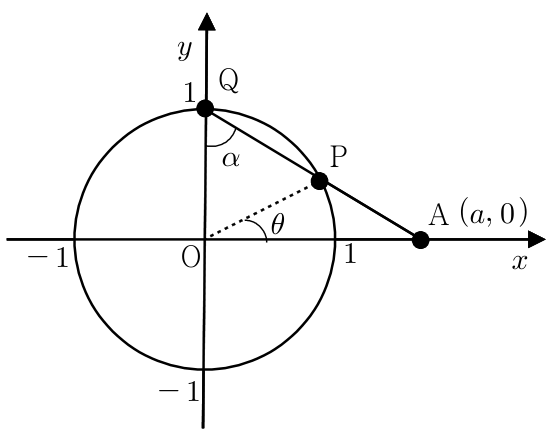
Q가 (0,1)에 있을 때 각 OQA와 OPQ
4단계 · 위 그림과 같이 점 Q\displaystyle \mathrm Q의 위치가 (0,1)\displaystyle (0,1)일 때, OQA=α\displaystyle \angle\mathrm{OQA}=\alpha라 하면 dA2=1cos2α\displaystyle d_{\mathrm A}^2=\frac1{\cos^2\alpha}이다. 한편, 직선 OQ\displaystyle \mathrm{OQ}와 직선 OP\displaystyle \mathrm{OP}의 길이가 같으므로 OPQ=α\displaystyle \angle\mathrm{OPQ}=\alpha이고, 2α=θ+π2\displaystyle 2\alpha=\theta+\frac\pi2가 성립한다. 따라서, dA2=1cos2α=21+cos2α=21+cos(θ+π2)=21sinθ\displaystyle d_{\mathrm A}^2=\frac1{\cos^2\alpha}=\frac2{1+\cos2\alpha}=\frac2{1+\cos\left(\theta+\frac\pi2\right)}=\frac2{1-\sin\theta}이고, dA2vA=2sinθ=4\displaystyle \frac{d_{\mathrm A}^2}{|v_{\mathrm A}|}=\frac2{\sin\theta}=4이므로, θ=π6\displaystyle \theta=\frac\pi6이다. 「문항(3) 답」

Correction. ‘직선 OQ\displaystyle \mathrm{OQ}와 직선 OP\displaystyle \mathrm{OP}’는 ‘선분 OQ\displaystyle \mathrm{OQ}와 선분 OP\displaystyle \mathrm{OP}’의 오기다. 그러나 원칙에 따라 원문 표기를 그대로 실었다.

위 그림과 같이 점 Q\displaystyle \mathrm Q의 위치가 (0,1)\displaystyle (0,1)일 때, OQA=α\displaystyle \angle\mathrm{OQA}=\alpha라 하면 dA2=1cos2α\displaystyle d_{\mathrm A}^2=\frac1{\cos^2\alpha}이다. 한편, 직선 OQ\displaystyle \mathrm{OQ}와 직선 OP\displaystyle \mathrm{OP}의 길이가 같으므로 OPQ=α\displaystyle \angle\mathrm{OPQ}=\alpha이고, 2α=θ+π2\displaystyle 2\alpha=\theta+\frac\pi2가 성립한다.Correction. ‘직선 OQ\displaystyle \mathrm{OQ}와 직선 OP\displaystyle \mathrm{OP}’는 ‘선분 OQ\displaystyle \mathrm{OQ}와 선분 OP\displaystyle \mathrm{OP}’의 오기다. 그러나 원칙에 따라 원문 표기를 그대로 실었다.따라서, dA2=1cos2α=21+cos2α=21+cos(θ+π2)=21sinθ\displaystyle d_{\mathrm A}^2=\frac1{\cos^2\alpha}=\frac2{1+\cos2\alpha}=\frac2{1+\cos\left(\theta+\frac\pi2\right)}=\frac2{1-\sin\theta}이고, dA2vA=2sinθ=4\displaystyle \frac{d_{\mathrm A}^2}{|v_{\mathrm A}|}=\frac2{\sin\theta}=4이므로, θ=π6\displaystyle \theta=\frac\pi6이다.

채점 기준배점
[1단계]부터 [4단계]까지 모든 단계를 논증이 매끄럽게 작성한 경우S
모든 단계를 잘 작성하였으나 논증이 부족한 부분이 하나 이상 존재하는 경우A
[1단계]부터 [3단계]까지 논증이 매끄럽게 작성한 경우B
[1단계]부터 [2단계]까지 논증이 매끄럽게 작성한 경우C
[1단계]부터 [2단계]의 음함수 표현까지만 올바르게 작성한 경우D
[1단계]까지만 작성한 경우E
어느 단계의 일부분도 논증이 매끄럽게 진술하지 못한 경우, 백지인 경우F

*음함수의 미분을 쓰지 않고 직선의 방정식을 통해 a를 구하고, 속력을 구할 수도 있다.

첨삭 사례

아직 등록된 첨삭 사례가 없습니다.

질문과 답변 · 0개질문과 답변 · 고정 0개

아직 등록된 질문이 없습니다. 질문 작성은 멤버십 회원만 가능합니다.