수리논술, 이게 다다.

자연계열 1번

오류 제보

문제

[문제 1] (30점) 다음 제시문을 읽고 물음에 답하시오.

(가) [사인법칙] 삼각형 ABC\displaystyle ABC에서 외접원의 반지름의 길이를 R\displaystyle R라고 하면asin⁡A=bsin⁡B=csin⁡C=2R\displaystyle \frac{a}{\sin A}=\frac{b}{\sin B}=\frac{c}{\sin C}=2R이다.

(나) [코사인법칙] 삼각형 ABC\displaystyle ABC에서a2=b2+c2−2bccos⁡Ab2=c2+a2−2cacos⁡Bc2=a2+b2−2abcos⁡C\displaystyle \begin{aligned}a^2&=b^2+c^2-2bc\cos A\\b^2&=c^2+a^2-2ca\cos B\\c^2&=a^2+b^2-2ab\cos C\end{aligned}이다.

(다) [음함수의 미분법] 음함수 표현 f(x,y)=0\displaystyle f(x,y)=0에서 y\displaystyle y를 x\displaystyle x의 함수로 보고 양변을 x\displaystyle x에 대하여 미분하여 dydx\displaystyle \frac{dy}{dx}를 구한다.

(라) lim⁡x→0sin⁡xx=1\displaystyle \lim_{x\to0}\frac{\sin x}{x}=1 (단, x\displaystyle x의 단위는 라디안)

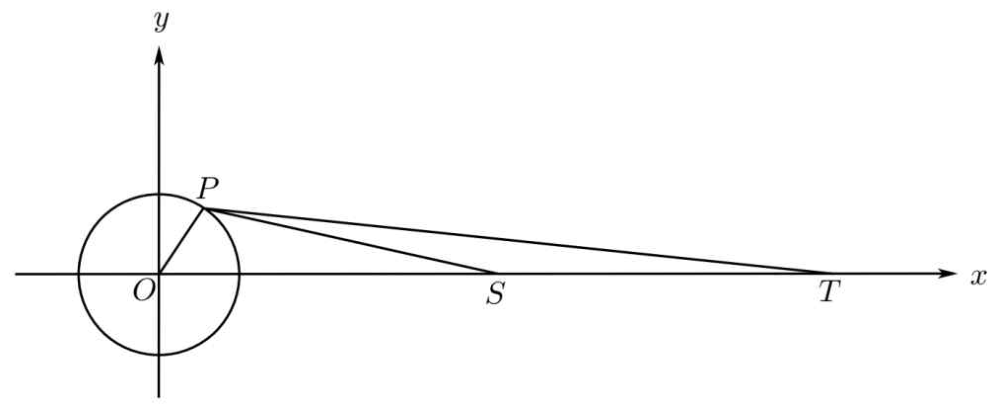
(※) 단위원 위의 한 점을 P(cos⁡θ,sin⁡θ)\displaystyle P(\cos\theta,\sin\theta)라 하자. 여기서 θ\displaystyle \theta는 0≤θ≤π\displaystyle 0\le\theta\le\pi를 만족한다. 점 P\displaystyle P로부터 거리가 4\displaystyle 4와 8\displaystyle 8인 x\displaystyle x축의 양의 방향 위의 점들을 각각 S\displaystyle S와 T\displaystyle T라 하자.

단위원 위의 점 P와 x축 위의 두 점 S, T

(1-1) (a) 점 S\displaystyle S의 x\displaystyle x좌표를 변수 θ\displaystyle \theta에 관한 식으로 나타내시오. [5점](b) 원점을 O\displaystyle O라 하자. 각 ∠OPS\displaystyle \angle OPS의 크기를 f(θ)\displaystyle f(\theta)라 할 때, f′(π/2)\displaystyle f^{\prime}(\pi/2)의 값을 구하시오. [10점]

(1-2) (a) 각 ∠PSO\displaystyle \angle PSO를 θ1\displaystyle \theta_1라 하자. sin⁡θ=15\displaystyle \sin\theta=\frac{1}{5}일 때, sin⁡θ1\displaystyle \sin\theta_1의 값을 구하시오. [5점](b) 각 ∠SPT\displaystyle \angle SPT의 크기를 g(θ)\displaystyle g(\theta)라 할 때, 극한값 lim⁡θ→πg(θ)π−θ\displaystyle \lim_{\theta\to\pi}\frac{g(\theta)}{\pi-\theta}를 구하시오. [10점]

해설강의 준비중
+3점 · 코사인법칙을 적용하여 방정식을 구하면 3점

(1-1) (a) S\displaystyle S의 좌표를 (s,0)\displaystyle (s,0)이라 하자. 선분 PS\displaystyle PS의 길이는 피타고라스 정리에 의해서 (cos⁡θ−s)2+(sin⁡θ)2=4\displaystyle \sqrt{(\cos\theta-s)^2+(\sin\theta)^2}=4이므로 이것을 s\displaystyle s에 대해서 풀면 s=cos⁡θ±16−(sin⁡θ)2\displaystyle s=\cos\theta\pm\sqrt{16-(\sin\theta)^2}이 된다.

+2점 · 양수 조건 및 삼각함수의 범위를 이용하여 문제를 완전히 해결하면 2점

S\displaystyle S는 x\displaystyle x축의 양의 방향 위의 점이고, ∣cos⁡θ∣,∣sin⁡θ∣≤1\displaystyle |\cos\theta|,|\sin\theta|\le1이므로 s=cos⁡θ+16−(sin⁡θ)2\displaystyle s=\cos\theta+\sqrt{16-(\sin\theta)^2}가 된다.

+2점 · 코사인법칙을 이용하여 방정식을 구하면 2점

(b) 제시문 (나)를 삼각형 △OPS\displaystyle \triangle OPS에 적용하면 다음과 같은 관계식을 얻을 수 있다.s2=12+42−8cos⁡f(θ)\displaystyle s^2=1^2+4^2-8\cos f(\theta)

+3점 · 음함수를 이용하여 f′(θ)\displaystyle f^{\prime}(\theta)를 s,dsdθ,f(θ)\displaystyle s,\frac{ds}{d\theta},f(\theta)로 표현하면 3점

이를 제시문 (다)를 이용하여 θ\displaystyle \theta에 대해서 미분하면2s⋅dsdθ=8sin⁡f(θ)⋅f′(θ)\displaystyle 2s\cdot\frac{ds}{d\theta}=8\sin f(\theta)\cdot f^{\prime}(\theta)를 얻을 수 있다.

+3점 · (1-1)(a)의 관계식을 미분하여 dsdθ\displaystyle \frac{ds}{d\theta}를 구하면 2점

Comment. (1-1)(b)의 채점기준에서 ds/dθ\displaystyle ds/d\theta를 구하는 단계는 설명에 2점, 배점란에 3점으로 적혀 있다. 값을 대입하는 단계는 설명에 3점, 배점란에 2점으로 적혀 있어 서로 일치하지 않는다. 두 단계의 합계는 5점이다. 원칙에 따라 원문 표기를 그대로 실었다.

이 때, (a)의 결과를 θ\displaystyle \theta에 대해서 미분하면, dsdθ=−sin⁡θ−sin⁡θ⋅cos⁡θ16−(sin⁡θ)2\displaystyle \frac{ds}{d\theta}=-\sin\theta-\frac{\sin\theta\cdot\cos\theta}{\sqrt{16-(\sin\theta)^2}}임을 알 수 있다.

+2점 · 주어진 값들을 대입하여 f′(θ)\displaystyle f^{\prime}(\theta)를 구하면 3점

θ=π2\displaystyle \theta=\frac{\pi}{2}일 때, dsdθ=−1\displaystyle \frac{ds}{d\theta}=-1이고, sin⁡f(θ)=s4\displaystyle \sin f(\theta)=\frac{s}{4}이므로, 두 식을 이용하면 f′(θ)=−1\displaystyle f^{\prime}(\theta)=-1을 얻을 수 있다.

+3점 · 사인법칙을 이용하여 관계식을 구하면 3점

(1-2) (a) 제시문 (가)를 삼각형 △PSO\displaystyle \triangle PSO에 이용하면, sin⁡θ1=sin⁡θ4\displaystyle \sin\theta_1=\frac{\sin\theta}{4}이므로

+2점 · 계산 실수 없이 답을 구하면 2점

sin⁡θ1=120\displaystyle \sin\theta_1=\frac{1}{20}임을 알 수 있다.

+2점 · 각 ∠PSO\displaystyle \angle PSO와 각 ∠PTO\displaystyle \angle PTO를 이용하여 g(θ)\displaystyle g(\theta)를 표현하면 2점

(b) 각 ∠PSO\displaystyle \angle PSO를 θ1\displaystyle \theta_1, 각 ∠PTO\displaystyle \angle PTO를 θ2\displaystyle \theta_2라 하자.

+5점 · 사인함수의 극한을 이용하여 주어진 극한을 θ\displaystyle \theta에 관한 구체적인 극한으로 나타내면 5점

그러면 g(θ)=θ1−θ2\displaystyle g(\theta)=\theta_1-\theta_2이며, (1-2) (a)에서와 같은 방법으로 sin⁡θ1=sin⁡θ4\displaystyle \sin\theta_1=\frac{\sin\theta}{4}, sin⁡θ2=sin⁡θ8\displaystyle \sin\theta_2=\frac{\sin\theta}{8}임을 쉽게 알 수 있다. 그리고 lim⁡θ→π−g(θ)=lim⁡θ→π−θ1=lim⁡θ→π−θ2=0\displaystyle \lim_{\theta\to\pi^-}g(\theta)=\lim_{\theta\to\pi^-}\theta_1=\lim_{\theta\to\pi^-}\theta_2=0이므로 제시문 (라)에 의해서 lim⁡θ→π−sin⁡θ1θ1=lim⁡θ→π−sin⁡θ2θ2=1\displaystyle \lim_{\theta\to\pi^-}\frac{\sin\theta_1}{\theta_1}=\lim_{\theta\to\pi^-}\frac{\sin\theta_2}{\theta_2}=1이 된다.

+3점 · 사인함수의 극한을 이용하여 구하고자 하는 극한을 구하면 3점

따라서, 다음과 같이 구하고자 하는 극한을 구할 수 있다.lim⁡θ→π−g(θ)π−θ=lim⁡θ→π−θ1−θ2π−θ=lim⁡θ→π−(θ1π−θ−θ2π−θ)=lim⁡θ→π−(sin⁡θ1π−θ⋅θ1sin⁡θ1−sin⁡θ2π−θ⋅θ2sin⁡θ2)=lim⁡θ→π−sin⁡θ1−sin⁡θ2π−θ=lim⁡θ→π−sin⁡θ8(π−θ)=18\displaystyle \begin{aligned}\lim_{\theta\to\pi^-}\frac{g(\theta)}{\pi-\theta}&=\lim_{\theta\to\pi^-}\frac{\theta_1-\theta_2}{\pi-\theta}=\lim_{\theta\to\pi^-}\left(\frac{\theta_1}{\pi-\theta}-\frac{\theta_2}{\pi-\theta}\right)\\&=\lim_{\theta\to\pi^-}\left(\frac{\sin\theta_1}{\pi-\theta}\cdot\frac{\theta_1}{\sin\theta_1}-\frac{\sin\theta_2}{\pi-\theta}\cdot\frac{\theta_2}{\sin\theta_2}\right)\\&=\lim_{\theta\to\pi^-}\frac{\sin\theta_1-\sin\theta_2}{\pi-\theta}=\lim_{\theta\to\pi^-}\frac{\sin\theta}{8(\pi-\theta)}=\frac{1}{8}\end{aligned}

첨삭 사례

아직 등록된 첨삭 사례가 없습니다.

질문과 답변 · 0개질문과 답변 · 고정 0개

아직 등록된 질문이 없습니다. 질문 작성은 멤버십 회원만 가능합니다.