수리논술, 이게 다다.

의학계 1번

오류 제보

문제

Ⅰ. 다음 제시문과 그림을 참조하여 논제에 답하시오. <수학>

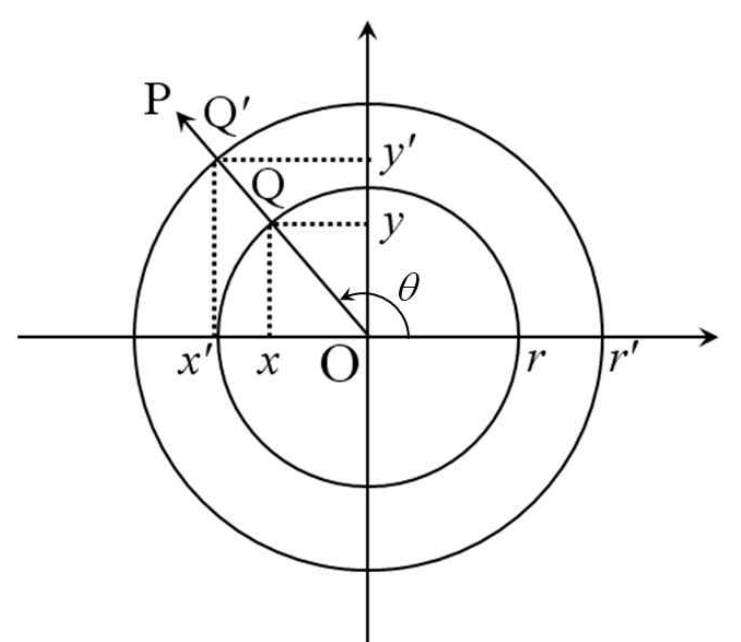
[가] 다음 그림과 같이 좌표평면 위에서 동경 OP\displaystyle \mathrm{OP}가 나타내는 일반각의 크기를 θ\displaystyle \theta라 할 때, 반지름의 길이가 r\displaystyle r, r′\displaystyle r^{\prime}인 두 원과 동경 OP\displaystyle \mathrm{OP}의 교점을 각각 Q(x,y)\displaystyle \mathrm{Q} \left( x , y \right), Q′(x′,y′)\displaystyle \mathrm{Q}^{\prime} \left( x^{\prime} , y^{\prime} \right)이라고 하면 xx′=yy′=rr′\displaystyle \frac{x}{x^{\prime}} = \frac{y}{y^{\prime}} = \frac{r}{r^{\prime}}에서 yr=y′r′\displaystyle \frac{y}{r} = \frac{y^{\prime}}{r^{\prime}}, xr=x′r′\displaystyle \frac{x}{r} = \frac{x^{\prime}}{r^{\prime}}, yx=y′x′\displaystyle \frac{y}{x} = \frac{y^{\prime}}{x^{\prime}}이 성립한다.Caution. 나누거나 약분할 때는 그 식이 0\displaystyle 0이 아닌지 확인해야 한다: 제시문 그림에서는 네 좌표가 모두 0\displaystyle 0이 아니므로 xx′=yy′=rr′\displaystyle \frac{x}{x^{\prime}}=\frac{y}{y^{\prime}}=\frac r{r^{\prime}}를 쓸 수 있다. 그러나 이를 일반각 전체에 적용할 때는 축 위의 점을 따로 확인해야 한다. 예를 들어 θ=0\displaystyle \theta=0이면 y=y′=0\displaystyle y=y^{\prime}=0이므로 yy′\displaystyle \frac y{y^{\prime}}는 정의되지 않는다. 양수인 반지름으로 나눈 xr=x′r′\displaystyle \frac xr=\frac{x^{\prime}}{r^{\prime}}, yr=y′r′\displaystyle \frac yr=\frac{y^{\prime}}{r^{\prime}}로 나타내면 축 위의 점도 포함할 수 있다.

일반적으로, 임의의 실수 θ\displaystyle \theta에 대하여 비 yr\displaystyle \frac{y}{r}, xr\displaystyle \frac{x}{r}, yx\displaystyle \frac{y}{x} (x≠0)\displaystyle \left( x \ne 0 \right)의 값은 r\displaystyle r의 값에 관계없이 θ\displaystyle \theta의 크기에 따라 각각 한 가지로 결정된다. 즉, 대응 관계 θ→yr\displaystyle \theta \to \frac{y}{r}, θ→xr\displaystyle \theta \to \frac{x}{r}, θ→yx\displaystyle \theta \to \frac{y}{x} (x≠0)\displaystyle \left( x \ne 0 \right)는 각각 함수이다. 이 함수를 차례로 사인함수, 코사인함수, 탄젠트함수라고 하고, 이것을 각각 sin⁡θ=yr\displaystyle \sin \theta = \frac{y}{r}, cos⁡θ=xr\displaystyle \cos \theta = \frac{x}{r}, tan⁡θ=yx\displaystyle \tan \theta = \frac{y}{x} (x≠0)\displaystyle \left( x \ne 0 \right)와 같이 나타낸다. 이들 함수를 일반각 θ\displaystyle \theta에 대한 삼각함수라고 한다.

경희대 2016 모의 의학계 삼각함수 정의

[나] 한 도형을 일정한 비율로 확대하거나 축소하여 얻은 도형과 합동인 도형을 처음 도형과 서로 닮음인 관계에 있다고 하며, 닮음인 관계에 있는 두 도형을 닮은 도형이라고 한다. 서로 닮은 다각형에서는 대응하는 변의 길이의 비와 대응하는 각의 크기가 각각 같다. 역으로 대응하는 변의 길이의 비가 모두 같고, 대응하는 각의 크기도 각각 같은 두 다각형은 서로 닮은 도형이다.

[다] 함수 f(x)\displaystyle f ( x )가 어떤 구간에 속하는 임의의 두 수 x1\displaystyle x_{1}, x2\displaystyle x_{2}에 대하여 x1<x2\displaystyle x_{1} < x_{2}일 때, f(x1)<f(x2)\displaystyle f ( x_{1} ) < f ( x_{2} )이면 함수 f(x)\displaystyle f ( x )는 이 구간에서 증가한다고 한다. 또, x1<x2\displaystyle x_{1} < x_{2}일 때, f(x1)>f(x2)\displaystyle f ( x_{1} ) > f ( x_{2} )이면 함수 f(x)\displaystyle f ( x )는 이 구간에서 감소한다고 한다.

[라] 함수 f(x)\displaystyle f ( x )에서 충분히 작은 양수 h\displaystyle h에 대하여 f(a−h)<f(a)<f(a+h)\displaystyle f ( a - h ) < f ( a ) < f ( a + h )일 때, 함수 f(x)\displaystyle f ( x )는 x=a\displaystyle x = a에서 증가상태에 있다고 하고, f(a−h)>f(a)>f(a+h)\displaystyle f ( a - h ) > f ( a ) > f ( a + h )일 때, 함수 f(x)\displaystyle f ( x )는 x=a\displaystyle x = a에서 감소상태에 있다고 한다.

이제 함수의 증가상태, 감소상태와 미분계수의 부호 사이의 관계를 알아보자.

함수 f(x)\displaystyle f ( x )가 x=a\displaystyle x = a에서 미분가능하면 f′(a)=lim⁡Δx→0f(a+Δx)−f(a)Δx\displaystyle f^{\prime} ( a ) = \lim_{\Delta x \to 0} \frac{{f ( a + \Delta x ) - f ( a )}}{\Delta x}이므로 ∣Δx∣\displaystyle | \Delta x |가 충분히 작으면 f′(a)≒f(a+Δx)−f(a)Δx\displaystyle f^{\prime} ( a ) \fallingdotseq \frac{{f ( a + \Delta x ) - f ( a )}}{\Delta x}이다. 따라서 f′(a)\displaystyle f^{\prime} ( a )와 f(a+Δx)−f(a)Δx\displaystyle \frac{{f ( a + \Delta x ) - f ( a )}}{\Delta x}는 같은 부호를 갖는다.Comment. 위의 두 식이 같은 부호를 갖는다는 설명은 f′(a)≠0\displaystyle f'(a)\ne0일 때 성립한다. 그러나 원칙에 따라 원문 표기를 그대로 실었다.

(ⅰ) f′(a)>0\displaystyle f^{\prime} ( a ) > 0이면 f(a+Δx)−f(a)Δx>0\displaystyle \frac{{f ( a + \Delta x ) - f ( a )}}{\Delta x} > 0이므로, Δx>0\displaystyle \Delta x > 0일 때 f(a+Δx)>f(a)\displaystyle f ( a + \Delta x ) > f ( a ), Δx<0\displaystyle \Delta x < 0일 때 f(a+Δx)<f(a)\displaystyle f ( a + \Delta x ) < f ( a )이다. 따라서 h=∣Δx∣\displaystyle h = | \Delta x |라고 하면 f(a−h)<f(a)<f(a+h)\displaystyle f ( a - h ) < f ( a ) < f ( a + h )이므로 함수 f(x)\displaystyle f ( x )는 x=a\displaystyle x = a에서 증가상태에 있다.

(ⅱ) f′(a)<0\displaystyle f^{\prime} ( a ) < 0이면 f(a+Δx)−f(a)Δx<0\displaystyle \frac{{f ( a + \Delta x ) - f ( a )}}{\Delta x} < 0이므로, Δx>0\displaystyle \Delta x > 0일 때 f(a+Δx)<f(a)\displaystyle f ( a + \Delta x ) < f ( a ), Δx<0\displaystyle \Delta x < 0일 때 f(a+Δx)>f(a)\displaystyle f ( a + \Delta x ) > f ( a )이다. 따라서 h=∣Δx∣\displaystyle h = | \Delta x |라고 하면 f(a−h)>f(a)>f(a+h)\displaystyle f ( a - h ) > f ( a ) > f ( a + h )이므로 함수 f(x)\displaystyle f ( x )는 x=a\displaystyle x = a에서 감소상태에 있다.

이상을 정리하면 다음과 같다.

함수의 증가상태와 감소상태

함수 y=f(x)\displaystyle y = f ( x )가 x=a\displaystyle x = a에서 미분가능할 때

(1) f′(a)>0\displaystyle f^{\prime} ( a ) > 0이면 f(x)\displaystyle f ( x )는 x=a\displaystyle x = a에서 증가상태에 있다.

(2) f′(a)<0\displaystyle f^{\prime} ( a ) < 0이면 f(x)\displaystyle f ( x )는 x=a\displaystyle x = a에서 감소상태에 있다.

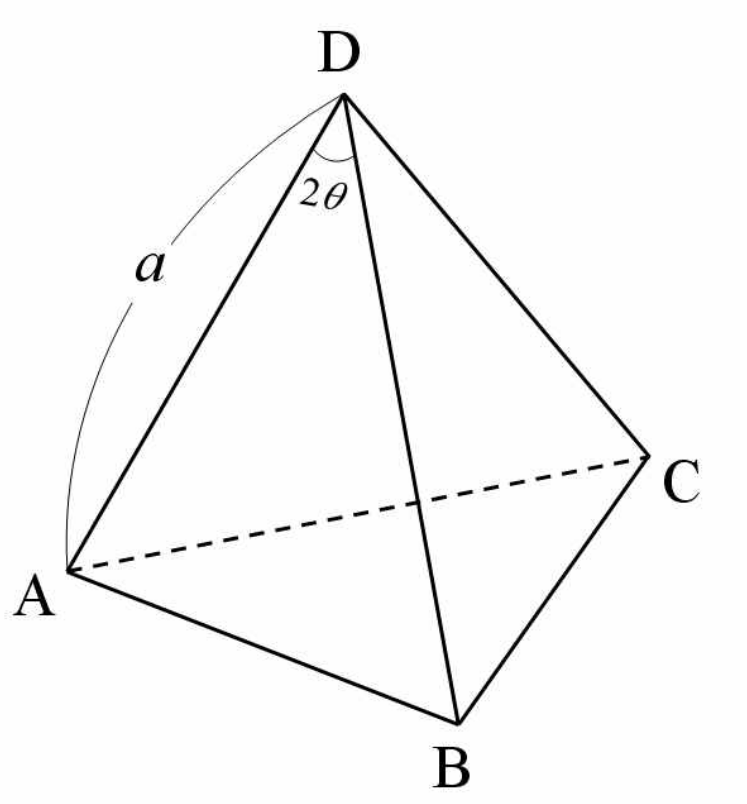
[논제 Ⅰ] 다음 그림과 같이 변 DA\displaystyle \mathrm{DA}, 변 DB\displaystyle \mathrm{DB}, 변 DC\displaystyle \mathrm{DC}의 길이가 일정한 상수 a\displaystyle a이고, 밑면이 정삼각형 ABC\displaystyle \mathrm{ABC}로 이루어진 사면체 DABC\displaystyle \mathrm{DABC}가 있을 때, 그 사면체에 내접하는 구의 반지름을 r\displaystyle r, 외접하는 구의 반지름을 R\displaystyle R이라고 하자. 그리고, 삼각형 DAB\displaystyle \mathrm{DAB}에서 각 ∠BDA\displaystyle \angle \mathrm{BDA}를 2θ\displaystyle 2 \theta라고 하자.

경희대 2016 모의 의학계 사면체

[논제 Ⅰ-1] 내접하는 구의 반지름 r\displaystyle r을 a\displaystyle a와 θ\displaystyle \theta로 표현하고 그 근거를 논술하시오. (12점)

[논제 Ⅰ-2] 내접하는 구의 반지름 r\displaystyle r과 변 AB\displaystyle \mathrm{AB}의 길이 AB‾\displaystyle \overline{\mathrm{AB}}에 대하여, 다음의 부등식이 성립함을 증명하시오. (18점)

23r<AB‾\displaystyle 2 \sqrt{3} r < \overline{\mathrm{AB}}

[논제 Ⅰ-3] 외접하는 구의 반지름 R\displaystyle R을 a\displaystyle a와 θ\displaystyle \theta로 표현하고 그 근거를 논술하시오. (12점)

[논제 Ⅰ-4] 외접하는 구의 반지름 R\displaystyle R과 내접하는 구의 반지름 r\displaystyle r에 대하여, 다음의 부등식이 성립함을 증명하고, 이 부등식에서 등식을 만족할 때가 어떤 사면체인지 논술하시오. (18점)

3r≤R\displaystyle 3 r \le R

해설강의 준비중

<논제 Ⅰ> 수학

[논제 Ⅰ-1]

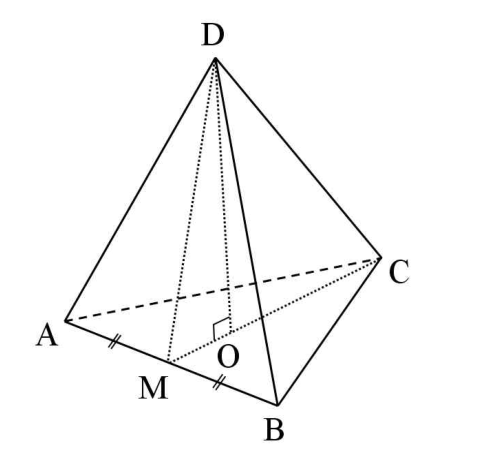
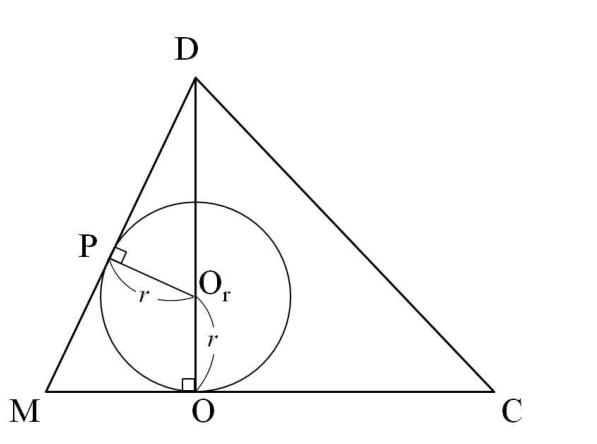
변 AB\displaystyle \mathrm{AB}의 중점을 M\displaystyle \mathrm{M}이라고 하고, 정삼각형 ABC\displaystyle \mathrm{ABC}의 무게중심을 O\displaystyle \mathrm{O}라고 하면 다음의 왼쪽 그림과 같고, 주어진 사면체에 내접하는 구의 중심은 사면체의 세 옆면과 동일한 거리에 있기 때문에, 선분 OD\displaystyle \mathrm{OD} 위에 있음을 알 수 있다. 이때, 내접하는 구의 반지름을 r\displaystyle r이라고 하고 그 중심을 Or\displaystyle \mathrm{O}_{\mathrm{r}}이라 할 때, 삼각형 DMC\displaystyle \mathrm{DMC}를 지나는 평면으로 잘라 단면을 보면 다음의 오른쪽 그림과 같다. 여기에서 점 P\displaystyle \mathrm{P}는 그 구가 삼각형 DAB\displaystyle \mathrm{DAB}를 지나는 평면에 접하는 점이다.

경희대 2016 모의 의학계 내접구
경희대 2016 모의 의학계 내접구 단면

변 DA\displaystyle \mathrm{DA}의 길이가 a\displaystyle a이고 각 ∠ADM\displaystyle \angle \mathrm{ADM}이 θ\displaystyle \theta이므로, 변 DM\displaystyle \mathrm{DM}의 길이는 acos⁡θ\displaystyle a \cos \theta이고, 변 AB\displaystyle \mathrm{AB}의 길이는 2asin⁡θ\displaystyle 2 a \sin \theta이다. (이때, 사면체를 이루는 θ\displaystyle \theta의 범위는 0<θ<π3\displaystyle 0 < \theta < \frac{\pi}{3}이다.) 삼각형 ABC\displaystyle \mathrm{ABC}는 정삼각형이므로, 선분 CM\displaystyle \mathrm{CM}의 길이는 3asin⁡θ\displaystyle \sqrt{3} a \sin \theta이고, O\displaystyle \mathrm{O}가 정삼각형 ABC\displaystyle \mathrm{ABC}의 무게중심이므로, 선분 OM\displaystyle \mathrm{OM}의 길이는 asin⁡θ3\displaystyle \frac{{a \sin \theta}}{\sqrt{3}}이다. 따라서, 선분 OD\displaystyle \mathrm{OD}의 길이는

a2cos⁡2θ−a2sin⁡2θ3=a3−4sin⁡2θ3=a3sin⁡θ−4sin⁡3θ3sin⁡θ=asin⁡3θ3sin⁡θ\displaystyle \sqrt{a^{2} \cos^{2} \theta - \frac{{a^{2} \sin^{2} \theta}}{3}} = a \sqrt{\frac{{3 - 4 \sin^{2} \theta}}{3}} = a \sqrt{\frac{{3 \sin \theta - 4 \sin^{3} \theta}}{3 \sin \theta}} = a \sqrt{\frac{{\sin 3 \theta}}{3 \sin \theta}}

이 된다. 삼각형 DPOr\displaystyle \mathrm{DPO}_{\mathrm{r}}과 삼각형 DOM\displaystyle \mathrm{DOM}은 닮은 직각삼각형이므로, 내접하는 구의 반지름 r\displaystyle r은

asin⁡θsin⁡3θ3sin⁡θ+3cos⁡θ\displaystyle \frac{{a \sqrt{\sin \theta \sin 3 \theta}}}{\sqrt{3} \sin \theta + 3 \cos \theta} (혹은 asin⁡θsin⁡3θ23sin⁡(θ+π3)\displaystyle \frac{{a \sqrt{\sin \theta \sin 3 \theta}}}{2 \sqrt{3} \sin \left( \theta + \frac{\pi}{3} \right)}, asin⁡θ3−4sin⁡2θ3sin⁡θ+3cos⁡θ\displaystyle \frac{{a \sin \theta \sqrt{3 - 4 \sin^{2} \theta}}}{\sqrt{3} \sin \theta + 3 \cos \theta}, asin⁡θ4cos⁡2θ−13sin⁡θ+3cos⁡θ\displaystyle \frac{{a \sin \theta \sqrt{4 \cos^{2} \theta - 1}}}{\sqrt{3} \sin \theta + 3 \cos \theta})

이 된다.

[논제 Ⅰ-2]

변 AB\displaystyle \mathrm{AB}의 길이가 2asin⁡θ\displaystyle 2 a \sin \theta이므로, 주어진 부등식을 증명하기 위해서 r2asin⁡θ\displaystyle \frac{r}{2 a \sin \theta}을 고려한다.

r2asin⁡θ=3−4sin⁡2θ23sin⁡θ+6cos⁡θ\displaystyle \frac{r}{2 a \sin \theta} = \frac{{\sqrt{3 - 4 \sin^{2} \theta}}}{2 \sqrt{3} \sin \theta + 6 \cos \theta}이므로, r2asin⁡θ\displaystyle \frac{r}{2 a \sin \theta}을 θ\displaystyle \theta에 대하여 미분하면 다음과 같다.

−4sin⁡θcos⁡θ3−4sin⁡2θ(23sin⁡θ+6cos⁡θ)−3−4sin⁡2θ(23cos⁡θ−6sin⁡θ)(23sin⁡θ+6cos⁡θ)2\displaystyle \frac{\frac{-4\sin\theta\cos\theta}{\sqrt{3-4\sin^2\theta}}(2\sqrt3\sin\theta+6\cos\theta)-\sqrt{3-4\sin^2\theta}(2\sqrt3\cos\theta-6\sin\theta)}{(2\sqrt3\sin\theta+6\cos\theta)^2}

이고 이를 정리하면, −sin⁡θ+3cos⁡θ23−4sin⁡2θ(23sin⁡θ+6cos⁡θ)2\displaystyle - \frac{{\sin \theta + \sqrt{3} \cos \theta}}{2 \sqrt{3 - 4 \sin^{2} \theta} ( 2 \sqrt{3} \sin \theta + 6 \cos \theta )^{2}}이다.Correction. 미분한 식을 정리하는 과정에서 계수가 잘못되었다. 올바른 도함수는 원문에 적힌 식의 12배다. 부호는 그대로 음수이므로 부등식의 증명에는 영향이 없다. 원칙에 따라 원문 표기를 그대로 실었다.이 값은, 0<θ<π3\displaystyle 0 < \theta < \frac{\pi}{3}에 대하여 항상 음수이므로, θ\displaystyle \theta가 증가하면 r2asin⁡θ\displaystyle \frac{r}{2 a \sin \theta}은 감소함을 알 수 있다. 따라서, r2asin⁡θ\displaystyle \frac{r}{2 a \sin \theta}의 값은 lim⁡θ→0r2asin⁡θ\displaystyle \lim_{\theta \to 0} \frac{r}{2 a \sin \theta}보다 작으므로, r2asin⁡θ=3−4sin⁡2θ23sin⁡θ+6cos⁡θ<lim⁡θ→0r2asin⁡θ=123\displaystyle \frac{r}{2 a \sin \theta} = \frac{{\sqrt{3 - 4 \sin^{2} \theta}}}{2 \sqrt{3} \sin \theta + 6 \cos \theta} < \lim_{\theta \to 0} \frac{r}{2 a \sin \theta} = \frac{1}{2 \sqrt{3}}이다. 그러므로, 주어진 부등식이 성립한다.

[논제 Ⅰ-3]

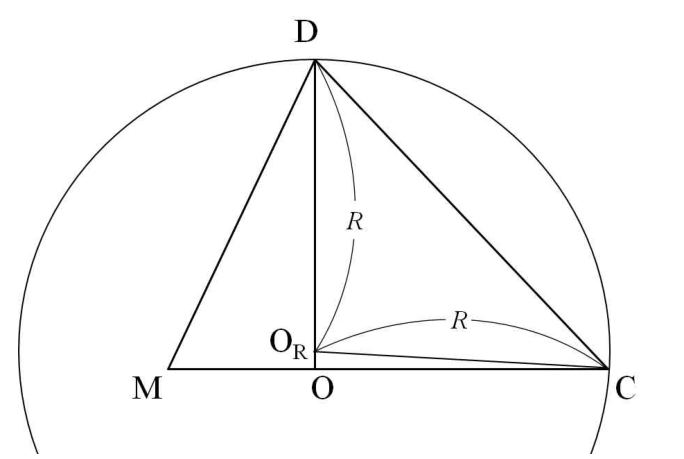
주어진 사면체에 외접하는 구의 중심도, 점 A\displaystyle \mathrm{A}, 점 B\displaystyle \mathrm{B}, 점 C\displaystyle \mathrm{C}와 동일한 거리에 있기 때문에, 내접하는 구와 마찬가지로 선분 OD\displaystyle \mathrm{OD} 위에 있음을 알 수 있다. 이때, 외접하는 구의 반지름을 R\displaystyle R이라고 하고 그 중심을 OR\displaystyle \mathrm{O}_{\mathrm{R}}이라 할 때, 삼각형 DMC\displaystyle \mathrm{DMC}를 지나는 평면으로 잘라 단면을 보면 다음의 그림과 같다.Caution. 식을 길이나 넓이로 해석할 때는 그 값이 음이 아닌지 확인해야 한다: 외접구의 중심은 직선 OD\displaystyle OD 위에 있으나 항상 선분 OD\displaystyle OD 위에 있는 것은 아니다. 또한 OOR\displaystyle OO_R은 거리이므로 ∣OD−R∣\displaystyle |OD-R|로 써야 한다. 뒤의 제곱식과 계산 결과에는 영향이 없다. 원칙에 따라 원문 표기를 그대로 실었다.

경희대 2016 모의 의학계 외접구

그러면 논제Ⅰ-(1)에서와 같은 이유로 선분 OC\displaystyle \mathrm{OC}의 길이는 2asin⁡θ3\displaystyle \frac{{2 a \sin \theta}}{\sqrt{3}}이고, 선분 OOR\displaystyle \mathrm{OO}_{\mathrm{R}}은 a3−4sin⁡2θ3−R\displaystyle a \sqrt{\frac{{3 - 4 \sin^{2} \theta}}{3}} - R이 된다. 삼각형 OCOR\displaystyle \mathrm{OCO}_{\mathrm{R}}도 직각삼각형이므로, 피타고라스 정리에 의하여, (a3−4sin⁡2θ3−R)2+4a2sin⁡2θ3=R2\displaystyle \left( a \sqrt{\frac{{3 - 4 \sin^{2} \theta}}{3}} - R \right)^{2} + \frac{{4 a^{2} \sin^{2} \theta}}{3} = R^{2}이 성립한다. 따라서, 외접하는 구의 반지름 R\displaystyle R은

3a23−4sin⁡2θ\displaystyle \frac{{\sqrt{3} a}}{2 \sqrt{3 - 4 \sin^{2} \theta}} (혹은 a3sin⁡θ2sin⁡3θ\displaystyle \frac{{a \sqrt{3 \sin \theta}}}{2 \sqrt{\sin 3 \theta}}, 3a24cos⁡2θ−1\displaystyle \frac{{\sqrt{3} a}}{2 \sqrt{4 \cos^{2} \theta - 1}})

이 된다.

[논제 Ⅰ-4]

[논제 Ⅰ-2]와 같은 방법으로 rR\displaystyle \frac{r}{R}의 최댓값을 고려한다. rR=2sin⁡3θ3sin⁡θ+33cos⁡θ\displaystyle \frac{r}{R} = \frac{{2 \sin 3 \theta}}{3 \sin \theta + 3 \sqrt{3} \cos \theta}이고 sin⁡π3=32\displaystyle \sin \frac{\pi}{3} = \frac{\sqrt{3}}{2}, cos⁡π3=12\displaystyle \cos \frac{\pi}{3} = \frac{1}{2}이므로, rR=sin⁡3θ3sin⁡(θ+π3)\displaystyle \frac{r}{R} = \frac{{\sin 3 \theta}}{3 \sin \left( \theta + \frac{\pi}{3} \right)}이 된다. 여기에서, θ+π3\displaystyle \theta + \frac{\pi}{3}을 t\displaystyle t로 치환하자. 즉, t=θ+π3\displaystyle t = \theta + \frac{\pi}{3}이라 하자. 그러면, t\displaystyle t의 범위는 π3≤t≤2π3\displaystyle \frac{\pi}{3} \le t \le 2 \frac{\pi}{3}이고,Caution. 범위의 끝값을 포함하거나 제외할 때는 문제의 조건을 확인해야 한다: 이 문제에서 0<θ<π3\displaystyle 0<\theta<\frac\pi3이므로 t=θ+π3\displaystyle t=\theta+\frac\pi3의 범위는 π3<t<2π3\displaystyle \frac\pi3<t<\frac{2\pi}3이다. 양 끝값 t=π3\displaystyle t=\frac\pi3, t=2π3\displaystyle t=\frac{2\pi}3은 각각 원래 조건에서 제외한 θ=0\displaystyle \theta=0, θ=π3\displaystyle \theta=\frac\pi3에 대응하므로 포함할 수 없다. 최댓값 13\displaystyle \frac13은 구간 안의 t=π2\displaystyle t=\frac\pi2에서 얻으므로 최댓값과 등호가 성립하는 조건에는 영향이 없다. 원칙에 따라 원문 표기를 그대로 실었다.

rR=sin⁡(3t−π)3sin⁡t=−sin⁡3t3sin⁡t=4sin⁡3t−3sin⁡t3sin⁡t=4sin⁡2t3−1\displaystyle \frac{r}{R} = \frac{{\sin ( 3 t - \pi )}}{3 \sin t} = - \frac{{\sin 3 t}}{3 \sin t} = \frac{{4 \sin^{3} t - 3 \sin t}}{3 \sin t} = \frac{{4 \sin^{2} t}}{3} - 1

가 된다. 따라서, rR\displaystyle \frac{r}{R}는 범위 π3≤t≤2π3\displaystyle \frac{\pi}{3} \le t \le 2 \frac{\pi}{3}에서 t=π2\displaystyle t = \frac{\pi}{2}일 때 최대가 됨을 사인함수의 성질로부터 쉽게 알 수 있다. 즉, rR=4sin⁡2t3−1≤4sin⁡2π23−1=13\displaystyle \frac{r}{R} = \frac{{4 \sin^{2} t}}{3} - 1 \le \frac{{4 \sin^{2} \frac{\pi}{2}}}{3} - 1 = \frac{1}{3}이므로, 논제에 주어진 부등식이 성립한다. 이때 등식이 성립하는 경우는, t=π2\displaystyle t = \frac{\pi}{2}인 경우이므로 그때 θ=π6\displaystyle \theta = \frac{\pi}{6}이다. 이 경우는 정사면체이다.

첨삭 사례

아직 등록된 첨삭 사례가 없습니다.

질문과 답변 · 0개질문과 답변 · 고정 0개

아직 등록된 질문이 없습니다. 질문 작성은 멤버십 회원만 가능합니다.