수리논술, 배움에서 논증의 완성까지.

자연계열 I 2번

문제

🔒
짧은 시간에 너무 많은 문제를 여셔서 열람을 잠시 제한했습니다. 잠시 후 다시 시도하시거나 로그인해 주세요.
해설강의 준비중
+15점 · af(5)+(a+b)=bf(5)\displaystyle -af(5)+(a+b)=bf(5)임을 보이고 f(5)=1\displaystyle f(5)=1임을 보이면 +15점 · af(5)=bf(5)\displaystyle -af^{\prime}(5)=bf^{\prime}(5)임을 보이고 f(5)=0\displaystyle f^{\prime}(5)=0임을 보이면

【2-1】함수 g(x)\displaystyle g(x)x=5\displaystyle x=5에서 미분가능하고 연속이므로 다음이 성립한다.af(5)+(a+b)=bf(5),af(5)=bf(5)\displaystyle -af(5)+(a+b)=bf(5),\quad-af^{\prime}(5)=bf^{\prime}(5)그러므로 a+b>0\displaystyle a+b>0이므로 f(5)=1\displaystyle f(5)=1, f(5)=0\displaystyle f^{\prime}(5)=0이다.

【2-2】y=tg(x)=g(x)t\displaystyle y=|t-g(x)|=|g(x)-t|y=g(x)\displaystyle y=g(x)y=t\displaystyle y=t의 윗부분은 그대로 y=t\displaystyle y=t의 아랫부분은 y=t\displaystyle y=t에 대하여 대칭시킨 그래프이다. 그러므로 다음의 두 가지를 가짐을 알 수 있다.

① 모든 x\displaystyle x에 대하여 g(x)0\displaystyle g^{\prime}(x)\ge0이다.

g(x)=0\displaystyle g^{\prime}(x)=0는 오직 2\displaystyle 2개의 실근을 가진다.

+10점 · g(x)\displaystyle g(x)가 증가함수임을 증명하면

함수 f(x)\displaystyle f(x)의 최고차항 계수가 양수이므로 limxg(x)=\displaystyle \lim_{x\to\infty}g(x)=\infty이고 limxg(x)=\displaystyle \lim_{x\to-\infty}g(x)=-\infty이다.만일 어떤 x=m\displaystyle x=m에서 g(x)<0\displaystyle g^{\prime}(x)<0이면 y=g(x)\displaystyle y=g(x)와 직선 y=g(m)\displaystyle y=g(m)이 만나는 교점이 3\displaystyle 3개 이상이다. 즉, t=g(m)\displaystyle t=g(m)에서 h(t)3\displaystyle h(t)\ge3이므로 h(t)\displaystyle h(t)의 함숫값이 1\displaystyle 1이하인 조건에 모순이다. 그러므로 ①이 성립한다.

+10점 · g(x)=0\displaystyle g^{\prime}(x)=0가 서로 다른 두 실근을 가짐을 증명하면

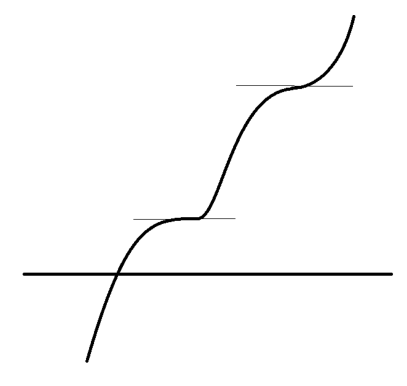
t=t1\displaystyle t=t_1t=t2\displaystyle t=t_2에서 h(t)=0\displaystyle h(t)=0이고 두 점을 제외한 모든 점에서 h(t)=1\displaystyle h(t)=1를 만족하기 위해서는 ②를 만족해야 한다. 그때 함수 g(x)\displaystyle g(x)의 그래프의 개형은 다음과 같이 나타낼 수 있다.

두 점에서 접선이 수평인 증가함수 g(x)의 개형

g(x)\displaystyle g(x)의 개형에 따라 g(x)=0\displaystyle g^{\prime}(x)=0는 오직 2\displaystyle 2개의 서로 다른 실근인 해를 가진다.g(5)=bf(5)=0\displaystyle g^{\prime}(5)=bf^{\prime}(5)=0이므로 x=5\displaystyle x=5g(x)=0\displaystyle g^{\prime}(x)=0의 해이다. x=5\displaystyle x=5가 아닌 다른 해를 p\displaystyle p라고 하자. 그러면 (i) p<5\displaystyle p<5 와 (ii) p>5\displaystyle p>5인 두 가지 경우가 존재한다.(i) p<5\displaystyle p<5인 경우g(p)=af(p)=0\displaystyle g^{\prime}(p)=-af^{\prime}(p)=0이고 다음이 성립한다.

xx=px=5\hlinef(x)00+\displaystyle \begin{array}{c|ccccc}x & \cdots & x=p & \cdots & x=5 & \cdots\\\hlinef^{\prime}(x) & - & 0 & - & 0 & +\end{array}

그러므로 x=p\displaystyle x=pf(x)=0\displaystyle f^{\prime}(x)=0의 중근이다.(ii) p>5\displaystyle p>5인 경우g(p)=bf(p)=0\displaystyle g^{\prime}(p)=bf^{\prime}(p)=0이고 다음이 성립한다.

xx=5x=p\hlinef(x)0+0+\displaystyle \begin{array}{c|ccccc}x & \cdots & x=5 & \cdots & x=p & \cdots\\\hlinef^{\prime}(x) & - & 0 & + & 0 & +\end{array}

그러므로 x=p\displaystyle x=pf(x)=0\displaystyle f^{\prime}(x)=0의 중근이다.

+20점 · f(x)=0\displaystyle f^{\prime}(x)=0x=p (p5)\displaystyle x=p\ (p\ne5)인 중근을 가짐을 증명하면

(i)와 (ii)에 의해서 f(x)=0\displaystyle f^{\prime}(x)=0의 해는 x=5\displaystyle x=5, x=p5\displaystyle x=p\ne5(중근)이다.

+10점 · f(x)f(p)=(xp)3(3x+p20)\displaystyle f(x)-f(p)=(x-p)^3(3x+p-20)을 보이면

【2-3】문제 2-2 결과에 의해서 f(x)=0\displaystyle f^{\prime}(x)=05\displaystyle 5p\displaystyle p(중근)인 해를 가진다. 그러므로 f(x)\displaystyle f^{\prime}(x)는 다음과 같이 나타낼 수 있다.f(x)=12(xp)2(x5)=12(xp)2(xp+p5)=12(xp)3+12(p5)(xp)2\displaystyle \begin{aligned}f^{\prime}(x)&=12(x-p)^2(x-5)\\&=12(x-p)^2(x-p+p-5)\\&=12(x-p)^3+12(p-5)(x-p)^2\end{aligned}이것을 적분하면 f(x)=3(xp)4+4(p5)(xp)3+C\displaystyle f(x)=3(x-p)^4+4(p-5)(x-p)^3+C이다. x=p\displaystyle x=p를 대입하면 C=f(p)\displaystyle C=f(p)이다.그러므로 f(x)\displaystyle f(x)는 다음과 같이 나타낼 수 있다.f(x)=3(xp)4+4(p5)(xp)3+f(p)\displaystyle f(x)=3(x-p)^4+4(p-5)(x-p)^3+f(p)즉, f(x)f(p)=(xp)3(3x+p20)\displaystyle f(x)-f(p)=(x-p)^3(3x+p-20)이다. x=5\displaystyle x=5를 양변에 대입하면 다음이 성립한다.f(5)f(p)=(5p)4\displaystyle f(5)-f(p)=-(5-p)^4------------------------------(*)f(p)\displaystyle f(p)를 구하기 위해서 2\displaystyle 2가지 경우를 생각해보자.p<5\displaystyle p<5인 경우h(t)={1(t3)0(t=3)1(3<t<6)0(t=6)1(t>6)\displaystyle h(t)=\begin{cases}1&(t\le3)\\0&(t=3)\\1&(3<t<6)\\0&(t=6)\\1&(t>6)\end{cases} ------------------------------(**)Correction. 2-3 예시답안의 식 (**)에서 첫 줄의 t3\displaystyle t\le3t<3\displaystyle t<3의 오기이다. 문제에서 t1=3\displaystyle t_1=3, t2=6\displaystyle t_2=6이므로h(t)={0(t=3,6),1(t3,6)\displaystyle h(t)=\begin{cases}0& (t=3,6),\\1& (t\ne3,6)\end{cases}이다. 따라서 h(t)=1\displaystyle h(t)=1인 첫 구간에는 t=3\displaystyle t=3이 포함되지 않는다. 그러나 원문 표기는 그대로 실었다.

+10점 · f(p)=1\displaystyle f(p)=1을 보이면 +10점 · p<5\displaystyle p<5이면 f(x)\displaystyle f(x)가 존재하지 않음을 보이면

이므로 g(p)=2f(p)+5=3\displaystyle g(p)=-2f(p)+5=3, g(5)=3f(5)=6\displaystyle g(5)=3f(5)=6이므로 f(p)=1\displaystyle f(p)=1, f(5)=2\displaystyle f(5)=2이다. 하지만 문제 2-1에 의해 f(5)=1\displaystyle f(5)=1이므로 조건을 만족하는 f(x)\displaystyle f(x)는 존재하지 않는다.

+10점 · f(x)=3(x6)3(x143)+2\displaystyle f(x)=3(x-6)^3\left(x-\dfrac{14}3\right)+2임을 보이면

5<p\displaystyle 5<p인 경우(**)에 의해서 g(p)=3f(p)=6\displaystyle g(p)=3f(p)=6, g(5)=3f(5)=3\displaystyle g(5)=3f(5)=3이므로 f(p)=2\displaystyle f(p)=2, f(5)=1\displaystyle f(5)=1이다. (*)에 대입 후 5<p\displaystyle 5<p이므로 5p=1\displaystyle 5-p=-1이다. 즉, p=6\displaystyle p=6이다. 그러므로 f(x)=3(x6)3(x143)+2\displaystyle f(x)=3(x-6)^3\left(x-\dfrac{14}3\right)+2이다.

+10점 · x=6\displaystyle x=6x=143\displaystyle x=\dfrac{14}3임을 보이고 그 합을 구하면

곡선 y=f(x)\displaystyle y=f(x)와 직선 y=2\displaystyle y=2가 만나는 점의 x\displaystyle x좌표는 x=6\displaystyle x=6x=143\displaystyle x=\dfrac{14}3이고, 그 합은 323\displaystyle \dfrac{32}3이다.

첨삭 사례

아직 등록된 첨삭 사례가 없습니다.

질문과 답변 · 0개질문과 답변 · 고정 0개

아직 등록된 질문이 없습니다. 질문 작성은 멤버십 회원만 가능합니다.