+15점 · y = f − 1 ( x ) = g ( x ) \displaystyle y=f^{-1}(x)=g(x) y = f − 1 ( x ) = g ( x ) y = f ( x ) = tan x \displaystyle y=f(x)=\tan x y = f ( x ) = tan x x = tan y \displaystyle x=\tan y x = tan y y \displaystyle y y d x d y = ( tan y ) ′ \displaystyle \frac{dx}{dy}=(\tan y)^{\prime} d y d x = ( tan y ) ′ d x d y = sec 2 y \displaystyle \frac{dx}{dy}=\sec^2y d y d x = sec 2 y d y d x = 1 d x d y = 1 sec 2 y \displaystyle \frac{dy}{dx}=\frac1{\frac{dx}{dy}}=\frac1{\sec^2y} d x d y = d y d x 1 = sec 2 y 1 [2-1] 단계1. y = f − 1 ( x ) = g ( x ) \displaystyle y=f^{-1}(x)=g(x) y = f − 1 ( x ) = g ( x ) y = f ( x ) = tan x \displaystyle y=f(x)=\tan x y = f ( x ) = tan x x = tan y \displaystyle x=\tan y x = tan y y \displaystyle y y d x d y = ( tan y ) ′ \displaystyle \frac{dx}{dy}=(\tan y)^{\prime} d y d x = ( tan y ) ′ d x d y = sec 2 y \displaystyle \frac{dx}{dy}=\sec^2y d y d x = sec 2 y 이다.
+15점 · 그러므로
d y d x = 1 d x d y = 1 sec 2 y = 1 1 cos 2 y = 1 cos 2 y + sin 2 y cos 2 y = 1 1 + tan 2 y = 1 1 + x 2 \displaystyle \frac{dy}{dx}=\frac1{\frac{dx}{dy}}=\frac1{\sec^2y}=\frac1{\frac1{\cos^2y}}=\frac1{\frac{\cos^2y+\sin^2y}{\cos^2y}}=\frac1{1+\tan^2y}=\frac1{1+x^2} d x d y = d y d x 1 = sec 2 y 1 = c o s 2 y 1 1 = c o s 2 y c o s 2 y + s i n 2 y 1 = 1 + tan 2 y 1 = 1 + x 2 1 1 cos 2 y = cos 2 y + sin 2 y cos 2 y = 1 + tan 2 y \displaystyle \frac1{\cos^2y}=\frac{\cos^2y+\sin^2y}{\cos^2y}=1+\tan^2y cos 2 y 1 = cos 2 y cos 2 y + sin 2 y = 1 + tan 2 y d y d x = 1 1 + tan 2 y = 1 1 + x 2 \displaystyle \frac{dy}{dx}=\frac1{1+\tan^2y}=\frac1{1+x^2} d x d y = 1 + tan 2 y 1 = 1 + x 2 1 단계2. 그러므로 d y d x = 1 d x d y = 1 sec 2 y = 1 1 cos 2 y = 1 cos 2 y + sin 2 y cos 2 y = 1 1 + tan 2 y = 1 1 + x 2 \displaystyle \frac{dy}{dx}=\frac1{\frac{dx}{dy}}=\frac1{\sec^2y}=\frac1{\frac1{\cos^2y}}=\frac1{\frac{\cos^2y+\sin^2y}{\cos^2y}}=\frac1{1+\tan^2y}=\frac1{1+x^2} d x d y = d y d x 1 = sec 2 y 1 = c o s 2 y 1 1 = c o s 2 y c o s 2 y + s i n 2 y 1 = 1 + tan 2 y 1 = 1 + x 2 1
+15점 · ∫ 1 1 + x 2 d x = g ( x ) + C \displaystyle \int\frac1{1+x^2}dx=g(x)+C ∫ 1 + x 2 1 d x = g ( x ) + C ∫ 0 1 g ( x ) d x = ∫ 0 1 1 g ( x ) d x = [ x g ( x ) ] 0 1 − ∫ 0 1 x g ′ ( x ) d x = g ( 1 ) − ∫ 0 1 x 1 + x 2 d x \displaystyle \begin{aligned}\int_0^1g(x)\,dx&=\int_0^1 1g(x)\,dx\\&=\Biggl[xg(x)\Biggr]_0^1-\int_0^1xg^{\prime}(x)\,dx\\&=g(1)-\int_0^1\frac x{1+x^2}dx\end{aligned} ∫ 0 1 g ( x ) d x = ∫ 0 1 1 g ( x ) d x = [ xg ( x ) ] 0 1 − ∫ 0 1 x g ′ ( x ) d x = g ( 1 ) − ∫ 0 1 1 + x 2 x d x (해설) 부분적분법을 이용하여 ∫ 0 1 g ( x ) d x = g ( 1 ) − ∫ 0 1 x 1 + x 2 d x \displaystyle \int_0^1g(x)\,dx=g(1)-\int_0^1\frac x{1+x^2}dx ∫ 0 1 g ( x ) d x = g ( 1 ) − ∫ 0 1 1 + x 2 x d x 을 풀이하면 15점 [2-2] 단계1. ∫ 1 1 + x 2 d x = g ( x ) + C \displaystyle \int\frac1{1+x^2}dx=g(x)+C ∫ 1 + x 2 1 d x = g ( x ) + C ∫ 0 1 g ( x ) d x = ∫ 0 1 1 g ( x ) d x = [ x g ( x ) ] 0 1 − ∫ 0 1 x g ′ ( x ) d x = g ( 1 ) − ∫ 0 1 x 1 + x 2 d x \displaystyle \begin{aligned}\int_0^1g(x)\,dx&=\int_0^1 1g(x)\,dx\\&=\Biggl[xg(x)\Biggr]_0^1-\int_0^1xg^{\prime}(x)\,dx\\&=g(1)-\int_0^1\frac x{1+x^2}dx\end{aligned} ∫ 0 1 g ( x ) d x = ∫ 0 1 1 g ( x ) d x = [ xg ( x ) ] 0 1 − ∫ 0 1 x g ′ ( x ) d x = g ( 1 ) − ∫ 0 1 1 + x 2 x d x
+15점 · = g ( 1 ) − ∫ 1 2 1 2 u d u , 여기에서 ( 1 + x 2 ) = u , 2 x = d u d x = g ( 1 ) − 1 2 [ ln u ] 1 2 = g ( 1 ) − 1 2 ln 2 \displaystyle \begin{aligned}&=g(1)-\int_1^2\frac1{2u}du,\;\text{여기에서 }(1+x^2)=u,\;2x=\frac{du}{dx}\\&=g(1)-\frac12\Biggl[\ln u\Biggr]_1^2\\&=g(1)-\frac12\ln2\end{aligned} = g ( 1 ) − ∫ 1 2 2 u 1 d u , 여기에서 ( 1 + x 2 ) = u , 2 x = d x d u = g ( 1 ) − 2 1 [ ln u ] 1 2 = g ( 1 ) − 2 1 ln 2 (해설) 치환적분법을 이용하여 ∫ 0 1 x 1 + x 2 d x = 1 2 ln 2 \displaystyle \int_0^1\frac x{1+x^2}dx=\frac12\ln2 ∫ 0 1 1 + x 2 x d x = 2 1 ln 2 임을 계산하면 15점 단계2. = g ( 1 ) − ∫ 1 2 1 2 u d u , 여기에서 ( 1 + x 2 ) = u , 2 x = d u d x = g ( 1 ) − 1 2 [ ln u ] 1 2 = g ( 1 ) − 1 2 ln 2 \displaystyle \begin{aligned}&=g(1)-\int_1^2\frac1{2u}du,\;\text{여기에서 }(1+x^2)=u,\;2x=\frac{du}{dx}\\&=g(1)-\frac12\Biggl[\ln u\Biggr]_1^2\\&=g(1)-\frac12\ln2\end{aligned} = g ( 1 ) − ∫ 1 2 2 u 1 d u , 여기에서 ( 1 + x 2 ) = u , 2 x = d x d u = g ( 1 ) − 2 1 [ ln u ] 1 2 = g ( 1 ) − 2 1 ln 2
+10점 · ∫ 0 1 g ( x ) d x = π 4 − 1 2 ln 2 \displaystyle \int_0^1g(x)\,dx=\frac\pi4-\frac12\ln2 ∫ 0 1 g ( x ) d x = 4 π − 2 1 ln 2 g ( 1 ) = π 4 \displaystyle g(1)=\frac\pi4 g ( 1 ) = 4 π ∫ 0 1 g ( x ) d x = π 4 − 1 2 ln 2 \displaystyle \int_0^1g(x)\,dx=\frac\pi4-\frac12\ln2 ∫ 0 1 g ( x ) d x = 4 π − 2 1 ln 2 단계3. = π 4 − 1 2 ln 2 \displaystyle =\frac\pi4-\frac12\ln2 = 4 π − 2 1 ln 2
+15점 · ∫ 0 π 4 tan x d x = ∫ 0 π 4 sin x cos x d x = ∫ 1 1 2 − 1 u d u , 여기에서 cos x = u , − sin x = d u d x = [ − ln u ] 1 1 2 = − ln 1 2 = 1 2 ln 2 \displaystyle \begin{aligned}\int_0^{\frac\pi4}\tan x\,dx&=\int_0^{\frac\pi4}\frac{\sin x}{\cos x}dx\\&=\int_1^{\frac1{\sqrt2}}-\frac1u du,\;\text{여기에서 }\cos x=u,\;-\sin x=\frac{du}{dx}\\&=\Biggl[-\ln u\Biggr]_1^{\frac1{\sqrt2}}\\&=-\ln\frac1{\sqrt2}\\&=\frac12\ln2\end{aligned} ∫ 0 4 π tan x d x = ∫ 0 4 π cos x sin x d x = ∫ 1 2 1 − u 1 d u , 여기에서 cos x = u , − sin x = d x d u = [ − ln u ] 1 2 1 = − ln 2 1 = 2 1 ln 2 (해설) 치환적분법을 이용하여 ∫ 0 π 4 tan x d x = − ln 1 2 \displaystyle \int_0^{\frac\pi4}\tan x\,dx=-\ln\frac1{\sqrt2} ∫ 0 4 π tan x d x = − ln 2 1 을 계산하면 15점 [2-3] 단계1. ∫ 0 π 4 tan x d x = ∫ 0 π 4 sin x cos x d x = ∫ 1 1 2 − 1 u d u , 여기에서 cos x = u , − sin x = d u d x = [ − ln u ] 1 1 2 = − ln 1 2 = 1 2 ln 2 \displaystyle \begin{aligned}\int_0^{\frac\pi4}\tan x\,dx&=\int_0^{\frac\pi4}\frac{\sin x}{\cos x}dx\\&=\int_1^{\frac1{\sqrt2}}-\frac1u du,\;\text{여기에서 }\cos x=u,\;-\sin x=\frac{du}{dx}\\&=\Biggl[-\ln u\Biggr]_1^{\frac1{\sqrt2}}\\&=-\ln\frac1{\sqrt2}\\&=\frac12\ln2\end{aligned} ∫ 0 4 π tan x d x = ∫ 0 4 π cos x sin x d x = ∫ 1 2 1 − u 1 d u , 여기에서 cos x = u , − sin x = d x d u = [ − ln u ] 1 2 1 = − ln 2 1 = 2 1 ln 2
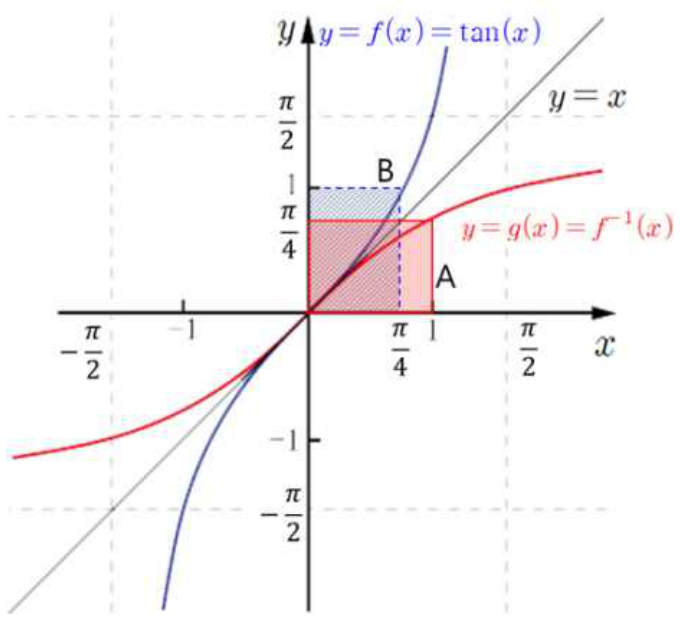
+15점 · (해설) 그림에 있는 사각형 A와 사각형 B와 같은 적분값을 구하는데 필요한 사각형을 표시하고, f ( x ) \displaystyle f(x) f ( x ) g ( x ) = f − 1 ( x ) \displaystyle g(x)=f^{-1}(x) g ( x ) = f − 1 ( x ) y = x \displaystyle y=x y = x [2-4] 단계1.
+15점 · 그림의 실선(x = 1 , y = π 4 \displaystyle x=1,y=\frac\pi4 x = 1 , y = 4 π x \displaystyle x x y = 0 \displaystyle y=0 y = 0 y \displaystyle y y x = 0 \displaystyle x=0 x = 0 π 4 \displaystyle \frac\pi4 4 π 또한, 점선(x = π 4 , y = 1 \displaystyle x=\frac\pi4,y=1 x = 4 π , y = 1 x \displaystyle x x y = 0 \displaystyle y=0 y = 0 y \displaystyle y y x = 0 \displaystyle x=0 x = 0 π 4 \displaystyle \frac\pi4 4 π ∫ 0 1 g ( x ) d x = ( 사각형 A의 넓이 ) \displaystyle \int_0^1g(x)\,dx=(\text{사각형 A의 넓이}) ∫ 0 1 g ( x ) d x = ( 사각형 A 의 넓이 ) − ( y = π 4 , x = 0 , y = g ( x ) 로 둘러싸인 부분의 넓이 ) \displaystyle -\left(y=\frac\pi4,x=0,y=g(x)\text{로 둘러싸인 부분의 넓이}\right) − ( y = 4 π , x = 0 , y = g ( x ) 로 둘러싸인 부분의 넓이 ) (해설) ∫ 0 1 g ( x ) d x \displaystyle \int_0^1g(x)\,dx ∫ 0 1 g ( x ) d x y = tan x \displaystyle y=\tan x y = tan x x = 0 \displaystyle x=0 x = 0 x = π 4 \displaystyle x=\frac\pi4 x = 4 π 단계2. 그림의 실선(x = 1 , y = π 4 \displaystyle x=1,y=\frac\pi4 x = 1 , y = 4 π x \displaystyle x x y = 0 \displaystyle y=0 y = 0 y \displaystyle y y x = 0 \displaystyle x=0 x = 0 π 4 \displaystyle \frac\pi4 4 π 또한, 점선(x = π 4 , y = 1 \displaystyle x=\frac\pi4,y=1 x = 4 π , y = 1 x \displaystyle x x y = 0 \displaystyle y=0 y = 0 y \displaystyle y y x = 0 \displaystyle x=0 x = 0 π 4 \displaystyle \frac\pi4 4 π ∫ 0 1 g ( x ) d x = ( 사각형 A의 넓이 ) \displaystyle \int_0^1g(x)\,dx=(\text{사각형 A의 넓이}) ∫ 0 1 g ( x ) d x = ( 사각형 A 의 넓이 ) − ( y = π 4 , x = 0 , y = g ( x ) 로 둘러싸인 부분의 넓이 ) \displaystyle -\left(y=\frac\pi4,x=0,y=g(x)\text{로 둘러싸인 부분의 넓이}\right) − ( y = 4 π , x = 0 , y = g ( x ) 로 둘러싸인 부분의 넓이 )
+15점 · 여기에서, y = g ( x ) \displaystyle y=g(x) y = g ( x ) y = tan x \displaystyle y=\tan x y = tan x y = x \displaystyle y=x y = x ( y = π 4 , x = 0 , y = g ( x ) 로 둘러싸인 부분의 넓이 ) \displaystyle \left(y=\frac\pi4,x=0,y=g(x)\text{로 둘러싸인 부분의 넓이}\right) ( y = 4 π , x = 0 , y = g ( x ) 로 둘러싸인 부분의 넓이 ) ∫ 0 π 4 tan x d x = 1 2 ln 2 \displaystyle \int_0^{\frac\pi4}\tan x\,dx=\frac12\ln2 ∫ 0 4 π tan x d x = 2 1 ln 2 ∫ 0 1 g ( x ) d x = π 4 − 1 2 ln 2 \displaystyle \int_0^1g(x)\,dx=\frac\pi4-\frac12\ln2 ∫ 0 1 g ( x ) d x = 4 π − 2 1 ln 2 ∫ 0 1 g ( x ) d x \displaystyle \int_0^1g(x)\,dx ∫ 0 1 g ( x ) d x π 4 \displaystyle \frac\pi4 4 π 1 2 ln 2 \displaystyle \frac12\ln2 2 1 ln 2 π 4 − 1 2 ln 2 \displaystyle \frac\pi4-\frac12\ln2 4 π − 2 1 ln 2 단계3. 여기에서, y = g ( x ) \displaystyle y=g(x) y = g ( x ) y = tan x \displaystyle y=\tan x y = tan x y = x \displaystyle y=x y = x ( y = π 4 , x = 0 , y = g ( x ) 로 둘러싸인 부분의 넓이 ) \displaystyle \left(y=\frac\pi4,x=0,y=g(x)\text{로 둘러싸인 부분의 넓이}\right) ( y = 4 π , x = 0 , y = g ( x ) 로 둘러싸인 부분의 넓이 ) ∫ 0 π 4 tan x d x = 1 2 ln 2 \displaystyle \int_0^{\frac\pi4}\tan x\,dx=\frac12\ln2 ∫ 0 4 π tan x d x = 2 1 ln 2 즉, ∫ 0 1 g ( x ) d x = π 4 − 1 2 ln 2 \displaystyle \int_0^1g(x)\,dx=\frac\pi4-\frac12\ln2 ∫ 0 1 g ( x ) d x = 4 π − 2 1 ln 2
 수리논술, 배움에서 논증의 완성까지.
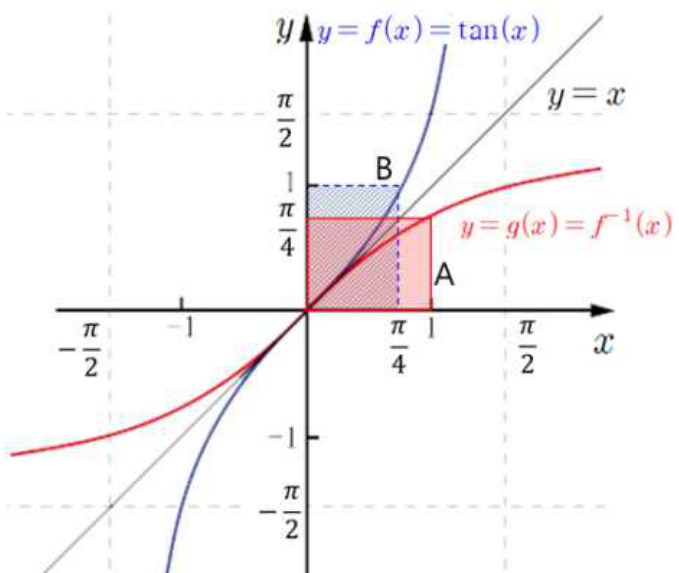 (해설)그림에 있는 사각형 A와 사각형 B와 같은 적분값을 구하는데 필요한 사각형을 표시하고, 와 의 그래프를 에 대하여 대칭으로 그리면 15점