+15점 · ∣ P A → ∣ ≤ 7 \displaystyle |\overrightarrow{\mathrm{PA}}|\le7 ∣ PA ∣ ≤ 7 A \displaystyle \mathrm{A} A +15점 · ∣ P B → ∣ ≥ 73 \displaystyle |\overrightarrow{\mathrm{PB}}|\ge\sqrt{73} ∣ PB ∣ ≥ 73 ∣ P Y ′ → ∣ ≥ 73 \displaystyle |\overrightarrow{\mathrm{PY}^{\prime}}|\ge\sqrt{73} ∣ PY ′ ∣ ≥ 73 B , Y ′ \displaystyle \mathrm{B},\ \mathrm{Y}^{\prime} B , Y ′ +25점 · ∠ B A Y ′ \displaystyle \angle\mathrm{BAY}^{\prime} ∠ BAY ′ ∠ B A Y ′ = π 2 \displaystyle \angle\mathrm{BAY}^{\prime}=\frac{\pi}{2} ∠ BAY ′ = 2 π +25점 · ∠ B A Y ′ = π 2 \displaystyle \angle\mathrm{BAY}^{\prime}=\frac{\pi}{2} ∠ BAY ′ = 2 π B Y ′ \displaystyle \mathrm{BY}^{\prime} BY ′ B A Y ′ \displaystyle \mathrm{BAY}^{\prime} BAY ′ 9 \displaystyle 9 9 [1-1] 두 원의 교점을 점 C \displaystyle \mathrm{C} C D \displaystyle \mathrm{D} D O O ′ \displaystyle \mathrm{OO}^{\prime} OO ′ H \displaystyle \mathrm{H} H C P H \displaystyle \mathrm{CPH} CPH C H ‾ = 3 3 2 \displaystyle \overline{\mathrm{CH}}=\frac{3\sqrt3}{2} CH = 2 3 3 P C ‾ = 7 \displaystyle \overline{\mathrm{PC}}=7 PC = 7 ∣ P A → ∣ ≤ 7 \displaystyle |\overrightarrow{\mathrm{PA}}|\le7 ∣ PA ∣ ≤ 7 A \displaystyle \mathrm{A} A C ′ \displaystyle C^{\prime} C ′ O O ′ \displaystyle \mathrm{OO}^{\prime} OO ′ O ′ \displaystyle \mathrm{O}^{\prime} O ′ I , J \displaystyle \mathrm{I},\ \mathrm{J} I , J I P O ′ \displaystyle \mathrm{IPO}^{\prime} IPO ′ I O ′ ‾ = 3 \displaystyle \overline{\mathrm{IO}^{\prime}}=3 IO ′ = 3 P O ′ ‾ = 8 \displaystyle \overline{\mathrm{PO}^{\prime}}=8 PO ′ = 8 P I ‾ = 73 \displaystyle \overline{\mathrm{PI}}=\sqrt{73} PI = 73 ∣ P B → ∣ ≥ 73 \displaystyle |\overrightarrow{\mathrm{PB}}|\ge\sqrt{73} ∣ PB ∣ ≥ 73 ∣ P Y ′ → ∣ ≥ 73 \displaystyle |\overrightarrow{\mathrm{PY}^{\prime}}|\ge\sqrt{73} ∣ PY ′ ∣ ≥ 73 B , Y ′ \displaystyle \mathrm{B},\ \mathrm{Y}^{\prime} B , Y ′ I J \displaystyle \mathrm{IJ} IJ O \displaystyle \mathrm{O} O I J \displaystyle \mathrm{IJ} IJ ∠ B A Y ′ \displaystyle \angle\mathrm{BAY}^{\prime} ∠ BAY ′ C ′ \displaystyle C^{\prime} C ′ ∠ B A Y ′ = π 2 \displaystyle \angle\mathrm{BAY}^{\prime}=\frac{\pi}{2} ∠ BAY ′ = 2 π B Y ′ \displaystyle \mathrm{BY}^{\prime} BY ′ B Y ′ ‾ = 6 \displaystyle \overline{\mathrm{BY}^{\prime}}=6 BY ′ = 6 A O ′ \displaystyle \mathrm{AO}^{\prime} AO ′ B Y ′ \displaystyle \mathrm{BY}^{\prime} BY ′ B A Y ′ \displaystyle \mathrm{BAY}^{\prime} BAY ′ B A Y ′ \displaystyle \mathrm{BAY}^{\prime} BAY ′ 1 2 × 6 × 3 = 9 \displaystyle \frac12\times6\times3=9 2 1 × 6 × 3 = 9
+10점 · 선분 O O ′ \displaystyle \mathrm{OO}^{\prime} OO ′ H \displaystyle \mathrm{H} H B A → = B H → + H A → \displaystyle \overrightarrow{\mathrm{BA}}=\overrightarrow{\mathrm{BH}}+\overrightarrow{\mathrm{HA}} BA = BH + HA +20점 · O O ′ → ⋅ B A → = − 2 ( H O ′ → ⋅ H B → ) + O O ′ → ⋅ H A → \displaystyle \overrightarrow{\mathrm{OO}^{\prime}}\cdot\overrightarrow{\mathrm{BA}}=-2(\overrightarrow{\mathrm{HO}^{\prime}}\cdot\overrightarrow{\mathrm{HB}})+\overrightarrow{\mathrm{OO}^{\prime}}\cdot\overrightarrow{\mathrm{HA}} OO ′ ⋅ BA = − 2 ( HO ′ ⋅ HB ) + OO ′ ⋅ HA +20점 · − 2 ( H O ′ → ⋅ H B → ) \displaystyle -2(\overrightarrow{\mathrm{HO}^{\prime}}\cdot\overrightarrow{\mathrm{HB}}) − 2 ( HO ′ ⋅ HB ) B \displaystyle \mathrm{B} B +20점 · O O ′ → ⋅ H A → \displaystyle \overrightarrow{\mathrm{OO}^{\prime}}\cdot\overrightarrow{\mathrm{HA}} OO ′ ⋅ HA A \displaystyle \mathrm{A} A +10점 · A B ‾ = 3 \displaystyle \overline{\mathrm{AB}}=3 AB = 3 [1-2] 선분 O O ′ \displaystyle \mathrm{OO}^{\prime} OO ′ H \displaystyle \mathrm{H} H B A → = B H → + H A → \displaystyle \overrightarrow{\mathrm{BA}}=\overrightarrow{\mathrm{BH}}+\overrightarrow{\mathrm{HA}} BA = BH + HA O O ′ → ⋅ B A → = O O ′ → ⋅ ( B H → + H A → ) = O O ′ → ⋅ B H → + O O ′ → ⋅ H A → = 2 H O ′ → ⋅ ( − H B → ) + O O ′ → ⋅ H A → = − 2 ( H O ′ → ⋅ H B → ) + O O ′ → ⋅ H A → \displaystyle \begin{aligned}\overrightarrow{\mathrm{OO}^{\prime}}\cdot\overrightarrow{\mathrm{BA}}&=\overrightarrow{\mathrm{OO}^{\prime}}\cdot(\overrightarrow{\mathrm{BH}}+\overrightarrow{\mathrm{HA}})\\&=\overrightarrow{\mathrm{OO}^{\prime}}\cdot\overrightarrow{\mathrm{BH}}+\overrightarrow{\mathrm{OO}^{\prime}}\cdot\overrightarrow{\mathrm{HA}}\\&=2\overrightarrow{\mathrm{HO}^{\prime}}\cdot(-\overrightarrow{\mathrm{HB}})+\overrightarrow{\mathrm{OO}^{\prime}}\cdot\overrightarrow{\mathrm{HA}}\\&=-2(\overrightarrow{\mathrm{HO}^{\prime}}\cdot\overrightarrow{\mathrm{HB}})+\overrightarrow{\mathrm{OO}^{\prime}}\cdot\overrightarrow{\mathrm{HA}}\end{aligned} OO ′ ⋅ BA = OO ′ ⋅ ( BH + HA ) = OO ′ ⋅ BH + OO ′ ⋅ HA = 2 HO ′ ⋅ ( − HB ) + OO ′ ⋅ HA = − 2 ( HO ′ ⋅ HB ) + OO ′ ⋅ HA O A → = O H → + H A → \displaystyle \overrightarrow{\mathrm{OA}}=\overrightarrow{\mathrm{OH}}+\overrightarrow{\mathrm{HA}} OA = OH + HA ∣ O O ′ → ∣ = 3 \displaystyle |\overrightarrow{\mathrm{OO}^{\prime}}|=3 ∣ OO ′ ∣ = 3 ∣ O A → ∣ ≤ 3 \displaystyle |\overrightarrow{\mathrm{OA}}|\le3 ∣ OA ∣ ≤ 3 ∣ O H → ∣ = 3 2 \displaystyle |\overrightarrow{\mathrm{OH}}|=\frac32 ∣ OH ∣ = 2 3 O O ′ → ⋅ H A → = O O ′ → ⋅ ( O A → − O H → ) = O O ′ → ⋅ O A → − O O ′ → ⋅ O H → = ∣ O O ′ → ∣ ∣ O A → ∣ cos θ − 3 × 3 2 \displaystyle \begin{aligned}\overrightarrow{\mathrm{OO}^{\prime}}\cdot\overrightarrow{\mathrm{HA}}&=\overrightarrow{\mathrm{OO}^{\prime}}\cdot(\overrightarrow{\mathrm{OA}}-\overrightarrow{\mathrm{OH}})=\overrightarrow{\mathrm{OO}^{\prime}}\cdot\overrightarrow{\mathrm{OA}}-\overrightarrow{\mathrm{OO}^{\prime}}\cdot\overrightarrow{\mathrm{OH}}\\&=|\overrightarrow{\mathrm{OO}^{\prime}}||\overrightarrow{\mathrm{OA}}|\cos\theta-3\times\frac32\end{aligned} OO ′ ⋅ HA = OO ′ ⋅ ( OA − OH ) = OO ′ ⋅ OA − OO ′ ⋅ OH = ∣ OO ′ ∣∣ OA ∣ cos θ − 3 × 2 3 (θ \displaystyle \theta θ O O ′ → \displaystyle \overrightarrow{\mathrm{OO}^{\prime}} OO ′ O A → \displaystyle \overrightarrow{\mathrm{OA}} OA θ = 0 \displaystyle \theta=0 θ = 0 A \displaystyle \mathrm{A} A O ′ \displaystyle \mathrm{O}^{\prime} O ′ O O ′ → ⋅ H A → \displaystyle \overrightarrow{\mathrm{OO}^{\prime}}\cdot\overrightarrow{\mathrm{HA}} OO ′ ⋅ HA 또한, H O ′ → ⋅ H B → ≤ 0 \displaystyle \overrightarrow{\mathrm{HO}^{\prime}}\cdot\overrightarrow{\mathrm{HB}}\le0 HO ′ ⋅ HB ≤ 0 B \displaystyle \mathrm{B} B − 2 ( H O ′ → ⋅ H B → ) \displaystyle -2(\overrightarrow{\mathrm{HO}^{\prime}}\cdot\overrightarrow{\mathrm{HB}}) − 2 ( HO ′ ⋅ HB ) H B → + B O ′ → = H O ′ → \displaystyle \overrightarrow{\mathrm{HB}}+\overrightarrow{\mathrm{BO}^{\prime}}=\overrightarrow{\mathrm{HO}^{\prime}} HB + BO ′ = HO ′ H O ′ → ⋅ H B → = H O ′ → ⋅ ( H O ′ → − B O ′ → ) = H O ′ → ⋅ H O ′ → − H O ′ → ⋅ B O ′ → = ( 3 2 ) 2 − O ′ H → ⋅ O ′ B → \displaystyle \begin{aligned}\overrightarrow{\mathrm{HO}^{\prime}}\cdot\overrightarrow{\mathrm{HB}}&=\overrightarrow{\mathrm{HO}^{\prime}}\cdot(\overrightarrow{\mathrm{HO}^{\prime}}-\overrightarrow{\mathrm{BO}^{\prime}})=\overrightarrow{\mathrm{HO}^{\prime}}\cdot\overrightarrow{\mathrm{HO}^{\prime}}-\overrightarrow{\mathrm{HO}^{\prime}}\cdot\overrightarrow{\mathrm{BO}^{\prime}}\\&=\left(\frac32\right)^2-\overrightarrow{\mathrm{O}^{\prime}\mathrm{H}}\cdot\overrightarrow{\mathrm{O}^{\prime}\mathrm{B}}\end{aligned} HO ′ ⋅ HB = HO ′ ⋅ ( HO ′ − BO ′ ) = HO ′ ⋅ HO ′ − HO ′ ⋅ BO ′ = ( 2 3 ) 2 − O ′ H ⋅ O ′ B 그러므로 점 A \displaystyle \mathrm{A} A O ′ \displaystyle \mathrm{O}^{\prime} O ′ B \displaystyle \mathrm{B} B O \displaystyle \mathrm{O} O O O ′ → ⋅ B A → \displaystyle \overrightarrow{\mathrm{OO}^{\prime}}\cdot\overrightarrow{\mathrm{BA}} OO ′ ⋅ BA A B ‾ = 3 \displaystyle \overline{\mathrm{AB}}=3 AB = 3
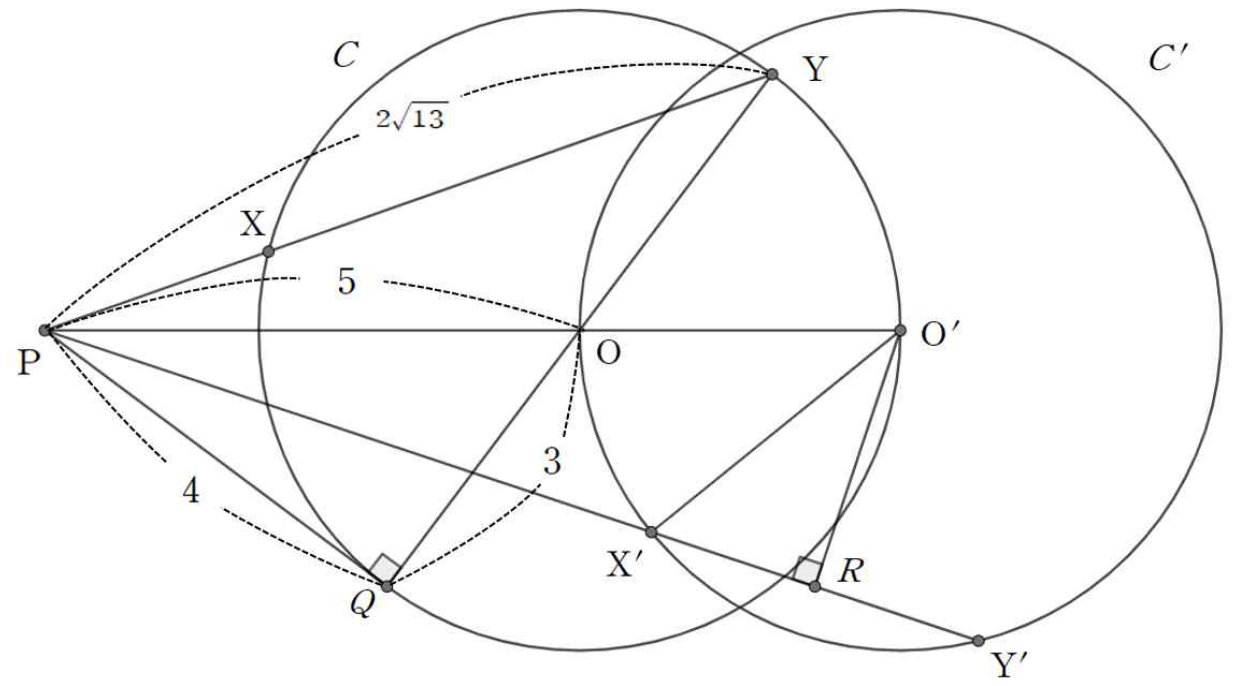
+10점 · P F ‾ = 4 \displaystyle \overline{\mathrm{PF}}=4 PF = 4 +20점 · P F ‾ = 4 \displaystyle \overline{\mathrm{PF}}=4 PF = 4 G F P \displaystyle \mathrm{GFP} GFP +30점 · P G ‾ = 2 13 \displaystyle \overline{\mathrm{PG}}=2\sqrt{13} PG = 2 13 G \displaystyle \mathrm{G} G Y \displaystyle \mathrm{Y} Y +20점 · 점 F \displaystyle \mathrm{F} F Q \displaystyle \mathrm{Q} Q [1-3] 점 P \displaystyle \mathrm{P} P C \displaystyle C C O O ′ \displaystyle \mathrm{OO}^{\prime} OO ′ Y \displaystyle \mathrm{Y} Y F \displaystyle \mathrm{F} F O F P \displaystyle \mathrm{OFP} OFP P O ‾ = 5 \displaystyle \overline{\mathrm{PO}}=5 PO = 5 O F ‾ = 3 \displaystyle \overline{\mathrm{OF}}=3 OF = 3 P F ‾ = 4 \displaystyle \overline{\mathrm{PF}}=4 PF = 4 O F \displaystyle \mathrm{OF} OF C \displaystyle C C G \displaystyle \mathrm{G} G F \displaystyle \mathrm{F} F G F P \displaystyle \mathrm{GFP} GFP P F ‾ = 4 \displaystyle \overline{\mathrm{PF}}=4 PF = 4 F G ‾ = 6 \displaystyle \overline{\mathrm{FG}}=6 FG = 6 P G ‾ = 2 13 \displaystyle \overline{\mathrm{PG}}=2\sqrt{13} PG = 2 13 O O ′ \displaystyle \mathrm{OO}^{\prime} OO ′ G \displaystyle \mathrm{G} G C \displaystyle C C P \displaystyle \mathrm{P} P 2 13 \displaystyle 2\sqrt{13} 2 13 G \displaystyle \mathrm{G} G Y \displaystyle \mathrm{Y} Y Y O \displaystyle \mathrm{YO} YO C \displaystyle C C Q \displaystyle \mathrm{Q} Q F \displaystyle \mathrm{F} F Q \displaystyle \mathrm{Q} Q Y Q P \displaystyle \mathrm{YQP} YQP
+15점 · X Y ‾ = 18 13 13 \displaystyle \overline{\mathrm{XY}}=\frac{18\sqrt{13}}{13} XY = 13 18 13 +15점 · X ′ Y ′ ‾ = 2 5 65 \displaystyle \overline{\mathrm{X}^{\prime}\mathrm{Y}^{\prime}}=\frac{2}{5}\sqrt{65} X ′ Y ′ = 5 2 65 [1-4] 문제 [1-3]의 결과에 의해 P Q ‾ = 4 \displaystyle \overline{\mathrm{PQ}}=4 PQ = 4 P Q \displaystyle \mathrm{PQ} PQ C \displaystyle C C P Q ‾ 2 = P X ‾ × P Y ‾ \displaystyle \overline{\mathrm{PQ}}^2=\overline{\mathrm{PX}}\times\overline{\mathrm{PY}} PQ 2 = PX × PY P X ‾ = 8 13 \displaystyle \overline{\mathrm{PX}}=\frac8{\sqrt{13}} PX = 13 8 X Y ‾ = 18 13 13 \displaystyle \overline{\mathrm{XY}}=\frac{18\sqrt{13}}{13} XY = 13 18 13 O ′ \displaystyle \mathrm{O}^{\prime} O ′ X ′ Y ′ \displaystyle \mathrm{X}^{\prime}\mathrm{Y}^{\prime} X ′ Y ′ R \displaystyle \mathrm{R} R O ′ R P \displaystyle \mathrm{O}^{\prime}\mathrm{RP} O ′ RP sin ∠ O P X ′ = sin ∠ O ′ P R = 10 10 \displaystyle \sin\angle\mathrm{OPX}^{\prime}=\sin\angle\mathrm{O}^{\prime}\mathrm{PR}=\frac{\sqrt{10}}{10} sin ∠ OPX ′ = sin ∠ O ′ PR = 10 10 O ′ R ‾ = 8 10 \displaystyle \overline{\mathrm{O}^{\prime}\mathrm{R}}=\frac8{\sqrt{10}} O ′ R = 10 8 X ′ Y ′ ‾ = 2 5 65 \displaystyle \overline{\mathrm{X}^{\prime}\mathrm{Y}^{\prime}}=\frac25\sqrt{65} X ′ Y ′ = 5 2 65 직선 O O ′ \displaystyle \mathrm{OO}^{\prime} OO ′ X Y → \displaystyle \overrightarrow{\mathrm{XY}} XY X ′ Y ′ → \displaystyle \overrightarrow{\mathrm{X}^{\prime}\mathrm{Y}^{\prime}} X ′ Y ′
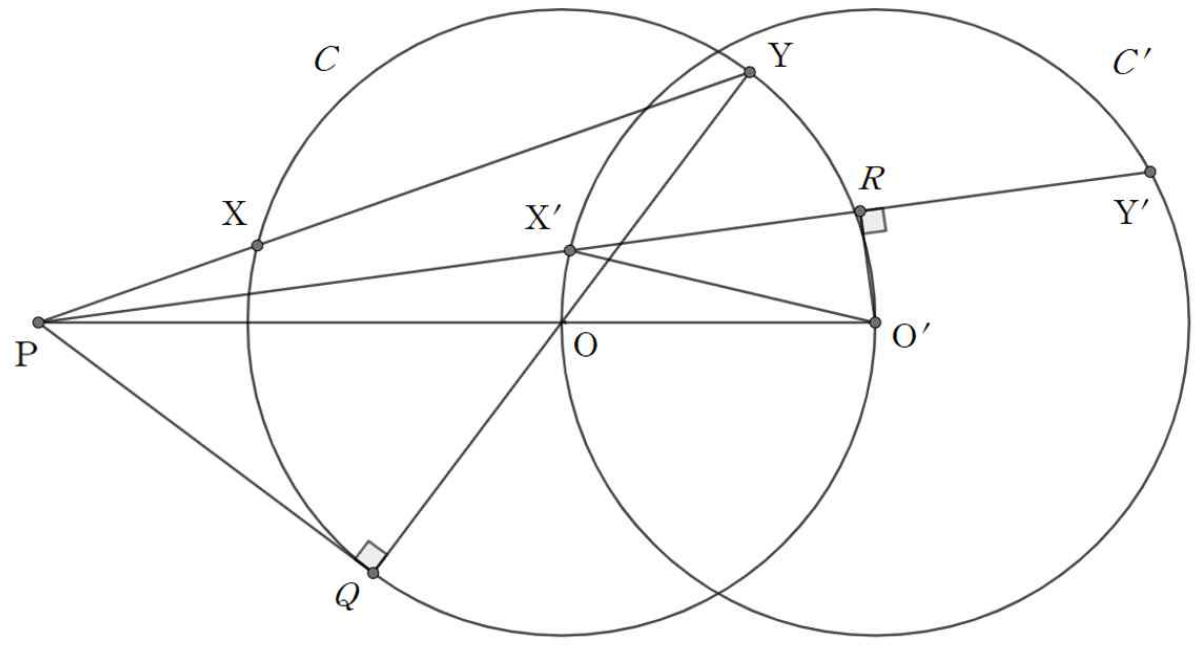
+20점 · 경우(ⅰ)의 두 벡터 사잇각 cos ∠ Y P Y ′ = 9 130 \displaystyle \cos\angle\mathrm{YPY}^{\prime}=\frac{9}{\sqrt{130}} cos ∠ YPY ′ = 130 9 +15점 · 경우(ⅰ)의 X Y → ⋅ X ′ Y ′ → = 162 65 26 \displaystyle \overrightarrow{\mathrm{XY}}\cdot\overrightarrow{\mathrm{X}^{\prime}\mathrm{Y}^{\prime}}=\frac{162}{65}\sqrt{26} XY ⋅ X ′ Y ′ = 65 162 26 (ⅰ) X Y → \displaystyle \overrightarrow{\mathrm{XY}} XY X ′ Y ′ → \displaystyle \overrightarrow{\mathrm{X}^{\prime}\mathrm{Y}^{\prime}} X ′ Y ′ α = ∠ O ′ P Y ′ \displaystyle \alpha=\angle\mathrm{O}^{\prime}\mathrm{PY}^{\prime} α = ∠ O ′ PY ′ β = ∠ Y P Q \displaystyle \beta=\angle\mathrm{YPQ} β = ∠ YPQ γ = ∠ O ′ P Q \displaystyle \gamma=\angle\mathrm{O}^{\prime}\mathrm{PQ} γ = ∠ O ′ PQ δ = ∠ Y P O ′ \displaystyle \delta=\angle\mathrm{YPO}^{\prime} δ = ∠ YPO ′ tan α = 1 3 \displaystyle \tan\alpha=\frac13 tan α = 3 1 tan β = 3 2 \displaystyle \tan\beta=\frac32 tan β = 2 3 tan γ = 3 4 \displaystyle \tan\gamma=\frac34 tan γ = 4 3 tan δ = tan ( β − γ ) = 3 2 − 3 4 1 + 3 2 × 3 4 = 6 17 \displaystyle \tan\delta=\tan(\beta-\gamma)=\frac{\frac32-\frac34}{1+\frac32\times\frac34}=\frac6{17} tan δ = tan ( β − γ ) = 1 + 2 3 × 4 3 2 3 − 4 3 = 17 6 tan ∠ Y P Y ′ = tan ( δ + α ) = 6 17 + 1 3 1 − 6 17 × 1 3 = 7 9 \displaystyle \tan\angle\mathrm{YPY}^{\prime}=\tan(\delta+\alpha)=\frac{\frac6{17}+\frac13}{1-\frac6{17}\times\frac13}=\frac79 tan ∠ YPY ′ = tan ( δ + α ) = 1 − 17 6 × 3 1 17 6 + 3 1 = 9 7 이다. sec 2 ∠ Y P Y ′ = 1 + tan 2 ∠ Y P Y ′ = 1 + ( 7 9 ) 2 = 130 81 \displaystyle \sec^2\angle\mathrm{YPY}^{\prime}=1+\tan^2\angle\mathrm{YPY}^{\prime}=1+\left(\frac79\right)^2=\frac{130}{81} sec 2 ∠ YPY ′ = 1 + tan 2 ∠ YPY ′ = 1 + ( 9 7 ) 2 = 81 130 X Y → ⋅ X ′ Y ′ → = ∣ X Y → ∣ ∣ X ′ Y ′ → ∣ cos ∠ Y P Y ′ = ( 18 13 13 ) ( 2 5 65 ) 9 130 = 162 65 26 \displaystyle \overrightarrow{\mathrm{XY}}\cdot\overrightarrow{\mathrm{X}^{\prime}\mathrm{Y}^{\prime}}=|\overrightarrow{\mathrm{XY}}||\overrightarrow{\mathrm{X}^{\prime}\mathrm{Y}^{\prime}}|\cos\angle\mathrm{YPY}^{\prime}=\left(\frac{18}{13}\sqrt{13}\right)\left(\frac25\sqrt{65}\right)\frac9{\sqrt{130}}=\frac{162}{65}\sqrt{26} XY ⋅ X ′ Y ′ = ∣ XY ∣∣ X ′ Y ′ ∣ cos ∠ YPY ′ = ( 13 18 13 ) ( 5 2 65 ) 130 9 = 65 162 26
+20점 · 경우(ⅱ)의 cos ∠ Y P Y ′ = 57 5 130 \displaystyle \cos\angle\mathrm{YPY}^{\prime}=\frac{57}{5\sqrt{130}} cos ∠ YPY ′ = 5 130 57 +15점 · 경우(ⅱ)의 X Y → ⋅ X ′ Y ′ → = 1026 325 26 \displaystyle \overrightarrow{\mathrm{XY}}\cdot\overrightarrow{\mathrm{X}^{\prime}\mathrm{Y}^{\prime}}=\frac{1026}{325}\sqrt{26} XY ⋅ X ′ Y ′ = 325 1026 26 (ⅱ) X Y → \displaystyle \overrightarrow{\mathrm{XY}} XY X ′ Y ′ → \displaystyle \overrightarrow{\mathrm{X}^{\prime}\mathrm{Y}^{\prime}} X ′ Y ′ tan α = 1 3 \displaystyle \tan\alpha=\frac13 tan α = 3 1 tan β = 3 2 \displaystyle \tan\beta=\frac32 tan β = 2 3 tan γ = 3 4 \displaystyle \tan\gamma=\frac34 tan γ = 4 3 tan ∠ Y P Y ′ = tan ( δ − α ) = 6 17 − 1 3 1 + 6 17 × 1 3 = 1 57 \displaystyle \tan\angle\mathrm{YPY}^{\prime}=\tan(\delta-\alpha)=\frac{\frac6{17}-\frac13}{1+\frac6{17}\times\frac13}=\frac1{57} tan ∠ YPY ′ = tan ( δ − α ) = 1 + 17 6 × 3 1 17 6 − 3 1 = 57 1 이다. 직선 X Y \displaystyle \mathrm{XY} XY X ′ Y ′ \displaystyle \mathrm{X}^{\prime}\mathrm{Y}^{\prime} X ′ Y ′ P \displaystyle \mathrm{P} P X Y → , X ′ Y ′ → \displaystyle \overrightarrow{\mathrm{XY}},\ \overrightarrow{\mathrm{X}^{\prime}\mathrm{Y}^{\prime}} XY , X ′ Y ′ ∠ Y P Y ′ \displaystyle \angle\mathrm{YPY}^{\prime} ∠ YPY ′ sec 2 ∠ Y P Y ′ = 1 + tan 2 ∠ Y P Y ′ = 1 + ( 1 57 ) 2 = 3250 3249 \displaystyle \sec^2\angle\mathrm{YPY}^{\prime}=1+\tan^2\angle\mathrm{YPY}^{\prime}=1+\left(\frac1{57}\right)^2=\frac{3250}{3249} sec 2 ∠ YPY ′ = 1 + tan 2 ∠ YPY ′ = 1 + ( 57 1 ) 2 = 3249 3250 X Y → ⋅ X ′ Y ′ → = ∣ X Y → ∣ ∣ X ′ Y ′ → ∣ cos ∠ Y P Y ′ = ( 18 13 13 ) ( 2 5 65 ) 57 5 130 = 1026 325 26 \displaystyle \overrightarrow{\mathrm{XY}}\cdot\overrightarrow{\mathrm{X}^{\prime}\mathrm{Y}^{\prime}}=|\overrightarrow{\mathrm{XY}}||\overrightarrow{\mathrm{X}^{\prime}\mathrm{Y}^{\prime}}|\cos\angle\mathrm{YPY}^{\prime}=\left(\frac{18}{13}\sqrt{13}\right)\left(\frac25\sqrt{65}\right)\frac{57}{5\sqrt{130}}=\frac{1026}{325}\sqrt{26} XY ⋅ X ′ Y ′ = ∣ XY ∣∣ X ′ Y ′ ∣ cos ∠ YPY ′ = ( 13 18 13 ) ( 5 2 65 ) 5 130 57 = 325 1026 26
 수리논술, 배움에서 논증의 완성까지.