수리논술, 이게 다다.

자연계열 3번

오류 제보

문제

[문제 3] 다음 <제시문 1>과 <제시문 2>를 읽고 [문제 3-ⅰ] ~ [문제 3-ⅲ]을 문항별로 풀이와 함께 답하시오. (35점)

<제시문 1>모든 자연수 n\displaystyle n에 대하여, an\displaystyle a_{n}을 54484333333\displaystyle \frac{54484}{333333}의 소수점 n\displaystyle n번째 자리의 수로 정의하고, 양의 정수 집합에서 정의되는 함수 f(n)\displaystyle f(n)을 f(n)=an−an+4\displaystyle f(n)=a_{n}-a_{n+4}로 정의하자.

<제시문 2>함수 g(x)\displaystyle g(x)를 g(x)=x−x2\displaystyle g(x)=x-x^{2}으로 정의하고, 1\displaystyle 1보다 크거나 같은 실수 x\displaystyle x에 대하여 함수 h(x)\displaystyle h(x)를 다음과 같이 정의하자.h(x)={f(1)g(x−1),1≤x<2f(2)g(x−2),2≤x<3f(3)g(x−3),3≤x<4f(4)g(x−4),4≤x<5f(5)g(x−5),5≤x<6f(6)g(x−6),6≤x<7h(x−6),7≤x\displaystyle h(x)=\begin{cases}f(1)g(x-1), & 1\le x<2 \\ f(2)g(x-2), & 2\le x<3 \\ f(3)g(x-3), & 3\le x<4 \\ f(4)g(x-4), & 4\le x<5 \\ f(5)g(x-5), & 5\le x<6 \\ f(6)g(x-6), & 6\le x<7 \\ h(x-6), & 7\le x\end{cases}

[문제 3-ⅰ] 1≤n≤20\displaystyle 1\le n\le20에 대하여, <제시문 1>의 수열 an\displaystyle a_{n}의 값과 f(n)\displaystyle f(n)의 값을 표로 나타내고, <제시문 2>의 함수 h(x)\displaystyle h(x)의 그래프의 개형에 대하여 논하여라. (10점)

[문제 3-ⅱ] 구간 1<x<100\displaystyle 1<x<100에서 <제시문 2>의 함수 h(x)\displaystyle h(x)의 미분불가능한 점의 개수에 대하여 논하여라. (10점)

[문제 3-ⅲ] <제시문 2>의 함수 h(x)\displaystyle h(x)에 대하여, ∫1100h(x)dx\displaystyle \int_{1}^{100}h(x)dx의 값에 대하여 논하여라. (15점)

해설강의 준비중

[문제 3-ⅰ]

+5점 · 수열 an\displaystyle a_{n}과 함수 f(n)\displaystyle f(n)의 정의에 따라 수열의 값과 함수의 값을 구하고, 이를 표로 나타낼 수 있다.

1≤n≤20\displaystyle 1\le n\le20에 대하여, 수열 an\displaystyle a_{n}의 값과 f(n)\displaystyle f(n)의 값을 표로 나타내면 다음과 같다.n1234567891011121314151617181920an16345216345216345216f(n)−442−22−2−442−22−2−442−22−2−44\displaystyle \begin{array}{|c|c|c|c|c|c|c|c|c|c|c|c|c|c|c|c|c|c|c|c|c|} \hline n & 1 & 2 & 3 & 4 & 5 & 6 & 7 & 8 & 9 & 10 & 11 & 12 & 13 & 14 & 15 & 16 & 17 & 18 & 19 & 20 \\ \hline a_{n} & 1 & 6 & 3 & 4 & 5 & 2 & 1 & 6 & 3 & 4 & 5 & 2 & 1 & 6 & 3 & 4 & 5 & 2 & 1 & 6 \\ \hline f(n) & -4 & 4 & 2 & -2 & 2 & -2 & -4 & 4 & 2 & -2 & 2 & -2 & -4 & 4 & 2 & -2 & 2 & -2 & -4 & 4 \\ \hline \end{array}

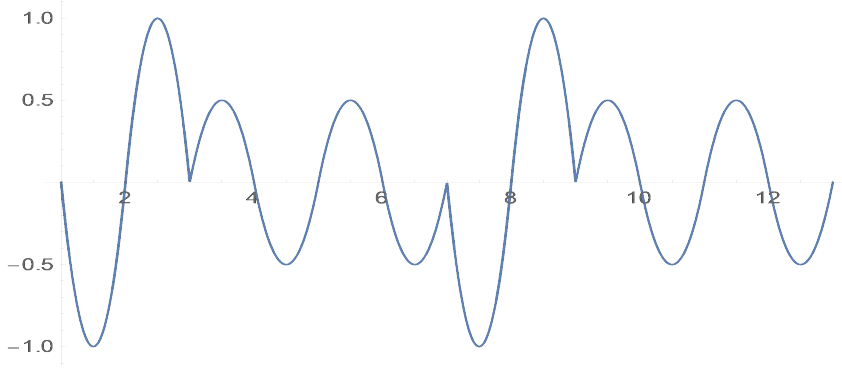
+5점 · 함수 f(n)\displaystyle f(n)의 값과 함수 h(x)\displaystyle h(x)의 정의로부터, 함수 h(x)\displaystyle h(x)의 그래프의 개형을 올바로 그릴 수 있다.

한편, 1≤x<7\displaystyle 1\le x<7에 대하여 함수 h(x)\displaystyle h(x)의 구체적인 표현은 아래와 같다.h(x)={−4g(x−1),1≤x<24g(x−2),2≤x<32g(x−3),3≤x<4−2g(x−4),4≤x<52g(x−5),5≤x<6−2g(x−6),6≤x<7\displaystyle h(x)=\begin{cases}-4g(x-1), & 1\le x<2 \\ 4g(x-2), & 2\le x<3 \\ 2g(x-3), & 3\le x<4 \\ -2g(x-4), & 4\le x<5 \\ 2g(x-5), & 5\le x<6 \\ -2g(x-6), & 6\le x<7\end{cases}g(x−m)\displaystyle g(x-m)의 그래프는 g(x)\displaystyle g(x)의 그래프를 x\displaystyle x축으로 m\displaystyle m만큼 평행 이동하여 얻어지고, h(x)=h(x−6)\displaystyle h(x)=h(x-6)이므로, 함수 h(x)\displaystyle h(x)의 그래프의 개형은 아래 그림과 같다.

구간 1 ≤ x ≤ 13에서 함수 h(x)의 그래프. 주기 6으로 같은 모양이 반복되며 −1과 1 사이를 오르내린다.

[문제 3-ⅱ]

+8점 · 함수 h(x)\displaystyle h(x)의 미분불가능한 점은 x=3+6k\displaystyle x=3+6k, x=7+6k\displaystyle x=7+6k (k=0,1,2,⋯ )\displaystyle (k=0,1,2,\cdots)에서 발생함을 보일 수 있다.

y=g(x)\displaystyle y=g(x)의 x=0\displaystyle x=0에서의 기울기는 1\displaystyle 1이고, x=1\displaystyle x=1에서의 기울기는 −1\displaystyle -1이다. g(x−m)\displaystyle g(x-m)의 그래프는 g(x)\displaystyle g(x)의 그래프를 x\displaystyle x축으로 m\displaystyle m만큼 평행 이동하여 얻어지므로, y=g(x−m)\displaystyle y=g(x-m)의 x=m\displaystyle x=m에서의 기울기는 1\displaystyle 1이고, x=m+1\displaystyle x=m+1에서의 기울기는 −1\displaystyle -1이 된다. 또한 y=c⋅g(x−m)\displaystyle y=c\cdot g(x-m)의 x=m\displaystyle x=m에서의 기울기는 c\displaystyle c이고, x=m+1\displaystyle x=m+1에서의 기울기는 −c\displaystyle -c가 된다. 이제, 풀이 (ⅰ)에 주어진 구간 1≤x<7\displaystyle 1\le x<7에서의 함수 h(x)\displaystyle h(x)의 구체적인 표현과 h(x)=h(x+6)\displaystyle h(x)=h(x+6)라는 성질로부터, h(x)\displaystyle h(x)의 미분불가능한 점은x=3+6k, x=7+6k (k=0,1,2,⋯ )\displaystyle x=3+6k,\ x=7+6k\ (k=0,1,2,\cdots)에서 발생함을 알 수 있다.

+2점 · 구간 1<x<100\displaystyle 1<x<100에서 h(x)\displaystyle h(x)의 미분불가능한 점의 개수가 총 33\displaystyle 33개임을 보일 수 있다.

따라서, 구간 1<x<100\displaystyle 1<x<100에서 h(x)\displaystyle h(x)의 미분불가능한 점은x=3+6k (k=0,1,2,⋯ ,16), x=7+6k (k=0,1,2,⋯ ,15)\displaystyle x=3+6k\ (k=0,1,2,\cdots,16),\ x=7+6k\ (k=0,1,2,\cdots,15)이므로, 이들의 총 개수는 17+16=33\displaystyle 17+16=33개가 된다.

[문제 3-ⅲ]

+5점 · ∫1100h(x)dx\displaystyle \int_{1}^{100}h(x)dx의 값이 16∫17h(x)dx+∫14h(x)dx\displaystyle 16\int_{1}^{7}h(x)dx+\int_{1}^{4}h(x)dx과 같음을 보일 수 있다.

모든 실수 x\displaystyle x에 대하여, h(x)=h(x+6)\displaystyle h(x)=h(x+6)이므로, 다음의 등식이 성립한다.Comment. 함수 h\displaystyle h의 정의역은 x≥1\displaystyle x\ge1이므로, ‘모든 실수 x’는 ‘1 이상인 모든 실수 x’로 써야 한다. 그러나 원칙에 따라 원문 표기를 그대로 실었다.∫17h(x)dx=∫1+6k7+6kh(x)dx\displaystyle \int_{1}^{7}h(x)dx=\int_{1+6k}^{7+6k}h(x)dx위의 등식으로부터, 정적분 ∫1100h(x)dx\displaystyle \int_{1}^{100}h(x)dx의 값은 다음과 같이 표현됨을 알 수 있다.∫1100h(x)dx=∫17h(x)dx+∫713h(x)dx+⋯+∫9197h(x)dx+∫97100h(x)dx=16∫17h(x)dx+∫14h(x)dx\displaystyle \begin{aligned} \int_{1}^{100}h(x)dx &=\int_{1}^{7}h(x)dx+\int_{7}^{13}h(x)dx+\cdots+\int_{91}^{97}h(x)dx+\int_{97}^{100}h(x)dx \\ &=16\int_{1}^{7}h(x)dx+\int_{1}^{4}h(x)dx \end{aligned}

+10점 · 16∫17h(x)dx+∫14h(x)dx\displaystyle 16\int_{1}^{7}h(x)dx+\int_{1}^{4}h(x)dx의 값을 제대로 계산할 수 있다.

한편, 풀이 (ⅰ)에 주어진 1≤x<7\displaystyle 1\le x<7일 때, 함수 h(x)\displaystyle h(x)의 구체적인 표현식으로부터, ∫17h(x)dx\displaystyle \int_{1}^{7}h(x)dx의 값과 ∫14h(x)dx\displaystyle \int_{1}^{4}h(x)dx의 값은 다음과 같이 계산된다.∫17h(x)dx=∫12(−4)g(x−1)dx+∫234g(x−2)dx+∫342g(x−3)dx+∫45(−2)g(x−4)dx+∫562g(x−5)dx+∫67(−2)g(x−6)dx=((−4)+4+2+(−2)+2+(−2))∫01g(t)dt=0,\displaystyle \begin{aligned} \int_{1}^{7}h(x)dx &=\int_{1}^{2}(-4)g(x-1)dx+\int_{2}^{3}4g(x-2)dx+\int_{3}^{4}2g(x-3)dx+\int_{4}^{5}(-2)g(x-4)dx \\ &\quad+\int_{5}^{6}2g(x-5)dx+\int_{6}^{7}(-2)g(x-6)dx \\ &=((-4)+4+2+(-2)+2+(-2))\int_{0}^{1}g(t)dt=0, \end{aligned}∫14h(x)dx=∫12(−4)g(x−1)dx+∫234g(x−2)dx+∫342g(x−3)dx=((−4)+4+2)∫01g(t)dt=2∫01(t−t2)dt=13\displaystyle \begin{aligned} \int_{1}^{4}h(x)dx &=\int_{1}^{2}(-4)g(x-1)dx+\int_{2}^{3}4g(x-2)dx+\int_{3}^{4}2g(x-3)dx \\ &=((-4)+4+2)\int_{0}^{1}g(t)dt=2\int_{0}^{1}(t-t^{2})dt=\frac{1}{3} \end{aligned}따라서, 정적분 ∫1100h(x)dx\displaystyle \int_{1}^{100}h(x)dx의 값은 13\displaystyle \frac{1}{3}이 된다.

첨삭 사례

아직 등록된 첨삭 사례가 없습니다.

질문과 답변 · 0개질문과 답변 · 고정 0개

아직 등록된 질문이 없습니다. 질문 작성은 멤버십 회원만 가능합니다.