수리논술, 배움에서 논증의 완성까지.

수리형 2번

문제

🔒
짧은 시간에 너무 많은 문제를 여셔서 열람을 잠시 제한했습니다. 잠시 후 다시 시도하시거나 로그인해 주세요.
해설강의 준비중

[문제 2-ⅰ]

+7점 · 삼각형의 합동을 이용하여, 사각형 ABGH\displaystyle \mathrm{ABGH}의 넓이를 네 삼각형(삼각형 AFE\displaystyle \mathrm{AFE}, 삼각형 EGH\displaystyle \mathrm{EGH}, 삼각형 FBG\displaystyle \mathrm{FBG}, 삼각형 EFG\displaystyle \mathrm{EFG})의 넓이의 합으로 표시하고, 이를 a\displaystyle ab\displaystyle b에 관한 식으로 표현한다.

삼각형 FBG\displaystyle \mathrm{FBG}와 삼각형 FEG\displaystyle \mathrm{FEG}는 서로 합동이므로, 사각형 ABGH\displaystyle \mathrm{ABGH}의 넓이를 네 삼각형 (삼각형 AFE\displaystyle \mathrm{AFE}, 삼각형 EGH\displaystyle \mathrm{EGH}, 삼각형 FBG\displaystyle \mathrm{FBG}, 삼각형 EFG\displaystyle \mathrm{EFG})의 넓이의 합으로 표현하면 다음과 같다.9b=2FBG+(AFE+EGH)=2(12ab)+12(9a)AE+129EH=ab+129(AE+EH)12aAE=ab+129b12aa2(9a)2=ab+9b2a9(2a9)2\displaystyle \begin{aligned} 9b &=2\triangle\mathrm{FBG}+(\triangle\mathrm{AFE}+\triangle\mathrm{EGH})=2\left(\frac{1}{2}ab\right)+\frac{1}{2}(9-a)\overline{\mathrm{AE}}+\frac{1}{2}\cdot9\cdot\overline{\mathrm{EH}} \\ &=ab+\frac{1}{2}\cdot9(\overline{\mathrm{AE}}+\overline{\mathrm{EH}})-\frac{1}{2}\cdot a\cdot\overline{\mathrm{AE}}=ab+\frac{1}{2}\cdot9\cdot b-\frac{1}{2}\cdot a\cdot\sqrt{a^{2}-(9-a)^{2}} \\ &=ab+\frac{9b}{2}-\frac{a\sqrt{9(2a-9)}}{2} \end{aligned}

+3점 · b\displaystyle ba\displaystyle a에 관한 식으로 제대로 나타낸다.

삼각형 AEF\displaystyle \mathrm{AEF}는 빗변의 길이가 EF=a\displaystyle \overline{\mathrm{EF}}=a이고 AF=9a\displaystyle \overline{\mathrm{AF}}=9-a인 직각삼각형이다. 따라서 a\displaystyle a는 부등식 92<a<9\displaystyle \frac{9}{2}<a<9를 만족해야하므로, 2a9\displaystyle 2a-9는 양수임을 알 수 있다. 이제 위에서 구한 식으로부터 b\displaystyle ba\displaystyle a에 관하여 풀면, b=3a2a9\displaystyle b=\frac{3a}{\sqrt{2a-9}}를 얻는다.Comment. 제시문의 조건에는 a=9\displaystyle a=9도 포함된다. 이때 b=9\displaystyle b=9이고 F=A\displaystyle F=A이므로 삼각형은 만들어지지 않으며, 넓이 식의 값은 0\displaystyle 0이다. 넓이의 최댓값에는 영향이 없다.

[문제 2-ⅱ]

+5점 · 삼각형 AEF\displaystyle \mathrm{AEF}의 넓이의 제곱을 a\displaystyle a에 관한 식으로 표현한다.

[문제 2-i]의 예시답안에서, a\displaystyle a는 부등식 92<a<9\displaystyle \frac{9}{2}<a<9를 만족해야함을 알고 있다. 또한 a\displaystyle ab\displaystyle b는 [문제 2-i]의 답에서 구한 조건, 즉, b=3a2a917\displaystyle b=\frac{3a}{\sqrt{2a-9}}\le17을 추가로 만족해야한다. 함수 f(a)\displaystyle f(a)를 삼각형 AEF\displaystyle \mathrm{AEF}의 넓이의 제곱으로 두자. 그러면, f(a)=14(9a)2(a2(9a)2)=94(9a)2(2a9)\displaystyle f(a)=\frac{1}{4}(9-a)^{2}(a^{2}-(9-a)^{2})=\frac{9}{4}(9-a)^{2}(2a-9)이 되고, f(a)\displaystyle f(a)의 극값을 조사하여 f(a)\displaystyle f(a)의 최댓값을 구하도록 하자.Comment. 제시문의 조건에는 a=9\displaystyle a=9도 포함된다. 이때 b=9\displaystyle b=9이고 F=A\displaystyle F=A이므로 삼각형은 만들어지지 않으며, 넓이 식의 값은 0\displaystyle 0이다. 넓이의 최댓값에는 영향이 없다.

+5점 · 도함수를 활용하여 삼각형 AEF\displaystyle \mathrm{AEF}의 넓이의 최댓값을 구한다.

f(a)\displaystyle f(a)의 도함수 f(a)\displaystyle f^{\prime}(a)를 계산하여 정리하면, f(a)=92(9a)(183a)\displaystyle f^{\prime}(a)=\frac{9}{2}(9-a)(18-3a)이고, a=6\displaystyle a=6일 때 함수 f(a)\displaystyle f(a)는 극댓값 f(6)=2434\displaystyle f(6)=\frac{243}{4}을 갖게 되는데, 위에서 구한 조건으로부터 b=63\displaystyle b=6\sqrt{3}이 얻어지고, (a,b)=(6,63)\displaystyle (a,b)=(6,6\sqrt{3})b17\displaystyle b\le17을 만족함을 알 수 있다. 또한 92<a<9\displaystyle \frac{9}{2}<a<9일 때, 함수 f(a)\displaystyle f(a)의 증감을 살펴보면, 극댓값 f(6)=2434\displaystyle f(6)=\frac{243}{4}이 최댓값이 됨을 알 수 있다. 따라서 삼각형 삼각형 AEF\displaystyle \mathrm{AEF} 넓이의 최댓값은 932\displaystyle \frac{9\sqrt{3}}{2}이 된다.Correction. ‘삼각형 삼각형’에서 ‘삼각형’이 두 번 쓰였다. 그러나 원칙에 따라 원문 표기를 그대로 실었다.

[문제 2-ⅲ]

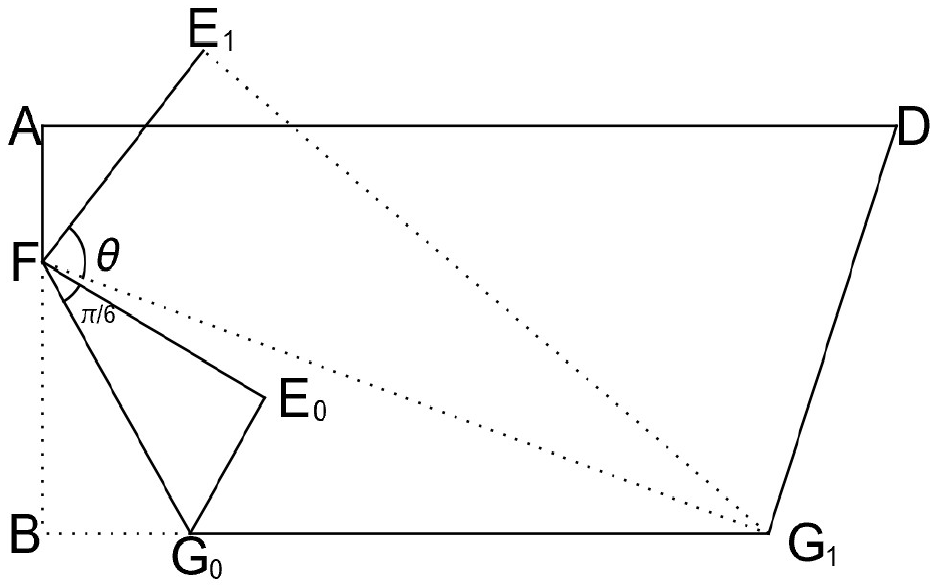
G0\displaystyle \mathrm{G}_{0}와 점 G1\displaystyle \mathrm{G}_{1}G0=(a3,9)\displaystyle \mathrm{G}_{0}=\left(\frac{a}{\sqrt{3}},-9\right), G1=C\displaystyle \mathrm{G}_{1}=\mathrm{C}로 두자. 또한 G=G0\displaystyle \mathrm{G}=\mathrm{G}_{0}일 때, 점 E\displaystyle \mathrm{E}E0\displaystyle \mathrm{E}_{0}, G=G1\displaystyle \mathrm{G}=\mathrm{G}_{1}일 때, 점 E\displaystyle \mathrm{E}E1\displaystyle \mathrm{E}_{1}으로 표기하자. 제시된 상황을 그림으로 나타내면 아래와 같다.

점 F를 고정하고 점 G가 G₀에서 G₁까지 움직일 때 점 E가 E₀에서 E₁까지 옮겨 가는 그림. 점 F에서의 각이 θ와 π/6으로 표시되어 있다.
+5점 · 점 G\displaystyle \mathrm{G}가 점 G0\displaystyle \mathrm{G}_{0}일 때, E0FB\displaystyle \angle\mathrm{E}_{0}\mathrm{FB}를 구한다.

G\displaystyle \mathrm{G}가 점 G0\displaystyle \mathrm{G}_{0}을 출발하여 선분 BC\displaystyle \mathrm{BC}를 따라 점 G1\displaystyle \mathrm{G}_{1}까지 움직일 때, 점 E\displaystyle \mathrm{E}가 그리는 곡선은 중심이 F\displaystyle \mathrm{F}이고 반지름이 EF=a\displaystyle \overline{\mathrm{EF}}=a인 원의 일부이다. 또한 삼각형 EFG\displaystyle \mathrm{EFG}는 삼각형 BFG\displaystyle \mathrm{BFG}와 서로 합동인 직각삼각형임을 주목하자. 따라서, 점 G\displaystyle \mathrm{G}가 점 G0\displaystyle \mathrm{G}_{0}일 때, BG0=E0G0=13a\displaystyle \overline{\mathrm{BG}_{0}}=\overline{\mathrm{E}_{0}\mathrm{G}_{0}}=\frac{1}{\sqrt{3}}a이다. 또한 삼각형 E0FG0\displaystyle \mathrm{E}_{0}\mathrm{FG}_{0}E0F=a\displaystyle \overline{\mathrm{E}_{0}\mathrm{F}}=a, E0G0=13a\displaystyle \overline{\mathrm{E}_{0}\mathrm{G}_{0}}=\frac{1}{\sqrt{3}}a인 직각삼각형이고, E0FB=π3\displaystyle \angle\mathrm{E}_{0}\mathrm{FB}=\frac{\pi}{3}임을 알 수 있다.

+5점 · 점 G\displaystyle \mathrm{G}가 점 G1\displaystyle \mathrm{G}_{1}일 때, E1FB\displaystyle \angle\mathrm{E}_{1}\mathrm{FB}를 구한다.

한편 점 G\displaystyle \mathrm{G}가 점 G1\displaystyle \mathrm{G}_{1}일 때, 삼각형 E1FG1\displaystyle \mathrm{E}_{1}\mathrm{FG}_{1}E1F=a\displaystyle \overline{\mathrm{E}_{1}\mathrm{F}}=a, E1G1=17\displaystyle \overline{\mathrm{E}_{1}\mathrm{G}_{1}}=17인 직각삼각형이 된다. 이때 tan(E1FG1)=17a\displaystyle \tan(\angle\mathrm{E}_{1}\mathrm{FG}_{1})=\frac{17}{a}이므로, E1FG1=θ\displaystyle \angle\mathrm{E}_{1}\mathrm{FG}_{1}=\theta이고, E1FB=2θ\displaystyle \angle\mathrm{E}_{1}\mathrm{FB}=2\theta임을 알 수 있다.

+5점 · 점 E\displaystyle \mathrm{E}가 될 수 있는 점들의 집합이 이루는 호에 대한 중심각을 구하고, 이 호의 길이를 θ\displaystyle \theta에 관한 식으로 표현한다.

따라서 점 E\displaystyle \mathrm{E}가 될 수 있는 점들의 집합이 이루는 호에 대한 중심각은 2θπ3\displaystyle 2\theta-\frac{\pi}{3}가 되고, EF=a=17tanθ\displaystyle \overline{\mathrm{EF}}=a=\frac{17}{\tan\theta}이므로, 이 호의 길이는 17tanθ(2θπ3)\displaystyle \frac{17}{\tan\theta}\left(2\theta-\frac{\pi}{3}\right)임을 알 수 있다.

첨삭 사례

아직 등록된 첨삭 사례가 없습니다.

질문과 답변 · 0개질문과 답변 · 고정 0개

아직 등록된 질문이 없습니다. 질문 작성은 멤버십 회원만 가능합니다.