수리논술, 배움에서 논증의 완성까지.

자연계열 1-3번

문제

🔒
짧은 시간에 너무 많은 문제를 여셔서 열람을 잠시 제한했습니다. 잠시 후 다시 시도하시거나 로그인해 주세요.
해설강의 준비중
1단계 · 제시문 <다>의 핵심 내용을 정확하게 파악한다. 2단계 · 제시문 <다>에서 논의된 과정을 문제에 적용하여 설명한다. 3단계 · <1-3(a)>에서 두 점 A1\displaystyle \mathrm A_1A2\displaystyle \mathrm A_2로부터 점 C\displaystyle \mathrm C를 찾고 두 점 A3\displaystyle \mathrm A_3A4\displaystyle \mathrm A_4가 선분 OC\displaystyle \mathrm{OC}의 수직이등분선과 원 x2+y2=1\displaystyle x^2+y^2=1의 두 교점임을 설명한다.

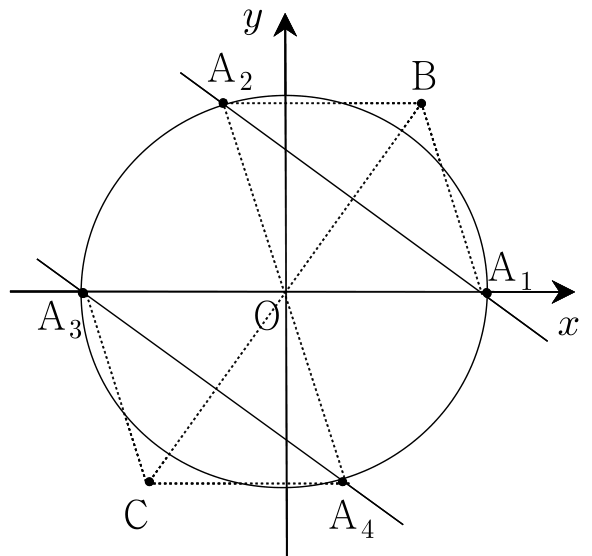
■ 1-3(a)먼저 점 A2\displaystyle \mathrm A_2y\displaystyle y좌표가 0\displaystyle 0 이하라 하면, 문제의 가정에 의하여 두 점 A3\displaystyle \mathrm A_3A4\displaystyle \mathrm A_4y\displaystyle y좌표가 모두 음수가 되므로 OA1+OA2+OA3+OA4=0\displaystyle \overrightarrow{\mathrm{OA}_1}+\overrightarrow{\mathrm{OA}_2}+\overrightarrow{\mathrm{OA}_3}+\overrightarrow{\mathrm{OA}_4}=\vec0를 만족시킬 수 없다. 따라서 점 A2\displaystyle \mathrm A_2y\displaystyle y좌표는 0\displaystyle 0보다 크다. 벡터 OA1+OA2\displaystyle \overrightarrow{\mathrm{OA}_1}+\overrightarrow{\mathrm{OA}_2}의 끝점을 점 B\displaystyle \mathrm B라 하고 점 B\displaystyle \mathrm B를 원점에 대하여 대칭이동한 점을 점 C\displaystyle \mathrm C라 두자. OA1+OA2=OB\displaystyle \overrightarrow{\mathrm{OA}_1}+\overrightarrow{\mathrm{OA}_2}=\overrightarrow{\mathrm{OB}}이므로 사각형 OA1BA2\displaystyle \mathrm{OA}_1\mathrm{BA}_2는 평행사변형이다. 그런데 두 변 OA1\displaystyle \mathrm{OA}_1OA2\displaystyle \mathrm{OA}_2는 원의 반지름으로 길이가 같으므로 사각형 OA1BA2\displaystyle \mathrm{OA}_1\mathrm{BA}_2는 마름모이다. 마름모의 두 대각선은 서로 다른 것을 수직이등분하므로 선분 A1A2\displaystyle \mathrm A_1\mathrm A_2는 선분 OB\displaystyle \mathrm{OB}의 수직이등분선이다. 따라서 두 점 A1\displaystyle \mathrm A_1A2\displaystyle \mathrm A_2는 선분 OB\displaystyle \mathrm{OB}의 수직이등분선과 원 x2+y2=1\displaystyle x^2+y^2=1의 두 교점이다. 같은 방법으로 OA3+OA4=OC\displaystyle \overrightarrow{\mathrm{OA}_3}+\overrightarrow{\mathrm{OA}_4}=\overrightarrow{\mathrm{OC}}이므로 점 A3\displaystyle \mathrm A_3A4\displaystyle \mathrm A_4는 선분 OC\displaystyle \mathrm{OC}의 수직이등분선과 원 x2+y2=1\displaystyle x^2+y^2=1의 두 교점임을 알 수 있다.

답안 1-3(a)의 마름모와 대칭점
4단계 · <1-3(a)>에서 점 A3\displaystyle \mathrm A_3은 점 A1\displaystyle \mathrm A_1을 원점에 대하여 대칭이동한 점임을 증명한다.

그림에서 OA1=OA3=1\displaystyle \overline{\mathrm{OA}_1}=\overline{\mathrm{OA}_3}=1, A1B=A3C=1\displaystyle \overline{\mathrm A_1\mathrm B}=\overline{\mathrm A_3\mathrm C}=1이고, OB=OC\displaystyle \overline{\mathrm{OB}}=\overline{\mathrm{OC}}이므로 삼각형 OA1B\displaystyle \mathrm{OA}_1\mathrm B와 삼각형 OA3C\displaystyle \mathrm{OA}_3\mathrm C는 합동이다. 따라서 BOA1=COA3\displaystyle \angle\mathrm{BOA}_1=\angle\mathrm{COA}_3이고 두 선분 OB\displaystyle \mathrm{OB}OC\displaystyle \mathrm{OC}가 일직선을 이루므로 두 선분 OA1\displaystyle \mathrm{OA}_1OA3\displaystyle \mathrm{OA}_3은 일직선을 이룬다. 따라서 점 A3\displaystyle \mathrm A_3는 점 A1\displaystyle \mathrm A_1을 원점에 대하여 대칭이동한 점 A3(1,0)\displaystyle \mathrm A_3(-1,0)이다.

1단계 · 제시문 <다>의 핵심 내용을 정확하게 파악한다. 2단계 · 제시문 <다>에서 논의된 과정을 문제에 적용하여 설명한다. 5단계 · <1-3(b)>에서 문제의 가정으로부터 두 벡터 OA4\displaystyle \overrightarrow{\mathrm{OA}_4}, OA5\displaystyle \overrightarrow{\mathrm{OA}_5}의 합이 만족시켜야 할 조건을 구한다.

■ 1-3(b)A4\displaystyle \mathrm A_4, A5\displaystyle \mathrm A_5OA4+OA5=(3a,b)\displaystyle \overrightarrow{\mathrm{OA}_4}+\overrightarrow{\mathrm{OA}_5}=(-\sqrt3-a,-b)를 만족시키는 원 x2+y2=1\displaystyle x^2+y^2=1 위의 점이다. 점 B(3a,b)\displaystyle \mathrm B(-\sqrt3-a,-b)에 대하여 두 벡터 OA4\displaystyle \overrightarrow{\mathrm{OA}_4}, OA5\displaystyle \overrightarrow{\mathrm{OA}_5}의 합이 OB\displaystyle \overrightarrow{\mathrm{OB}}가 되어야 하므로 두 점 A4\displaystyle \mathrm A_4, A5\displaystyle \mathrm A_5가 원 위에 존재하기 위해서는 선분 OB\displaystyle \mathrm{OB}의 수직이등분선과 원이 서로 다른 두 점에서 만나야 한다. 즉, 선분 OB\displaystyle \mathrm{OB}의 길이가 2\displaystyle 2 미만이 되어야 한다. (선분 OB\displaystyle \mathrm{OB}의 길이가 2\displaystyle 2일 때는 선분 OB\displaystyle \mathrm{OB}의 수직이등분선과 원이 접하여 한점에서 만난다.)

6단계 · <1-3(b)>에서 앞에서 구한 조건을 적용하여 점 A3(a,b)\displaystyle \mathrm A_3(a,b)가 나타내는 도형이 반원임을 설명하고 그 길이를 구한다.

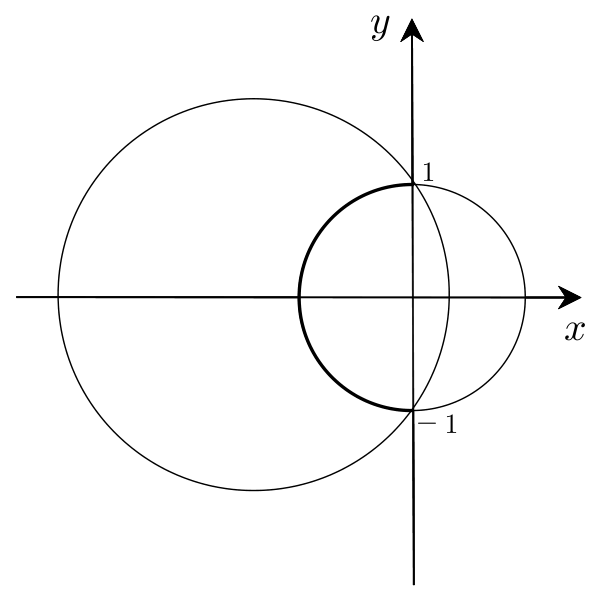
그러므로 A3(a,b)\displaystyle \mathrm A_3(a,b)는 원 x2+y2=1\displaystyle x^2+y^2=1 위의 점이면서 원(x+3)2+y2=4\displaystyle (x+\sqrt3)^2+y^2=4의 내부의 점이다. 따라서, 점 A3(a,b)\displaystyle \mathrm A_3(a,b)가 나타내는 도형은 반원이다. 그러므로 도형의 길이는 π\displaystyle \pi이다.

답안 1-3(b)의 두 원과 왼쪽 반원
5단계 · <1-3(b)>에서 문제의 가정으로부터 두 벡터 OA4\displaystyle \overrightarrow{\mathrm{OA}_4}, OA5\displaystyle \overrightarrow{\mathrm{OA}_5}의 합이 만족시켜야 할 조건을 구한다. 6단계 · <1-3(b)>에서 앞에서 구한 조건을 적용하여 점 A3(a,b)\displaystyle \mathrm A_3(a,b)가 나타내는 도형이 반원임을 설명하고 그 길이를 구한다.

<다른 풀이>A3(cosθ,sinθ)\displaystyle \mathrm A_3(\cos\theta,\sin\theta)라 두면OA4+OA5=(3cosθ,sinθ)\displaystyle \overrightarrow{\mathrm{OA}_4}+\overrightarrow{\mathrm{OA}_5}=(-\sqrt3-\cos\theta,-\sin\theta)이다. 점 B(3cosθ,sinθ)\displaystyle \mathrm B(-\sqrt3-\cos\theta,-\sin\theta)에 대하여 두 벡터 OA4\displaystyle \overrightarrow{\mathrm{OA}_4}, OA5\displaystyle \overrightarrow{\mathrm{OA}_5}의 합이 OB\displaystyle \overrightarrow{\mathrm{OB}}이므로 두 점 A4\displaystyle \mathrm A_4, A5\displaystyle \mathrm A_5가 원 위에 존재하기 위하여는 선분 OB\displaystyle \mathrm{OB}의 수직이등분선과 원이 서로 다른 두 점에서 만나야 한다. 즉, 선분 OB\displaystyle \mathrm{OB}의 길이가 2\displaystyle 2 미만이 되어야 한다. 따라서(cosθ+3)2+sin2θ<2,\displaystyle \sqrt{(\cos\theta+\sqrt3)^2+\sin^2\theta}<2,즉, 23cosθ<0\displaystyle 2\sqrt3\cos\theta<0이므로 이를 풀면 π2<θ<3π2\displaystyle \frac\pi2<\theta<\frac{3\pi}2이고 점 A3\displaystyle \mathrm A_3가 나타내는 도형은 반원이다. 그러므로 도형의 길이는 π\displaystyle \pi이다.

각 세부 문항별로 다음과 같은 기준을 만족시켜야 한다.

첨삭 사례

아직 등록된 첨삭 사례가 없습니다.

질문과 답변 · 0개질문과 답변 · 고정 0개

아직 등록된 질문이 없습니다. 질문 작성은 멤버십 회원만 가능합니다.