수리논술, 배움에서 논증의 완성까지.

자연계열 (오후) 1번

문제

다음 제시문을 읽고 논제에 답하시오.

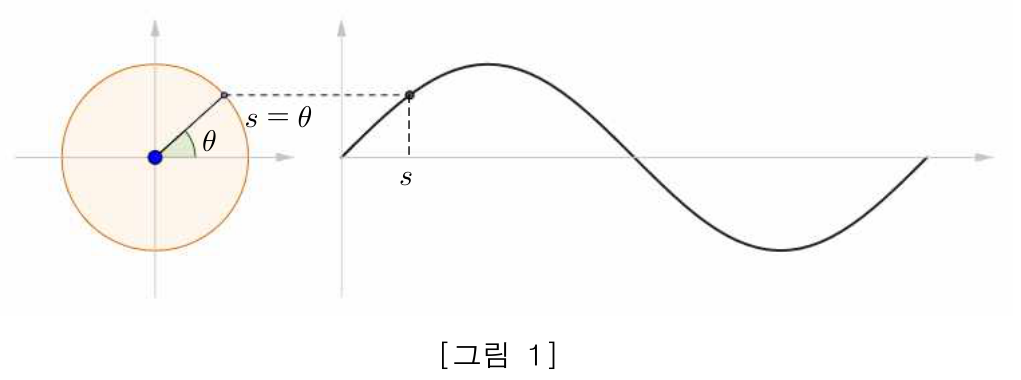
(가) 반지름이 1이고 중심이 O\displaystyle O인 원 위에서 한 점 P\displaystyle P가 움직일 때 OP\displaystyle \overline{OP}와 양의 x\displaystyle x축이 이루는 각 θ\displaystyle \thetaP\displaystyle P의 높이, 즉 P\displaystyle Py\displaystyle y좌표와의 관계를 함수로 나타내면 y=sinθ\displaystyle y=\sin\theta가 된다는 사실이 알려져 있다.

그림 1: 원 위의 점의 이동 거리와 높이

한편 중심각이 θ\displaystyle \theta인 원호의 길이 s\displaystyle ss=θ\displaystyle s=\theta이므로 (0,1)\displaystyle (0,1)에서 출발한 점이 시계바늘이 도는 방향의 반대방향으로 s\displaystyle s만큼 이동하여 도달한 점 P\displaystyle P의 높이 y\displaystyle ys\displaystyle s에 대한 함수로 나타내어도 y=sins\displaystyle y=\sin s가 된다. 이와 비슷하게 평면상에 어떤 도형 또는 그래프가 주어졌을 때 그 위를 움직이는 점의 이동한 거리와 도달한 점의 높이와의 관계를 함수로 나타내는 경우를 생각해 보자.Correction. 제시문 (가)의 출발점 (0,1)\displaystyle (0,1)(1,0)\displaystyle (1,0)이어야 y=sins\displaystyle y=\sin s가 된다. (0,1)\displaystyle (0,1)에서 출발하면 높이는 y=coss\displaystyle y=\cos s이다. 그러나 원칙에 따라 원문 표기를 그대로 실었다.

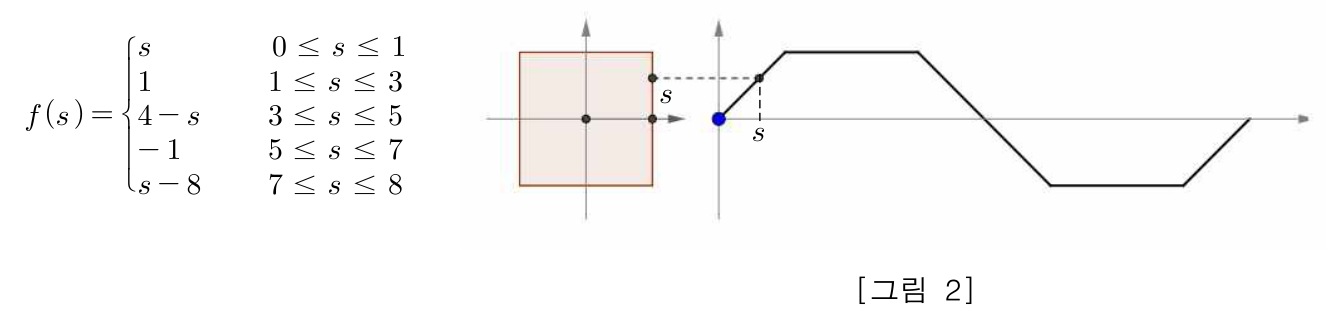
(나) 아래 그림과 같은 (1,1)\displaystyle (1,1), (1,1)\displaystyle (1,-1), (1,1)\displaystyle (-1,-1), (1,1)\displaystyle (-1,1)을 네 꼭지점으로 하는 정사각형을 생각하자. 점 (1,0)\displaystyle (1,0)에서 출발한 점이 시계바늘이 도는 방향의 반대 방향으로 s\displaystyle s만큼 이동하여 점 P\displaystyle P에 도달했을 때 P\displaystyle P의 높이 y\displaystyle y를 이동한 거리 s\displaystyle s에 따른 함수로 나타내면 0s8\displaystyle 0\le s\le8 구간에서 아래와 같고 이를 그래프로 그리면 [그림 2]와 같다.

그림 2: 정사각형을 따라 움직인 점의 높이와 구간별 함수

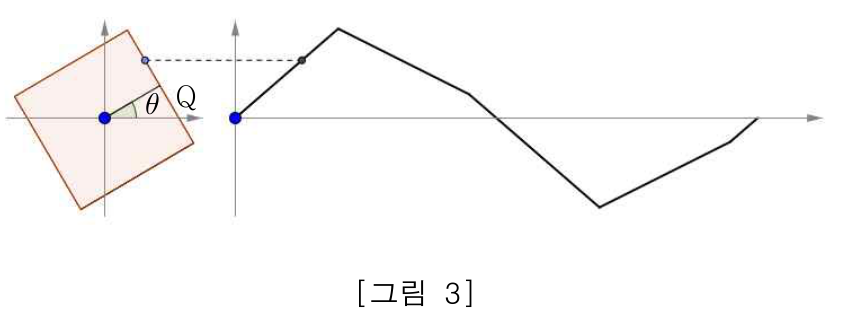
위 정사각형을 [그림 3]의 왼쪽 그림과 같이 θ\displaystyle \theta만큼 회전시킨 도형을 R\displaystyle R이라 하자. (단, 0θπ2\displaystyle 0\le\theta\le\frac\pi2) 이 도형이 양의 x\displaystyle x축과 만나는 점 Q\displaystyle Q에서 출발하여 시계바늘이 도는 방향의 반대 방향으로 s\displaystyle s만큼 이동하여 점 P\displaystyle P에 도달했을 때, P\displaystyle P의 높이를 함수 h(s)\displaystyle h(s)로 나타내면, [그림 3]의 오른쪽 그림과 같은 h(s)\displaystyle h(s)의 그래프를 얻을 수 있다. 이때 θ\displaystyle \theta에 따라 h(s)\displaystyle h(s)의 그래프의 개형 및 h(s)\displaystyle h(s)의 최댓값이 달라짐을 관찰 할 수 있다.

그림 3: 회전한 정사각형과 이동 거리에 따른 높이

[문제 1-1] (10점) 좌표평면에서 x+y=2\displaystyle |x|+|y|=\sqrt2를 만족하는 도형을 생각하자. 점 (2,0)\displaystyle (\sqrt2,0)에서 출발하여 시계바늘이 도는 방향의 반대방향으로 도형을 따라 s\displaystyle s만큼 이동한 후 점 P\displaystyle P에 도달했을 때, P\displaystyle P의 높이 g(s)\displaystyle g(s)0s8\displaystyle 0\le s\le8범위에서 구하시오.

[문제 1-2] (15점) 점 (1,0)\displaystyle (1,0)에서 출발하여 f(x)=xx21ln(x+x21)2\displaystyle f(x)=\frac{x\sqrt{x^2-1}-\ln(x+\sqrt{x^2-1})}2의 그래프를 따라 x\displaystyle x가 증가하는 방향으로 s\displaystyle s만큼 이동하여 점 P(x,y)\displaystyle P(x,y)에 도달하였다.(1) 이 때 P(x,y)\displaystyle P(x,y)y\displaystyle y좌표를 이동한 거리 s\displaystyle s에 대한 함수 g(s)\displaystyle g(s)로 나타내시오. (단, s0\displaystyle s\ge0)(2) 극한 limsg(s)s\displaystyle \lim_{s\to\infty}\frac{g(s)}s의 수렴성에 관해 논하시오.

[문제 1-3] (25점) 제시문 (나)에서 설명한 θ\displaystyle \theta에 따라 변하는 도형 R\displaystyle Rh(s)\displaystyle h(s)를 생각하자.(1) h(s)\displaystyle h(s)의 최댓값을 θ\displaystyle \theta에 대한 함수로 나타내시오.(2) 구간 0s8\displaystyle 0\le s\le8에서 함수 h(s)\displaystyle h(s)의 그래프로 나타나는 곡선의 길이는 θ\displaystyle \theta에 대한 함수이다. 이를 (θ)\displaystyle \ell(\theta)라 할 때 (θ)\displaystyle \ell(\theta)를 구하고 (θ)\displaystyle \ell(\theta)의 그래프가 가지는 모양에 관해 논하시오.

해설강의 준비중
+2점 · [문제 1-1] 0s2\displaystyle 0\le s\le2, 2s4\displaystyle 2\le s\le4, 4s6\displaystyle 4\le s\le6, 6s8\displaystyle 6\le s\le8의 구간으로 나누어서 접근하면 +8점 · 각 구간 당 2점씩

[문제 1-1] 0s2\displaystyle 0\le s\le2일 때 s2=x2+y2=2x2\displaystyle s^2=x^2+y^2=2x^2이므로 h(s)=s2\displaystyle h(s)=\frac s{\sqrt2}이다. 다른 구간에서도 비슷하게 생각하면, g(s)\displaystyle g(s)는 다음과 같다.Comment. 첫 구간에서 점 P\displaystyle P의 원래 좌표를 (x,y)\displaystyle (x,y)라 하면 s2=(x2)2+y2=2y2\displaystyle s^2=(x-\sqrt2)^2+y^2=2y^2이다. 원문의 x,y\displaystyle x,y를 원래 좌표로 읽으면 이 등식은 성립하지 않는다. 또한 이 문항에서 구하는 함수 이름은 h(s)\displaystyle h(s)가 아니라 g(s)\displaystyle g(s)이다. 그러나 원칙에 따라 원문 표기를 그대로 실었다.g(s)={s20s24s22s6s826s8\displaystyle g(s)=\begin{cases}\frac s{\sqrt2}&0\le s\le2\\\frac{4-s}{\sqrt2}&2\le s\le6\\\frac{s-8}{\sqrt2}&6\le s\le8\end{cases}

[문제 1-2]

+3점 · [문제 1-2] (1) f(x)\displaystyle f^{\prime}(x)를 계산했으면 (1~3점) +3점 · x\displaystyle xs\displaystyle s의 관계를 찾았으면 +3점 · g(s)=12(2s2s+1ln(2s+1+2s))\displaystyle g(s)=\frac12(\sqrt{2s}\sqrt{2s+1}-\ln(\sqrt{2s+1}+\sqrt{2s}))

(1) f(x)=12(x21+x2x2x211+2x2x21x+x21)=12(x21+x2x211x21)=x21\displaystyle \begin{aligned}f^{\prime}(x)&=\frac12\left(\sqrt{x^2-1}+x\frac{2x}{2\sqrt{x^2-1}}-\frac{1+\frac{2x}{2\sqrt{x^2-1}}}{x+\sqrt{x^2-1}}\right)\\&=\frac12\left(\frac{x^2-1+x^2}{\sqrt{x^2-1}}-\frac1{\sqrt{x^2-1}}\right)=\sqrt{x^2-1}\end{aligned}이므로 s=s(x)=1x1+(f(t))2dt=1xtdt=12(x21)\displaystyle s=s(x)=\int_1^x\sqrt{1+(f^{\prime}(t))^2}\,dt=\int_1^x t\,dt=\frac12(x^2-1).따라서 x21=2s\displaystyle \sqrt{x^2-1}=\sqrt{2s}, x=2s+1\displaystyle x=\sqrt{2s+1}P(x,y)\displaystyle P(x,y)y\displaystyle y좌표는 f(x)=12(2s2s+1ln(2s+1+2s)=g(s)\displaystyle f(x)=\frac12(\sqrt{2s}\sqrt{2s+1}-\ln(\sqrt{2s+1}+\sqrt{2s})=g(s)Correction. f(x)\displaystyle f(x)s\displaystyle s로 나타낸 마지막 식에는 닫는 괄호가 하나 빠져 있다. 식은 12(2s2s+1ln(2s+1+2s))\displaystyle \frac12\left(\sqrt{2s}\sqrt{2s+1}-\ln(\sqrt{2s+1}+\sqrt{2s})\right)을 뜻한다. 그러나 원칙에 따라 원문 표기를 그대로 실었다.

+3점 · (2) 수렴한다라고 적었으면 +3점 · 수렴값을 찾았으면

(2) g(s)s=12(22+12sln(2s+1+2s)s)\displaystyle \frac{g(s)}s=\frac12\left(\sqrt2\sqrt{2+\frac1{2s}}-\frac{\ln(\sqrt{2s+1}+\sqrt{2s})}s\right)Correction. 첫 근호항의 2+12s\displaystyle 2+\frac1{2s}2+1s\displaystyle 2+\frac1s이어야 한다. 2s2s+1/s=22+1/s\displaystyle \sqrt{2s}\sqrt{2s+1}/s=\sqrt2\sqrt{2+1/s}이다. 두 식의 극한은 같아 최종 답 1에는 영향이 없다. 원칙에 따라 원문 표기를 그대로 실었다.k(x)=xlnx\displaystyle k(x)=x-\ln x라 하면 k(x)=11x=x1x>0\displaystyle k^{\prime}(x)=1-\frac1x=\frac{x-1}x>0, (x>1\displaystyle x>1)이므로 증가함수이고 k(1)=1>0\displaystyle k(1)=1>0이므로 k(x)>0\displaystyle k(x)>0 즉, lnx<x\displaystyle \ln x<x, (x>1\displaystyle x>1). 이제 x\displaystyle x 대신 x\displaystyle \sqrt x를 대입하면 12lnx<x\displaystyle \frac12\ln x<\sqrt x 이제 lnxx<2x\displaystyle \frac{\ln x}x<\frac2{\sqrt x}이므로 limxlnxx=0\displaystyle \lim_{x\to\infty}\frac{\ln x}x=0ln(2s+1+2s)s<ln(22s+1)s=ln2+12ln(2s+1)s=ln2s+2s+12sln(2s+1)2s+10\displaystyle \frac{\ln(\sqrt{2s+1}+\sqrt{2s})}s<\frac{\ln(2\sqrt{2s+1})}s=\frac{\ln2+\frac12\ln(2s+1)}s=\frac{\ln2}s+\frac{2s+1}{2s}\frac{\ln(2s+1)}{2s+1}\to0따라서 limsg(s)s=1\displaystyle \lim_{s\to\infty}\frac{g(s)}s=1

[문제 1-3]

+5점 · [문제 1-3] (1) sinθ+cosθ\displaystyle \sin\theta+\cos\theta, 2sin(θ+π4)\displaystyle \sqrt2\sin(\theta+\frac\pi4), 2cos(θπ4)\displaystyle \sqrt2\cos(\theta-\frac\pi4) 등 이와 동치인 식으로 적었으면

(1) h(θ)\displaystyle h(\theta)의 최댓값은 R\displaystyle R의 높이이므로, 꼭짓점의 높이를 계산하면 충분하다. 0θπ4\displaystyle 0\le\theta\le\frac\pi4 (0tanθ1\displaystyle 0\le\tan\theta\le1)일 때 회전변환을 생각하면 점 (1,1)\displaystyle (1,1)(cosθsinθsinθcosθ)(11)=(cosθsinθsinθ+cosθ)\displaystyle \begin{pmatrix}\cos\theta&-\sin\theta\\\sin\theta&\cos\theta\end{pmatrix}\binom11=\binom{\cos\theta-\sin\theta}{\sin\theta+\cos\theta}에서 (cosθsinθ,sinθ+cosθ)\displaystyle (\cos\theta-\sin\theta,\sin\theta+\cos\theta)로 이동된다.Correction. 이 문단의 h(θ)\displaystyle h(\theta)는 고정한 θ\displaystyle \theta에 대해 정의된 높이 함수 h(s)\displaystyle h(s)를 뜻한다. 최댓값 sinθ+cosθ\displaystyle \sin\theta+\cos\theta는 문제의 전체 범위 0θπ2\displaystyle 0\le\theta\le\frac\pi2에서도 성립한다. 원칙에 따라 원문 표기를 그대로 실었다.따라서 h(θ)\displaystyle h(\theta)의 최댓값은 sinθ+cosθ\displaystyle \sin\theta+\cos\theta 혹은 2sin(θ+π4)\displaystyle \sqrt2\sin(\theta+\frac\pi4), 2cos(θπ4)\displaystyle \sqrt2\cos(\theta-\frac\pi4)

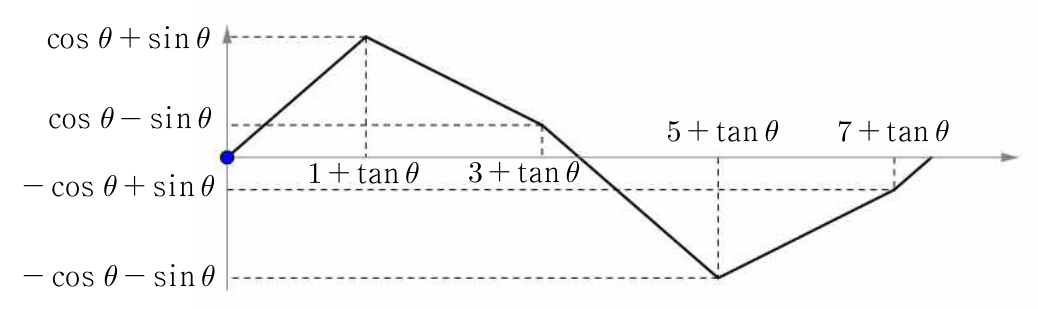
(2) 위의 회전변환으로부터 R\displaystyle R의 각 꼭짓점의 위치를 확인해 보면(1,1)\displaystyle (1,1)(cosθsinθ,sinθ+cosθ)\displaystyle (\cos\theta-\sin\theta,\sin\theta+\cos\theta)(1,1)\displaystyle (-1,1)(cosθsinθ,sinθ+cosθ)\displaystyle (-\cos\theta-\sin\theta,-\sin\theta+\cos\theta)(1,1)\displaystyle (-1,-1)(cosθ+sinθ,sinθcosθ)\displaystyle (-\cos\theta+\sin\theta,-\sin\theta-\cos\theta)(1,1)\displaystyle (1,-1)(cosθ+sinθ,sinθcosθ)\displaystyle (\cos\theta+\sin\theta,\sin\theta-\cos\theta)이므로, 0θπ4\displaystyle 0\le\theta\le\frac\pi4일 때 다음과 같은 그래프를 그릴 수 있다.

회전한 정사각형의 높이 함수 h(s)의 그래프
+10점 · (2) (θ)=4(1+sin2θ+1+cos2θ)\displaystyle \ell(\theta)=4(\sqrt{1+\sin^2\theta}+\sqrt{1+\cos^2\theta})를 정확히 구했으면

위의 그래프는 다섯 구간으로 나뉘어져 있고, 직선의 기울기의 절댓값을 보면 x\displaystyle x축 방향의 길이가 2이면서 y\displaystyle y축 방향의 길이가 2sinθ\displaystyle 2\sin\theta인 구간이 두 개, x\displaystyle x축 방향의 길이가 2이면서 기울기가 2cosθ\displaystyle 2\cos\theta인 구간이 한 개, x\displaystyle x축 방향의 길이가 tanθ+1\displaystyle \tan\theta+1이면서 기울기가 2cosθ\displaystyle 2\cos\theta인 구간이 한 개, x\displaystyle x축 방향의 길이가 1tanθ\displaystyle 1-\tan\theta이면서 기울기가 2cosθ\displaystyle 2\cos\theta인 구간이 한 개이다. 양 끝 두 구간은 합쳐 생각하면 x\displaystyle x축 방향의 길이가 2이면서 기울기가 2cosθ\displaystyle 2\cos\theta인 구간과 길이가 같다. 결국Correction. 이 문단에서 반복되는 기울기 2cosθ\displaystyle 2\cos\thetacosθ\displaystyle \cos\theta이어야 한다. 가로 길이가 2인 구간의 높이 변화가 2cosθ\displaystyle 2\cos\theta이므로 기울기의 절댓값은 cosθ\displaystyle \cos\theta이다. 이어지는 길이 공식과 별해는 이를 올바르게 사용한다. 원칙에 따라 원문 표기를 그대로 실었다.(θ)=4(sin2θ+1+cos2θ+1)\displaystyle \ell(\theta)=4\left(\sqrt{\sin^2\theta+1}+\sqrt{\cos^2\theta+1}\right) (단, 0θπ4\displaystyle 0\le\theta\le\frac\pi4).이다. 한편, π4θπ2\displaystyle \frac\pi4\le\theta\le\frac\pi2일 때의 h(s)\displaystyle h(s)의 그래프는 π2θ\displaystyle \frac\pi2-\theta일 때의 h(s)\displaystyle h(s)의 그래프를 s=4\displaystyle s=4를 기준으로 대칭하여 y\displaystyle y축으로 반전시킨 함수의 그래프, 즉 h(8s)\displaystyle -h(8-s)의 그래프와 같다. 즉, (θ)=(π2θ)\displaystyle \ell(\theta)=\ell(\frac\pi2-\theta)이고,(θ)=(π2θ)=4(sin2(π2θ)+1+cos2(π2θ)+1)=4(1+cos2θ+1+sin2θ)\displaystyle \ell(\theta)=\ell(\frac\pi2-\theta)=4\left(\sqrt{\sin^2(\frac\pi2-\theta)+1}+\sqrt{\cos^2(\frac\pi2-\theta)+1}\right)=4\left(\sqrt{1+\cos^2\theta}+\sqrt{1+\sin^2\theta}\right)이므로, 이를 종합하면 모든 θ\displaystyle \theta에 대해서 (θ)=4(1+sin2θ+1+cos2θ)\displaystyle \ell(\theta)=4\left(\sqrt{1+\sin^2\theta}+\sqrt{1+\cos^2\theta}\right)이다.

+3점 · θ<π4\displaystyle \theta<\frac\pi4까지 증가임을 이야기 하면 1점 + 이유 2점 +3점 · θ>π4\displaystyle \theta>\frac\pi4까지 감소임을 이야기 하면 1점 + 이유 2점

Comment. 채점기준의 도함수 뒤 0\displaystyle \ge0은 전체 구간에서 성립하지 않는다. 0<θ<π4\displaystyle 0<\theta<\frac\pi4에서 양수, π4<θ<π2\displaystyle \frac\pi4<\theta<\frac\pi2에서 음수이다. 그러나 원칙에 따라 원문 표기를 그대로 실었다.

+4점 · π4\displaystyle \frac\pi4에서 좌우 대칭임을 이야기 하면 2점 + 이유 2점

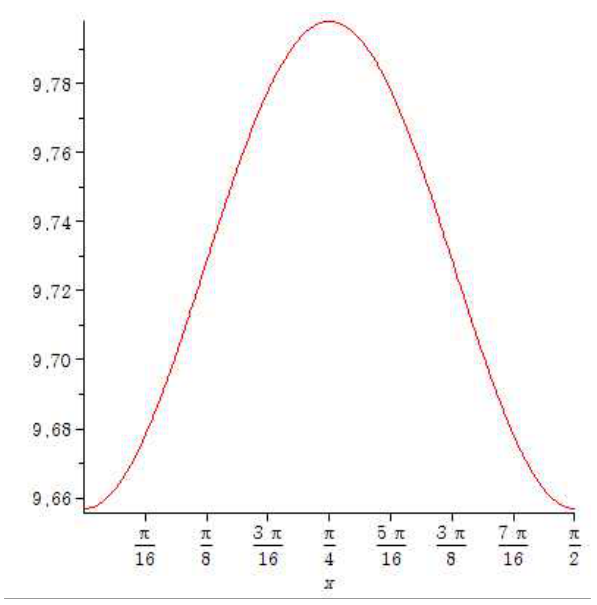
한편 이 함수를 미분하면 (θ)=4sinθcosθ(cos2θ+1sin2θ+1)cos2θ+1sin2θ+10\displaystyle \ell^{\prime}(\theta)=\frac{4\sin\theta\cos\theta\left(\sqrt{\cos^2\theta+1}-\sqrt{\sin^2\theta+1}\right)}{\sqrt{\cos^2\theta+1}\sqrt{\sin^2\theta+1}}\ge0, (단, 0θπ4\displaystyle 0\le\theta\le\frac\pi4)이므로 (θ)\displaystyle \ell(\theta)는 구간 0θπ4\displaystyle 0\le\theta\le\frac\pi4에서 증가한다. (θ)\displaystyle \ell(\theta)θ=π4\displaystyle \theta=\frac\pi4를 중심으로 대칭이므로, (θ)\displaystyle \ell(\theta)는 구간 π4θπ2\displaystyle \frac\pi4\le\theta\le\frac\pi2에서는 감소한다. 따라서 (θ)\displaystyle \ell(\theta)의 개형의 중요한 특성은 아래와 같다.(i) θ=π4\displaystyle \theta=\frac\pi4를 중심으로 좌우대칭(ii) 0θπ4\displaystyle 0\le\theta\le\frac\pi4구간에서 증가 (π4θπ2\displaystyle \frac\pi4\le\theta\le\frac\pi2구간에서 감소)

θ에 대한 그래프 길이 함수의 개형

[문제 1-2] (1) 참고) ②에서 s=x22\displaystyle s=\frac{x^2}2라고 적었으면 2점. ③에서 12(2s2s1ln(2s1+2s))\displaystyle \frac12(\sqrt{2s}\sqrt{2s-1}-\ln(\sqrt{2s-1}+\sqrt{2s}))로 적었으면 2점.

[문제 1-2] (2) ①로부터 얻은 g(s)\displaystyle g(s)가 정답과 유사한 경우에만 점수를 부여할 수 있다.

[문제 1-3] (1) 답은 틀렸지만 최대가 되는 꼭짓점에 대해서 언급했으면 2점 부여.

[문제 1-3] (2) ①에서 특정구간(θ<π4\displaystyle \theta<\frac\pi4일 때나 θ>π4\displaystyle \theta>\frac\pi4 둘 중 하나)의 θ\displaystyle \theta에 대하여 그래프 개형과 함께 h(s)\displaystyle h(s)를 제시하면 5점.

②, ③, ④에서 (θ)=4sinθcosθ(cos2θ+1sin2θ+1)cos2θ+1sin2θ+10\displaystyle \ell^{\prime}(\theta)=\frac{4\sin\theta\cos\theta(\sqrt{\cos^2\theta+1}-\sqrt{\sin^2\theta+1})}{\sqrt{\cos^2\theta+1}\sqrt{\sin^2\theta+1}}\ge0을 계산했으면 각 주장에 대한 이유를 들었다고 인정할 수 있음.

①에서 사소한 계산 실수 1~5점 감점.

②, ③에서 π4\displaystyle \frac\pi4나 양 끝점에서 극값임을 언급하면 1점 부여.

② 혹은 ③ 하나만 적었더라도 ④를 같이 적었으면 모두 적은 것으로 인정.

단순히 그림만 그렸을 경우에 ②, ③, ④의 모양이 나타난 그림이면 해당항목을 주장한 것으로 인정.

첨삭 사례

아직 등록된 첨삭 사례가 없습니다.

질문과 답변 · 0개질문과 답변 · 고정 0개

아직 등록된 질문이 없습니다. 질문 작성은 멤버십 회원만 가능합니다.