수리논술, 배움에서 논증의 완성까지.

자연계열 4번

문제

🔒
짧은 시간에 너무 많은 문제를 여셔서 열람을 잠시 제한했습니다. 잠시 후 다시 시도하시거나 로그인해 주세요.
해설강의 준비중

[문제 4-1]

+5점 · C1\displaystyle C_1, C2\displaystyle C_2, C3\displaystyle C_3의 넓이 (72c2)π\displaystyle (7^2-c^2)\pi, (72a2)π\displaystyle (7^2-a^2)\pi, (72b2)π\displaystyle (7^2-b^2)\pi를 얻으면

S\displaystyle S 위의 점 (a,b,c)\displaystyle (a,b,c)를 중심으로 하고 반지름의 길이가 7\displaystyle 7인 구 (xa)2+(yb)2+(zc)2=72\displaystyle (x-a)^2+(y-b)^2+(z-c)^2=7^2xy\displaystyle xy평면과 만나는 원 C1\displaystyle C_1의 방정식은 z=0\displaystyle z=0을 대입하여 얻은 (xa)2+(yb)2=72c2\displaystyle (x-a)^2+(y-b)^2=7^2-c^2이다. 따라서 그 넓이는 (72c2)π\displaystyle (7^2-c^2)\pi이다. 마찬가지로 C2\displaystyle C_2, C3\displaystyle C_3의 넓이는 각각 (72a2)π\displaystyle (7^2-a^2)\pi, (72b2)π\displaystyle (7^2-b^2)\pi이므로 Aπ=147(a2+b2+c2)\displaystyle \frac A\pi=147-(a^2+b^2+c^2)

+5점 · OP=501\displaystyle \overline{\mathrm{OP}}=\sqrt{50}-1, OQ=50+1\displaystyle \overline{\mathrm{OQ}}=\sqrt{50}+1을 얻으면

원점 O\displaystyle \mathrm{O}와 구 S\displaystyle S의 중심 C(3,4,5)\displaystyle \mathrm{C}(3,4,5)를 통과하는 직선은 구 S\displaystyle S와 두 점에서 만나는데, 이 중 한 점은 구 S\displaystyle S 위의 점 중에서 원점과 가장 가까운 점이고 다른 한 점은 가장 먼 점이다. 이 두 점을 P\displaystyle \mathrm{P}, Q\displaystyle \mathrm{Q}라 하고 OP<OQ\displaystyle \overline{\mathrm{OP}}<\overline{\mathrm{OQ}}라 가정할 수 있다. 그러면 OC=32+42+52=50\displaystyle \overline{\mathrm{OC}}=\sqrt{3^2+4^2+5^2}=\sqrt{50}이므로 OP=501\displaystyle \overline{\mathrm{OP}}=\sqrt{50}-1, OQ=50+1\displaystyle \overline{\mathrm{OQ}}=\sqrt{50}+1이다.

+5점 · Aπ\displaystyle \frac A\pi의 최댓값과 최솟값의 합 192\displaystyle 192를 얻으면

501a2+b2+c250+1\displaystyle \sqrt{50}-1\le\sqrt{a^2+b^2+c^2}\le\sqrt{50}+1이므로51250a2+b2+c251+250\displaystyle 51-2\sqrt{50}\le a^2+b^2+c^2\le51+2\sqrt{50}96250147(a2+b2+c2)96+250\displaystyle 96-2\sqrt{50}\le147-(a^2+b^2+c^2)\le96+2\sqrt{50}에서 Aπ\displaystyle \frac A\pi의 최솟값과 최댓값은 각각 96250\displaystyle 96-2\sqrt{50}, 96+250\displaystyle 96+2\sqrt{50}이고 그 합은 192\displaystyle 192이다.

[문제 4-2]

+5점 · a=10\displaystyle a=\sqrt{10}을 구하면

타원 E\displaystyle Ex2a2+y2b2=1\displaystyle \frac{x^2}{a^2}+\frac{y^2}{b^2}=1이라 하고 그 위의 두 점 A\displaystyle \mathrm{A}, B\displaystyle \mathrm{B}를 잡자. 삼각형 ABF\displaystyle \mathrm{ABF}의 둘레가 4a\displaystyle 4a 이하임을 다음의 두 가지 경우로 나누어 관찰한다.

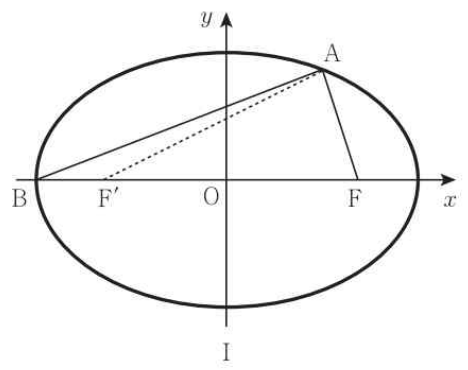
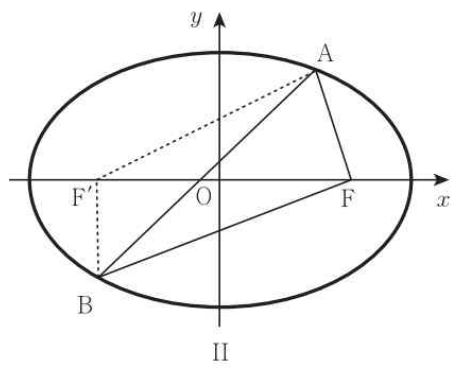
(a) 점 A\displaystyle \mathrm{A}, B\displaystyle \mathrm{B} 중에서 한 점, 가령 점 B\displaystyle \mathrm{B}x\displaystyle x축에 있거나 점 A\displaystyle \mathrm{A}, B\displaystyle \mathrm{B}x\displaystyle x축 반대편에 있는 경우 (그림 I, II 참고):AB+BF+FAAF+FB+BF+FA=(FA+AF)+(FB+BF)=2a+2a=4a\displaystyle \overline{\mathrm{AB}}+\overline{\mathrm{BF}}+\overline{\mathrm{FA}}\le\overline{\mathrm{AF}^{\prime}}+\overline{\mathrm{F}^{\prime}\mathrm{B}}+\overline{\mathrm{BF}}+\overline{\mathrm{FA}}=(\overline{\mathrm{FA}}+\overline{\mathrm{AF}^{\prime}})+(\overline{\mathrm{F}^{\prime}\mathrm{B}}+\overline{\mathrm{BF}})=2a+2a=4a

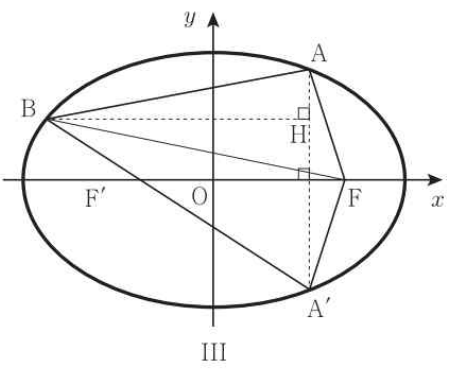
(b) 점 A\displaystyle \mathrm{A}, B\displaystyle \mathrm{B}x\displaystyle x축 한편에 있는 경우 (그림 III 참고): 점 A\displaystyle \mathrm{A}, B\displaystyle \mathrm{B} 중에서 x\displaystyle x축에 더 가깝지 않은 점, 가령 점 A\displaystyle \mathrm{A}x\displaystyle x축에 대하여 대칭 이동한 점을 A\displaystyle \mathrm{A}^{\prime}이라 하고, 점 B\displaystyle \mathrm{B}에서 직선 AA\displaystyle \mathrm{AA}^{\prime}에 내린 수선의 발을 H\displaystyle \mathrm{H}라 하면 AH<AH\displaystyle \overline{\mathrm{AH}}<\overline{\mathrm{A}^{\prime}\mathrm{H}}이고 FA=FA\displaystyle \overline{\mathrm{FA}}=\overline{\mathrm{FA}^{\prime}}이므로AB+BF+FA=AH2+HB2+BF+FA<AH2+HB2+BF+FA=AB+BF+FA\displaystyle \overline{\mathrm{AB}}+\overline{\mathrm{BF}}+\overline{\mathrm{FA}}=\sqrt{\overline{\mathrm{AH}}^2+\overline{\mathrm{HB}}^2}+\overline{\mathrm{BF}}+\overline{\mathrm{FA}^{\prime}}<\sqrt{\overline{\mathrm{A}^{\prime}\mathrm{H}}^2+\overline{\mathrm{HB}}^2}+\overline{\mathrm{BF}}+\overline{\mathrm{FA}^{\prime}}=\overline{\mathrm{A}^{\prime}\mathrm{B}}+\overline{\mathrm{BF}}+\overline{\mathrm{FA}^{\prime}}여기서, AB+BF+FA\displaystyle \overline{\mathrm{A}^{\prime}\mathrm{B}}+\overline{\mathrm{BF}}+\overline{\mathrm{FA}^{\prime}}는 (a)의 관찰에 의해 4a\displaystyle 4a이하이다.

초점 F\displaystyle \mathrm{F}^{\prime}을 지나고 y\displaystyle y축과 평행한 직선과 타원의 두 교점을 점 A\displaystyle \mathrm{A}, B\displaystyle \mathrm{B}로 잡으면 삼각형 ABF\displaystyle \mathrm{ABF}의 둘레가 4a\displaystyle 4a가 되므로 위 관찰 (a), (b)에 의해 삼각형 ABF\displaystyle \mathrm{ABF}의 둘레의 최댓값은 4a=410\displaystyle 4a=4\sqrt{10}이어서 a=10\displaystyle a=\sqrt{10}

+5점 · c=2\displaystyle c=2를 구하면

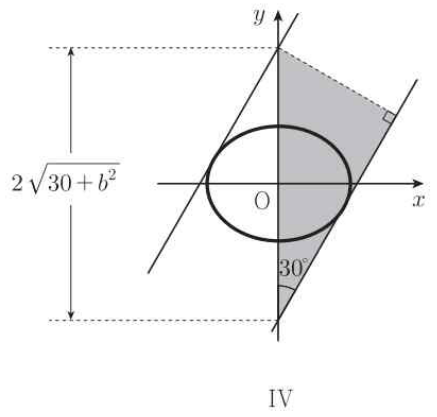
기울기가 3\displaystyle \sqrt3인 두 접선 y=3x±30+b2\displaystyle y=\sqrt3x\pm\sqrt{30+b^2}사이의 거리는 그림 IV에서 230+b2sin30=6\displaystyle 2\sqrt{30+b^2}\sin30^\circ=6이므로 b2=6\displaystyle b^2=6, c=a2b2=2\displaystyle c=\sqrt{a^2-b^2}=2

+5점 · PQF=35\displaystyle \triangle\mathrm{PQF}=3\sqrt5를 구하면

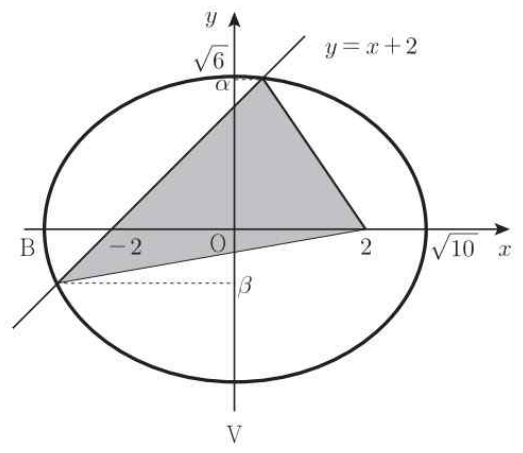
직선 y=x+2\displaystyle y=x+2와 타원 x210+y26=1\displaystyle \frac{x^2}{10}+\frac{y^2}{6}=1을 연립하여 얻은 이차방정식 4y26y9=0\displaystyle 4y^2-6y-9=0의 두 근은 α=3+354\displaystyle \alpha=\frac{3+3\sqrt5}{4}, β=3354\displaystyle \beta=\frac{3-3\sqrt5}{4}이므로 PQF=12αβFF=35\displaystyle \triangle\mathrm{PQF}=\frac12\cdot|\alpha-\beta|\cdot\overline{\mathrm{FF}^{\prime}}=3\sqrt5 (그림 V 참고)

타원의 초점과 한 점이 x축에 있는 삼각형
타원의 x축 양편에 놓인 두 점과 초점의 삼각형
타원 위 두 점과 대칭이동한 점
타원의 평행한 두 접선 사이의 거리
직선 y=x+2와 타원의 교점 P, Q 및 초점이 이루는 삼각형

※ 논리 전개 과정이 맞으면 답이 틀리더라도 1~2점의 부분 점수를 부여할 수 있습니다.

※ 채점자는 답안의 완성도에 따라 –0.5~+0.5점을 부여할 수 있습니다.

첨삭 사례

아직 등록된 첨삭 사례가 없습니다.

질문과 답변 · 0개질문과 답변 · 고정 0개

아직 등록된 질문이 없습니다. 질문 작성은 멤버십 회원만 가능합니다.