수리논술, 이게 다다.

자연계열 1번

오류 제보

문제

[문제1] 다음 제시문을 읽고 질문에 답하시오. (55점)

(가) 점 A(x1,y1,z1)\displaystyle \mathrm{A}(x_1,y_1,z_1)을 지나고 영벡터가 아닌 벡터 u⃗=(a,b,c)\displaystyle \vec u=(a,b,c)에 평행한 직선 위의 임의의 점을P(x,y,z)\displaystyle \mathrm{P}(x,y,z)라고 하면 매개변수 t\displaystyle t로 나타낸 이 직선의 방정식은{x=x1+aty=y1+btz=z1+ct\displaystyle \begin{cases}x=x_1+at\\y=y_1+bt\\z=z_1+ct\end{cases} (단, t\displaystyle t는 실수)

(나) 점 A(x0,y0,z0)\displaystyle \mathrm{A}(x_0,y_0,z_0)과 평면 ax+by+cz+d=0\displaystyle ax+by+cz+d=0 사이의 거리는∣ax0+by0+cz0+d∣a2+b2+c2\displaystyle \frac{|ax_0+by_0+cz_0+d|}{\sqrt{a^2+b^2+c^2}}

(다) 삼각함수의 덧셈정리sin⁡(α+β)=sin⁡αcos⁡β+cos⁡αsin⁡β\displaystyle \sin(\alpha+\beta)=\sin\alpha\cos\beta+\cos\alpha\sin\betacos⁡(α+β)=cos⁡αcos⁡β−sin⁡αsin⁡β\displaystyle \cos(\alpha+\beta)=\cos\alpha\cos\beta-\sin\alpha\sin\beta

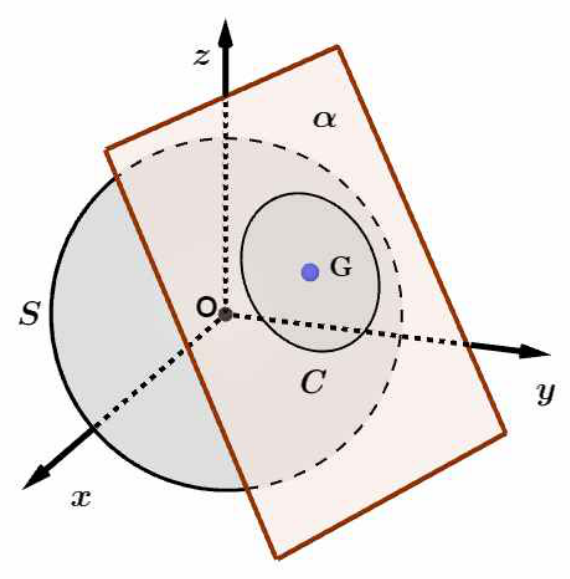
좌표공간에서 구 S:x2+y2+z2=9\displaystyle S:x^2+y^2+z^2=9와 세 점 (k,0,0),(0,k,0),(0,0,k)\displaystyle (k,0,0),(0,k,0),(0,0,k) (단, 0<k<33\displaystyle 0<k<3\sqrt3)을 지나는 평면 α\displaystyle \alpha가 만나서 생기는 원을 C\displaystyle C라 하자. 원 C\displaystyle C의 중심을 G\displaystyle \mathrm{G}라 하고 반지름의 길이를 r\displaystyle r라 하자.(단, O\displaystyle \mathrm{O}는 원점)

구 S와 평면 α의 교선인 원 C

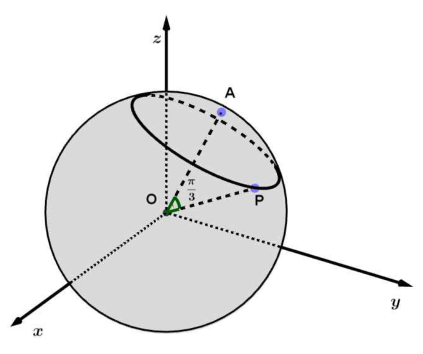
[논제 1] 구 S\displaystyle S 위에 한 점 A\displaystyle \mathrm{A}가 있다. 점 P\displaystyle \mathrm{P}가 ∠AOP=π3\displaystyle \angle\mathrm{AOP}=\frac\pi3를 만족시키며 S\displaystyle S 위를 움직일 때,점 P\displaystyle \mathrm{P}로 이루어지는 곡선의 길이를 구하시오. (15점)

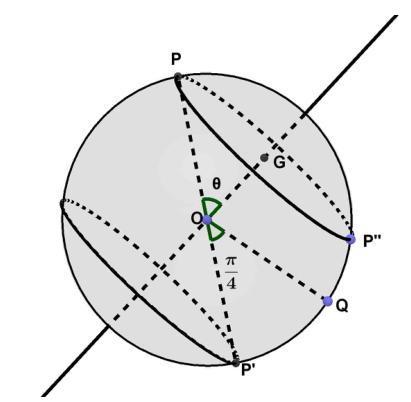
[논제 2] k=3\displaystyle k=3이라 하자. 원 C\displaystyle C 위의 점 P\displaystyle \mathrm{P}에 대하여 직선 PO\displaystyle \mathrm{PO}가 구 S\displaystyle S와 만나는 점을 P′\displaystyle \mathrm{P}^{\prime} (P≠P′\displaystyle \mathrm{P}\ne\mathrm{P}^{\prime})이라 하고 직선 PG\displaystyle \mathrm{PG}가 구 S\displaystyle S와 만나는 점을 P′′\displaystyle \mathrm{P}^{\prime\prime} (P≠P′′\displaystyle \mathrm{P}\ne\mathrm{P}^{\prime\prime})이라 할 때, 구 S\displaystyle S 위의 점 Q\displaystyle \mathrm{Q}가 다음 조건을 만족시킨다.

(1) 점 Q\displaystyle \mathrm{Q}는 중심이 O\displaystyle \mathrm{O}이고 점 P′′\displaystyle \mathrm{P}^{\prime\prime}을 포함하는 호 PP′⌢\displaystyle \overset{\frown}{\mathrm{PP}^{\prime}} 위에 있다.(2) ∠POQ=3∠P′OQ\displaystyle \angle\mathrm{POQ}=3\angle\mathrm{P}^{\prime}\mathrm{OQ}

점 P\displaystyle \mathrm{P}가 원 C\displaystyle C 위를 움직일 때 점 Q\displaystyle \mathrm{Q}로 이루어지는 곡선의 길이는 a(2+1)π\displaystyle a(\sqrt2+1)\pi이다.a\displaystyle a의 값을 구하시오. (20점)

[논제 3] 점 G\displaystyle \mathrm{G}를 지나고 벡터 u⃗=(1,2,3)\displaystyle \vec u=(1,2,3)에 평행한 직선 위의 점 B\displaystyle \mathrm{B}가 ∣GB→∣=273r\displaystyle |\overrightarrow{\mathrm{GB}}|=\frac{2\sqrt7}3r를 만족시킨다.원 C\displaystyle C 위를 움직이는 점 R\displaystyle \mathrm{R}에 대하여 ∣BR→∣\displaystyle |\overrightarrow{\mathrm{BR}}|의 최솟값이 53\displaystyle \frac53일 때, k\displaystyle k의 값을 구하시오. (20점)

해설강의 준비중
+10점 · 구하려는 곡선이 반지름의 길이가 332\displaystyle \frac{3\sqrt3}2인 원임을 제시

[논제 1] 점 P\displaystyle \mathrm{P}는 구 S\displaystyle S 위에 있고 ∠AOP=π3\displaystyle \angle\mathrm{AOP}=\frac\pi3인 점이므로점 P\displaystyle \mathrm{P}로 이루어지는 곡선은 중심이 선분 OA\displaystyle \mathrm{OA} 위에 있고반지름의 길이가 3sin⁡π3=332\displaystyle 3\sin\frac\pi3=\frac{3\sqrt3}2인 원이다.

각 AOP가 π/3인 구 위의 점 P의 자취
+5점 · 구하려는 곡선의 길이가 33π\displaystyle 3\sqrt3\pi임을 제시

따라서 구하려는 곡선의 길이는2×332×π=33π\displaystyle 2\times\frac{3\sqrt3}2\times\pi=3\sqrt3\pi이다.

+5점 · r=6\displaystyle r=\sqrt6 제시

[논제 2] 평면 α\displaystyle \alpha의 방정식은 x+y+z=3\displaystyle x+y+z=3이다. 점 O\displaystyle \mathrm{O}와 평면 α\displaystyle \alpha사이의 거리는 3\displaystyle \sqrt3이므로r=9−3=6\displaystyle r=\sqrt{9-3}=\sqrt6이다. 또한 ∠GOP=θ\displaystyle \angle\mathrm{GOP}=\theta라 하면sin⁡θ=63,cos⁡θ=33\displaystyle \sin\theta=\frac{\sqrt6}3,\quad\cos\theta=\frac{\sqrt3}3

+5점 · ∠GOQ\displaystyle \angle\mathrm{GOQ}가 일정한 값임을 제시

이다. ∠POP′=π\displaystyle \angle\mathrm{POP}^{\prime}=\pi이므로 ∠POQ=3∠P′OQ\displaystyle \angle\mathrm{POQ}=3\angle\mathrm{P}^{\prime}\mathrm{OQ}인점 Q\displaystyle \mathrm{Q}는 ∠POQ=3π4\displaystyle \angle\mathrm{POQ}=\frac{3\pi}4를 만족시킨다.이로부터 ∠GOQ\displaystyle \angle\mathrm{GOQ}는 일정한 값 3π4−θ\displaystyle \frac{3\pi}4-\theta이므로점 Q\displaystyle \mathrm{Q}로 이루어지는 곡선은 평면 α\displaystyle \alpha와 평행한 원이다.

구 위의 점 P, P′, P″, Q와 각 GOQ
+10점 · a=6\displaystyle a=\sqrt6 제시

sin⁡(3π4−θ)=sin⁡3π4cos⁡θ−cos⁡3π4sin⁡θ=22(63+33)\displaystyle \begin{aligned}\sin\left(\frac{3\pi}4-\theta\right)&=\sin\frac{3\pi}4\cos\theta-\cos\frac{3\pi}4\sin\theta\\&=\frac{\sqrt2}2\left(\frac{\sqrt6}3+\frac{\sqrt3}3\right)\end{aligned}으로부터 점 Q\displaystyle \mathrm{Q}로 이루어지는 원의 반지름의 길이는 3sin⁡(3π4−θ)=6(2+1)2\displaystyle 3\sin\left(\frac{3\pi}4-\theta\right)=\frac{\sqrt6(\sqrt2+1)}2이고, 이 원의 길이는 6(2+1)π\displaystyle \sqrt6(\sqrt2+1)\pi이다. 따라서 a=6\displaystyle a=\sqrt6이다.

+4점 · r=27−k23\displaystyle r=\frac{\sqrt{27-k^2}}{\sqrt3} 제시

[논제 3] 평면 α\displaystyle \alpha의 방정식은 x+y+z=k\displaystyle x+y+z=k이다. 점 O\displaystyle \mathrm{O}와 평면 α\displaystyle \alpha사이의 거리는 k3\displaystyle \frac k{\sqrt3}이므로r=9−k23=27−k23\displaystyle r=\sqrt{9-\frac{k^2}3}=\frac{\sqrt{27-k^2}}{\sqrt3} … ①

+6점 · ∣BB′→∣=263r\displaystyle |\overrightarrow{\mathrm{BB}^{\prime}}|=\frac{2\sqrt6}3r, ∣GB′→∣=23r\displaystyle |\overrightarrow{\mathrm{GB}^{\prime}}|=\frac23r 제시

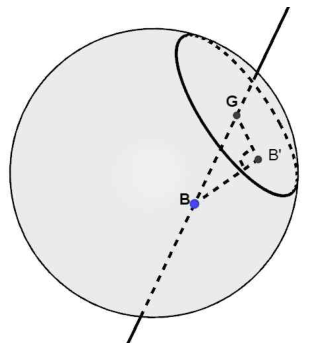
이다. GB→=(t,2t,3t)\displaystyle \overrightarrow{\mathrm{GB}}=(t,2t,3t) (t\displaystyle t는 실수)라 하면점 B\displaystyle \mathrm{B}의 조건 14∣t∣=273r\displaystyle \sqrt{14}|t|=\frac{2\sqrt7}3r로부터t=23r\displaystyle t=\frac{\sqrt2}3r 또는 t=−23r\displaystyle t=-\frac{\sqrt2}3r … ②를 얻는다. 이제 점 B\displaystyle \mathrm{B}에서 평면 α\displaystyle \alpha에 내린 수선의 발을B′\displaystyle \mathrm{B}^{\prime}이라 하면, BB′→\displaystyle \overrightarrow{\mathrm{BB}^{\prime}}은 v⃗=(1,1,1)\displaystyle \vec v=(1,1,1)과 평행하고GB′→\displaystyle \overrightarrow{\mathrm{GB}^{\prime}}은 v⃗=(1,1,1)\displaystyle \vec v=(1,1,1)에 수직이다. 따라서 실수 s\displaystyle s가 존재하여

그림 1 평면에 내린 수선의 발 B′

[그림 1]

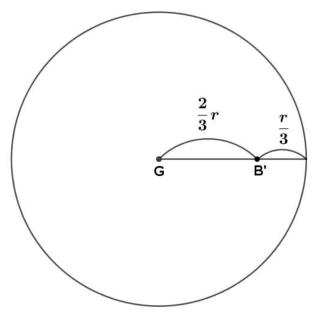
BB′→=(s,s,s)\displaystyle \overrightarrow{\mathrm{BB}^{\prime}}=(s,s,s)GB′→=GB→+BB′→=(t+s,2t+s,3t+s)\displaystyle \overrightarrow{\mathrm{GB}^{\prime}}=\overrightarrow{\mathrm{GB}}+\overrightarrow{\mathrm{BB}^{\prime}}=(t+s,2t+s,3t+s)(t+s,2t+s,3t+s)⋅(1,1,1)=0\displaystyle (t+s,2t+s,3t+s)\cdot(1,1,1)=0이 성립한다. 따라서 s=−2t\displaystyle s=-2t이다. 그러므로t=23r,  s=−223r\displaystyle t=\frac{\sqrt2}3r,\;s=-\frac{2\sqrt2}3r 또는 t=−23r,  s=223r\displaystyle t=-\frac{\sqrt2}3r,\;s=\frac{2\sqrt2}3r이다. 따라서BB′→=−223r(1,1,1),GB′→=23r(−1,0,1)\displaystyle \overrightarrow{\mathrm{BB}^{\prime}}=-\frac{2\sqrt2}3r(1,1,1),\quad\overrightarrow{\mathrm{GB}^{\prime}}=\frac{\sqrt2}3r(-1,0,1)또는BB′→=223r(1,1,1),GB′→=−23r(−1,0,1)\displaystyle \overrightarrow{\mathrm{BB}^{\prime}}=\frac{2\sqrt2}3r(1,1,1),\quad\overrightarrow{\mathrm{GB}^{\prime}}=-\frac{\sqrt2}3r(-1,0,1)이다. 그러므로∣BB′→∣=263r,∣GB′→∣=23r\displaystyle |\overrightarrow{\mathrm{BB}^{\prime}}|=\frac{2\sqrt6}3r,\quad|\overrightarrow{\mathrm{GB}^{\prime}}|=\frac23r … ③이다.

그림 2 원의 중심 G와 B′의 위치

[그림 2]

+10점 · k=26\displaystyle k=2\sqrt6 제시

[그림 1]과 [그림 2]로부터 ∣BR→∣\displaystyle |\overrightarrow{\mathrm{BR}}|의 최솟값은 ∣BB′→∣2+(r−∣GB′→∣)2\displaystyle \sqrt{|\overrightarrow{\mathrm{BB}^{\prime}}|^2+(r-|\overrightarrow{\mathrm{GB}^{\prime}}|)^2}임을 알 수 있고, ③, ①과 문제의 조건으로부터8r23+(r−2r3)2=5r3=53×27−k23=53\displaystyle \sqrt{\frac{8r^2}3+\left(r-\frac{2r}3\right)^2}=\frac{5r}3=\frac53\times\frac{\sqrt{27-k^2}}{\sqrt3}=\frac53이므로 k=26\displaystyle k=2\sqrt6이다.

예시 답안의 내용 및 평가 기준의 내용과는 일치하지 않더라도 기술한 내용이 논리적으로 타당한 경우에는 평가위원의 판단에 따라 부분 점수를 부여할 수 있음.

첨삭 사례

아직 등록된 첨삭 사례가 없습니다.

질문과 답변 · 0개질문과 답변 · 고정 0개

아직 등록된 질문이 없습니다. 질문 작성은 멤버십 회원만 가능합니다.