수리논술, 배움에서 논증의 완성까지.

자연계열 2번

문제

🔒
짧은 시간에 너무 많은 문제를 여셔서 열람을 잠시 제한했습니다. 잠시 후 다시 시도하시거나 로그인해 주세요.
해설강의 준비중
+5점 · 점 P(0,6,6)\displaystyle \mathrm{P}(0,-6,6)을 제시

[논제 1]P\displaystyle \mathrm{P}는 평면 α\displaystyle \alpha의 법선벡터 (1,1,2)\displaystyle (1,-1,2)를 방향벡터로 하고 점 (1,5,4)\displaystyle (-1,-5,4)를 지나는 직선 위에 있고,또한 평면 γ\displaystyle \gamma의 법선벡터 (1,1,10)\displaystyle (1,1,-10)을 방향벡터로 하고 점 (1,5,4)\displaystyle (1,-5,-4)를 지나는 직선 위에도 있다.따라서 두 직선의 방정식x+1=y+51=z42,x1=y+5=z+410\displaystyle x+1=\frac{y+5}{-1}=\frac{z-4}2,\quad x-1=y+5=\frac{z+4}{-10}을 연립하여 풀면 P(0,6,6)\displaystyle \mathrm{P}(0,-6,6)을 얻는다. 또한

PQ1PQ2=(PO1+O1Q1)(PO1+O1Q2)=PO12+(O1Q1O1Q2)\displaystyle \begin{aligned}\overrightarrow{\mathrm{PQ_1}}\cdot\overrightarrow{\mathrm{PQ_2}}&=(\overrightarrow{\mathrm{PO_1}}+\overrightarrow{\mathrm{O_1Q_1}})\cdot(\overrightarrow{\mathrm{PO_1}}+\overrightarrow{\mathrm{O_1Q_2}})\\&=|\overrightarrow{\mathrm{PO_1}}|^2+(\overrightarrow{\mathrm{O_1Q_1}}\cdot\overrightarrow{\mathrm{O_1Q_2}})\end{aligned}이고 점 P\displaystyle \mathrm{P}에서 평면 β\displaystyle \beta 사이의 거리가 PO1\displaystyle |\overrightarrow{\mathrm{PO_1}}|이므로PO1=62=32\displaystyle |\overrightarrow{\mathrm{PO_1}}|=\frac6{\sqrt2}=3\sqrt2이다. 따라서 O1Q1O1Q2\displaystyle \overrightarrow{\mathrm{O_1Q_1}}\cdot\overrightarrow{\mathrm{O_1Q_2}}의 최솟값을 구하면 된다.

+10점 · θ1=π3\displaystyle \theta_1=\frac\pi3일 때 최솟값을 가짐을 제시

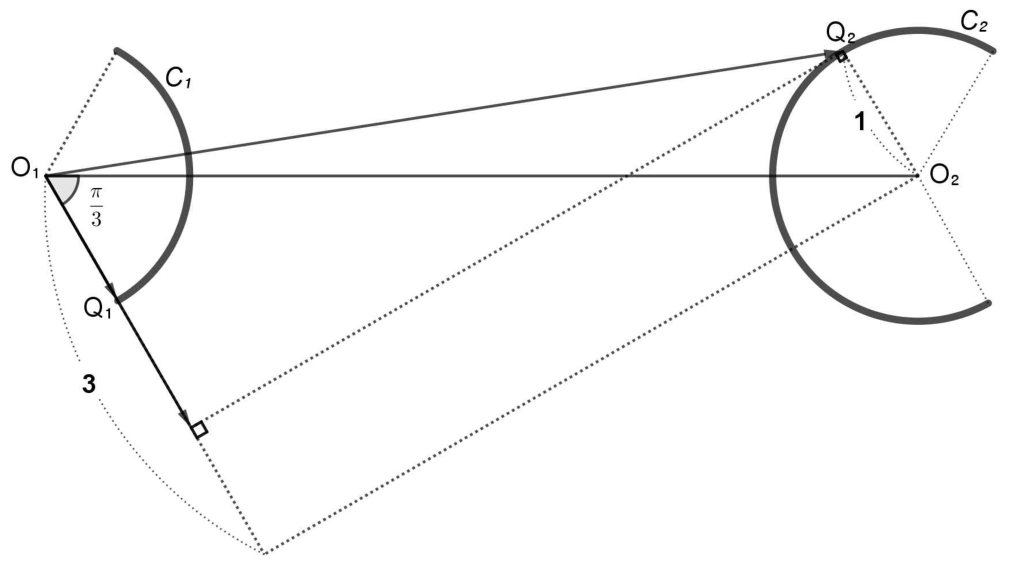
두 벡터 O1O2,O1Q1\displaystyle \overrightarrow{\mathrm{O_1O_2}},\overrightarrow{\mathrm{O_1Q_1}}가 이루는 각의 크기를 θ1\displaystyle \theta_1이라할 때3O1O2O1Q1=O1O2O1Q1cosθ1=6cosθ1\displaystyle 3\le\overrightarrow{\mathrm{O_1O_2}}\cdot\overrightarrow{\mathrm{O_1Q_1}}=|\overrightarrow{\mathrm{O_1O_2}}||\overrightarrow{\mathrm{O_1Q_1}}|\cos\theta_1=6\cos\theta_1이므로 cosθ112\displaystyle \cos\theta_1\ge\frac12이다. 즉, 0θ1π3\displaystyle 0\le\theta_1\le\frac\pi3. 마찬가지로 두 벡터 O1O2,O2Q2\displaystyle \overrightarrow{\mathrm{O_1O_2}},\overrightarrow{\mathrm{O_2Q_2}}가 이루는 각의 크기 θ2\displaystyle \theta_2의 범위는 π3θ2π\displaystyle \frac\pi3\le\theta_2\le\pi이다. 따라서 O1Q1\displaystyle \overrightarrow{\mathrm{O_1Q_1}}O1Q2\displaystyle \overrightarrow{\mathrm{O_1Q_2}}가 이루는 각의 크기를 θ\displaystyle \theta라 할 때O1Q1O1Q2=O1Q2cosθ\displaystyle \overrightarrow{\mathrm{O_1Q_1}}\cdot\overrightarrow{\mathrm{O_1Q_2}}=|\overrightarrow{\mathrm{O_1Q_2}}|\cos\theta=(점 O1으로부터 점 Q2에서 직선 O1Q1에 내린 수선의 발까지의 거리)\displaystyle =(\text{점 }\mathrm{O}_1\text{으로부터 점 }\mathrm{Q}_2\text{에서 직선 }\mathrm{O}_1\mathrm{Q}_1\text{에 내린 수선의 발까지의 거리})이다. 따라서 θ1\displaystyle \theta_1이 증가할 때 O1Q1O1Q2\displaystyle \overrightarrow{\mathrm{O_1Q_1}}\cdot\overrightarrow{\mathrm{O_1Q_2}}는 감소하므로, [그림 1]과 같이 θ1=π3\displaystyle \theta_1=\frac\pi3일 때 최솟값 2\displaystyle 2를 갖는다.

+5점 · 답 20\displaystyle 20을 제시

그러므로 PQ1PQ2\displaystyle \overrightarrow{\mathrm{PQ_1}}\cdot\overrightarrow{\mathrm{PQ_2}}의 최솟값은 20\displaystyle 20이다.

그림 1 두 원 위의 점과 내적의 최솟값

[그림 1]

+5점 · 최대 입체도형 E\displaystyle E가 비스듬히 잘린 원기둥임을 제시 +5점 · 구하는 정사영의 넓이가 타원과 평행사변형의 정사영의 넓이를 구해야 함을 제시

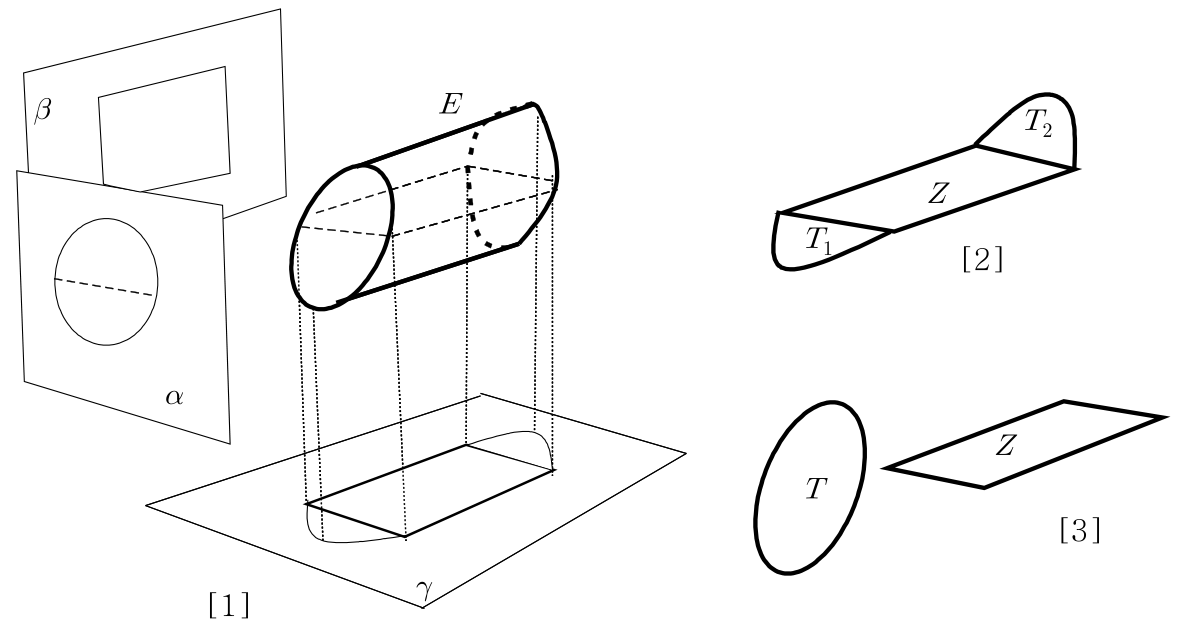
[논제 2] 평면 α\displaystyle \alpha 위로의 정사영의 지름의 길이와 β\displaystyle \beta 위로의 정사영의 한 변의 길이가 서로 같기 때문에, γ\displaystyle \gamma위로의 정사영의 넓이가 최대가 되는 입체도형은 그림 [1]과 같이 비스듬히 잘린 원기둥이다. 입체도형 E\displaystyle E를 이 원기둥이라 하자. 따라서 E\displaystyle E의 평면 γ\displaystyle \gamma위로의 정사영은 그림 [2]와 같이 평행사변형 Z\displaystyle Z와 양 쪽에 붙은 T1\displaystyle T_1T2\displaystyle T_2γ\displaystyle \gamma위로의 정사영과 같다. 그림 [3]과 같이 T1\displaystyle T_1T2\displaystyle T_2를 같은 쪽으로 이동하여 붙이면 타원 T\displaystyle T가 되므로, T\displaystyle T와 평행사변형 Z\displaystyle Zγ\displaystyle \gamma위로의 정사영의 넓이를 구하면 된다.

그림 1~3 입체도형 E, 타원 T와 평행사변형 Z
+5점 · 타원의 법선벡터 n=k(2,3,3)\displaystyle \vec n=k(2,-3,3) (k\displaystyle k는 상수)를 제시

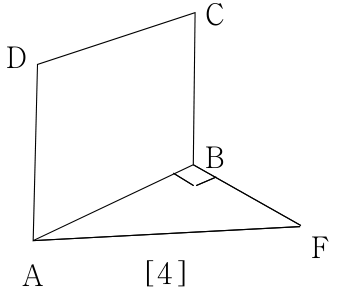
평면 β\displaystyle \beta 위로의 정사영인 정사각형 ABCD\displaystyle \mathrm{ABCD}의 각 변들은 T\displaystyle T를 포함하는 평면에 평행하거나 수직이므로, 수직인 변 중 하나를 AB\displaystyle \mathrm{AB}라 하자. 그림 [4]와 같이 평면 α\displaystyle \alpha에 수직이고 점 A\displaystyle \mathrm{A}를 지나는 직선과 평면 β\displaystyle \beta에 수직이고 점 B\displaystyle \mathrm{B}를 지나는 직선이 만나는 점을 F\displaystyle \mathrm{F}라 하자. =AF\displaystyle \ell=|\overrightarrow{\mathrm{AF}}|라 하면 제시문 (라)에 의하여AF=6(1,1,2)\displaystyle \overrightarrow{\mathrm{AF}}=\frac\ell{\sqrt6}(1,-1,2)이고 FB=26(0,1,1)\displaystyle \overrightarrow{\mathrm{FB}}=\frac\ell{2\sqrt6}(0,-1,-1) 또는AF=6(1,1,2)\displaystyle \overrightarrow{\mathrm{AF}}=-\frac\ell{\sqrt6}(1,-1,2)이고 FB=26(0,1,1)\displaystyle \overrightarrow{\mathrm{FB}}=-\frac\ell{2\sqrt6}(0,-1,-1)

그림 4 정사각형 ABCD와 점 F

이다. 따라서AB=AF+FB=26(2,3,3)\displaystyle \overrightarrow{\mathrm{AB}}=\overrightarrow{\mathrm{AF}}+\overrightarrow{\mathrm{FB}}=\frac\ell{2\sqrt6}(2,-3,3) 또는 AB=26(2,3,3)\displaystyle \overrightarrow{\mathrm{AB}}=-\frac\ell{2\sqrt6}(2,-3,3)이다. 그러므로 T\displaystyle T를 포함하는 평면의 법선벡터를 n=(2,3,3)\displaystyle \vec n=(2,-3,3)으로 두자.

+5점 · 타원의 넓이와 평행사변형의 넓이를 제시

타원 T\displaystyle T를 포함하는 평면과 α\displaystyle \alpha가 이루는 각의 크기를 θ1\displaystyle \theta_1이라 하면 (T의 넓이)×cosθ1=π\displaystyle (T\text{의 넓이})\times\cos\theta_1=\pi이고,법선벡터 n\displaystyle \vec nα\displaystyle \alpha의 법선벡터 (1,1,2)\displaystyle (1,-1,2)가 이루는 각의 크기도 θ1\displaystyle \theta_1이므로 제시문 (다)에 의해(T의 넓이)=πcosθ1=233π11\displaystyle (T\text{의 넓이})=\frac\pi{\cos\theta_1}=\frac{2\sqrt{33}\pi}{11}이다. 따라서 평면 γ\displaystyle \gammaT\displaystyle T를 포함하는 평면이 이루는 각의 크기를 θ2\displaystyle \theta_2라 하면 cosθ2=3121151\displaystyle \cos\theta_2=\frac{31}{2\sqrt{11}\sqrt{51}}이므로(T의 γ위로의 정사영의 넓이)=311117π\displaystyle (T\text{의 }\gamma\text{위로의 정사영의 넓이})=\frac{31}{11\sqrt{17}}\pi

이제 평행사변형 Z\displaystyle Z의 넓이를 구하자. Z\displaystyle Z의 높이는 2\displaystyle 2이므로 밑변의 길이 \displaystyle \ell을 구하면 된다. Z\displaystyle Z의 밑변은 α\displaystyle \alpha의 법선벡터 (1,1,2)\displaystyle (1,-1,2)와 평행하고 Z\displaystyle Zβ\displaystyle \beta로의 정사영은 법선벡터 n\displaystyle \vec n과 평행하므로=2cosθ1=43311\displaystyle \ell=\frac2{\cos\theta_1}=\frac{4\sqrt{33}}{11}이다. 따라서 (Z의 넓이)=83311\displaystyle (Z\text{의 넓이})=\frac{8\sqrt{33}}{11}이다. 평면 γ\displaystyle \gammaZ\displaystyle Z를 포함하는 평면이 이루는 각의 크기를 θ3\displaystyle \theta_3라 하면 (90θ3)\displaystyle (90^\circ-\theta_3)α\displaystyle \alpha의 법선벡터 (1,1,2)\displaystyle (1,-1,2)γ\displaystyle \gamma의 법선벡터 (1,1,10)\displaystyle (1,1,-10)이 이루는 각의 크기이므로 cos(90θ3)=206102\displaystyle \cos(90^\circ-\theta_3)=\frac{20}{\sqrt6\sqrt{102}}이다. 그러므로(Z의 γ위로의 정사영의 넓이)=(Z의 넓이)×cosθ3=83159187\displaystyle (Z\text{의 }\gamma\text{위로의 정사영의 넓이})=(Z\text{의 넓이})\times\cos\theta_3=\frac83\sqrt{\frac{159}{187}}

+5점 · 정답을 제시

이다. 결국 (E의 γ위로의 정사영의 넓이)=311117π+83159187\displaystyle (E\text{의 }\gamma\text{위로의 정사영의 넓이})=\frac{31}{11\sqrt{17}}\pi+\frac83\sqrt{\frac{159}{187}}이다.

예시 답안의 내용 및 평가 기준의 내용과는 일치하지 않더라도 기술한 내용이 논리적으로 타당한 경우에는 평가위원의 판단에 따라 부분 점수를 부여할 수 있음.

첨삭 사례

아직 등록된 첨삭 사례가 없습니다.

질문과 답변 · 0개질문과 답변 · 고정 0개

아직 등록된 질문이 없습니다. 질문 작성은 멤버십 회원만 가능합니다.