+6점 · f ( x ) = ln ( x 2 + 3 ) − ln 4 \displaystyle f(x)=\ln(x^2+3)-\ln4 f ( x ) = ln ( x 2 + 3 ) − ln 4 [논제 1] 먼저 f ( x ) = ∫ 1 x 2 t t 2 + 3 d t = ln ( x 2 + 3 ) − ln 4 = ln x 2 + 3 4 \displaystyle f(x)=\int_1^x\frac{2t}{t^2+3}\,dt=\ln(x^2+3)-\ln4=\ln\frac{x^2+3}4 f ( x ) = ∫ 1 x t 2 + 3 2 t d t = ln ( x 2 + 3 ) − ln 4 = ln 4 x 2 + 3
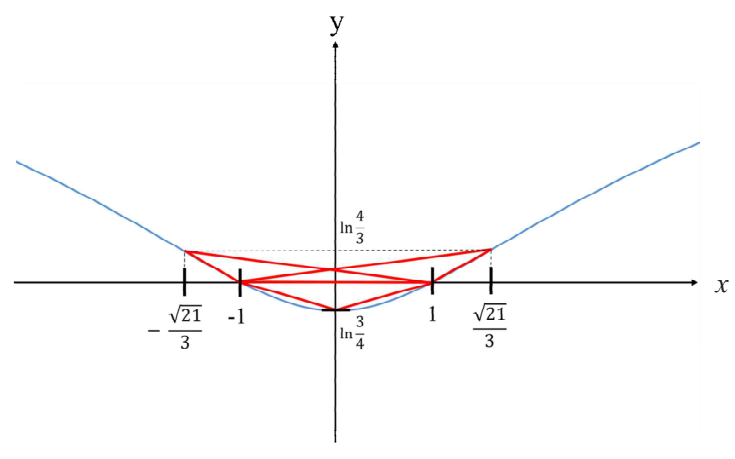
+9점 · 정답을 제시 (각 3점씩) 곡선 y = f ( x ) \displaystyle y=f(x) y = f ( x ) x \displaystyle x x x \displaystyle x x − 1 , 1 \displaystyle -1,1 − 1 , 1 2 \displaystyle 2 2 ∣ ln t 2 + 3 4 ∣ \displaystyle \left|\ln\frac{t^2+3}4\right| ln 4 t 2 + 3 (삼각형 넓이) = ∣ ln t 2 + 3 4 ∣ = ln 4 3 \displaystyle =\left|\ln\frac{t^2+3}4\right|=\ln\frac43 = ln 4 t 2 + 3 = ln 3 4 에서 t = 0 , 21 3 , − 21 3 \displaystyle t=0,\frac{\sqrt{21}}3,-\frac{\sqrt{21}}3 t = 0 , 3 21 , − 3 21 이다.
+3점 · g ′ ( x ) = a − 16 x ( x 2 + 3 ) 2 \displaystyle g^{\prime}(x)=a-\frac{16x}{(x^2+3)^2} g ′ ( x ) = a − ( x 2 + 3 ) 2 16 x [논제 2] 먼저 g ( x ) \displaystyle g(x) g ( x ) α < β \displaystyle \alpha<\beta α < β g ( α ) > g ( β ) \displaystyle g(\alpha)>g(\beta) g ( α ) > g ( β ) “함수 g ( x ) \displaystyle g(x) g ( x ) x = α \displaystyle x=\alpha x = α x = β \displaystyle x=\beta x = β 와 필요충분조건이다. 함수 g ′ ( x ) = a − 16 x ( x 2 + 3 ) 2 \displaystyle g^{\prime}(x)=a-\frac{16x}{(x^2+3)^2} g ′ ( x ) = a − ( x 2 + 3 ) 2 16 x
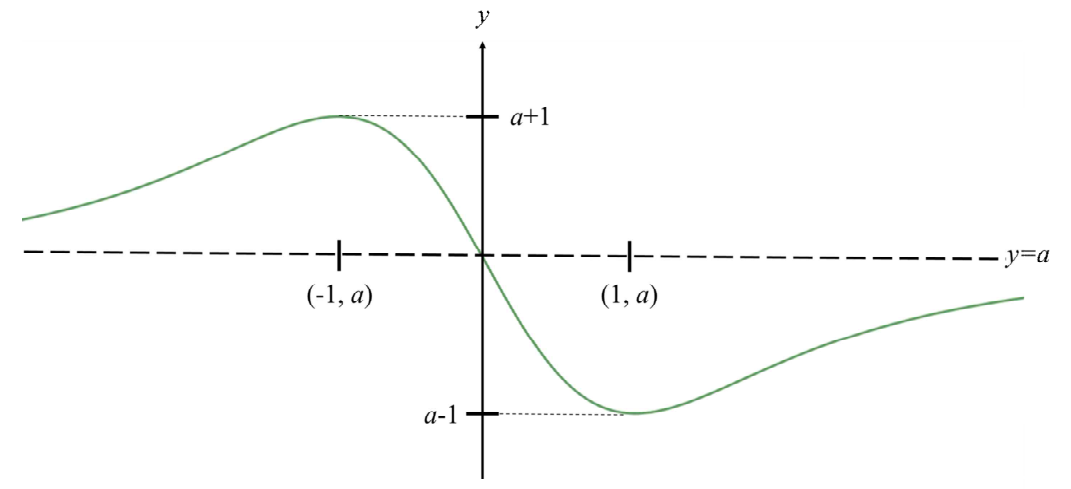
+7점 · 두 개의 극값을 갖는 a \displaystyle a a g ′ ′ ( x ) = − 16 ( x 2 + 3 ) 2 − 64 x 2 ( x 2 + 3 ) ( x 2 + 3 ) 4 = 48 ( x 2 − 1 ) ( x 2 + 3 ) 3 \displaystyle g^{\prime\prime}(x)=-\frac{16(x^2+3)^2-64x^2(x^2+3)}{(x^2+3)^4}=\frac{48(x^2-1)}{(x^2+3)^3} g ′′ ( x ) = − ( x 2 + 3 ) 4 16 ( x 2 + 3 ) 2 − 64 x 2 ( x 2 + 3 ) = ( x 2 + 3 ) 3 48 ( x 2 − 1 ) 이므로 g ′ ( x ) \displaystyle g^{\prime}(x) g ′ ( x ) x = − 1 \displaystyle x=-1 x = − 1 a + 1 \displaystyle a+1 a + 1 x = 1 \displaystyle x=1 x = 1 a − 1 \displaystyle a-1 a − 1 한편 g ′ ( 0 ) = a \displaystyle g^{\prime}(0)=a g ′ ( 0 ) = a { g ′ ( x ) < a ( x > 0 ) g ′ ( x ) > a ( x < 0 ) , lim x → ± ∞ g ′ ( x ) = a \displaystyle \begin{cases}g^{\prime}(x)<a&(x>0)\\g^{\prime}(x)>a&(x<0)\end{cases},\quad\lim_{x\to\pm\infty}g^{\prime}(x)=a { g ′ ( x ) < a g ′ ( x ) > a ( x > 0 ) ( x < 0 ) , x → ± ∞ lim g ′ ( x ) = a 이므로 함수 g ′ ( x ) \displaystyle g^{\prime}(x) g ′ ( x )
(y = g ′ ( x ) \displaystyle y=g^{\prime}(x) y = g ′ ( x )
+10점 · 정답을 제시 그러므로 함수 g ( x ) \displaystyle g(x) g ( x ) x = α \displaystyle x=\alpha x = α x = β \displaystyle x=\beta x = β α < β \displaystyle \alpha<\beta α < β x \displaystyle x x y = a − 1 \displaystyle y=a-1 y = a − 1 y = a \displaystyle y=a y = a a − 1 < 0 < a \displaystyle a-1<0<a a − 1 < 0 < a 즉 0 < a < 1 \displaystyle 0<a<1 0 < a < 1
(별해) g ′ ( x ) = a ( x 2 + 3 ) 2 − 16 x ( x 2 + 3 ) 2 \displaystyle g^{\prime}(x)=\frac{a(x^2+3)^2-16x}{(x^2+3)^2} g ′ ( x ) = ( x 2 + 3 ) 2 a ( x 2 + 3 ) 2 − 16 x x = α , β \displaystyle x=\alpha,\beta x = α , β G ( x ) = a ( x 2 + 3 ) 2 − 16 x \displaystyle G(x)=a(x^2+3)^2-16x G ( x ) = a ( x 2 + 3 ) 2 − 16 x x = α , β \displaystyle x=\alpha,\beta x = α , β G ( x ) \displaystyle G(x) G ( x ) x = α , β \displaystyle x=\alpha,\beta x = α , β Caution. g ′ ( x ) = G ( x ) ( x 2 + 3 ) 2 \displaystyle g^{\prime}(x)=\frac{G(x)}{(x^2+3)^2} g ′ ( x ) = ( x 2 + 3 ) 2 G ( x ) g ′ \displaystyle g^{\prime} g ′ G \displaystyle G G g \displaystyle g g G ( x ) = 0 \displaystyle G(x)=0 G ( x ) = 0
+5점 · h ( 0 ) = 16 9 , h ( 1 ) = − 1 \displaystyle h(0)=\frac{16}9,h(1)=-1 h ( 0 ) = 9 16 , h ( 1 ) = − 1 [논제 3] g ′ ( x ) = a − 16 x ( x 2 + 3 ) 2 \displaystyle g^{\prime}(x)=a-\frac{16x}{(x^2+3)^2} g ′ ( x ) = a − ( x 2 + 3 ) 2 16 x g ′ ′ ( x ) = − 16 ( x 2 + 3 ) 2 + 64 x 2 ( x 2 + 3 ) 3 \displaystyle g^{\prime\prime}(x)=-\frac{16}{(x^2+3)^2}+\frac{64x^2}{(x^2+3)^3} g ′′ ( x ) = − ( x 2 + 3 ) 2 16 + ( x 2 + 3 ) 3 64 x 2 f ( − 1 ) = 0 , g ( 1 ) = a + 2 , g ′ ( − 1 ) = a + 1 , g ′ ′ ( 0 ) = − 16 9 \displaystyle f(-1)=0,\quad g(1)=a+2,\quad g^{\prime}(-1)=a+1,\quad g^{\prime\prime}(0)=-\frac{16}9 f ( − 1 ) = 0 , g ( 1 ) = a + 2 , g ′ ( − 1 ) = a + 1 , g ′′ ( 0 ) = − 9 16 이다. 조건 (1)과 (2)에 의하여 h ( 0 ) = 16 9 , h ( 1 ) = g ′ ( − 1 ) − g ( 1 ) = − 1 \displaystyle h(0)=\frac{16}9,\quad h(1)=g^{\prime}(-1)-g(1)=-1 h ( 0 ) = 9 16 , h ( 1 ) = g ′ ( − 1 ) − g ( 1 ) = − 1 이다.
+5점 · ∫ 0 π 2 sin 2 x h ( cos x ) ( 3 + cos 2 x ) 2 d x = ∫ 0 1 2 u h ( u ) ( u 2 + 3 ) 2 d u \displaystyle \int_0^{\frac\pi2}\frac{\sin2x\,h(\cos x)}{(3+\cos^2x)^2}\,dx=\int_0^1\frac{2u\,h(u)}{(u^2+3)^2}\,du ∫ 0 2 π ( 3 + cos 2 x ) 2 sin 2 x h ( cos x ) d x = ∫ 0 1 ( u 2 + 3 ) 2 2 u h ( u ) d u sin 2 x = 2 sin x cos x \displaystyle \sin2x=2\sin x\cos x sin 2 x = 2 sin x cos x cos x = u \displaystyle \cos x=u cos x = u ∫ 0 π 2 sin 2 x h ( cos x ) ( 3 + cos 2 x ) 2 d x = ∫ 0 π 2 2 sin x cos x h ( cos x ) ( 3 + cos 2 x ) 2 d x = ∫ 0 1 2 u h ( u ) ( u 2 + 3 ) 2 d u \displaystyle \int_0^{\frac\pi2}\frac{\sin2x\,h(\cos x)}{(3+\cos^2x)^2}\,dx=\int_0^{\frac\pi2}\frac{2\sin x\cos x\,h(\cos x)}{(3+\cos^2x)^2}\,dx=\int_0^1\frac{2u\,h(u)}{(u^2+3)^2}\,du ∫ 0 2 π ( 3 + cos 2 x ) 2 sin 2 x h ( cos x ) d x = ∫ 0 2 π ( 3 + cos 2 x ) 2 2 sin x cos x h ( cos x ) d x = ∫ 0 1 ( u 2 + 3 ) 2 2 u h ( u ) d u 이다.
+10점 · 정답을 제시 여기서 k ( u ) = 1 u 2 + 3 \displaystyle k(u)=\frac1{u^2+3} k ( u ) = u 2 + 3 1 k ′ ( u ) = − 2 u ( u 2 + 3 ) 2 \displaystyle k^{\prime}(u)=-\frac{2u}{(u^2+3)^2} k ′ ( u ) = − ( u 2 + 3 ) 2 2 u 부분적분법을 이용하면 ∫ 0 1 2 u h ( u ) ( u 2 + 3 ) 2 d u = − ∫ 0 1 k ′ ( u ) h ( u ) d u = − [ k ( u ) h ( u ) ] 0 1 + ∫ 0 1 k ( u ) h ′ ( u ) d u = − k ( 1 ) h ( 1 ) + k ( 0 ) h ( 0 ) + ∫ 0 1 h ′ ( u ) u 2 + 3 d u = − 1 4 h ( 1 ) + 1 3 h ( 0 ) + ∫ 0 1 h ′ ( u ) u 2 + 3 d u = − 17 108 \displaystyle \begin{aligned}\int_0^1\frac{2u\,h(u)}{(u^2+3)^2}\,du&=-\int_0^1k^{\prime}(u)h(u)\,du\\&=-\Biggl[k(u)h(u)\Biggr]_0^1+\int_0^1k(u)h^{\prime}(u)\,du\\&=-k(1)h(1)+k(0)h(0)+\int_0^1\frac{h^{\prime}(u)}{u^2+3}\,du\\&=-\frac14h(1)+\frac13h(0)+\int_0^1\frac{h^{\prime}(u)}{u^2+3}\,du=-\frac{17}{108}\end{aligned} ∫ 0 1 ( u 2 + 3 ) 2 2 u h ( u ) d u = − ∫ 0 1 k ′ ( u ) h ( u ) d u = − [ k ( u ) h ( u ) ] 0 1 + ∫ 0 1 k ( u ) h ′ ( u ) d u = − k ( 1 ) h ( 1 ) + k ( 0 ) h ( 0 ) + ∫ 0 1 u 2 + 3 h ′ ( u ) d u = − 4 1 h ( 1 ) + 3 1 h ( 0 ) + ∫ 0 1 u 2 + 3 h ′ ( u ) d u = − 108 17 이다.
예시 답안의 내용 및 평가 기준의 내용과는 일치하지 않더라도 기술한 내용이 논리적으로 타당한 경우에는 평가위원의 판단에 따라 부분 점수를 부여할 수 있음.
 수리논술, 배움에서 논증의 완성까지.