+5점 · f ( x ) = a ( x 2 − 7 ) \displaystyle f(x)=a(x^2-7) f ( x ) = a ( x 2 − 7 ) [논제 1] f ( x ) = a x 2 + b x + c \displaystyle f(x)=ax^2+bx+c f ( x ) = a x 2 + b x + c a < 0 \displaystyle a<0 a < 0 g ′ ′ ( x ) = { a x 2 + ( 4 a + b ) x + 2 a + 2 b + c } e x \displaystyle g^{\prime\prime}(x)=\{ax^2+(4a+b)x+2a+2b+c\}e^x g ′′ ( x ) = { a x 2 + ( 4 a + b ) x + 2 a + 2 b + c } e x 조건 (1)에서 g ′ ′ ( 1 ) = g ′ ′ ( − 5 ) = 0 \displaystyle g^{\prime\prime}(1)=g^{\prime\prime}(-5)=0 g ′′ ( 1 ) = g ′′ ( − 5 ) = 0 4 a + b a = 4 , 2 a + 2 b + c a = − 5 \displaystyle \frac{4a+b}a=4,\quad\frac{2a+2b+c}a=-5 a 4 a + b = 4 , a 2 a + 2 b + c = − 5 이므로, b = 0 \displaystyle b=0 b = 0 c = − 7 a \displaystyle c=-7a c = − 7 a f ( x ) = a ( x 2 − 7 ) , g ( x ) = a ( x 2 − 7 ) e x \displaystyle f(x)=a(x^2-7),\quad g(x)=a(x^2-7)e^x f ( x ) = a ( x 2 − 7 ) , g ( x ) = a ( x 2 − 7 ) e x 또한 x = − 5 , 1 \displaystyle x=-5,1 x = − 5 , 1 g ′ ′ ( x ) \displaystyle g^{\prime\prime}(x) g ′′ ( x )
+10점 · − 1 2 e ≤ a \displaystyle -\frac1{2e}\le a − 2 e 1 ≤ a 조건 (2)에서 x > 0 \displaystyle x>0 x > 0 g ′ ( x ) ≤ 2 \displaystyle g^{\prime}(x)\le2 g ′ ( x ) ≤ 2 g ′ ( x ) = a ( x 2 + 2 x − 7 ) e x ≤ 2 \displaystyle g^{\prime}(x)=a(x^2+2x-7)e^x\le2 g ′ ( x ) = a ( x 2 + 2 x − 7 ) e x ≤ 2 이다. 따라서 x > 0 \displaystyle x>0 x > 0 ( x 2 + 2 x − 7 ) e x ≥ 2 a \displaystyle (x^2+2x-7)e^x\ge\frac2a ( x 2 + 2 x − 7 ) e x ≥ a 2 이다. 한편 m ( x ) = ( x 2 + 2 x − 7 ) e x \displaystyle m(x)=(x^2+2x-7)e^x m ( x ) = ( x 2 + 2 x − 7 ) e x m ′ ( x ) = ( x + 5 ) ( x − 1 ) e x \displaystyle m^{\prime}(x)=(x+5)(x-1)e^x m ′ ( x ) = ( x + 5 ) ( x − 1 ) e x m ′ ( x ) = 0 \displaystyle m^{\prime}(x)=0 m ′ ( x ) = 0 x = 1 \displaystyle x=1 x = 1 x = − 5 \displaystyle x=-5 x = − 5 x > 0 \displaystyle x>0 x > 0 m ( x ) \displaystyle m(x) m ( x )
x \displaystyle x x 0 \displaystyle 0 0 ⋯ \displaystyle \cdots ⋯ 1 \displaystyle 1 1 ⋯ \displaystyle \cdots ⋯ m ′ ( x ) \displaystyle m^{\prime}(x) m ′ ( x ) − \displaystyle - − 0 \displaystyle 0 0 + \displaystyle + + m ( x ) \displaystyle m(x) m ( x ) ↘ \displaystyle \searrow ↘ − 4 e \displaystyle -4e − 4 e ↗ \displaystyle \nearrow ↗
위 표로부터 x > 0 \displaystyle x>0 x > 0 m ( x ) \displaystyle m(x) m ( x ) x = 1 \displaystyle x=1 x = 1 m ( 1 ) = − 4 e \displaystyle m(1)=-4e m ( 1 ) = − 4 e 2 a ≤ − 4 e \displaystyle \frac2a\le-4e a 2 ≤ − 4 e a \displaystyle a a − 1 2 e ≤ a < 0 \displaystyle -\frac1{2e}\le a<0 − 2 e 1 ≤ a < 0
+5점 · 정답을 제시 f ( x ) = a ( x 2 − 7 ) \displaystyle f(x)=a(x^2-7) f ( x ) = a ( x 2 − 7 ) f ( 1 ) = − 6 a \displaystyle f(1)=-6a f ( 1 ) = − 6 a ①과 ②에서 f ( 1 ) = − 6 a ≤ 3 e \displaystyle f(1)=-6a\le\frac3e f ( 1 ) = − 6 a ≤ e 3 이다. 따라서 f ( 1 ) \displaystyle f(1) f ( 1 ) a = − 1 2 e \displaystyle a=-\frac1{2e} a = − 2 e 1 3 e \displaystyle \frac3e e 3
+3점 · k ′ ( x ) = h ′ ( x ) { h ( x ) − 1 } e h ( x ) \displaystyle k^{\prime}(x)=h^{\prime}(x)\{h(x)-1\}e^{h(x)} k ′ ( x ) = h ′ ( x ) { h ( x ) − 1 } e h ( x ) [논제 2] k ′ ( x ) = h ′ ( x ) { h ( x ) − 1 } e h ( x ) \displaystyle k^{\prime}(x)=h^{\prime}(x)\{h(x)-1\}e^{h(x)} k ′ ( x ) = h ′ ( x ) { h ( x ) − 1 } e h ( x ) k ′ ( x ) = 0 \displaystyle k^{\prime}(x)=0 k ′ ( x ) = 0 h ′ ( x ) = 0 \displaystyle h^{\prime}(x)=0 h ′ ( x ) = 0 h ( x ) = 1 \displaystyle h(x)=1 h ( x ) = 1 이다. h ′ ( x ) = 0 \displaystyle h^{\prime}(x)=0 h ′ ( x ) = 0 h ( x ) = 1 \displaystyle h(x)=1 h ( x ) = 1 h ′ ( x ) = 0 \displaystyle h^{\prime}(x)=0 h ′ ( x ) = 0
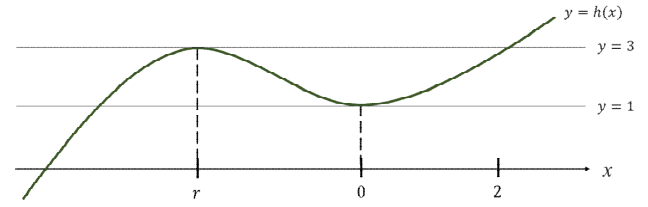
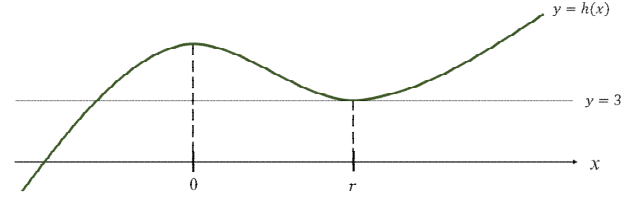
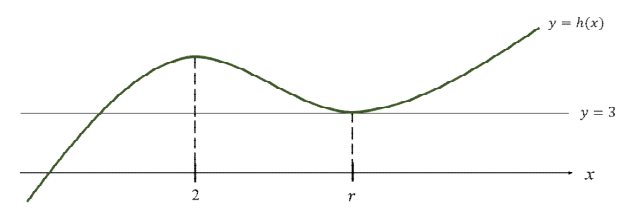
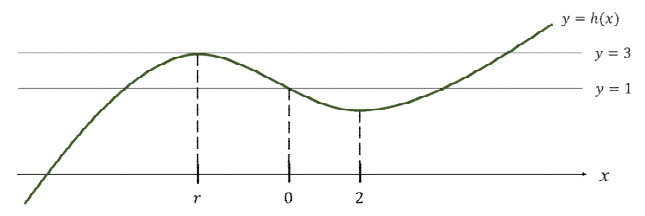
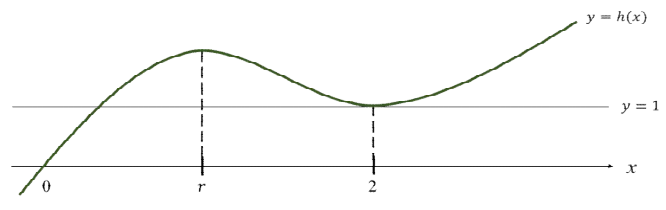
+10점 · 0 < r < 2 \displaystyle 0<r<2 0 < r < 2 방정식 h ′ ( x ) = 0 \displaystyle h^{\prime}(x)=0 h ′ ( x ) = 0 0 , 2 \displaystyle 0,2 0 , 2 0 , r \displaystyle 0,r 0 , r 2 , r \displaystyle 2,r 2 , r 로 나누어 생각하자. (i) 두 근이 0 , 2 \displaystyle 0,2 0 , 2 h ( r ) = 1 \displaystyle h(r)=1 h ( r ) = 1 (ii) 두 근이 0 , r \displaystyle 0,r 0 , r r < 0 \displaystyle r<0 r < 0 r > 0 \displaystyle r>0 r > 0 • r < 0 \displaystyle r<0 r < 0 h ( 0 ) = 1 \displaystyle h(0)=1 h ( 0 ) = 1
• r > 0 \displaystyle r>0 r > 0
따라서 두 근은 2 \displaystyle 2 2 r \displaystyle r r h ( 0 ) = 1 \displaystyle h(0)=1 h ( 0 ) = 1 0 , r , 2 \displaystyle 0,r,2 0 , r , 2 r < 0 \displaystyle r<0 r < 0 0 < r < 2 \displaystyle 0<r<2 0 < r < 2 r > 2 \displaystyle r>2 r > 2 • 2 < r \displaystyle 2<r 2 < r 1 ≥ h ( 2 ) > h ( r ) = 3 \displaystyle 1\ge h(2)>h(r)=3 1 ≥ h ( 2 ) > h ( r ) = 3
• r < 0 \displaystyle r<0 r < 0 h ( 0 ) = 1 \displaystyle h(0)=1 h ( 0 ) = 1 h ( 2 ) \displaystyle h(2) h ( 2 ) h ( x ) = 1 \displaystyle h(x)=1 h ( x ) = 1 3 \displaystyle 3 3
그러므로 0 < r < 2 \displaystyle 0<r<2 0 < r < 2 이고, h ( x ) \displaystyle h(x) h ( x )
+5점 · h ( x ) = a x ( x − 2 ) 2 + 1 \displaystyle h(x)=ax(x-2)^2+1 h ( x ) = a x ( x − 2 ) 2 + 1 h ( x ) − 1 = 0 \displaystyle h(x)-1=0 h ( x ) − 1 = 0 x = 0 \displaystyle x=0 x = 0 2 \displaystyle 2 2 h ( x ) − 1 = a x ( x − 2 ) 2 \displaystyle h(x)-1=ax(x-2)^2 h ( x ) − 1 = a x ( x − 2 ) 2 이다.
+5점 · r = 2 3 \displaystyle r=\frac23 r = 3 2 h ′ ( x ) = a ( x − 2 ) ( 3 x − 2 ) \displaystyle h^{\prime}(x)=a(x-2)(3x-2) h ′ ( x ) = a ( x − 2 ) ( 3 x − 2 ) 이므로 r = 2 3 \displaystyle r=\frac23 r = 3 2
+2점 · 정답을 제시 h ( 2 3 ) = 3 \displaystyle h\left(\frac23\right)=3 h ( 3 2 ) = 3 a = 27 16 \displaystyle a=\frac{27}{16} a = 16 27
예시 답안의 내용 및 평가 기준의 내용과는 일치하지 않더라도 기술한 내용이 논리적으로 타당한 경우에는 평가위원의 판단에 따라 부분 점수를 부여할 수 있음.
 수리논술, 배움에서 논증의 완성까지.