수리논술, 이게 다다.

자연계열 2번

오류 제보

문제

[문제2] 다음 제시문을 읽고 질문에 답하시오. (45점)

(가) 함수 f(x)\displaystyle f(x)가 실수 a\displaystyle a에 대하여 다음 조건을 모두 만족시킬 때, f(x)\displaystyle f(x)는 x=a\displaystyle x=a에서 연속이라고 한다.(ⅰ) 함수 f(x)\displaystyle f(x)가 x=a\displaystyle x=a에서 정의되어 있다.(ⅱ) 극한값 lim⁡x→af(x)\displaystyle \lim_{x\to a}f(x)가 존재한다.(ⅲ) lim⁡x→af(x)=f(a)\displaystyle \lim_{x\to a}f(x)=f(a)

(나) 미분가능한 두 함수 y=f(u)\displaystyle y=f(u), u=g(x)\displaystyle u=g(x)에 대하여 합성함수 y=f(g(x))\displaystyle y=f(g(x))의 도함수는{f(g(x))}′=f′(g(x))g′(x)\displaystyle \{f(g(x))\}^{\prime}=f^{\prime}(g(x))g^{\prime}(x)

(다) 다항함수 f(x)\displaystyle f(x)에 대하여 함수 g(t)\displaystyle g(t)가 f(g(t))=t\displaystyle f(g(t))=t를 만족하면, g(t)\displaystyle g(t)는 곡선 y=f(x)\displaystyle y=f(x)와 직선 y=t\displaystyle y=t의 교점의 x\displaystyle x좌표 중 하나이다. 만일 lim⁡t→t0+g(t)\displaystyle \lim_{t\to t_0+}g(t), lim⁡t→t0−g(t)\displaystyle \lim_{t\to t_0-}g(t), lim⁡t→t0g(t)\displaystyle \lim_{t\to t_0}g(t)가 존재하면 이 값들도 곡선 y=f(x)\displaystyle y=f(x)와 직선 y=t0\displaystyle y=t_0의 교점의 x\displaystyle x좌표 중 하나이다.

최고차항의 계수가 1인 삼차함수 f(x)\displaystyle f(x)에 대하여 다음 물음에 답하시오.

[논제1] 실수 전체의 집합에서 정의된 함수 g(t)\displaystyle g(t)가 모든 실수 t\displaystyle t에 대하여f(g(t))=t\displaystyle f(g(t))=t이고 다음 조건을 만족시킨다.

(1) f(3)=0\displaystyle f(3)=0, g(0)=−2\displaystyle g(0)=-2, g(6)=1\displaystyle g(6)=1(2) 함수 g(t)\displaystyle g(t)는 t=6\displaystyle t=6에서만 불연속이다.

lim⁡t→6−g(t)\displaystyle \lim_{t\to6-}g(t)와 lim⁡t→6+g(t)\displaystyle \lim_{t\to6+}g(t)의 값을 구하시오. (20점)

[논제2] 함수 f(x)\displaystyle f(x)가 x=0\displaystyle x=0, x=2\displaystyle x=2에서 극값을 가질 때, 함수 f(x)\displaystyle f(x)와 실수 전체 집합에서 연속인 함수 h(t)\displaystyle h(t)는 다음 조건을 만족시킨다. (단, n\displaystyle n은 자연수)

(1) 모든 t≥0\displaystyle t\ge0에 대하여 f(h(t))=t+n\displaystyle f(h(t))=t+n(2) 실수 전체 집합에서 정의되고 다음을 만족시키는 함수 k(t)\displaystyle k(t)는 연속이 아니다.“모든 t≥0\displaystyle t\ge0에 대하여 f(k(t))=t+n−1\displaystyle f(k(t))=t+n-1”(3) f(1)=f(h(n))\displaystyle f(1)=f(h(n))

h′(n)\displaystyle h^{\prime}(n)의 값을 구하시오. (25점)

해설강의 준비중
+5점 · f(x)=(x+2)(x−2)(x−3)\displaystyle f(x)=(x+2)(x-2)(x-3)임을 제시

[논제1] g(0)=−2\displaystyle g(0)=-2이므로 f(−2)=0\displaystyle f(-2)=0이다. 또한, f(3)=0\displaystyle f(3)=0이므로 f(x)=(x+2)(x−3)(x−a)\displaystyle f(x)=(x+2)(x-3)(x-a)이다.g(6)=1\displaystyle g(6)=1에 의해 f(1)=6\displaystyle f(1)=6이므로, a=2\displaystyle a=2이다.

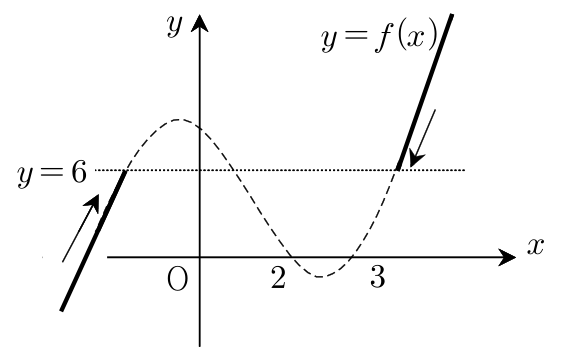
조건 (2)에 의하여 g(t)\displaystyle g(t)는 t<6\displaystyle t<6에서 연속이고, 삼차함수 f(x)\displaystyle f(x)의 그래프의 개형과 <제시문> (다)에 의하여 lim⁡t→6−g(t)\displaystyle \lim_{t\to6-}g(t)은 f(x)=6\displaystyle f(x)=6을 만족시키는 x\displaystyle x의 값 중 가장 작은 값이다. 또한 g(t)\displaystyle g(t)는 t>6\displaystyle t>6에서 연속이므로 lim⁡t→6+g(t)\displaystyle \lim_{t\to6+}g(t)은 f(x)=6\displaystyle f(x)=6을 만족시키는 x\displaystyle x의 값 중 가장 큰 값이다.

+5점 · f(x)=6\displaystyle f(x)=6의 해가 1−7,1,1+7\displaystyle 1-\sqrt7,1,1+\sqrt7임을 제시

방정식 f(x)=(x+2)(x−3)(x−2)=6\displaystyle f(x)=(x+2)(x-3)(x-2)=6에서 (x−1)(x2−2x−6)=0\displaystyle (x-1)(x^2-2x-6)=0. x=1−7,1,1+7\displaystyle x=1-\sqrt7,1,1+\sqrt7이므로

+5점 · lim⁡t→6−g(t)=1−7\displaystyle \lim_{t\to6-}g(t)=1-\sqrt7, lim⁡t→6+g(t)=1+7\displaystyle \lim_{t\to6+}g(t)=1+\sqrt7 중 하나를 제시
+5점 · lim⁡t→6−g(t)=1−7\displaystyle \lim_{t\to6-}g(t)=1-\sqrt7, lim⁡t→6+g(t)=1+7\displaystyle \lim_{t\to6+}g(t)=1+\sqrt7을 모두 제시

lim⁡t→6−g(t)=1−7,lim⁡t→6+g(t)=1+7\displaystyle \lim_{t\to6-}g(t)=1-\sqrt7,\quad\lim_{t\to6+}g(t)=1+\sqrt7

삼차함수와 직선 y=6의 세 교점 및 양쪽 역함수 가지
+7점 · f(x)\displaystyle f(x)의 극솟값이 n−1\displaystyle n-1보다 크고 n\displaystyle n보다 작거나 같음을 제시

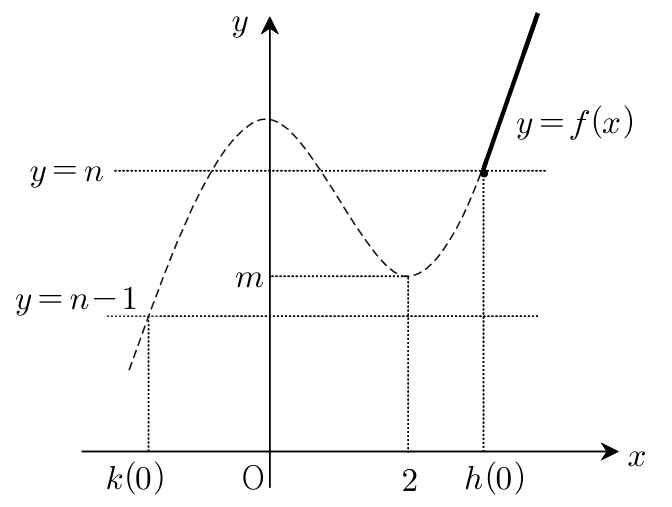
[논제2] f′(x)=3x2−6x\displaystyle f^{\prime}(x)=3x^2-6x이므로 f(x)\displaystyle f(x)는 x=2\displaystyle x=2에서 극솟값 m\displaystyle m을 갖는다고 하자. t=0\displaystyle t=0일 때, h(0)\displaystyle h(0)은 <제시문> (다)에 의하여 y=f(x)\displaystyle y=f(x)와 직선 y=n\displaystyle y=n의 교점의 x\displaystyle x좌표 중 하나이다. h(t)\displaystyle h(t)가 t≥0\displaystyle t\ge0에서 연속이기 위해서는 h(0)\displaystyle h(0)가 x≥2\displaystyle x\ge2인 구간에 위치해야 하고, h(t)\displaystyle h(t)는 곡선 y=f(x)\displaystyle y=f(x)와 직선 y=t+n\displaystyle y=t+n이 만나는 점의 x\displaystyle x좌표 중 가장 큰 값이다. 그러므로 h(t)\displaystyle h(t)가 t≥0\displaystyle t\ge0에서 연속이기 위해서는 f(x)\displaystyle f(x)는 x=2\displaystyle x=2에서 극솟값을 가지므로 h(0)\displaystyle h(0)가 x≥2\displaystyle x\ge2인 구간에 위치해야 하고, 그림과 같이 t≥0\displaystyle t\ge0에서 h(t)\displaystyle h(t)는 곡선 y=f(x)\displaystyle y=f(x)와 직선 y=t+n\displaystyle y=t+n이 만나는 점의 x\displaystyle x좌표 중 가장 큰 값이다. 그러므로 f(x)\displaystyle f(x)의 극솟값을 m\displaystyle m이라 하면 m≤n\displaystyle m\le n이다. 한편, m≤n−1\displaystyle m\le n-1이면 같은 이유로 모든 t≥0\displaystyle t\ge0에 대하여 f(k(t))=t+n−1\displaystyle f(k(t))=t+n-1을 만족하는 연속함수 k(t)\displaystyle k(t)가 존재하므로 m>n−1\displaystyle m>n-1이다. 따라서n−1<m≤n\displaystyle n-1<m\le n이다.

극솟값 m과 직선 y=n, y=n-1 및 h(0), k(0)의 위치
+5점 · f(x)=x3−3x2+6\displaystyle f(x)=x^3-3x^2+6을 제시
+6점 · n=2\displaystyle n=2임을 제시

f′(x)=3x2−6x\displaystyle f^{\prime}(x)=3x^2-6x이므로 f(x)=x3−3x2+c\displaystyle f(x)=x^3-3x^2+c이다. 따라서 m=f(2)=c−4\displaystyle m=f(2)=c-4이고 n−1<c−4≤n\displaystyle n-1<c-4\le n.f(h(n))=2n=f(1)=c−2\displaystyle f(h(n))=2n=f(1)=c-2로부터 c=2n+2\displaystyle c=2n+2에서 n+3<2n+2≤n+4\displaystyle n+3<2n+2\le n+4이고, 즉 1<n≤2\displaystyle 1<n\le2. 따라서 n=2\displaystyle n=2이고 c=6\displaystyle c=6이다.

+7점 · h′(2)=16\displaystyle h^{\prime}(2)=\frac16임을 제시

f(h(t))=t+2\displaystyle f(h(t))=t+2로부터 [f(h(t))]′=f′(h(t))h′(t)=1\displaystyle [f(h(t))]^{\prime}=f^{\prime}(h(t))h^{\prime}(t)=1이므로h′(2)=1f′(h(2))⋯⋯\displaystyle h^{\prime}(2)=\frac1{f^{\prime}(h(2))}\quad\cdots\cdots (★)또한 h(2)\displaystyle h(2)은 f(x)=4\displaystyle f(x)=4를 만족하는 x\displaystyle x 중 가장 큰 값이므로 4=f(x)=x3−3x2+6\displaystyle 4=f(x)=x^3-3x^2+6에서 h(2)=1+3\displaystyle h(2)=1+\sqrt3. 따라서 (★)로부터 h′(2)=1f′(1+3)=13(1+3)(−1+3)=16\displaystyle h^{\prime}(2)=\frac1{f^{\prime}(1+\sqrt3)}=\frac1{3(1+\sqrt3)(-1+\sqrt3)}=\frac16

예시 답안의 내용 및 평가 기준의 내용과는 일치하지 않더라도 기술한 내용이 논리적으로 타당한 경우에는 평가위원의 판단에 따라 부분 점수를 부여할 수 있음.

첨삭 사례

아직 등록된 첨삭 사례가 없습니다.

질문과 답변 · 0개질문과 답변 · 고정 0개

아직 등록된 질문이 없습니다. 질문 작성은 멤버십 회원만 가능합니다.