수리논술, 이게 다다.

자연계열 1번

오류 제보
해설강의 바로가기 ↓

문제

[문제 1번] 다음 제시문을 읽고 물음에 답하시오. (50점)

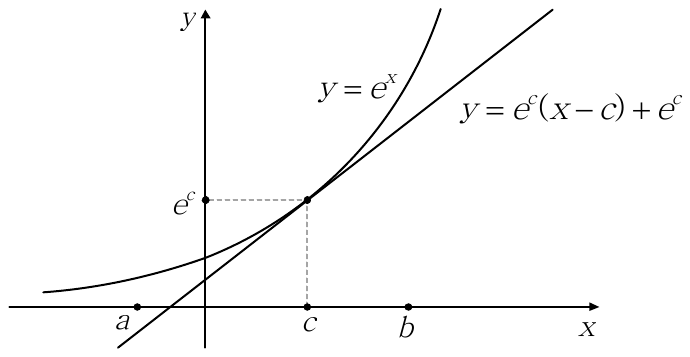
곡선 y=e^x와 점 (c, e^c)에서의 접선 y=e^c(x−c)+e^c을 나타낸 그래프. 접선이 곡선보다 아래에 있고 x축 위에 a, c, b가 표시되어 있다.

위 그림은 곡선 y=ex\displaystyle y=e^{x}와 이 곡선 위의 점 (c, ec)\displaystyle (c,\ e^{c})에서의 접선을 나타낸다. 이 접선은 그림에서와 같이 곡선 y=ex\displaystyle y=e^{x}보다 아래에 있다. 즉, 모든 실수 x\displaystyle x에 대하여 부등식ec(x−c)+ec≤ex\displaystyle e^{c}(x-c)+e^{c}\le e^{x} ①이 성립하고 등호는 x=c\displaystyle x=c인 경우에 성립한다. 예를 들면 c=1\displaystyle c=1일 때 부등식 ①은 ex≤ex\displaystyle ex\le e^{x} 또는x≤ex−1\displaystyle x\le e^{x-1}이 되고 등호는 x=1\displaystyle x=1인 경우에 성립한다.

한편 임의의 양수 a1,a2,⋯ ,an\displaystyle a_{1},a_{2},\cdots,a_{n}의 산술평균은M=a1+a2+⋯+ann\displaystyle M=\frac{a_{1}+a_{2}+\cdots+a_{n}}{n}이다. 부등식 x≤ex−1\displaystyle x\le e^{x-1}에서 x\displaystyle x 대신에 akM\displaystyle \frac{a_{k}}{M}를 대입하면 부등식akM≤eakM−1(k=1,2,⋯ ,n)\displaystyle \frac{a_{k}}{M}\le e^{\frac{a_{k}}{M}-1}\quad(k=1,2,\cdots,n) ②이 되고 등호는 ak=M\displaystyle a_{k}=M인 경우에 성립한다.

1. (1) 부등식 1+x≤ex\displaystyle 1+x\le e^{x}를 부등식 ①을 이용하여 설명하시오.

(2) a<b\displaystyle a<b일 때 정적분을 이용하여 다음 부등식이 성립함을 보이시오.eb−eab−a<ea+eb2\displaystyle \frac{e^{b}-e^{a}}{b-a}<\frac{e^{a}+e^{b}}{2}

(3) a<b\displaystyle a<b일 때 부등식 1+x≤ex\displaystyle 1+x\le e^{x}와 a1a2≤a1+a22\displaystyle \sqrt{a_{1}a_{2}}\le\frac{a_{1}+a_{2}}{2} (a1,a2\displaystyle a_{1},a_{2}는 양수)를 이용하여 다음 부등식이 성립함을 보이시오.223[(1+b)32−(1+a)32]≤∫ab1+e2x dx≤b−a+e2b−e2a4\displaystyle \frac{2\sqrt{2}}{3}\left[(1+b)^{\frac{3}{2}}-(1+a)^{\frac{3}{2}}\right]\le\int_{a}^{b}\sqrt{1+e^{2x}}\,dx\le b-a+\frac{e^{2b}-e^{2a}}{4}Caution. 좌변이 실수로 정의되려면 a≥−1\displaystyle a\ge-1이라는 조건이 필요하다. 그러나 원칙에 따라 원문 표기를 그대로 실었다.

2. 부등식 ②를 이용하여 임의의 양수 a1,a2,⋯ ,an\displaystyle a_{1},a_{2},\cdots,a_{n}에 대한 다음 부등식이 성립함을 보이시오.(a1a2⋯an)1n≤a1+a2+⋯+ann\displaystyle (a_{1}a_{2}\cdots a_{n})^{\frac{1}{n}}\le\frac{a_{1}+a_{2}+\cdots+a_{n}}{n}

3. 임의의 예각삼각형에서 세 각을 A\displaystyle A, B\displaystyle B, C\displaystyle C라 하자. 부등식 (a1a2a3)13≤a1+a2+a33\displaystyle (a_{1}a_{2}a_{3})^{\frac{1}{3}}\le\frac{a_{1}+a_{2}+a_{3}}{3} (a1,a2,a3\displaystyle a_{1},a_{2},a_{3}은 양수)을 이용하여 tan⁡A+tan⁡B+tan⁡C\displaystyle \tan A+\tan B+\tan C의 최솟값을 구하시오.

1번 문항 · 접선을 이해하고 있는가?

문항 1-1) c=0\displaystyle c=0 즉 점 (0, 1)\displaystyle (0,\ 1)에서 접선방정식을 구하면1+x≤ex.\displaystyle 1+x\le e^{x}.또는 ex−1≥x\displaystyle e^{x-1}\ge x 에서 x\displaystyle x 대신에 x+1\displaystyle x+1을 대입하면1+x≤ex.\displaystyle 1+x\le e^{x}.

1번 문항 · 정적분을 기하학적으로 잘 이해하고 있는가?

문항 1-2) x=a\displaystyle x=a에서 x=b\displaystyle x=b까지 y=ex\displaystyle y=e^{x}로 둘러싸인 도형의 넓이는 밑변 (b−a)\displaystyle (b-a)와 점 (a, ea)\displaystyle (a,\ e^{a}), 점 (b, eb)\displaystyle (b,\ e^{b})을 잇는 직선으로 둘러싸인 사다리꼴의 넓이보다 작다. 즉∫abexdx=eb−ea<(b−a)ea+eb2\displaystyle \int_{a}^{b}e^{x}dx=e^{b}-e^{a}<(b-a)\frac{e^{a}+e^{b}}{2}eb−eab−a<ea+eb2.\displaystyle \frac{e^{b}-e^{a}}{b-a}<\frac{e^{a}+e^{b}}{2}.

1번 문항 · 어려운 정적분을 기본적인 부등식을 통한 정적분의 근사치의 상하한을 구할 수 있는가?

문항 1-3) ∫ab1+e2x dx\displaystyle \int_{a}^{b}\sqrt{1+e^{2x}}\,dx의 상하한을 구하기 위하여 피적분함수 1+e2x\displaystyle \sqrt{1+e^{2x}} 의 상하한을 먼저 구한다.1+x≤ex\displaystyle 1+x\le e^{x} 를 이용하면 2+2x≤1+e2x\displaystyle \sqrt{2+2x}\le\sqrt{1+e^{2x}}이며, a1a2≤a1+a22\displaystyle \sqrt{a_{1}a_{2}}\le\frac{a_{1}+a_{2}}{2} 을 이용하면 1+e2x≤12+1+e2x2=1+e2x2\displaystyle \sqrt{1+e^{2x}}\le\frac{1}{2}+\frac{1+e^{2x}}{2}=1+\frac{e^{2x}}{2} 이다. 따라서2∫ab1+x dx≤∫ab1+e2x dx≤∫ab(1+e2x2)dx\displaystyle \sqrt{2}\int_{a}^{b}\sqrt{1+x}\,dx\le\int_{a}^{b}\sqrt{1+e^{2x}}\,dx\le\int_{a}^{b}\left(1+\frac{e^{2x}}{2}\right)dx223[(1+b)3/2−(1+a)3/2]≤∫ab1+e2x dx≤b−a+e2b−e2a4.\displaystyle \frac{2\sqrt{2}}{3}\left[(1+b)^{3/2}-(1+a)^{3/2}\right]\le\int_{a}^{b}\sqrt{1+e^{2x}}\,dx\le b-a+\frac{e^{2b}-e^{2a}}{4}.

2번 문항 · x≤ex−1\displaystyle x\le e^{x-1}를 이용하여 일반적인 산술평균기하평균을 유도할 수 있는가?

문항 2) 모든 k=1,2,⋯ ,n\displaystyle k=1,2,\cdots,n에 대하여 akM≠1\displaystyle \frac{a_{k}}{M}\ne1 (ak≠M\displaystyle a_{k}\ne M)이면 akM<eakM−1\displaystyle \frac{a_{k}}{M}<e^{\frac{a_{k}}{M}-1}, akM=1\displaystyle \frac{a_{k}}{M}=1이면 akM=e0=1\displaystyle \frac{a_{k}}{M}=e^{0}=1 이므로 akM≤eakM−1\displaystyle \frac{a_{k}}{M}\le e^{\frac{a_{k}}{M}-1}이 성립한다. 따라서 모든 k=1,2,⋯ ,n\displaystyle k=1,2,\cdots,n에 대해 ak≠M\displaystyle a_{k}\ne M 라면a1a2⋯anMn<ea1+a2+⋯+anM−n=1\displaystyle \frac{a_{1}a_{2}\cdots a_{n}}{M^{n}}<e^{\frac{a_{1}+a_{2}+\cdots+a_{n}}{M}-n}=1 (⋆)

2번 문항 · 등호가 성립하는 경우는 언제인가?

(⋆)식에서 부등식(<\displaystyle <)이 등호(=\displaystyle =)가 성립하는 경우는 모든 k=1,2,⋯ ,n\displaystyle k=1,2,\cdots,n에 대해 ak=M\displaystyle a_{k}=M 일 때 (⋆)식으로부터 즉a1a2⋯anMn=ea1+a2+⋯+anM−n=1\displaystyle \frac{a_{1}a_{2}\cdots a_{n}}{M^{n}}=e^{\frac{a_{1}+a_{2}+\cdots+a_{n}}{M}-n}=1또는 akM≤eakM−1\displaystyle \frac{a_{k}}{M}\le e^{\frac{a_{k}}{M}-1}을 k=1,2,⋯ ,n\displaystyle k=1,2,\cdots,n에 대하여 n\displaystyle n번 연속적으로 사용하고 그 부등식들을 각각 변변 곱하면 다음 부등식이 된다.a1a2⋯anMn≤ea1M−1ea2M−1⋯eanM−1=e0e0⋯e0=1\displaystyle \frac{a_{1}a_{2}\cdots a_{n}}{M^{n}}\le e^{\frac{a_{1}}{M}-1}e^{\frac{a_{2}}{M}-1}\cdots e^{\frac{a_{n}}{M}-1}=e^{0}e^{0}\cdots e^{0}=1 (⋆⋆)Comment. 각 지수가 모두 0\displaystyle 0인 것은 아니다. 지수의 합이 0\displaystyle 0이므로 곱이 1\displaystyle 1이 된다.(a1a2⋯an)1n≤a1+a2+⋯+ann\displaystyle (a_{1}a_{2}\cdots a_{n})^{\frac{1}{n}}\le\frac{a_{1}+a_{2}+\cdots+a_{n}}{n}(⋆⋆)식으로부터 등호는 모든 k=1,2,⋯ ,n\displaystyle k=1,2,\cdots,n 대하여 ak=M\displaystyle a_{k}=M 즉 a1=a2=⋯=an\displaystyle a_{1}=a_{2}=\cdots=a_{n} 일 때 성립한다.

3번 문항 · 삼각함수를 잘 이해하고 있는가?

문항 3) tan⁡C=tan⁡(π−(A+B))=−tan⁡(A+B)=−tan⁡A+tan⁡B1−tan⁡Atan⁡B\displaystyle \tan C=\tan(\pi-(A+B))=-\tan(A+B)=-\frac{\tan A+\tan B}{1-\tan A\tan B} 이므로 다음 식이 된다.tan⁡A+tan⁡B+tan⁡C=tan⁡A tan⁡B tan⁡C.\displaystyle \tan A+\tan B+\tan C=\tan A\,\tan B\,\tan C. (#)

3번 문항 · 2번 문항에서 구한 산술평균과 기하평균을 이해하여 최솟값을 구할 수 있는가?

예각이므로 tan⁡A\displaystyle \tan A, tan⁡B\displaystyle \tan B, tan⁡C\displaystyle \tan C는 양수이다. (a1a2a3)13≤a1+a2+a33\displaystyle (a_{1}a_{2}a_{3})^{\frac{1}{3}}\le\frac{a_{1}+a_{2}+a_{3}}{3} 을 이용하면tan⁡A+tan⁡B+tan⁡C3=tan⁡A tan⁡B tan⁡C3≥(tan⁡A tan⁡B tan⁡C)1/3\displaystyle \frac{\tan A+\tan B+\tan C}{3}=\frac{\tan A\,\tan B\,\tan C}{3}\ge(\tan A\,\tan B\,\tan C)^{1/3} (##)tan⁡A tan⁡B tan⁡C≥27=33.\displaystyle \tan A\,\tan B\,\tan C\ge\sqrt{27}=3\sqrt{3}.(#)식으로부터 tan⁡A+tan⁡B+tan⁡C≥33\displaystyle \tan A+\tan B+\tan C\ge3\sqrt{3} 등호는 tan⁡A=tan⁡B=tan⁡C\displaystyle \tan A=\tan B=\tan C (A=B=C=π3)\displaystyle \left(A=B=C=\frac{\pi}{3}\right) 일 때 즉, 정삼각형일 때 tan⁡A+tan⁡B+tan⁡C\displaystyle \tan A+\tan B+\tan C 는 최소값 33\displaystyle 3\sqrt{3}를 갖는다.위식 (##)에서 (tan⁡A+tan⁡B+tan⁡C)3≥{tan⁡A+tan⁡B+tan⁡C}1/3\displaystyle \frac{(\tan A+\tan B+\tan C)}{3}\ge\{\tan A+\tan B+\tan C\}^{1/3}, 즉 tan⁡A+tan⁡B+tan⁡C≥33\displaystyle \tan A+\tan B+\tan C\ge3\sqrt{3} 을 얻는다.

첨삭 사례

아직 등록된 첨삭 사례가 없습니다.

질문과 답변 · 0개질문과 답변 · 고정 0개

아직 등록된 질문이 없습니다. 질문 작성은 멤버십 회원만 가능합니다.