수리논술, 이게 다다.

자연계열 (토요일) 1번

오류 제보

문제

I. 다음 제시문을 읽고 논제에 답하시오.

[가]

공간에서 두 점 A(x1,y1,z1),B(x2,y2,z2)\displaystyle A \left( x_{1} , y_{1} , z_{1} \right) , B \left( x_{2} , y_{2} , z_{2} \right) 사이의 거리는

AB‾=(x2−x1)2+(y2−y1)2+(z2−z1)2\displaystyle \overline{AB} = \sqrt{\left( x_{2} - x_{1} \right)^{2} + \left( y_{2} - y_{1} \right)^{2} + \left( z_{2} - z_{1} \right)^{2}}

공간에서 한 점 C\displaystyle C로부터 일정한 거리에 있는 점 P\displaystyle P의 집합을 구라고 한다. 좌표공간에서 중심이 점 C(a,b,c)\displaystyle C \left( a , b , c \right)이고 반지름의 길이가 r\displaystyle r인 구의 방정식은 다음과 같다.

(x−a)2+(y−b)2+(z−c)2=r2\displaystyle \left( x - a \right)^{2} + \left( y - b \right)^{2} + \left( z - c \right)^{2} = r^{2}

공간에서 도형 F\displaystyle F의 각 점에서 평면 α\displaystyle \alpha에 내린 수선의 발로 이루어진 도형 F′\displaystyle F^{\prime}을 도형 F\displaystyle F의 평면 α\displaystyle \alpha 위로의 정사영이라고 한다. 예를 들어, 위에서 주어진 구의 xz\displaystyle x z평면 위로의 정사영은 (x−a)2+(z−c)2≤r2\displaystyle \left( x - a \right)^{2} + \left( z - c \right)^{2} \leq r^{2}을 만족하는 xz\displaystyle x z평면 위의 점의 집합이다.

[나]

공간에서 두 점 A(x1,y1,z1),B(x2,y2,z2)\displaystyle A \left( x_{1} , y_{1} , z_{1} \right) , B \left( x_{2} , y_{2} , z_{2} \right)를 지나는 직선의 방정식은

x−x1x2−x1=y−y1y2−y1=z−z1z2−z1\displaystyle \frac{{x - x_{1}}}{x_{2} - x_{1}} = \frac{{y - y_{1}}}{y_{2} - y_{1}} = \frac{{z - z_{1}}}{z_{2} - z_{1}} (단, x1≠x2,y1≠y2,z1≠z2\displaystyle x_{1} \ne x_{2} , y_{1} \ne y_{2} , z_{1} \ne z_{2})

이 직선의 xz\displaystyle x z평면 위로의 정사영은 x−x1x2−x1=z−z1z2−z1\displaystyle \frac{{x - x_{1}}}{x_{2} - x_{1}} = \frac{{z - z_{1}}}{z_{2} - z_{1}}을 만족한다.

[다]

구에서의 대원은 구의 중심을 지나는 평면으로 구를 자를 때 생기는 원이다. 구면 위의 두 점을 잇는 구면 위의 최단경로의 길이는 두 점을 지나가는 대원을 이용해 구할 수 있다. 공간에서 평면이 구를 자를 때, 구의 잘린 부분의 부피는 회전체 부피를 구하는 방법을 이용해 구할 수 있다.
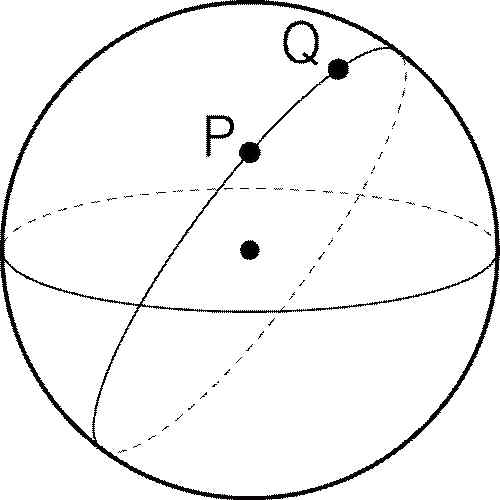
구의 대원과 구면 위의 두 점
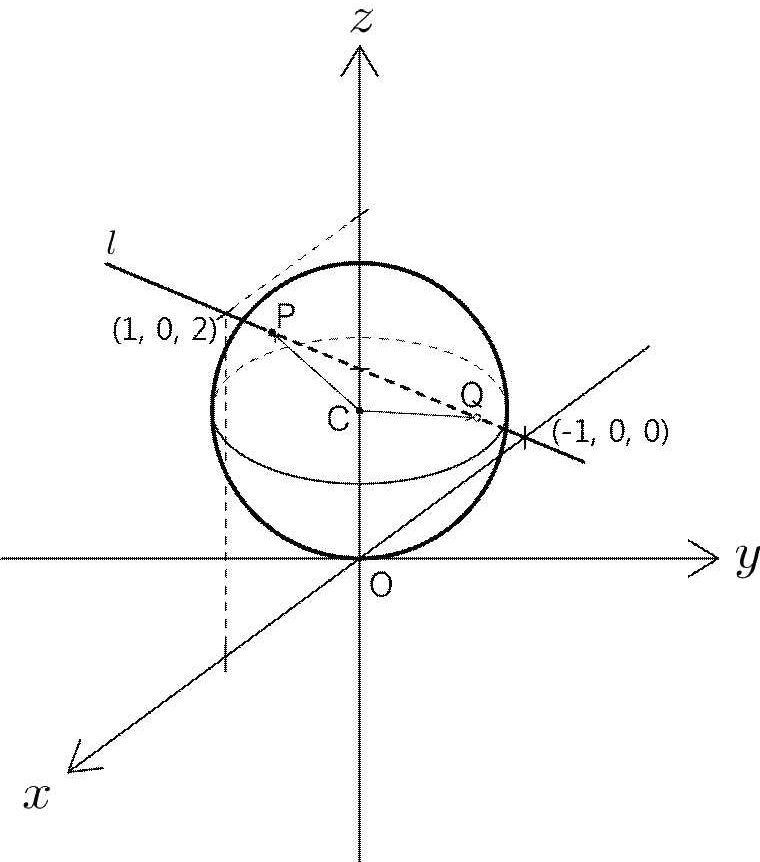
구와 직선의 교점

<논제 I-1> (9점)

공간에서 두 점 (−1,0,0),(1,0,2)\displaystyle \left( - 1 , 0 , 0 \right) , \left( 1 , 0 , 2 \right)를 지나는 직선 l\displaystyle l 위의 점 A\displaystyle A와 점 C(0,0,r)\displaystyle C \left( 0 , 0 , r \right) 사이의 거리가 최소가 되는 점 A\displaystyle A의 좌표를 구하시오. (구해진 최솟값은 직선 l\displaystyle l과 점 C\displaystyle C사이의 거리가 된다.)

<논제 I-2> (9점)

중심이 C(0,0,r)\displaystyle C \left( 0 , 0 , r \right)이고 반지름이 r\displaystyle r인 (r>0)\displaystyle \left( r > 0 \right) 구가 점 (−1,0,0)\displaystyle \left( - 1 , 0 , 0 \right)과 점 (1,0,2)\displaystyle \left( 1 , 0 , 2 \right)를 지나는 직선 l\displaystyle l에 접하기 위한 r\displaystyle r의 값을 구하고 그 방법을 서술하시오.

<논제 I-3> (10점)

r=12\displaystyle r = \frac{{1}}{2}일 때, 위 논제에서 제시된 구와 직선 l\displaystyle l은 두 점 P,Q\displaystyle P , Q에서 만난다. 이 두 점을 잇는 구면 위의 가장 짧은 곡선을 구하는 방법을 설명하고 그 곡선의 길이를 구하시오.

<논제 I-4> (12점)

점 (−1,0,0),(1,0,2),(−1,1,0)\displaystyle \left( - 1 , 0 , 0 \right) , \left( 1 , 0 , 2 \right) , \left( - 1 , 1 , 0 \right)을 지나는 평면(이 평면은 위 논제에서 제시된 직선 l\displaystyle l을 포함하고 y\displaystyle y축과 평행하다)은 r\displaystyle r의 범위에 따라 위 논제에서 주어진 구(중심이 C(0,0,r)\displaystyle C \left( 0 , 0 , r \right)이고 반지름이 r\displaystyle r인 구)와 만나지 않을 수도, 접할 수도, 혹은 그 구를 자를 수도 있다. 주어진 평면이 구를 자를 때, 구의 잘려진 윗부분의 부피를 r\displaystyle r의 범위에 따라 어떻게 계산할 수 있는지 적분식을 이용해 논술하시오. (적분값을 구할 필요는 없음)

해설강의 준비중

<논제 I-1>

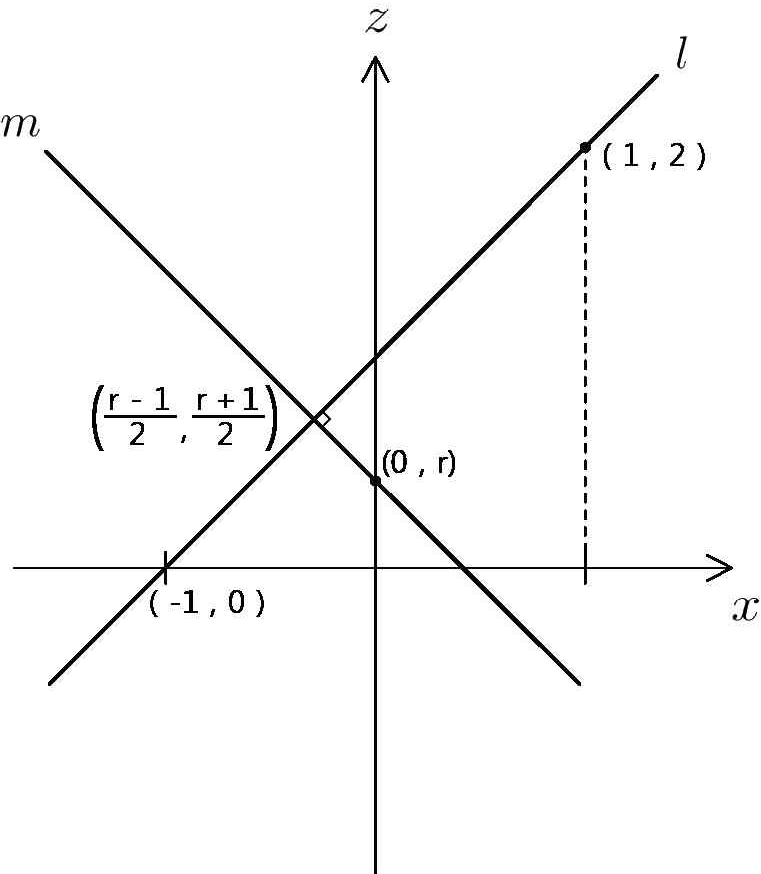
점 C\displaystyle C를 지나고 직선 l\displaystyle l에 수직인 직선을 m\displaystyle m이라고 하자. 점 A\displaystyle A는 직선 l\displaystyle l과 m\displaystyle m의 교점이다. 직선 l\displaystyle l과 m\displaystyle m은 xz\displaystyle xz평면에 있으므로 점 A\displaystyle A의 좌표를 구하기 위해서는 xz\displaystyle xz평면에서 직선 l\displaystyle l과 m\displaystyle m의 교점을 구하면 된다. xz\displaystyle xz평면에서의 l\displaystyle l의 방정식은 z=x+1\displaystyle z=x+1이다. xz\displaystyle xz평면에서 직선 m\displaystyle m은 직선 l\displaystyle l에 수직이므로 기울기는 −1\displaystyle -1이고 점 (0,r)\displaystyle (0,r)을 지나므로 직선 m\displaystyle m의 방정식은 z=−x+r\displaystyle z=-x+r이다. 두 방정식 z=x+1\displaystyle z=x+1, z=−x+r\displaystyle z=-x+r을 연립해서 풀면 x=r−12\displaystyle x=\frac{r-1}2, z=r+12\displaystyle z=\frac{r+1}2.

그러므로 점 A\displaystyle A의 공간에서의 좌표는 (r−12,0,r+12)\displaystyle \left(\frac{r-1}2,0,\frac{r+1}2\right)이다.

수선의 발을 찾는 두 직선

<논제 I-2>

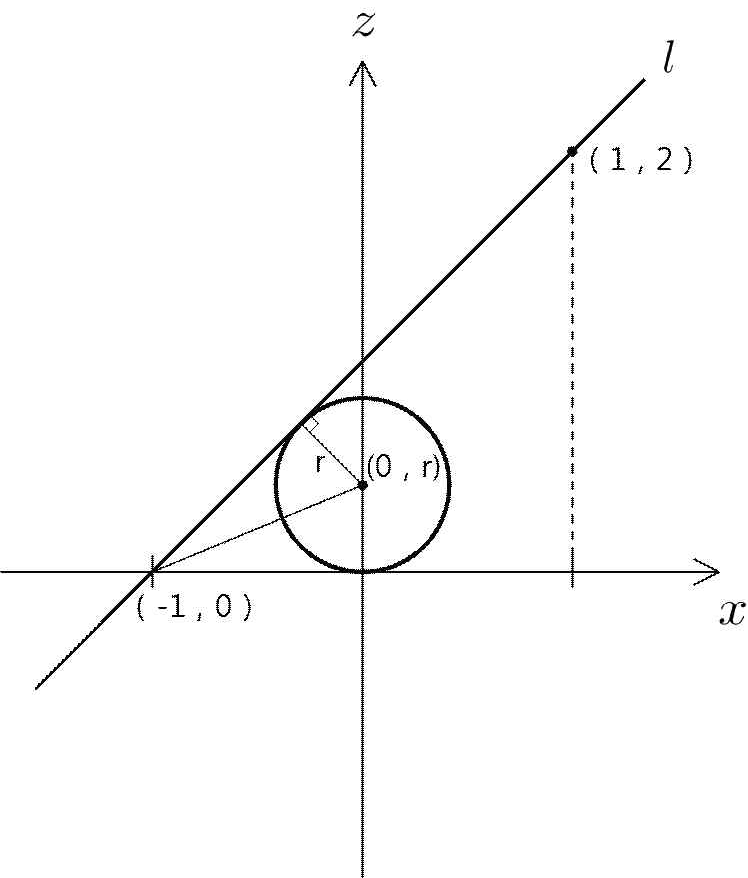
직선 l\displaystyle l이 구에 접하기 위해서는 구의 중심 C\displaystyle C와 논제 I-1에서 구한 점 A\displaystyle A 사이의 거리가 r\displaystyle r이 되어야 한다. 점 A\displaystyle A와 C\displaystyle C사이의 거리는

AC‾=(r−12)2+(r+12−r)2\displaystyle \overline{AC}=\sqrt{\left(\frac{r-1}2\right)^2+\left(\frac{r+1}2-r\right)^2}.

이 거리가 r\displaystyle r이 되기 위해서는

(r−12)2+(r+12−r)2=r\displaystyle \sqrt{\left(\frac{r-1}2\right)^2+\left(\frac{r+1}2-r\right)^2}=r.

이 식으로부터 방정식 r2+2r−1=0\displaystyle r^2+2r-1=0을 얻는다. 이 이차방정식의 양수 해는 r=−1+2\displaystyle r=-1+\sqrt2. 따라서 r=−1+2\displaystyle r=-1+\sqrt2일 때 직선 l\displaystyle l은 구에 접한다.

직선에 접하는 원

<논제 I-3>

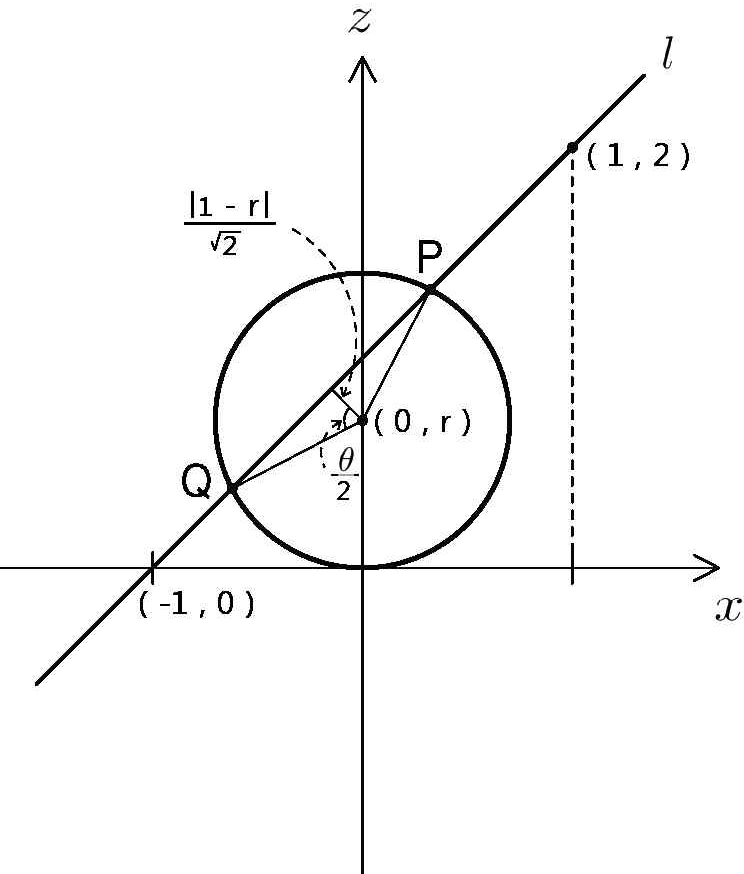
CP→\displaystyle \overrightarrow{CP}와 CQ→\displaystyle \overrightarrow{CQ}가 이루는 각 θ\displaystyle \theta을 알면 점 P\displaystyle P, Q\displaystyle Q를 지나는 대원의 중심각이 θ\displaystyle \theta인 부채꼴의 호의 길이를 구하면 된다. 중심각 θ\displaystyle \theta를 구하기 위해서 ∠ACQ=θ2\displaystyle \angle ACQ=\frac\theta2인 직각삼각형 ACQ\displaystyle ACQ를 이용한다. r=12\displaystyle r=\frac12일 때, QC‾=12\displaystyle \overline{QC}=\frac12, AC‾=122\displaystyle \overline{AC}=\frac1{2\sqrt2}이다. 따라서 cos⁡θ2=12\displaystyle \cos\frac\theta2=\frac1{\sqrt2}. 즉, θ=π2\displaystyle \theta=\frac\pi2. 중심각이 π2\displaystyle \frac\pi2이고 반지름이 12\displaystyle \frac12인 부채꼴의 호의 길이는 π4\displaystyle \frac\pi4. 그러므로 P\displaystyle P, Q\displaystyle Q를 잇는 구면 위의 가장 짧은 곡선의 길이는 π4\displaystyle \frac\pi4이다.

구의 단면과 두 교점의 중심각

<논제 I-4>

주어진 평면이 y\displaystyle y축에 평행하므로 구와 주어진 평면 사이의 거리는 구와 직선 l\displaystyle l과의 거리와 같다. 논제 I-1에 의해 r=−1+2\displaystyle r=-1+\sqrt2일 때 구와 직선 l\displaystyle l이 접하므로 평면이 구를 자르기 위해서는 r\displaystyle r이 −1+2\displaystyle -1+\sqrt2보다 큰 값을 가져야 한다. 구의 중심과 주어진 평면과의 거리는

AC‾=(r−12)2+(r+12−r)2=∣1−r∣2\displaystyle \overline{AC}=\sqrt{\left(\frac{r-1}2\right)^2+\left(\frac{r+1}2-r\right)^2}=\frac{|1-r|}{\sqrt2}.

따라서 구의 잘려진 윗부분의 부피는 평면에서 반지름이 r\displaystyle r이고 중심이 원점 (0,0)\displaystyle (0,0)인 원의 일부를 x\displaystyle x축을 중심으로 회전시켜 얻어지는 회전체의 부피와 같다. r\displaystyle r의 범위에 따라 다음의 두 경우로 나뉜다.

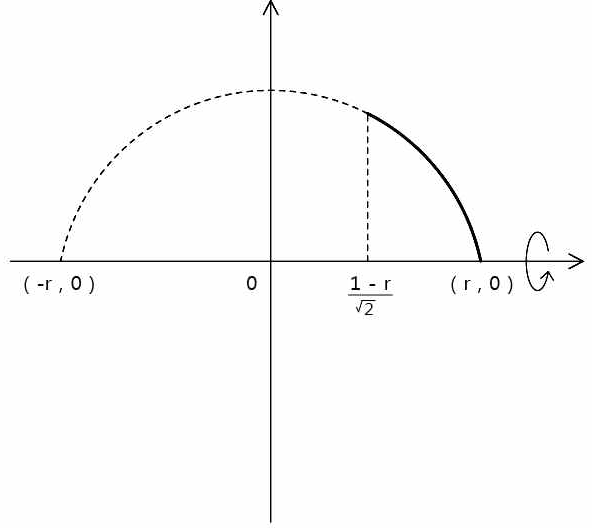
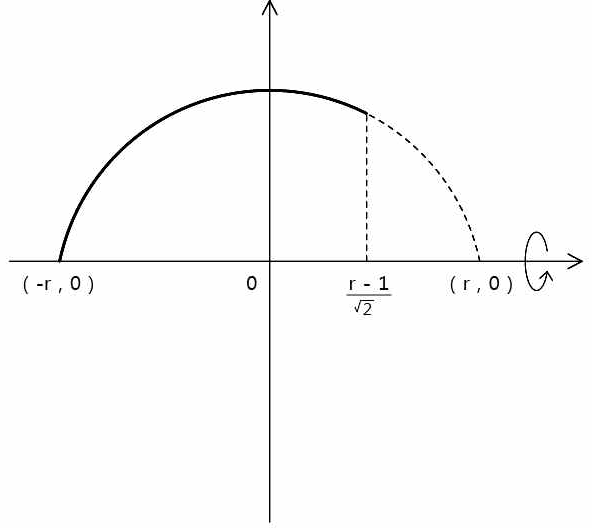
−1+2<r<1\displaystyle -1+\sqrt2<r<1일 때, 구의 잘려진 윗부분의 부피는 다음의 그래프를 x\displaystyle x축을 중심으로 회전시켜 얻어지는 회전체의 부피와 같다.

반지름이 1보다 작은 경우의 회전 영역

따라서 부피는 적분 ∫1−r2rπ(r2−x2) dx\displaystyle \int_{\frac{1-r}{\sqrt2}}^r\pi(r^2-x^2)\,dx (혹은 ∫−rr−12π(r2−x2) dx\displaystyle \int_{-r}^{\frac{r-1}{\sqrt2}}\pi(r^2-x^2)\,dx)를 계산하면 된다.

r≥1\displaystyle r\ge1일 때는 구의 잘려진 윗부분의 부피는 다음의 그래프를 x\displaystyle x축을 중심으로 회전시켜 얻어지는 회전체의 부피와 같다.

반지름이 1 이상인 경우의 회전 영역

따라서 부피는 적분 ∫−rr−12π(r2−x2) dx\displaystyle \int_{-r}^{\frac{r-1}{\sqrt2}}\pi(r^2-x^2)\,dx (혹은 ∫1−r2rπ(r2−x2) dx\displaystyle \int_{\frac{1-r}{\sqrt2}}^r\pi(r^2-x^2)\,dx)를 계산하면 된다.

첨삭 사례

아직 등록된 첨삭 사례가 없습니다.

질문과 답변 · 0개질문과 답변 · 고정 0개

아직 등록된 질문이 없습니다. 질문 작성은 멤버십 회원만 가능합니다.