수리논술, 이게 다다.

의학계 1번

오류 제보

문제

I. 다음 제시문과 그림을 참조하여 논제에 답하시오. (60점)

[가] x\displaystyle x의 값이 a\displaystyle a보다 작으면서 a\displaystyle a에 한없이 가까워질 때, f(x)\displaystyle f ( x )의 값이 일정한 값 β\displaystyle \beta에 한없이 가까워지면 β\displaystyle \beta를 x=a\displaystyle x = a에서의 함수 f(x)\displaystyle f ( x )의 좌극한이라고 하며, 다음과 같이 나타낸다.

lim⁡x→a−0f(x)=β\displaystyle \lim_{x \to a - 0} {f ( x )} = \beta

[나]

닫힌 구간 [a,b]\displaystyle \left[ a , b \right]에서 연속인 곡선 y=f(x)\displaystyle y = f ( x )와 x\displaystyle x축 및 두 직선 x=a\displaystyle x = a, x=b\displaystyle x = b로 둘러싸인 도형을 x\displaystyle x축의 둘레로 회전시킬 때 생기는 회전체의 부피를 구하여 보자. x\displaystyle x좌표가 x\displaystyle x인 점을 지나 x\displaystyle x축에 수직인 평면으로 이 회전체를 자르면 그 단면은 반지름의 길이가 ∣f(x)∣\displaystyle | f ( x ) |인 원이 된다. 그 단면의 넓이를 S(x)\displaystyle S ( x )라고 하면

S(x)=πy2=π{f(x)}2\displaystyle S ( x ) = \pi y^{2} = \pi \left\{ f ( x ) \right\}^{2}

이다. 따라서, 구하는 회전체의 부피 V\displaystyle V는 다음과 같다.

V=∫abS(x)dx=∫abπy2dx=π∫ab{f(x)}2dx\displaystyle V = \int_{a}^{b} {S ( x )} d x = \int_{a}^{b} {\pi y^{2} d x} = \pi \int_{a}^{b} {\left\{ f ( x ) \right\}^{2}} d x

[다]

함수 y=f(x)\displaystyle y = f ( x )에서 x\displaystyle x의 값이 a\displaystyle a에서 a+Δx\displaystyle a + \Delta x까지 변할 때의 평균변화율 ΔyΔx=f(a+Δx)−f(a)Δx\displaystyle \frac{{\Delta y}}{\Delta x} = {\frac{{f ( a + \Delta x ) - f ( a )}}{\Delta x}}에 대하여 극한값

lim⁡Δx→0ΔyΔx=lim⁡Δx→0f(a+Δx)−f(a)Δx\displaystyle \lim_{\Delta x \to 0} {\frac{{\Delta y}}{\Delta x}} = \lim_{\Delta x \to 0} {\frac{{f ( a + \Delta x ) - f ( a )}}{\Delta x}}

가 존재하면 함수 y=f(x)\displaystyle y = f ( x )는 x=a\displaystyle x = a에서 미분가능하다고 한다. 이때, 이 극한값을 함수 y=f(x)\displaystyle y = f ( x )의 x=a\displaystyle x = a에서의 순간변화율

또는 미분계수라 하고 기호 f′(a)\displaystyle f^{\prime} ( a )로 나타낸다.

[라]

미분가능한 두 함수 y=f(z)\displaystyle y = f ( z ), z=g(x)\displaystyle z = g ( x )에 대하여 합성함수 y=f(g(x))\displaystyle y = f ( g ( x ) )의 도함수는 다음과 같다.

dydx=dydzdzdx\displaystyle \frac{{d y}}{d x} = \frac{{d y}}{d z} \frac{{d z}}{d x} 또는 y′=f′(g(x))g′(x)\displaystyle y^{\prime} = f^{\prime} ( g ( x ) ) g^{\prime} ( x )

[마]

미분가능한 함수 y=f(x)\displaystyle y = f ( x )에 대하여 f′(a)=0\displaystyle f^{\prime} ( a ) = 0일 때

(1) x=a\displaystyle x = a의 좌우에서 f′(x)\displaystyle f^{\prime} ( x )의 부호가 양(+)에서 음(-)으로 바뀌면, 함수 f(x)\displaystyle f ( x )는 x=a\displaystyle x = a에서 극댓값을 갖는다.

(2) x=a\displaystyle x = a의 좌우에서 f′(x)\displaystyle f^{\prime} ( x )의 부호가 음(-)에서 양(+)으로 바뀌면, 함수 f(x)\displaystyle f ( x )는 x=a\displaystyle x = a에서 극솟값을 갖는다.

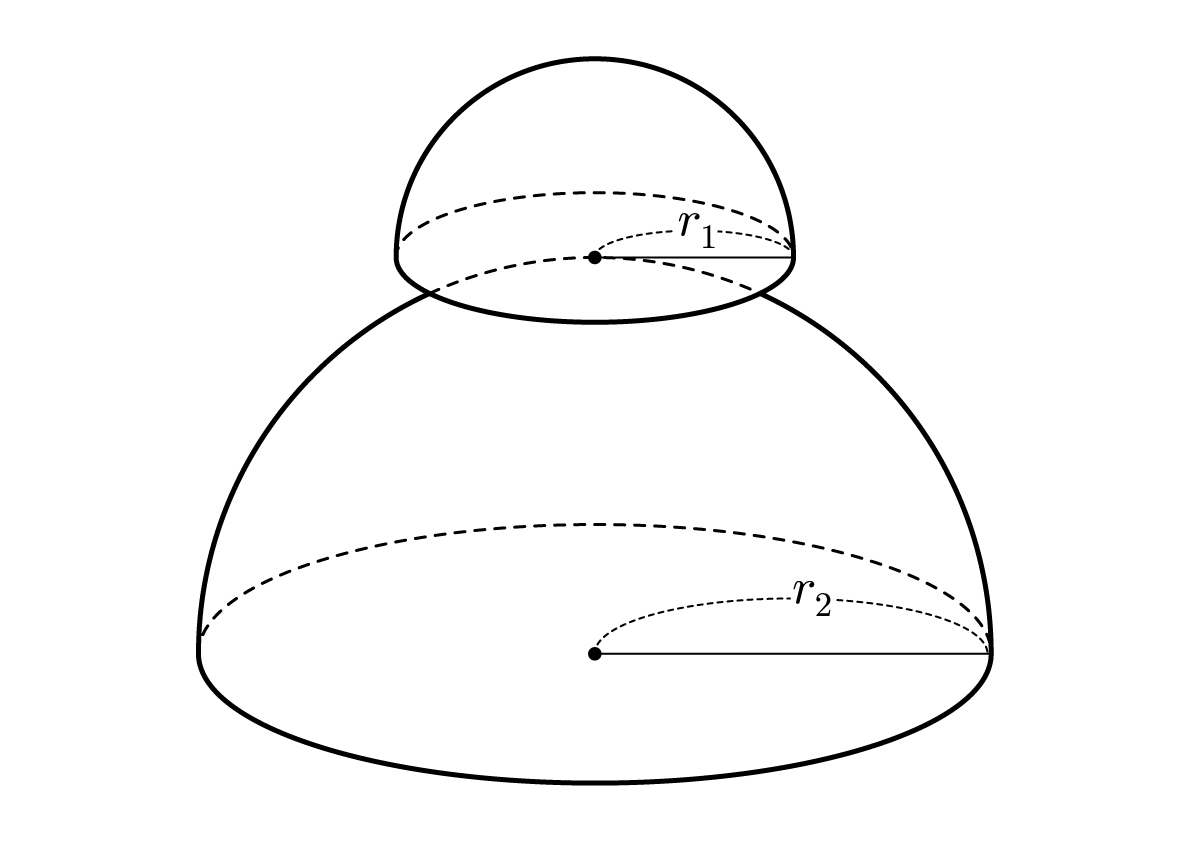
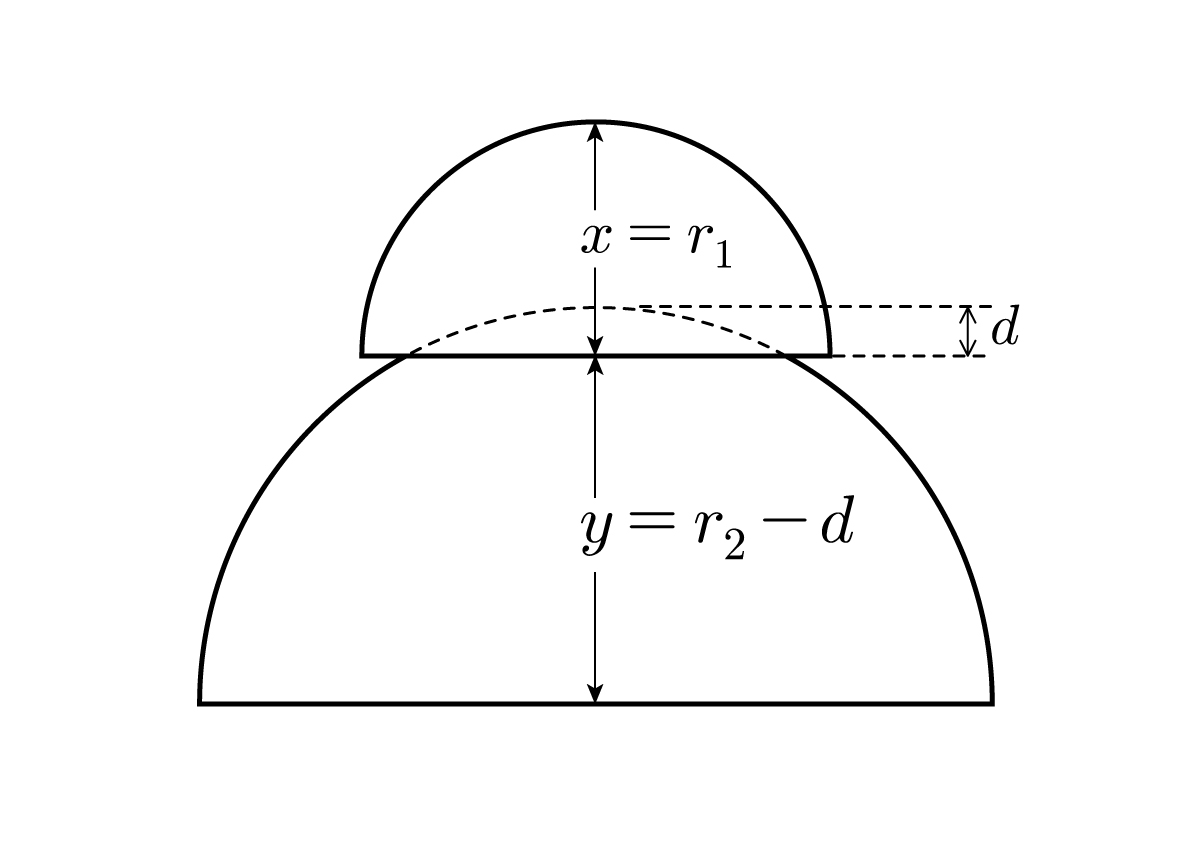
두 반구의 위치와 반지름·높이
[그림 1]
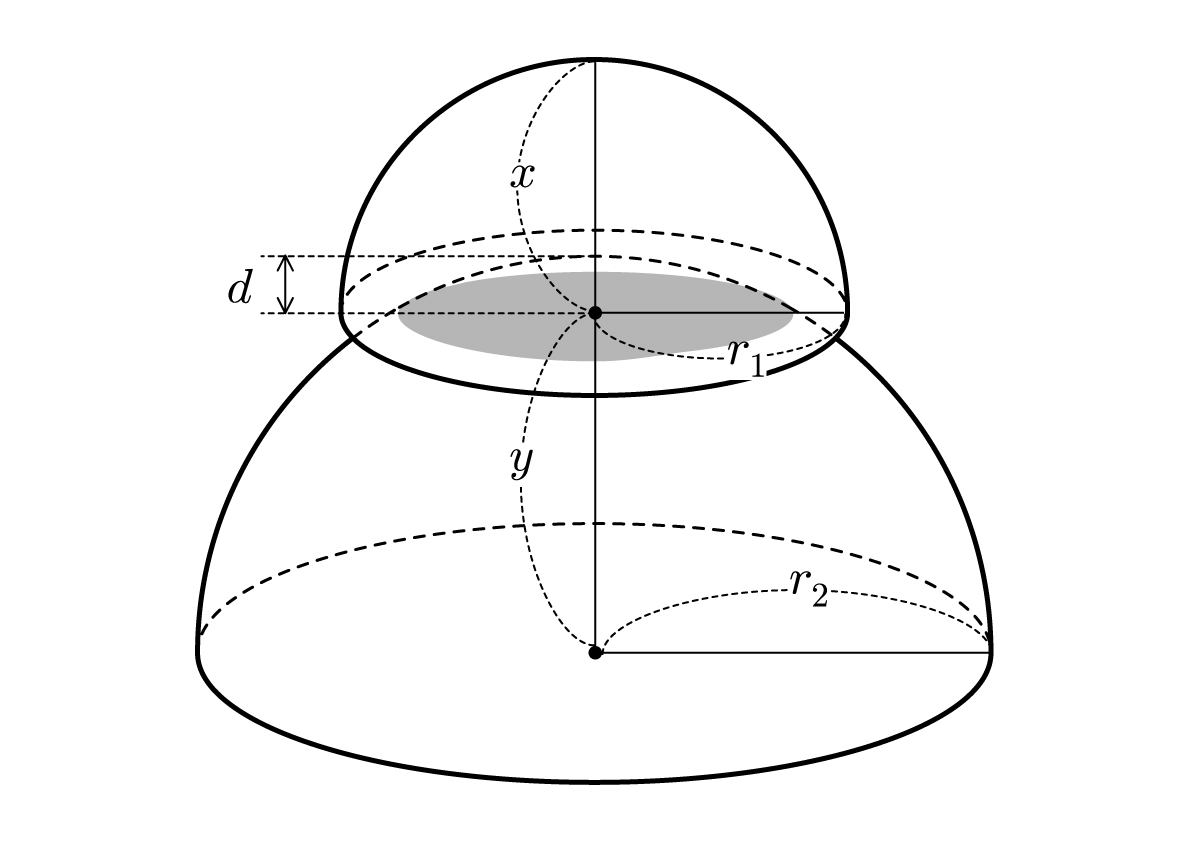
두 반구의 위치와 반지름·높이
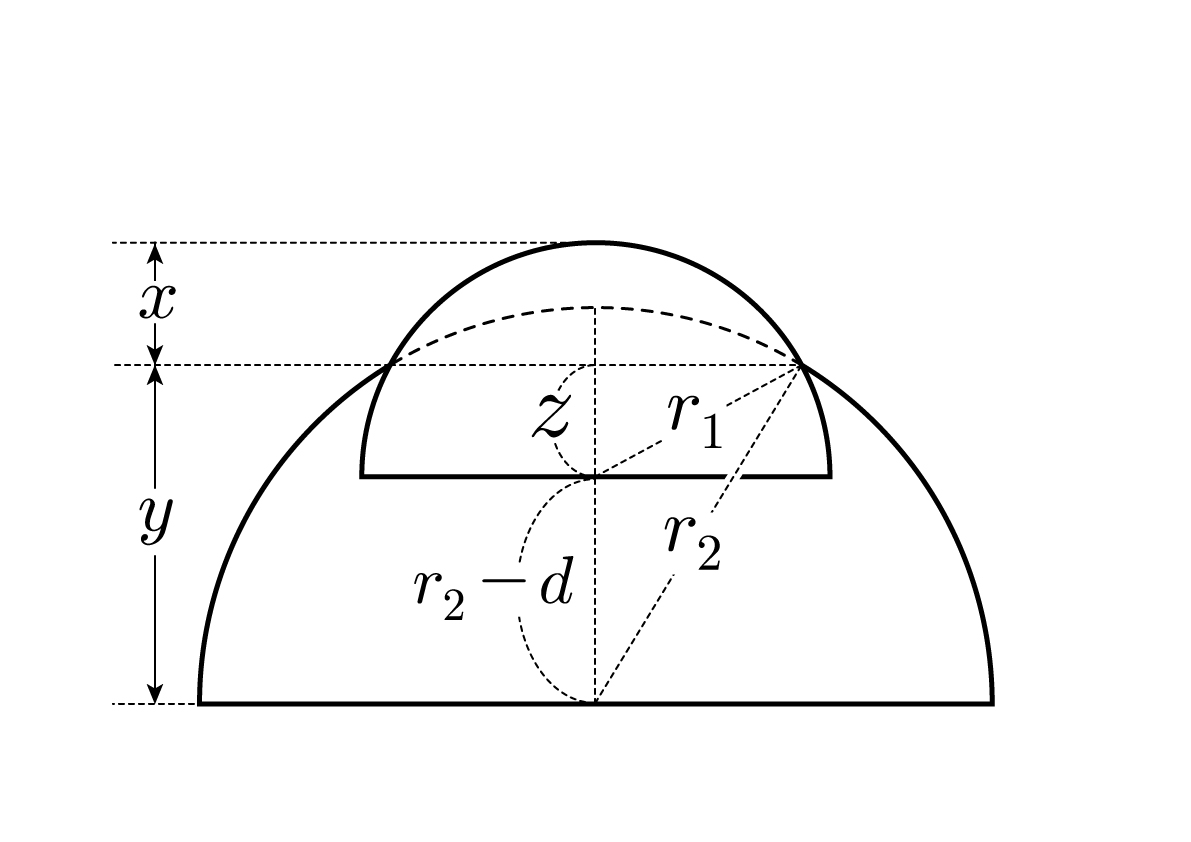
[그림 2]
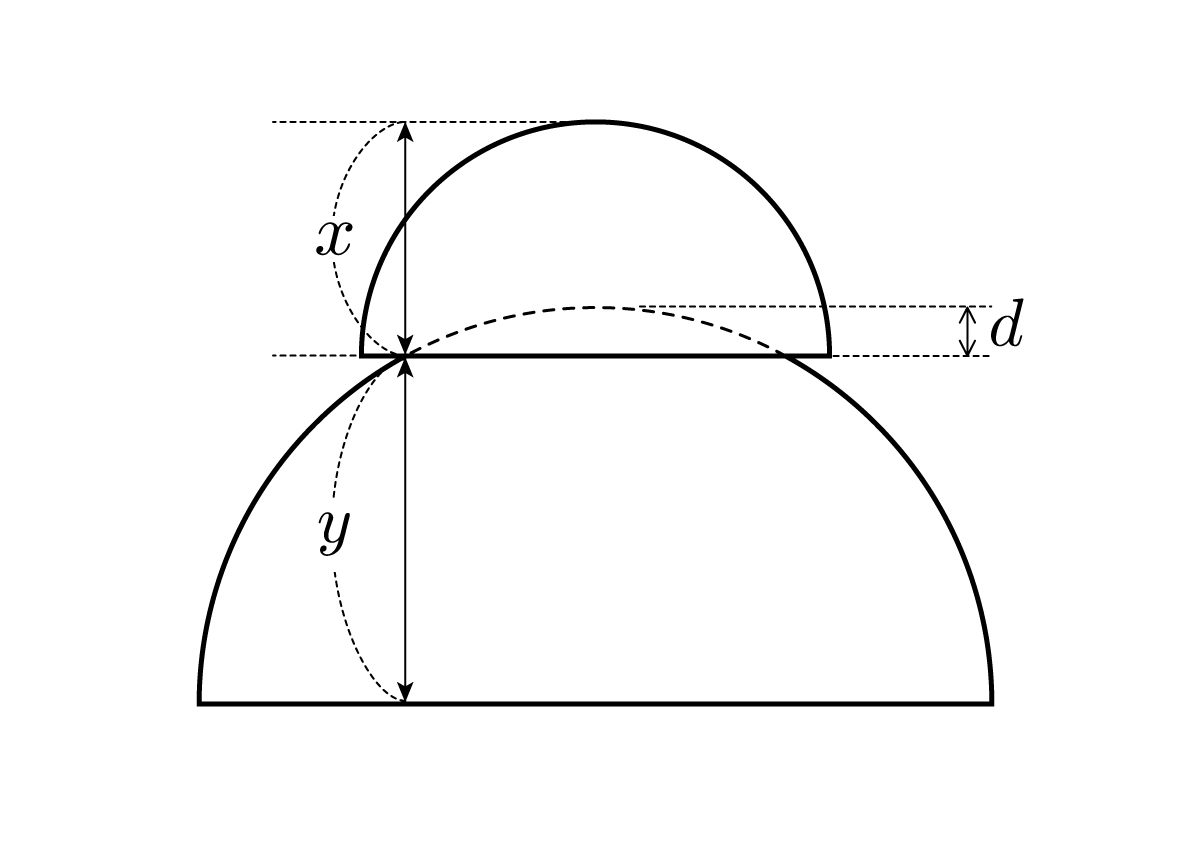
두 반구의 위치와 반지름·높이
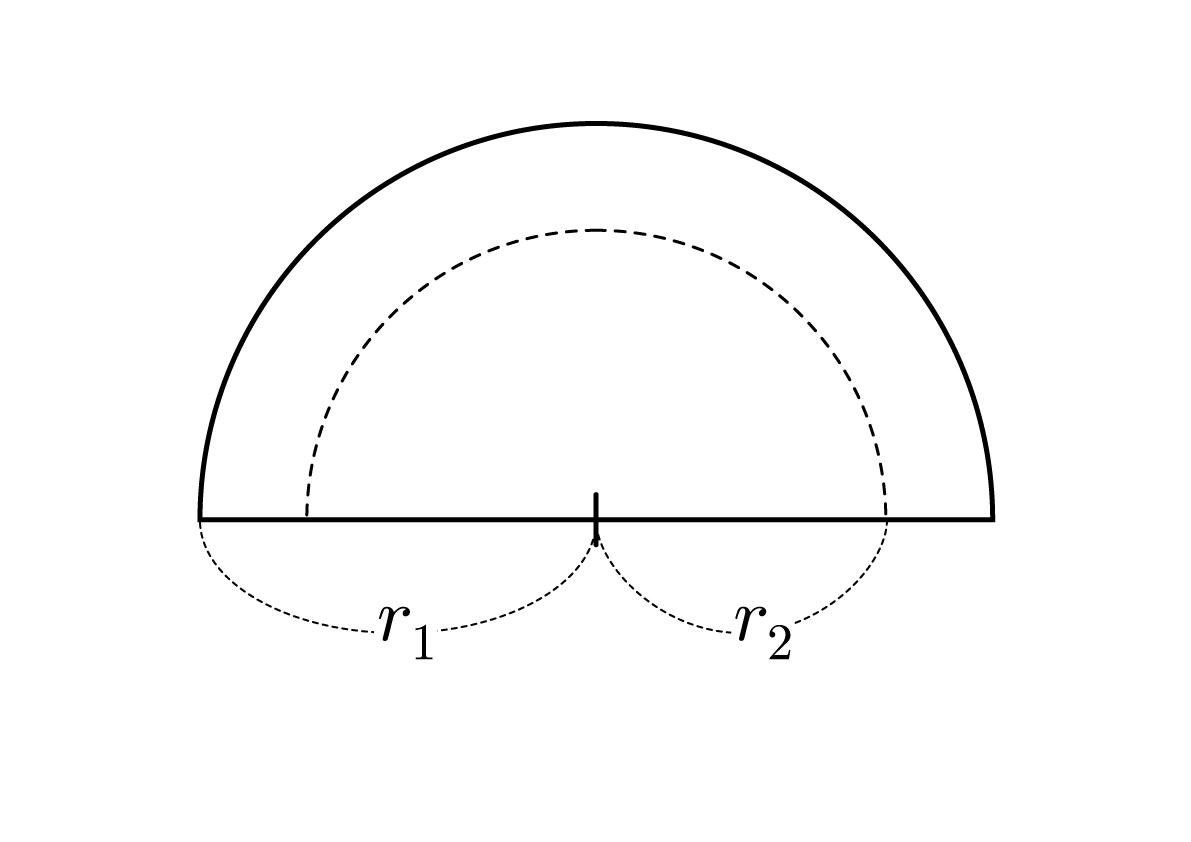
[그림 3]

[논제 I] 아래 상황 1과 상황 2를 읽고 논제에 답하시오.

상황 1: 반지름이 각각 r1=1\displaystyle r_{1} = 1과 r2=2\displaystyle r_{2} = 2인 서로 다른 물질로 만들어진 두 반구가 [그림 1]과 같이 서로 접하면서 놓여있고, 시간 t\displaystyle t (t≥0)\displaystyle ( t \ge 0 )가 지남에 따라 각 반구의 반지름 r1\displaystyle r_{1}이 1−t\displaystyle 1 - t로, r2\displaystyle r_{2}가 2−3t\displaystyle 2 - 3 t로 변한다. 여기서 항상 두 밑면은 평행하고, 윗 반구 밑면의 중심이 아래 반구와 접한다. 단, 각 반구의 반지름이 0\displaystyle 0이 되면, 그 반구는 녹아 없어진 것으로 생각한다. (여기서 반구는 구와 구의 중심을 지나는 평면으로 둘러싸인 한 쪽 입체도형을 말한다.)

상황 2: 반지름이 r1=1\displaystyle r_{1} = 1인 얼음으로 만들어진 반구와 r2=2\displaystyle r_{2} = 2인 눈으로 만들어진 반구가 [그림 1]과 같이 서로 접하면서 놓여있고, 시간 t\displaystyle t (t≥0)\displaystyle ( t \ge 0 )가 지남에 따라 각 반구의 반지름 r1\displaystyle r_{1}이 1−t\displaystyle 1 - t로, r2\displaystyle r_{2}가 2−3t\displaystyle 2 - 3 t로 변한다. 여기서 항상 두 밑면은 평행하지만 [그림 2]처럼 얼음 반구와 눈 반구의 공통 부분이 생긴다고 하자. 이때 얼음 반구는 항상 반구의 형태를 유지하지만, 눈 반구에서는 공통 부분에 해당하는 부분이 계속 녹아 없어진다. 두 반구의 밑면 사이의 거리와 r2\displaystyle r_{2}의 차를 d\displaystyle d라 하고, d\displaystyle d는 시간 t\displaystyle t에 따라 변하는 일차식 d=t\displaystyle d = t로 주어진다고 하자. 두 반구의 밑면의 중심을 지나는 평면으로 자른 단면은 각각 반원(밑변 포함)으로 둘러싸인 영역으로 [그림 3]과 같다. 입체를 옆에서 관찰하였을 때, 얼음과 눈으로 구분되어 보이는 경계 부분에서 얼음 반구의 최고점까지의 높이를 x\displaystyle x, 눈 반구의 밑면으로부터 그 경계까지의 높이를 y\displaystyle y라고 하자. 즉, [그림 3]에서와 같이, 두 반원(밑변 포함)의 교점과 아래 반원의 밑변 사이의 거리가 y\displaystyle y, 전체 도형의 높이에서 y\displaystyle y를 뺀 것이 x\displaystyle x이다. 단, 눈으로 이루어진 부분이 남아 있을 때에만 d\displaystyle d와 x\displaystyle x, y\displaystyle y를 정의한다. (상황 1은 모든 t\displaystyle t에 대해 d=0\displaystyle d = 0인 경우에 해당한다.)

[논제 I-1] 상황 1에서 제시된 입체의 부피를 V0\displaystyle \mathrm{V}_{0}이라 하자. 두 반구가 모두 녹아 없어질 때까지의 입체의 부피 V0\displaystyle \mathrm{V}_{0}를 t\displaystyle \mathrm{t}의 식으로 표현하고, 그 근거를 논술하시오. (5점)

[논제 I-2] 상황 2에서 눈으로 이루어진 부분이 완전히 녹아 없어질 때의 시각을 t0\displaystyle \mathrm{t}_{0}이라 하자. x\displaystyle \mathrm{x}와 y\displaystyle \mathrm{y}를 t\displaystyle \mathrm{t}의 함수로 표현하고, t0\displaystyle \mathrm{t}_{0}과 lim⁡t→t0−0x\displaystyle {\lim_{\mathrm{t} \to \mathrm{t}_{0} - 0} {}} \mathrm{x}, lim⁡t→t0−0y\displaystyle {\lim_{\mathrm{t} \to \mathrm{t}_{0} - 0} {}} \mathrm{y}를 구하시오. 그리고 그 근거를 논술하시오. (20점)

[논제 I-3] 상황 2에서 제시된 입체의 부피를 V\displaystyle \mathrm{V}라 하고, V\displaystyle \mathrm{V}가 0\displaystyle 0이 되는 시각을 t1\displaystyle \mathrm{t}_{1}이라 하자. 이때, t1\displaystyle \mathrm{t}_{1}을 구하고 0≤t≤t1\displaystyle {0} {\leq} {\mathrm{t}} {\leq} {\mathrm{t}_{1}}에서의 V\displaystyle \mathrm{V}를 r1\displaystyle \mathrm{r}_{1}, r2\displaystyle \mathrm{r}_{2}, x\displaystyle \mathrm{x}, y\displaystyle \mathrm{y}를 이용하여 표현하시오. 그리고 그 근거를 논술하시오. (V\displaystyle {\mathrm{V}}는 시간의 구간마다 다르게 표현될 수 있고, 각 변수는 정의되는 범위에서만 이용한다.) (15점)

[논제 I-4] V0\displaystyle \mathrm{V}_{0}와 V\displaystyle \mathrm{V}를 각각 [논제 I-1]과 [논제 I-3]에서 구한 입체의 부피라 하고, t1\displaystyle \mathrm{t}_{1}을 [논제 I-3]에서의 V\displaystyle \mathrm{V}가 0\displaystyle 0이 되는 시각이라고 하자. 이때, 제시문 [라]와 [마]를 참조하여 구간 [0,t1]\displaystyle {\left[ 0 , \mathrm{t}_{1} \right]}에서 V0−V\displaystyle {\mathrm{V}_{0}} {- \mathrm{V}}의 값이 최대가 되는 시각을 구하고, 그 근거를 논술하시오. (20점)

해설강의 준비중

[논제 I-1]

구간 0≤t<23\displaystyle 0 \le t < \frac{2}{3}에서 각 반구의 부피가 23πr13\displaystyle \frac{{2}}{3} \pi r_{1}^{3}, 23πr23\displaystyle \frac{{2}}{3} \pi r_{2}^{3}이므로, 입체의 부피 V0\displaystyle V_{0}는 다음과 같다.

V0=23π(r13+r23)=23π((1−t)3+(2−3t)3)\displaystyle V_{0} = \frac{{2}}{3} \pi ( r_{1}^{3} + r_{2}^{3} ) = \frac{{2}}{3} \pi ( ( 1 - t )^{3} + ( 2 - 3 t )^{3} )

그러나 구간 23≤t≤1\displaystyle \frac{{2}}{3} \leq t \leq 1에서는 아래 반구가 없어지므로, 입체의 부피는 V0=23πr13=23π(1−t)3\displaystyle V_{0} = \frac{{2}}{3} \pi r_{1}^{3} = \frac{{2}}{3} \pi ( 1 - t )^{3} 이다. 이를 종합하면, 입체의 부피 V0\displaystyle V_{0}는 아래와 같다.

V0={23π(r13+r23)=23π((1−t)3+(2−3t)3)(0≤t<23)23πr13=23π(1−t)3(23≤t≤1)\displaystyle V_{0} = {\begin{cases}\frac{{2}}{3} \pi ( r_{1}^{3} + r_{2}^{3} ) = \frac{{2}}{3} \pi ( ( 1 - t )^{3} + ( 2 - 3 t )^{3} ) & \left( 0 \leq t < \frac{{2}}{3} \right) \\ \frac{{2}}{3} \pi r_{1}^{3} = \frac{{2}}{3} \pi ( 1 - t )^{3} & \left( \frac{{2}}{3} \le t \leq 1 \right)\end{cases}}

[논제 I-2]

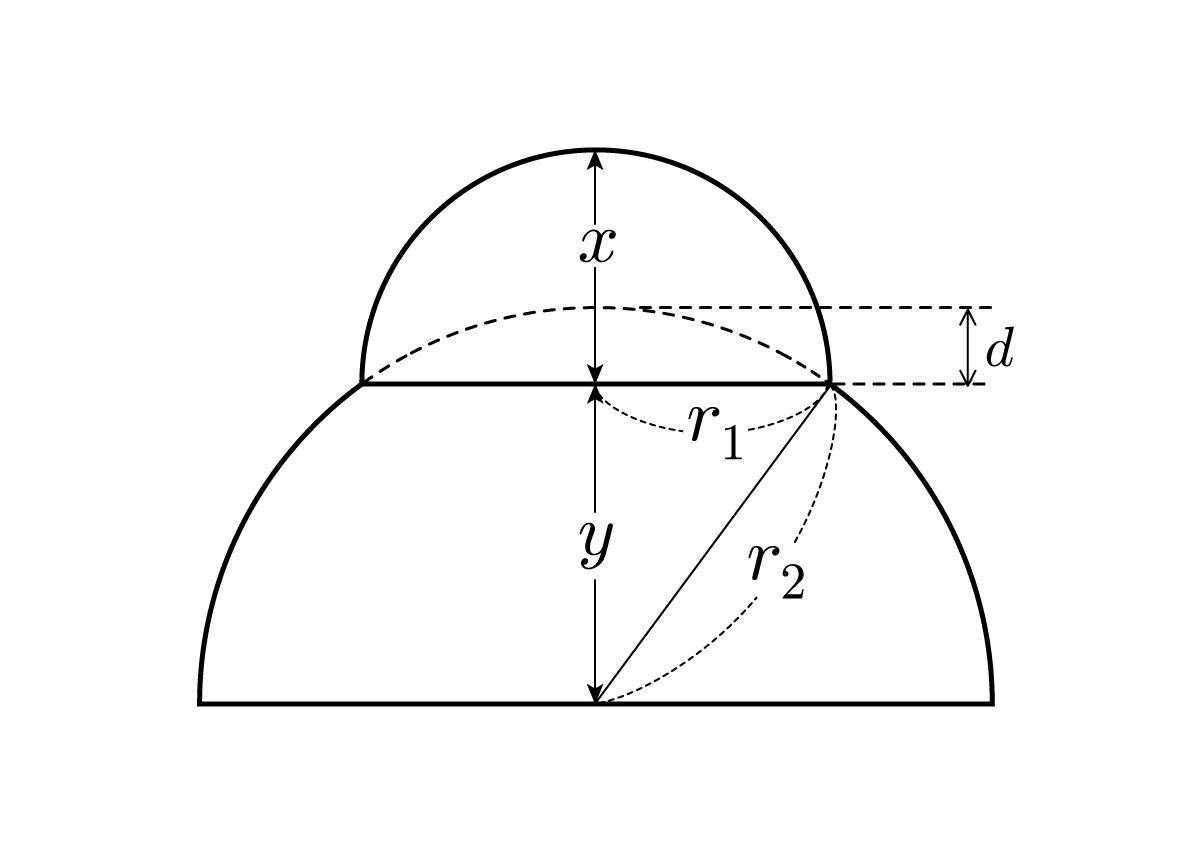
두 반구의 위치와 반지름·높이

적어도 하나의 반지름이 0\displaystyle 0보다 크거나 같아야 하므로, 0≤t≤1\displaystyle 0 \le t \le 1인 t\displaystyle t에 대해서만 고려한다. 다음으로, 두 반구의 위치관계를 이해하기 위해서 오른쪽 그림에서처럼 r22=r12+y2\displaystyle r_{2}^{2} = r_{1}^{2} + y^{2}이 되는 시각 t\displaystyle t를 구한다.

r22=r12+y2⇒8t2−6t+1=0⇒(4t−1)(2t−1)=0⇒t=14또는t=12\displaystyle r_{2}^{2} = r_{1}^{2} + y^{2} \Rightarrow 8 t^{2} - 6 t + 1 = 0 \Rightarrow ( 4 t - 1 ) ( 2 t - 1 ) = 0 \Rightarrow t = \frac{{1}}{4} \text{또는} t = \frac{{1}}{2}

두 반구의 위치와 반지름·높이
(그림 1)
두 반구의 위치와 반지름·높이
(그림 2)
두 반구의 위치와 반지름·높이
(그림 3)

두 반구의 형태는, 0≤t≤14\displaystyle 0 \le t \le \frac{1}{4}인 경우 (그림 1), 14<t<12\displaystyle \frac{{1}}{4} < t < \frac{{1}}{2}인 경우 (그림 2), 12≤t≤1\displaystyle \frac{1}{2} \le t \le 1인 경우 (그림 3) 등의 3가지로 표현될 수 있다.

(i) 0≤t≤14\displaystyle 0 \le t \le \frac{1}{4}인 경우, (그림 1)에서처럼 x=r1=1−t\displaystyle x = r_{1} = 1 - t이고 y=r2−d=2−4t\displaystyle y = r_{2} - d = 2 - 4 t이다.

(ii) 14<t<12\displaystyle \frac{1}{4} < t < \frac{1}{2}인 경우, (그림 2)에서와 같이 변수 z\displaystyle z를 설정하면 y=r2−d+z\displaystyle y = r_{2} - d + z이고 x=r1−z\displaystyle x = r_{1} - z가 된다. 피타고라스 정리를 이용하여 z\displaystyle z에 관한 방정식 r12−z2=r22−(r2−d+z)2\displaystyle r_{1}^{2} - z^{2} = r_{2}^{2} - ( r_{2} - d + z )^{2}을 만들면 다음과 같이 z\displaystyle z를 구할 수 있다.

z=2r2d−r12−d22(r2−d)=t−14\displaystyle z = \frac{{2 r_{2} d - r_{1}^{2} - d^{2}}}{2 ( r_{2} - d )} = t - \frac{1}{4}

따라서 x=r1−z=54−2t\displaystyle x = r_{1} - z = \frac{5}{4} - 2 t이고, y=r2−d+z=2−4t+t−14=74−3t\displaystyle y = r_{2} - d + z = 2 - 4 t + t - \frac{1}{4} = \frac{7}{4} - 3 t이다.

(iii)12≤t≤1\displaystyle \frac{{1}}{2} \leq t \leq 1인 경우, (그림 3)에서 보는 바와 같이, 눈 반구가 얼음 반구에 완전히 포함되기 때문에 눈 반구가 모두 녹아 없어진다. 따라서 x\displaystyle x와 y\displaystyle y는 정의하지 않는다.

(i), (ii), (iii)을 종합하면

x={1−t(0≤t≤14)54−2t(14<t<12)\displaystyle x = {\begin{cases}1 - t & \left( 0 \leq t \leq \frac{{1}}{4} \right) \\ \frac{{5}}{4} - 2 t & \left( \frac{{1}}{4} < t < \frac{{1}}{2} \right)\end{cases}} , y={2−4t(0≤t≤14)74−3t(14<t<12)\displaystyle y = {\begin{cases}2 - 4 t & \left( 0 \leq t \leq \frac{{1}}{4} \right) \\ \frac{{7}}{4} - 3 t & \left( \frac{{1}}{4} < t < \frac{{1}}{2} \right)\end{cases}}

이고, 눈으로 이루어진 부분이 완전히 녹아 없어질 때의 시각은 t0=12\displaystyle t_{0} = \frac{{1}}{2}이고, 이때 x\displaystyle x와 y\displaystyle y의 좌극한은 lim⁡t→t0−0x=lim⁡t→t0−0y=14\displaystyle \lim_{t \to t_{0} - 0} x = \lim_{t \to t_{0} - 0} y = \frac{{1}}{4}이다.

[논제 I-3]

[논제 I-2]의 해설처럼 t=1\displaystyle t = 1이후에는 두 반구 모두 녹아 없어지므로 t1=1\displaystyle t_{1} = 1이다. 편의상, 0≤t<12\displaystyle 0 \leq t < \frac{{1}}{2}인 경우에 얼음과 눈으로 구분되어 보이는 경계를 반구의 밑면과 평행한 단면으로 자르면 각각 높이가 x\displaystyle x, y\displaystyle y인 두 개의 입체를 생각할 수 있다. 이때 높이를 x\displaystyle x로 갖는 입체의 부피를 V1\displaystyle V_{1}, 높이를 y\displaystyle y로 갖는 입체의 부피를 V2\displaystyle V_{2}라 하자.

(i) 0≤t≤14\displaystyle 0 \le t \le \frac{1}{4}인 경우, V1\displaystyle V_{1}은 반지름이 r1\displaystyle r_{1}인 반구의 부피이므로 V1=23πr13\displaystyle V_{1} = \frac{2}{3} \pi r_{1}^{3}이고, V2\displaystyle V_{2}는 높이가 r22−u2\displaystyle \sqrt{r_{2}^{2} - u^{2}}, (0≤u≤y)\displaystyle ( 0 \leq u \leq y )인 평면도형의 u\displaystyle u축에 대한 회전체의 부피이므로 V2=π(r22y−13y3)\displaystyle V_{2} = \pi \left( r_{2}^{2} y - \frac{1}{3} y^{3} \right)이다. 따라서 이때 구하고자 하는 부피 V\displaystyle V는 다음과 같다.

V=V1+V2=π(23r13+r22y−13y3)\displaystyle V = V_{1} + V_{2} = \pi \left( \frac{{2}}{3} r_{1}^{3} + r_{2}^{2} y - \frac{{1}}{3} y^{3} \right)

(ii)14<t<12\displaystyle \frac{1}{4} < t < \frac{1}{2}인 경우, V1\displaystyle V_{1}은 높이가 r12−u2\displaystyle \sqrt{r_{1}^{2} - u^{2}}, (r1−x≤u≤r1)\displaystyle ( r_{1} - x \leq u \leq r_{1} )인 평면도형의 u\displaystyle u축에 대한 회전체의 부피이므로 V1=23πr13−π(r12(r1−x)−13(r1−x)3)\displaystyle V_{1} = \frac{2}{3} \pi r_{1}^{3} - \pi \left( r_{1}^{2} ( r_{1} - x ) - \frac{1}{3} ( r_{1} - x )^{3} \right)이고, V2\displaystyle V_{2}는 위에서처럼 V2=π(r22y−13y3)\displaystyle V_{2} = \pi \left( r_{2}^{2} y - \frac{1}{3} y^{3} \right)으로 표현된다. 따라서 구하고자 하는 부피 V\displaystyle V는 다음과 같다.

V=V1+V2=π(23r13−r12(r1−x)+13(r1−x)3+(r22y−13y3))=π(r1x2−13x3+r22y−13y3)\displaystyle V = V_{1} + V_{2} = \pi \left( \frac{2}{3} r_{1}^{3} - r_{1}^{2} ( r_{1} - x ) + \frac{1}{3} ( r_{1} - x )^{3} + ( r_{2}^{2} y - \frac{1}{3} y^{3} ) \right) = \pi \left( r_{1} x^{2} - \frac{1}{3} x^{3} + r_{2}^{2} y - \frac{1}{3} y^{3} \right)

(iii) 12≤t≤1\displaystyle \frac{1}{2} \le t \le 1인 경우, 반지름이 r1\displaystyle r_{1}인 얼음 반구만 고려하면 되므로 V=23πr13\displaystyle V = \frac{{2}}{3} \pi r_{1}^{3}이 된다.

(i), (ii), (iii)을 종합하면 입체의 부피 V\displaystyle V는 다음과 같다.

V={π(23r13+r22y−13y3)(0≤t≤14)π(r1x2−13x3+r22y−13y3)(14<t<12)23πr13(12≤t≤1)\displaystyle V = {\begin{cases}\pi \left( \frac{{2}}{3} r_{1}^{3} + r_{2}^{2} y - \frac{{1}}{3} y^{3} \right) & \left( 0 \leq t \leq \frac{{1}}{4} \right) \\ \pi \left( r_{1} x^{2} - \frac{{1}}{3} x^{3} + r_{2}^{2} y - \frac{{1}}{3} y^{3} \right) & \left( \frac{{1}}{4} < t < \frac{{1}}{2} \right) \\ \frac{{2}}{3} \pi r_{1}^{3} & \left( \frac{{1}}{2} \leq t \leq 1 \right)\end{cases}}

[논제 I-4]

Vd=V0−V\displaystyle V_{d} = V_{0} - V라 하자.

(i) 0≤t≤14\displaystyle 0 \le t \le \frac{1}{4}인 경우, Vd=π(23r23−r22y+13y3)\displaystyle V_{d} = \pi ( \frac{2}{3} r_{2}^{3} - r_{2}^{2} y + \frac{1}{3} y^{3} )이고 dr2dt=−3\displaystyle \frac{dr_{2}}{dt} = - 3, dydt=−4\displaystyle \frac{dy}{dt} = - 4이므로, 합성함수의 미분법을 사용하여 Vd\displaystyle V_{d}를 t\displaystyle t로 미분하면

dVddt=π(2r22(−3)−2r2(−3)y−r22(−4)+y2(−4))=−2π(r2−y)(r2−2y)=2πt(2−5t)≥0\displaystyle \begin{aligned}\frac{dV_{d}}{dt} & = \pi ( 2 r_{2}^{2} ( - 3 ) - 2 r_{2} ( - 3 ) y - r_{2}^{2} ( - 4 ) + y^{2} ( - 4 ) ) \\ & = - 2 \pi ( r_{2} - y ) ( r_{2} - 2 y ) = 2 \pi t ( 2 - 5 t ) \ge 0\end{aligned}

이 되어 Vd\displaystyle V_{d}는 항상 증가한다.

(ii)14<t<12\displaystyle \frac{1}{4} < t < \frac{1}{2}인 경우, Vd=π(23r13+23r23−r1x2+13x3−r22y+13y3)\displaystyle V_{d} = \pi \left( \frac{2}{3} r_{1}^{3} + \frac{2}{3} r_{2}^{3} - r_{1} x^{2} + \frac{1}{3} x^{3} - r_{2}^{2} y + \frac{1}{3} y^{3} \right)이 되고, dr1dt=−1\displaystyle \frac{dr_{1}}{dt} = - 1, dr2dt=−3\displaystyle \frac{dr_{2}}{dt} = - 3, dxdt=−2\displaystyle \frac{dx}{dt} = - 2, dydt=−3\displaystyle \frac{dy}{dt} = - 3이므로, 합성함수의 미분법을 사용하여 Vd\displaystyle V_{d}를 t\displaystyle t로 미분하면 다음과 같다.

dVddt=π(2r12(−1)+2r22(−3)−(−1)x2−2r1x(−2)+x2(−2)−2r2(−3)y−r22(−3)+y2(−3))=π(2t2−4t+54)\displaystyle \begin{aligned}\frac{dV_{d}}{dt} & = \pi ( 2 r_{1}^{2} ( - 1 ) + 2 r_{2}^{2} ( - 3 ) - ( - 1 ) x^{2} - 2 r_{1} x ( - 2 ) + x^{2} ( - 2 ) - 2 r_{2} ( - 3 ) y - r_{2}^{2} ( - 3 ) + y^{2} ( - 3 ) ) \\ & = \pi \left( 2 t^{2} - 4 t + \frac{5}{4} \right)\end{aligned}

따라서 dVddt\displaystyle \frac{dV_{d}}{dt}는 이 범위에서 한 개의 실근 t∗=1−38=1−64\displaystyle t_{*} = 1 - \sqrt{\frac{3}{8}} = 1 - \frac{\sqrt{6}}{4}을 갖는다. 14<t<t∗\displaystyle \frac{1}{4} < t < t_{*}일 때는

dVddt>0\displaystyle \frac{dV_{d}}{dt} > 0이고, t∗<t<12\displaystyle t_{*} < t < \frac{1}{2}일 때는 dVddt<0\displaystyle \frac{dV_{d}}{dt} < 0이므로, 이 구간에서는 t=t∗\displaystyle t = t_{*}에서 최댓값을 갖게 된다.

(iii) 12≤t≤1\displaystyle \frac{1}{2} \le t \le 1일 경우에는 상황 1에서의 아래 반구가 있을 때와 없을 때로 나누어 생각한다. 12≤t≤23\displaystyle \frac{1}{2} \le t \le \frac{2}{3}인 경우에 Vd=23πr23\displaystyle V_{d} = \frac{2}{3} \pi r_{2}^{3}이고, r2\displaystyle r_{2}가 시간 t\displaystyle t에 따라서 감소하므로, Vd\displaystyle V_{d}는 항상 감소한다. 그리고 23≤t≤1\displaystyle \frac{2}{3} \le t \le 1인 경우에는 Vd=0\displaystyle V_{d} = 0이다.

Vd\displaystyle V_{d}는 연속함수이므로, (i), (ii), (iii)을 종합하면 t=t∗=1−64\displaystyle t = t_{*} = 1 - \frac{\sqrt{6}}{4}에서 Vd\displaystyle V_{d}는 최댓값을 갖는다.

첨삭 사례

아직 등록된 첨삭 사례가 없습니다.

질문과 답변 · 0개질문과 답변 · 고정 0개

아직 등록된 질문이 없습니다. 질문 작성은 멤버십 회원만 가능합니다.