수리논술, 이게 다다.

자연계열 2번

오류 제보

문제

[문제 2] 다음 제시문을 이용하여 문항 별로 풀이와 함께 답하시오. (50점)

[매개변수로 나타내어진 함수] 두 변수 x, y\displaystyle x,~y 사이의 함수 관계가 변수 t\displaystyle t를 매개로 하여

x=f(t), y=g(t)\displaystyle x=f(t),~y=g(t)

의 꼴로 나타내어 질 때 변수 t\displaystyle t를 x, y\displaystyle x,~y의 매개변수라 하고, 이 관계를 매개변수로 나타내어진 함수라고 한다.

[매개변수로 나타내어진 함수의 도함수] 매개변수 t\displaystyle t로 나타내어진 두 함수 x=f(t), y=g(t)\displaystyle x=f(t) ,~ y=g(t)가 t\displaystyle t에 대하여 미분가능하고 dxdt=f′(t)≠0\displaystyle \frac{dx}{dt} = f^{\prime}(t) \ne 0이면

dydx=dydtdxdt=dgdtdfdt=g′(t)f′(t)\displaystyle \frac{dy}{dx} = \frac{ \frac{ dy}{dt } }{ \frac{ dx}{dt } } = \frac{ \frac{ dg}{dt } }{ \frac{ df}{dt } } = \frac{ g^{\prime}(t)}{ f^{\prime}(t) }

[매개변수로 나타내어진 곡선의 길이] 두 함수 f(t),g(t)\displaystyle f(t), g(t)의 도함수 f′(t),g′(t)\displaystyle f^{\prime}(t) , g^{\prime}(t)가 모두 구간 (α,β)\displaystyle (\alpha , \beta )에서 연속일 때, 매개변수 t\displaystyle t로 나타내어진 곡선 x=f(t),y=g(t) (α≤t≤β)\displaystyle x=f(t) , y=g(t)~(\alpha \le t \le \beta )의 길이 l\displaystyle l은

l=∫αβ{f′(t)}2+{g′(t)}2dt\displaystyle l= \int _{ \alpha } ^{ \beta } { \sqrt {\left\{ f^{\prime}(t) \right\}^{2} + \left\{ g^{\prime}(t) \right\} ^{2}} }dt

[벡터의 내적] 두 벡터 a⃗,b⃗\displaystyle \vec{a} , \vec{b}가 이루는 각의 크기가 θ\displaystyle \theta일 때,

a⃗⋅b⃗=∣a⃗∣∣b⃗∣cos⁡θ  (0≤θ≤π)\displaystyle \vec{a} \cdot \vec{b} = | \vec{a} | | \vec{b} | \cos \theta ~~(0 \le \theta \le \pi )

[합성함수의 미분법] 두 함수 y=f(u), u=g(x)\displaystyle y= f(u) , ~ u = g(x)가 미분가능 할 때, 합성함수 y=f(g(x))\displaystyle y=f(g(x))의 도함수는

dydx=dydududx=f′(g(x))g′(x)\displaystyle \frac{dy}{dx} = \frac{dy}{du} \frac{du}{dx} = f^{\prime}(g(x)) g^{\prime}(x)

[음함수의 미분법] 음함수 f(x,y)=0\displaystyle f(x,y) = 0의 각 항을 합성함수의 미분법을 이용하여 x\displaystyle x에 관하여 미분한 후, dydx\displaystyle \frac{dy}{dx}를 구한다.

※ ([1]~[5]) 평면 위에서 움직이는 점 P(x,y)\displaystyle \mathrm{P}(x,y)의 좌표가 매개변수 t\displaystyle t의 함수로 다음과 같이 주어졌다.

x=cos⁡t+cos⁡2t, y=sin⁡t+12sin⁡2t, 0≤t≤π\displaystyle x= \cos t + \cos ^{2} t, ~ y=\sin t + \frac{1}{2} \sin 2t ,~ 0 \le t \le \pi

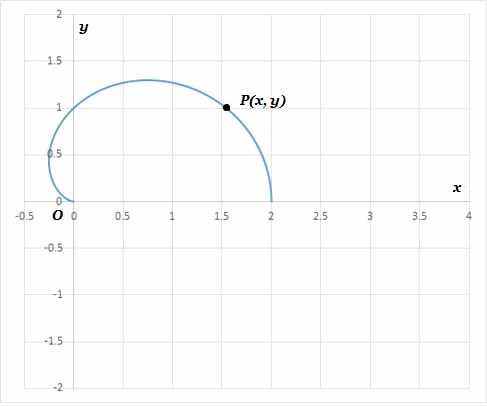
<그림 1> 점 P가 만드는 곡선
<그림 1> 점 P가 만드는 곡선

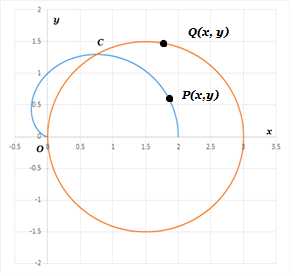
이때 점 P\displaystyle \mathrm{P}가 만드는 곡선을 그리면 <그림 1>과 같다. 또한 같은 평면 위에서 움직이는 다른 점 Q(x,y)\displaystyle \mathrm{Q}(x,y)는 매개변수 t\displaystyle t의 함수로 다음과 같이 주어졌다.

x=3cos⁡2t, y=3sin⁡tcos⁡t, 0≤t≤π\displaystyle x= 3 \cos ^{2} t , ~y=3 \sin t \cos t, ~ 0 \le t \le \pi

점 P\displaystyle \mathrm{P}와 Q\displaystyle \mathrm{Q}가 만드는 평면 위의 두 곡선에 대한 다음 물음에 답하시오.

[1] 점 Q\displaystyle \mathrm{Q}를 나타내는 x=3cos⁡2t, y=3sin⁡tcos⁡t\displaystyle x= 3 \cos ^{2} t , ~y=3 \sin t \cos t에서 변수 t\displaystyle t를 소거하여 점 Q\displaystyle \mathrm{Q}가 그리는 곡선을 두 변수 x\displaystyle x와 y\displaystyle y만의 관계식으로 나타내고, 그 관계식이 어떤 도형을 나타내는지 서술하시오. [6점]

[2] 0<t<π\displaystyle 0<t<\pi이고, t≠π2\displaystyle t \ne \frac{\pi}{2}인 t\displaystyle t에 대응하는 점 P\displaystyle \mathrm{P}와 Q\displaystyle \mathrm{Q}에 대하여 두 벡터 OP→\displaystyle \overrightarrow{\mathrm{OP}}와 OQ→\displaystyle \overrightarrow{\mathrm{OQ}}가 이루는 각 θ\displaystyle \theta의 크기를 구하시오. (단, 점 O\displaystyle \mathrm{O}는 평면의 원점이다.) [12점]

[3] 두 곡선이 t=t0\displaystyle t= t_{0}일 때 점 C\displaystyle \mathrm{C}에서 만난다고 하자.

(1) 점 C\displaystyle \mathrm{C}의 좌표를 구하시오. [6점]

(2) 원점과 점 C\displaystyle \mathrm{C}를 지나는 직선이 x\displaystyle x축의 양의 방향과 이루는 각 β\displaystyle \beta를 구하시오. (단, 0≤β≤π2\displaystyle 0 \le \beta \le \frac{\pi}{2}) [4점]

[4] 문항 [3]의 t=t0\displaystyle t=t_{0}과 점 C\displaystyle \mathrm{C}에 관련한 다음 물음에 답하시오.

(1) t=t0\displaystyle t=t_{0}에서 점 P\displaystyle \mathrm{P}가 만드는 곡선에 대하여 dydx\displaystyle \frac{dy}{dx}를 구하시오. [4점]

(2) 점 Q\displaystyle \mathrm{Q}가 만드는 곡선에 대하여 점 C\displaystyle \mathrm{C}에서의 접선의 방정식을 구하시오. [7점]

[5] 0≤t≤s\displaystyle 0 \le t \le s의 구간에서 점 P\displaystyle \mathrm{P}가 만드는 곡선의 길이를 D(s)\displaystyle D(s), 점 Q\displaystyle \mathrm{Q}가 만드는 곡선의 길이를 L(s)\displaystyle L(s)라고 할 때, 다음 극한값을 구하시오. (단, s≤π\displaystyle s \le \pi) [11점]

lim⁡s→+0D(s)L(s)\displaystyle \lim_{s\to+0}\frac{D(s)}{L(s)}

해설강의 준비중

매개변수로 나타낸 함수의 미분법

관련 개념강의 준비중

음함수의 미분법

관련 개념강의 준비중

곡선의 길이

관련 개념강의 준비중
+2점

[1] 주어진 x,y \displaystyle x, y~를 제곱하면 다음을 얻는다.

x2=9cos⁡4t, y2=9sin⁡2tcos⁡2t\displaystyle x^{2} = 9 \cos ^{4} t, ~y^{2} = 9 \sin ^{2} t \cos ^{2} t

(또는 y2=9sin⁡2tcos⁡2t=3sin⁡2t3cos⁡2t\displaystyle y^{2} = 9 \sin ^{2} t \cos ^{2} t = 3 \sin ^{2} t 3 \cos ^{2} t)

+2점

이때 cos⁡2t+sin⁡2t=1\displaystyle \cos ^{2} t + \sin ^{2} t =1이고, x=3cos⁡2t\displaystyle x= 3 \cos ^{2} t이므로 다음이 성립한다.

x2+y2=9cos⁡2t(cos⁡2t+sin⁡2t)=3x\displaystyle x^{2} + y^{2} = 9 \cos ^{2} t (\cos ^{2} t + \sin ^{2} t ) = 3x

(또는 y2=3(1−cos⁡2t)x=3x−x2\displaystyle y^{2} = 3(1- \cos ^{2} t ) x = 3x - x^{2})

이를 정리하면 다음과 같다.

(x−32)2+y2=(32)2\displaystyle \left ( x- \frac{3}{2} \right )^{2} + y^{2} = \left ( \frac{3}{2} \right )^{2}또는 x2+y2=3x\displaystyle x^{2} + y^{2} = 3x

+2점

따라서 구하는 관계식은 중심이 (32,0)\displaystyle \left (\frac{3}{2}, 0 \right )이고, 반지름이 32\displaystyle \frac{3}{2}인 원을 나타낸다.

<그림 1> 점 P, Q가 만드는 곡선
+2점

[2] 먼저 두 벡터를 구하면 다음과 같다.

OP→=(cos⁡t+cos⁡2t,sin⁡t+12sin⁡2t)=(cos⁡t+cos⁡2t,sin⁡t+sin⁡tcos⁡t)\displaystyle \overrightarrow{\mathrm{OP}} = \left ( \cos t + \cos ^{2} t , \sin t + \frac{1}{2} \sin 2t \right ) = (\cos t + \cos ^{2} t , \sin t + \sin t \cos t )

OQ→ = (3cos⁡2t,3cos⁡tsint)\displaystyle \overrightarrow{\mathrm{OQ}} ~=~(3 \cos ^{2} t, 3 \cos tsint )

두 벡터가 이루는 각을 θ\displaystyle \theta라고 하자. 벡터의 내적에 의해 다음이 성립한다.

OP→⋅OQ→ =∣OP→∣ ∣OQ→∣cos⁡θ\displaystyle \overrightarrow{\mathrm{OP}} \cdot \overrightarrow{\mathrm{OQ}} ~=| \overrightarrow{\mathrm{OP}} |~|\overrightarrow{\mathrm{OQ}} | \cos \theta

그런데 삼각함수의 성질을 이용하여 정리하면

OP→⋅OQ→ = 3cos⁡3t+3cos⁡4t+3cos⁡tsin2t+3cos⁡2tsin⁡2t\displaystyle \overrightarrow{\mathrm{OP}} \cdot \overrightarrow{\mathrm{OQ}} ~=~3 \cos ^{3} t+ 3 \cos ^{4} t + 3 \cos tsin^{2} t + 3 \cos ^{2} t \sin ^{2} t

=3cos⁡t(cos⁡2t+sin⁡2t)+3cos⁡2t(cos⁡2t+sin⁡2t)\displaystyle = 3 \cos t ( \cos ^{2} t + \sin ^{2} t ) + 3 \cos ^{2} t ( \cos ^{2} t + \sin ^{2} t )

=3cos⁡t+3cos⁡2t\displaystyle =3 \cos t + 3 \cos ^{2} t

=3cos⁡t(1+cos⁡t)\displaystyle = 3 \cos t (1 + \cos t )

+2점

∣OP→∣=cos⁡2t+2cos⁡3t+cos⁡4t+sin⁡2t+2sin⁡2tcos⁡t+sin⁡2tcos⁡2t\displaystyle | \overrightarrow{\mathrm{OP}} | = \sqrt { \cos ^{2} t + 2 \cos ^{3} t + \cos ^{4} t +\sin ^{2} t + 2 \sin ^{2} t \cos t + \sin ^{2} t \cos ^{2} t}

=1+2cos⁡3t+2sin⁡2tcos⁡t+cos⁡4t+sin⁡2tcos⁡2t\displaystyle =\sqrt {1+ 2 \cos ^{3} t + 2 \sin ^{2} t \cos t + \cos ^{4} t + \sin ^{2} t \cos ^{2} t }

=1+2cos⁡t(cos⁡2t+sin⁡2t)+cos⁡2t(cos⁡2t+sin⁡2t)\displaystyle =\sqrt {1+ 2 \cos t (\cos ^{2} t + \sin ^{2} t )+ \cos ^{2} t(\cos ^{2} t + \sin ^{2} t) }

=1+cos⁡t\displaystyle = 1 + \cos t

+2점

∣OQ→∣=9cos⁡4t+9cos⁡2tsin⁡2t\displaystyle |\overrightarrow{\mathrm{OQ}}|=\sqrt{9\cos^4t+9\cos^2t\sin^2t}

=9cos⁡2t(cos⁡2t+sin⁡2t)\displaystyle =\sqrt{9\cos^2t(\cos^2t+\sin^2t)}

=3∣cos⁡t∣\displaystyle = 3 |\cos t |

+2점

이므로 OP→⋅OQ→= ∣OP→∣∣OQ→∣cos⁡θ\displaystyle \overrightarrow{\mathrm{OP}} \cdot \overrightarrow{\mathrm{OQ}} = ~| \overrightarrow{\mathrm{OP}} | |\overrightarrow{\mathrm{OQ}} | \cos \theta에서 다음을 얻는다.

3cos⁡t(1+cos⁡t)=3∣cos⁡t∣(1+cos⁡t)cos⁡θ\displaystyle 3 \cos t (1+\cos t) = 3|\cos t| (1+\cos t) \cos \theta

+2점

따라서 주어진 t\displaystyle t에 대해 다음을 얻는다.

cos⁡θ=cos⁡t∣cos⁡t∣,  0<t<π,t≠π2\displaystyle \cos \theta = \frac{\cos t}{|\cos t|} , ~~0<t<\pi , t\ne \frac{\pi}{2}

그런데 ∣cos⁡t∣={  cos⁡t, 0<t<π2−cos⁡t, π2<t<π\displaystyle |\cos t|= \begin{cases} ~~\cos t, ~0<t< \frac{\pi}{2}\\ -\cos t, ~\frac{\pi}{2} < t< \pi \end{cases}이므로 다음이 성립한다.

cos⁡θ={  1, 0<t<π2−1, π2<t<π\displaystyle \cos \theta = \begin{cases} ~~1,~0<t< \frac{\pi}{2} \\ -1, ~ \frac{\pi}{2} < t < \pi \end{cases}

+2점

이로부터 다음을 얻는다.

θ={0, 0<t<π2π, π2<t<π\displaystyle \theta = \begin{cases} 0, ~0<t< \frac{\pi}{2}\\ \pi , ~\frac{\pi}{2} < t< \pi \end{cases}

+2점

[3] (a) 두 곡선이 t\displaystyle t일 때 만나면 두 점의 대응하는 성분이 같아야 하므로 다음이 성립한다.

cos⁡t+cos⁡2t=3cos⁡2t,  sin⁡t+cos⁡tsin⁡t=3cos⁡tsin⁡t,  0≤t≤π\displaystyle \cos t + \cos ^{2} t = 3 \cos ^{2} t , ~~ \sin t + \cos t \sin t = 3 \cos t \sin t , ~~0 \le t \le \pi

이를 정리하면 다음 연립 방정식을 얻는다.

cos⁡t(1−2cos⁡t)=0, sin⁡t(1−2cos⁡t)=0, 0≤t≤π\displaystyle \cos t (1-2 \cos t) = 0, ~\sin t (1-2 \cos t ) =0,~0 \le t \le \pi

+2점

따라서 cos⁡t=12,t=π3\displaystyle \cos t = \frac{1}{2} , t = \frac{\pi}{3}이다. 따라서 점 C\displaystyle \mathrm{C}의 좌표는 다음과 같다.

+2점

C(34,334)\displaystyle \mathrm{C} \left ( \frac{3}{4} , \frac{3\sqrt 3 }{4} \right )

+2점

(b) 원점과 점 C\displaystyle \mathrm{C}를 잇는 직선의 기울기 α\displaystyle \alpha는 다음과 같다.

α=33434=3\displaystyle \alpha=\frac{\frac{3\sqrt3}{4}}{\frac34}=\sqrt3

+2점

한편, tan⁡β=3\displaystyle \tan \beta = \sqrt 3이므로 β=π3\displaystyle \beta = \frac{\pi}{3}이다.

+2점 · ※ 여기서 분모만 계산한 경우에도 [2점]

[4] (a) 문항 [3]에서 t0=π3\displaystyle t_{0} = \frac{\pi}{3}이므로 점 P(x,y)\displaystyle \mathrm{P}(x,y)에 대해 다음을 얻는다.

dydt=cos⁡t+cos⁡2t=12−12=0,\displaystyle \frac{dy}{dt} = \cos t + \cos 2t = \frac{1}{2} - \frac{1}{2} = 0,

dxdt=−sin⁡t−2sin⁡tcos⁡t=−32−2⋅32⋅12=−3\displaystyle \frac{dx}{dt} = -\sin t - 2 \sin t \cos t = - \frac{\sqrt 3}{2} - 2 \cdot \frac{\sqrt 3}{2} \cdot \frac{1}{2} = - \sqrt 3

+2점

이로부터 점 P\displaystyle \mathrm{P}가 만드는 곡선 위의 점 C\displaystyle \mathrm{C}에 대응하는 t\displaystyle t에서 다음을 얻는다.

dydx=dydtdxdt=0\displaystyle \frac{dy}{dx} = \frac{ \frac{ dy}{dt } }{ \frac{ dx}{ dt} } =0

+2점

(b) 문항 [1]에서 점 Q\displaystyle \mathrm{Q}가 만드는 곡선은 다음과 같은 원임을 보였다.

(x−32)2+y2=(32)2\displaystyle \left ( x- \frac{3}{2} \right )^{2} + y^{2} = \left ( \frac{3}{2} \right )^{2}또는 x2+y2=3x\displaystyle x^{2} + y^{2} = 3x

이로부터 음함수 미분법을 사용하면 다음을 얻는다.

2x+2ydydx=3\displaystyle 2x+2y\frac{dy}{dx}=3 또는 dydx=3−2x2y\displaystyle \frac{dy}{dx}=\frac{3-2x}{2y}

+2점

따라서 점 C(34,334)\displaystyle \mathrm{C} \left ( \frac{3}{4} , \frac{3\sqrt 3}{4} \right )에서 접선의 방정식의 기울기는 다음과 같다.

dydx=3−2⋅342⋅334=33\displaystyle \frac{dy}{dx} = \frac{ 3-2\cdot \frac{3}{4}}{ 2 \cdot \frac{3\sqrt 3}{4} } = \frac{\sqrt 3}{3}

+3점

따라서 구하는 접선의 방정식은 다음과 같다.

y−334=33(x−34)\displaystyle y- \frac{3\sqrt 3}{4} = \frac{\sqrt 3}{3} \left ( x- \frac{3}{4} \right ) 또는 y=33x+32\displaystyle y= \frac{\sqrt 3}{3} x + \frac{\sqrt 3}{2}

+2점

[5] 점 P\displaystyle \mathrm{P}에 대해

{x′(t)=−sin⁡t−2cos⁡tsin⁡t=−sin⁡t−sin⁡2ty′(t)=cos⁡t+cos⁡2t\displaystyle \begin{cases} x^{\prime}(t) = -\sin t -2 \cos t \sin t = -\sin t - \sin 2t \\ y^{\prime}(t) = \cos t + \cos 2t \end{cases}

이므로 다음을 얻는다.

(x′(t))2+(y′(t))2=sin⁡2t+2sin⁡tsin⁡2t+sin⁡22t+cos⁡2t+2cos⁡tcos⁡2t+cos⁡22t\displaystyle (x^{\prime}(t))^2+(y^{\prime}(t))^2=\sin^2t+2\sin t\sin2t+\sin^22t+\cos^2t+2\cos t\cos2t+\cos^22t

=2+2{cos⁡2tcos⁡t+sin⁡2tsin⁡t}=2(1+cos⁡t)\displaystyle =2+ 2 \left\{ \cos 2t \cos t + \sin 2t \sin t \right\} = 2(1+ \cos t)

=4cos⁡2t2\displaystyle = 4 \cos ^{2} {\frac{t}{2}}

+2점

따라서 구간 0≤t≤s\displaystyle 0 \le t \le s에 대응하는 구하는 곡선의 길이 D(s)\displaystyle D(s)는 다음과 같다.

D(s)=∫0s(x′(t))2+(y′(t))2dt=∫0s2cos⁡t2dt=[4sin⁡t2]0s=4sin⁡s2\displaystyle D(s) = \int _{ 0} ^{s } { \sqrt {(x^{\prime}(t))^{2} +(y^{\prime}(t))^{2} } }dt = \int _{ 0} ^{ s} {2 \cos \frac{t}{2} }dt = \Biggl[ 4 \sin \frac{t}{2} \Biggr]_{0}^s =4 \sin \frac{s}{2}

+3점

한편, 점 Q\displaystyle \mathrm{Q}에 대해

{x′(t)=−6cos⁡tsin⁡t=−3sin⁡2ty′(t)=3cos⁡2t\displaystyle \begin{cases} x^{\prime}(t) = -6 \cos t \sin t = -3 \sin 2t \\ y^{\prime}(t) =3 \cos 2t \end{cases}

이므로 구간 0≤t≤s\displaystyle 0 \le t \le s에 대응하는 곡선의 길이 L(s)\displaystyle L(s)는 다음과 같다.

L(s)=∫0s{x′(t)}2+{y′(t)}2dt=∫0s3sin⁡22t+cos⁡22tdt=[3t]0s=3s\displaystyle L(s) = \int _{ 0} ^{s } { \sqrt {\{x^{\prime}(t)\}^{2}+\{y^{\prime}(t)\}^{2} } }dt = \int _{ 0} ^{s } 3{ \sqrt {\sin ^{2} 2t+\cos ^{2} 2t } }dt =\Biggl[3t\Biggr]_{0}^s = 3s

+4점

따라서 lim⁡x→0sin⁡xx=1\displaystyle \lim _{ x\to 0} { \frac{\sin x}{x} =1}을 이용하면 다음을 얻는다.

lim⁡s→+0D(s)L(s)=lim⁡s→+04sin⁡s23s=lim⁡s→+04sin⁡s26s2=23\displaystyle \lim _{ s \to +0} { \frac{ D(s)}{L(s) } }=\lim _{ s \to +0} { \frac{ 4 \sin \frac{s}{2}}{3s } } =\lim _{ s \to +0} { \frac{ 4 \sin \frac{s}{2}}{6 \frac{s}{2} } } = \frac{2}{3}

첨삭 사례

아직 등록된 첨삭 사례가 없습니다.

질문과 답변 · 0개질문과 답변 · 고정 0개

아직 등록된 질문이 없습니다. 질문 작성은 멤버십 회원만 가능합니다.